Monday, May 12, 2014

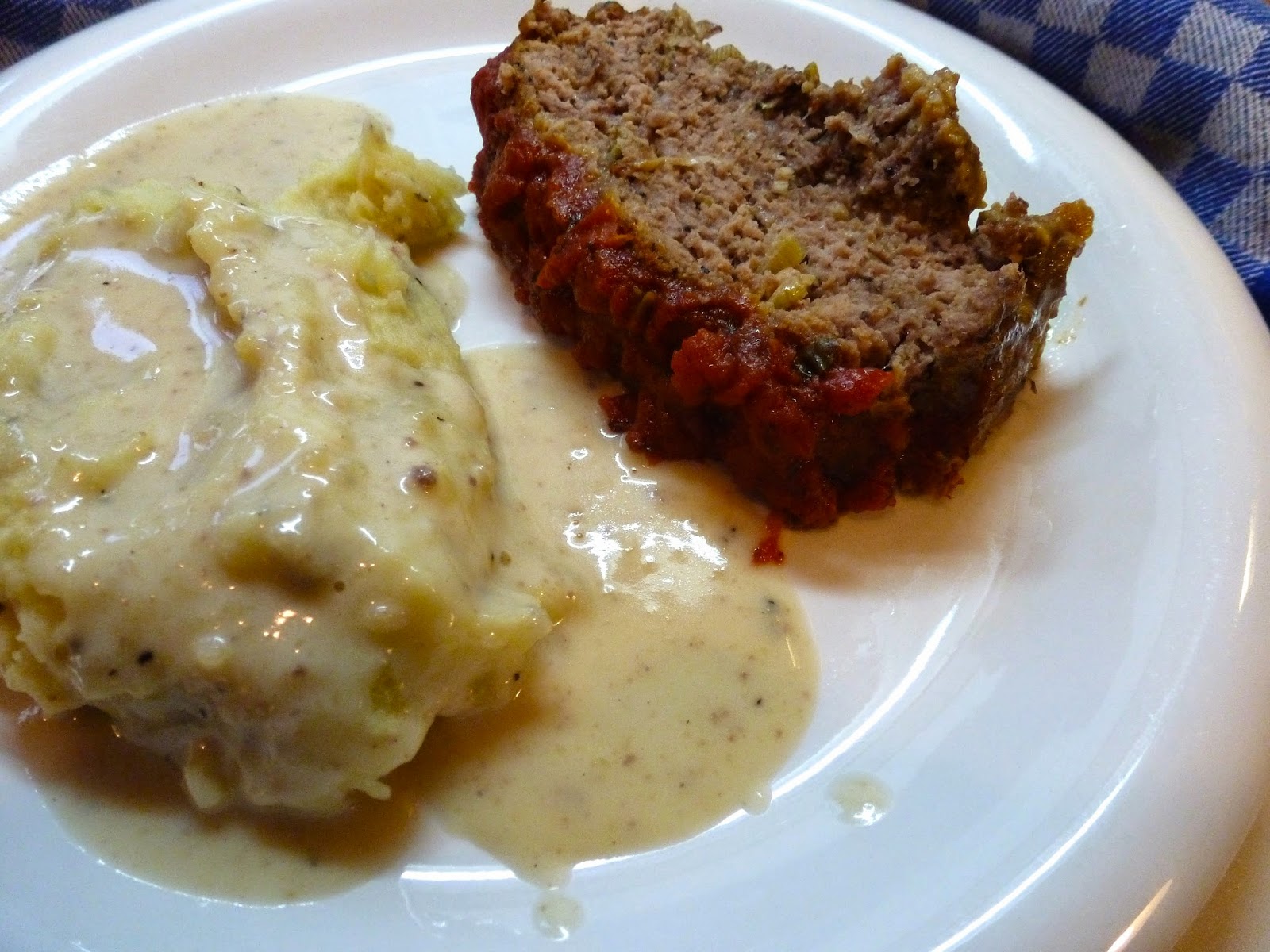
Meatloaf and Mashed Potatoes: Comfort Food Supreme


Who hasn’t dug into some meatloaf?  So many varieties and subtle variations.  Maybe that’s the attraction.   We all strive for individuality.

Fortunately, they don’t sell meatloaf at “Gimme-yer-bucks.”  There could be fistfights and broken teeth when the guy in front of you orders meatloaf latte with low fat, organic goat’s milk.

You know more about meatloaf than you think you do.  You’ve eaten the best and the worst, from Mom’s meatloaf heaven to the brown-fungus slopped on your tray in the school cafeteria.  You may even have had meatloaf at a “Grab-your-wallet-and-pray” restaurant.

Folks, you can concoct a wonderful meatloaf without taking a twelve-month course at the Paris Cordon Bleu.  Nothing complicated.  Just use fresh ingredients and you’re on your way back to the childhood you wish you’d had, before your parents spoiled things.

We’re going to make this meal in three parts, and bring them together at the end:  Meatloaf, mashed potatoes, and gravy.

Let’s get down to it.  Heat the oven to 350ºF (180ºC)

First, the Meatloaf.

1 lb Freshly ground beef
1 lb Freshly ground pork

Don’t screw around!  Get the butcher to grind a fresh batch!

½ Cup green onions, white and light green parts thinly sliced
½ Cup regular onions, diced
6-8 Ounces white cheddar, coarsely grated
½ Cup plain breadcrumbs (I put a stale baguette in a food processor)
2 Eggs, well beaten
Salt to taste
Ground black pepper and white pepper

1 Cup Homemade pizza sauce to top the meatloaf.  To make the sauce, use whole tomatoes, canned or fresh.  In either case, hand-squeeze, or chop the whole tomatoes into a sauce pan.  If using fresh tomatoes, peel them and cook them long enough for the water to evaporate.  Add some finely diced onions and seasonings of your choice.

Put everything except the pizza sauce topping, in a medium-sized mixing bowl and hand mix it to form a loaf.

The fuzzy looking stuff is only breadcrumbs!


The inner pan is on the right and the outer pan on the left.


Pack it into a double-layered meatloaf pan.  The top pan has holes, so the juices run out and collect in the bottom of the second pan.  You’ll use the juices for gravy.


Put the meatloaf in the hot oven and cook for about 40 minutes, or until the top is very brown.  


Meanwhile, read on…

Mashed Potatoes

6-8 Medium sized, light skinned potatoes, washed and cut into chunks.  Do not skin the potatoes. (Normal, heavy skinned baking potatoes are too dry and flaky.)
1 Stick of butter
1 Cup of reserved potato water
Strong dash of both onion and garlic powder
Salt and black and white and cayenne pepper

Heat a pot of water, deep enough for the potatoes to be covered.  When the water boils, drop in the potatoes and cook until the potato chunks are easily pierced with a fork.

Drain the potatoes, reserving one cup of the potato water.  Put the potato chunks in a large mixing bowl and mash roughly with a pastry cutter.  Add a whole stick of butter and use an electric mixer to blend.  If the potatoes are too dry, add some of the reserved potato water.  Careful!  You want moist, not soggy. Add  garlic and onion powders, salt and peppers to taste.


Next…

Pull the meatloaf out of the oven, add the pizza sauce to the top, and slip it back in the oven for 10-15 minutes, or until the pizza sauce sets.


When the meatloaf comes out, make the gravy

Pan drippings
2 Heaping tablespoons of white flour
1 Cup water
1 Cup milk
salt and pepper to taste

After you pull the meatloaf out of the oven, leave it in the top of the pan and  put it on a plate to cool.  Take the bottom part of the pan and pour the collected drippings into a frying pan (medium heat).  As the dripping start to bubble, add two tablespoons of flour and stir with a whisk until creamy.  Add a cup of water.  Mix.  Quickly add a cup of milk. Mix. Taste and add salt. 

Hey, folks, that’s it!  Slice the meatloaf, add a scoop of mashed potatoes to each plate, and spoon some gravy over the potatoes.


Now, ain’t that comfortable?


Friday, May 9, 2014

Agatha Christie's Greenway, House and Gardens


Dame Agatha Christie is on the top left.


Heard of Agatha Christie?  No?  Still fumbling along in a first grade primer?  She’s only the most popular novelist of all time, her books having sold over four billion copies.  The Bible and Shakespeare have out sold her, but no one else.

Greenway, in Devon, England, overlooking the picturesque Dart River and city of Dartmouth, was Christie’s holiday home, purchased in 1938, her ‘getaway,” to relax with family, away from public pressures. It’s now part of the National Trust, including the extensive grounds and gardens.


To get there from Dartmouth is an adventure in itself, much like one of Dame Agatha’s stories.  First you catch a ferry across the River Dart.  Then you hop on an ancient train, pulled by an historic steam engine.  


Some twenty minutes later, you get off (alight, as Agatha would say) at a stop that appears to be nowhere.  A couple of small, low buildings to protect travelers from any sudden shower, an iron fence and a sign mark the landing.  Steps lead steeply through the trees to a tarmac road that winds along the side of a hill.  Ten or fifteen minutes of walking and you’re at the entry to Greenway.  It’s not a bad stroll amid the verdant grasses, flowers, and huge trees rising like giants to embrace the sky.


Greenway House is white, Georgian, boxy and large, but without much character aside from the pillared portico.  


Inside is another matter.  Agatha Christie and her husband, the archeologist Max Mallowan (1904-1978), were great collectors and the rooms are tastefully filled with every collectable knick-knack imaginable. Teapots, walking sticks, archeological momentos. Evidently, the house was not always so orderly.  The story goes that when the house, which fell to shambles sometime after Christie’s death in 1976, was restored in 2008, mountains of ‘stuff’ had to be sorted and disposed of.


The restorers did a fab job.  The rooms seem much lived in.  Homey. Normal. The perfect place for a couple, their children and grandchildren to calm themselves and wander blissfully into family life.

Yet, it couldn’t have been normal, as you and I think of it.  Such a spacious home must have required servants, even if just for the dusting and cleaning.  That wouldn’t even count routine maintenance on the structure itself.

As any homeowner knows, houses and grounds are not inexpensive in their upkeep.  Besides the 18th Century house itself and surrounding buildings, the garden and grounds must take a massive amount of money and work.  No wonder it was best for the remaining family members to turn it over to the National Trust.

Each room in the house has a different personality, from the very plain bedroom, where you will hear a recording of Agatha’s own voice discussing her methods of writing, to the small ‘fax room,” where Max worked, to the map and archeology room, to the expansive library, whose walls hold a decoration dating from World War II, when American forces used the house to plan for D-Day. A young Coast Guard artist left a panoramic graphic of his ship’s journey from America to England.  Dame Agatha left it, believing it to be part of an historic undertaking.


A tea-totaler, Dame Agatha drank double-cream with her meals.


Novelist.  I routinely get a blank stare when I say the word.  So, just to clear things up:  Novels are books of fiction, fanciful tales written by a novelist, and meant to entertain.  They come in many forms:  Romances, Histories, Sci-Fi, Mysteries, and while they may be based on truth, or contain historically accurate settings and characters, the stories are completely constructed in the author’s imagination.  They are not true stories.

In Agatha’s Christie’s case, she wrote 66 novels under her own name, as well as several using a pseudo name, Mary Westmacott. She also penned plays and short stories.  The Mousetrap still runs in London’s West End. It’s the longest running play in history.

Several of Christie’s novels use all or parts of Greenway as their setting:  Five Little Pigs (1942), Towards Zero (1944), and Dead Man’s Folly (1956).


Her two most famous characters?  Hercule Poirot and Miss Jane Marple.   Even an illiterate couch potato knows those two names.  The last of the Hercule Poirot stories was just on TV, starring David Suchet, who played the part for twenty-five years.

Something you may not know.  She wrote none of her books at Greenway.  However, she often sat in the living room (also called the library) and read completed novels to her family.  I’m sure they tired of this.  grumbled and complained, no doubt.  Families are like that.  It is said her husband sometimes closed his eyes and nodded off.

As a writer, I enjoy seeing firsthand how other writers lived.  You somehow getting a feel for the kind of person they were.  I had not read an Agatha Christie mystery in ages, but I quickly grabbed a copy of Dead Man’s Folly.  Dame Agatha certainly lived an upper crust sort of life, yet her concerns seemed very down to earth, almost elegantly normal, and Greenway, with its comfortable couches (which you’re allowed to sit on), the subdued colors, and the room decorations, make it a place where anyone could spend a holiday.

Agatha in her twenties.


Travel is like that, isn’t it?  Allows you to effortlessly expand your horizons, pick up threads of interest, and encourages you to explore possibilities.  Greenway does it all.  When I hopped on that old train and listened to the whistle of the steam engine, I stepped into the time and tone of a Christie novel.  Getting off at the Greenway train stop continued the plot, tangled and enhanced room-by-room, acre-by-acre.  This was Agatha Christie country and I loved it.


http://www.nationaltrust.org.uk/greenway/facilities-and-access/

Tuesday, May 6, 2014

Peters Brauhaus und Kölsch: What a Combo!


When you get to Köln (Cologne in English) and start strolling the cobblestones, your first stop should be Peters Brauhaus.  


Too early?  Yeah, ok.  Wander around; see one of the world’s great cathedrals, St Peter’s, often referred to simply as the Dom.  Beautiful.  Intriguing.  Historic.  NOT completely leveled in the Second World War – which sets it apart from 90% of Cologne. 

Ok.  Got all that.  Beer time yet?  No?  Good god, man, I marvel at your patience!  In the name of heaven, how long are you going to wait?

Right.  Roman museums.  Art museums.  Do your own research, except I will mention the Museum Ludwig and the Wallraf-Richartz Museum, both of which have some wonderful 19th -20th Century art.  If you’re short of time, I’d pick the second.

An early Van Gogh, although there aren't any 'late ones.  He only painted for ten years.


Walk around the old town (Altstadt), cover the waterfront, and glimpse the placid beauty of the Rhine River.


Thirsty yet?  ‘Bout time.  Art and history have their place, but you have to pace yourself.  A man could die of thirst.  Never heard of anyone dying of art… although there is Van Gogh…but even he didn’t kill himself with the sharp end of a paintbrush.


Back to Peters Brauhaus.  In good weather, settle into a chair beneath an awning in the old market.  The tent-sized, red canopies say Peters Brauhaus, just to tip you off and allay any confusion.  Unusual to have the outdoor café on the market square when the restaurant is on an alley around the corner.  But, it makes sense. Gives a taste of tangy sunshine.

You won’t sit there longer than a blink before a waiter asks what you want to drink.  Simple answer:  Beer.  Before you can snap your fingers, another waiter waltzes by with a Kranz (wreath) of Kölsch.


filling a 'wreath' of beer


Kölsch comes in a slender cylindrical glass.  On the small side, but not to fret.  Before you can see the bottom of your glass, he’ll deliver another, until you lose the power of speech, or your wife gives the waiter a glance that could stop a galloping stallion.

What’s special about Kölsch?  I mean besides being one of the Germany’s most delicious species of beer?  First off, Kölsch can only be brewed within Cologne, according to the 1985 Kölsch Konvention.  Twenty-four Cologne breweries came up with the idea to resist outside brewers jumping onto the Kölsch brew-wagon.

Secondly, Kölsch is a top-fermented beer, almost as light colored as a pilsner.  Also by convention, it’s filtered, with a specific gravity between 11 and 15 percent.  Alcohol content sits at around 4.8%.

Thirdly, Kölsch has a smooth, rounded flavor, without the heavy bite of most German beers.  Goes down easy and in some instances sports barely sweet undertones.

Yes, you can get Kölsch bottled, but I prefer it straight out of the wooden barrels, a gravity beer.

Peters is one of the remaining real Kölsch brewers, though the Peters Brewery isn’t based in Cologne, but in Monheim, about 30 minutes up the Rhine.  The Konvention must have grandfathered the signers.


Beer isn’t the only thing on Peters menu.  They have great lunches. When I was there, it was asparagus season and time for Spargel Soup. Want to make your own? Here’s an earlier post:  http://stroudallover.blogspot.de/2012/06/spargel-soup-too-delicious-for-all-but.html


Lots of other good stuff at Peters.  Extensive menu covering a host of local specialties, such as pork knuckle, and the ever-present schnitzel.  I’m convinced Germans are not allowed to open a restaurant without serving potatoes.  Peters is no exception.  Outstanding Bratkartoffeln. Slices of potato fried with bits of onion and bacon.

A bit chilly for you?  Feel like the full Brauhaus experience?  Go around the corner to Peters Brauhaus Restaurant.  


The building dates back to the end of the 19th Century, but Peters has only been there since 1994. You’d never know it.  They’ve captured the dark, worn-wood atmosphere of an old-time German beer palace. Every time I’ve walked through the door, it’s been packed. Good mix of tourists and locals.


Ok, enough chit-chat.  Sit back and quaff a glass of Kölsch or six. Drink up!  Here comes the waiter with a full Kranz.  You need to prep yourself for the next museum.


Mühlengasse 1
Köln, 50667

phone: +49 221 2573950