Showing posts with label Picasso. Show all posts

Tuesday, March 24, 2020

Picasso and Paper


My mother said to me, “If you are a soldier, you will become a general.  If you are a monk, you will become the Pope.”  Instead, I was a painter, and became Picasso.

On my recent trip to London, I visited the Royal Academy of Arts, on the famous Piccadilly Street, right across the street from the equally famous purveyor of fine foods to the Royal Family, Fortum & Mason.

This trip, the Royal Academy offered an exhibit of Picasso and Paper.  I knew a little about the celebrity artist, Pablo Picasso.  Visited the Reina Sofia Museum in Madrid to view Picasso’s most famous and probably his most massive painting, Guernica.  Most major museums have had Picasso exhibits and I’ve seen many of them, but it was not until I visited this Royal Academy exhibit that I was able to come to grips with Picasso the man and Picasso the artist.  My simple conclusion is that the two are inseparable.

It’s impossible for me to do justice to the complete multi media panorama of Picasso’s life offered by the Academy, but I will do my best to show you what I learned about how the man was never separated from his art.  Every person he met left an impression on him, every angle, every color, every substance became an amalgam of his mind and his art.

Guitar, 1912, cut-out cardboard, pasted paper, canvas, string, oil and pencil.

So many times I’ve heard, modern art is shit, or something worse.  I see and understand your point of view, but I advise you to look past the art to the process and the intriguing mind of a man who saw art in everything, whose whole life revolved around a connection to his art.  He is reported as having said, “I learned to draw before I learned to speak.”  The Academy exhibit showed clearly that at a very early age, he created art that even now is impressive.  So, when I write that Picasso’s life revolved around art, I mean his whole life, from childhood to his passing, using every conceivable manner of artistic expression:  canvas, paper of every sort, paints, crayons, dyes, pens, pencils, brushes, clay for both sculpture and ceramics and on and on.

At the age of 9 or 10, the artist hand cut these straight from paper without drawing a line!

Face of a Woman, 1962

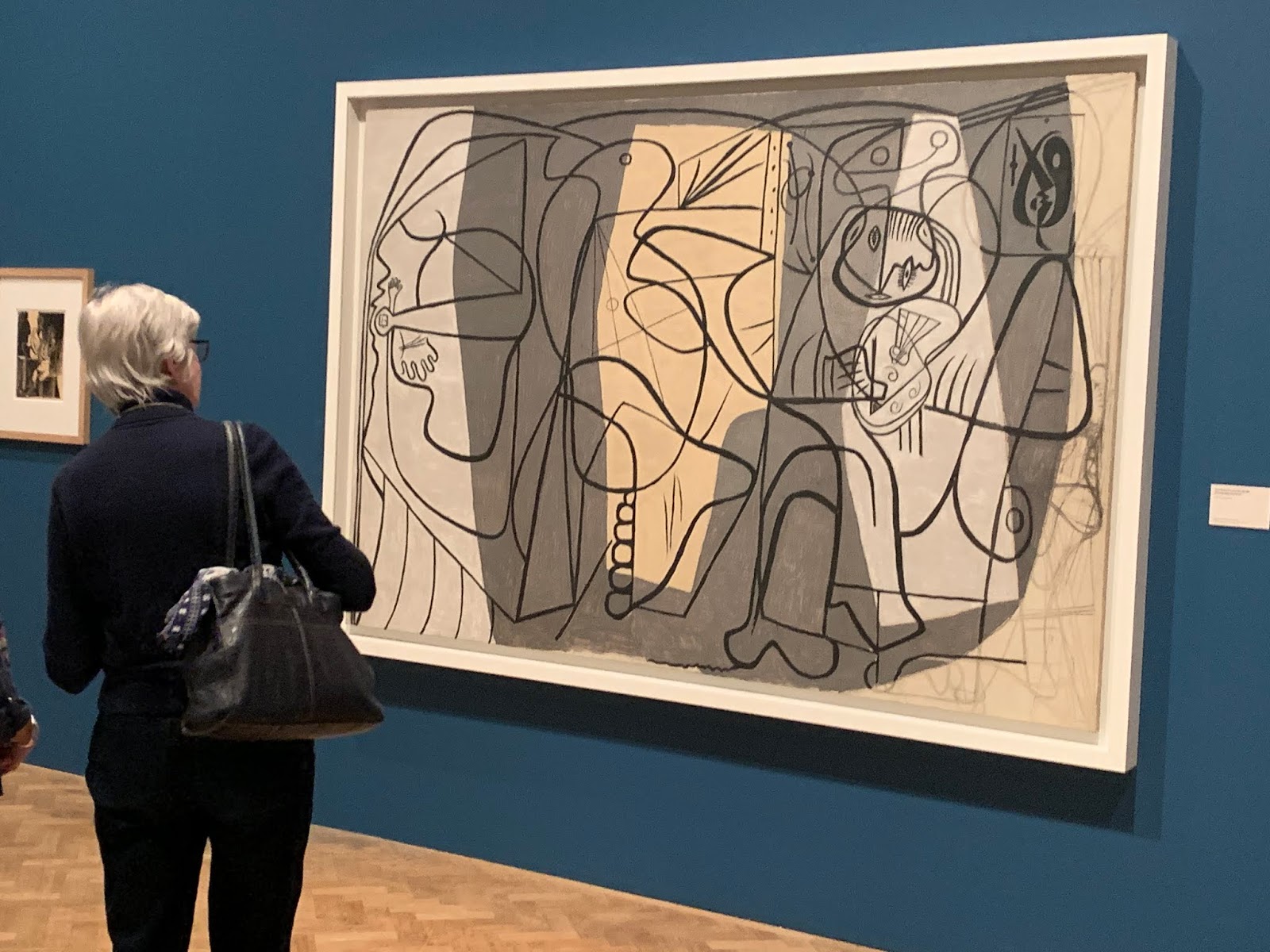
He worked tirelessly, throughout his life and like most true artists, he worked without fear and without stagnation of any sort.  His style changed often.  The creations that we know, such as Guernica, were the product of sketch after sketch after sketch, on paper, on canvas, with pen, with oil, with anything else that was handy, as he probed and refined unceasingly toward his masterpiece.

God is really only another artist.  He invented the giraffe, the elephant and the cat.  He has no real style.  He just goes on trying other things. –Pablo Picasso

Self portrait, 1907

More cut-outs from Picasso's childhood, in the foreground, mounted on clear glass.
The casual person often persists in the misapprehension that all it takes is talent, and you either have it or you don’t.  In my view, talent is merely a blank sheet of paper and what you do with it is what counts. We all have several blank sheets.

I am always doing that which I cannot do, in order to learn how to do it.  ---Pablo Picasso

In Picasso’s case, working every minute of everyday, closely associating with other artists, wooing women, much of which has nothing to do with art….or does it?  He embraced life and all it has to offer, to the fullest, and all of it he applied to his art.
Notebook after notebook.

Seated Woman, 1938


The artist is a receptacle for emotions that come from all over the place: from the sky, from the earth, from a scrap of paper, from a passing shape, from a spider’s web.
---Pablo Picasso

One of the points of his artistic compass was to distill and simplify his art, even as it became more and more complicated.

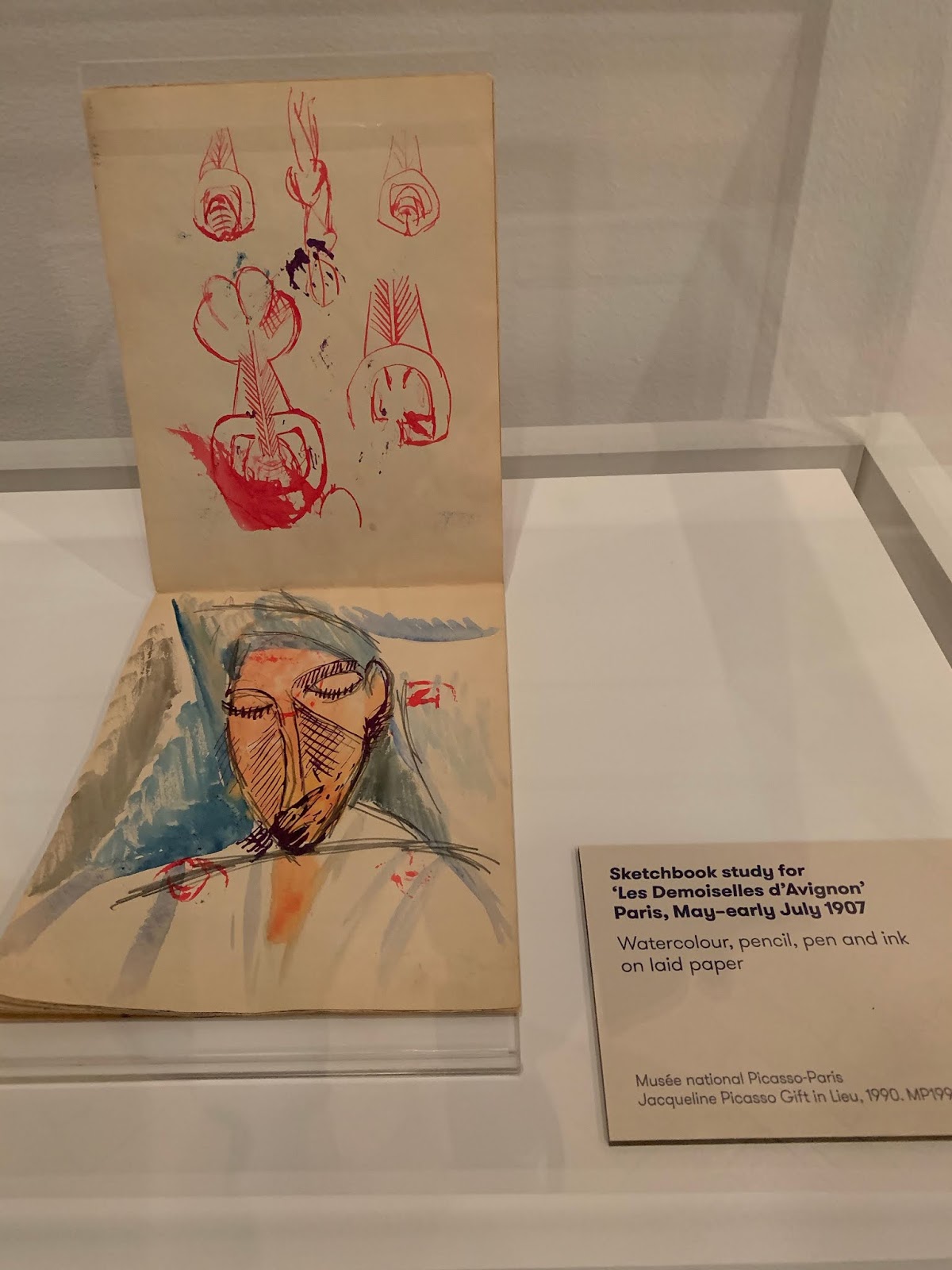
He drew constantly and kept multiple notebooks.


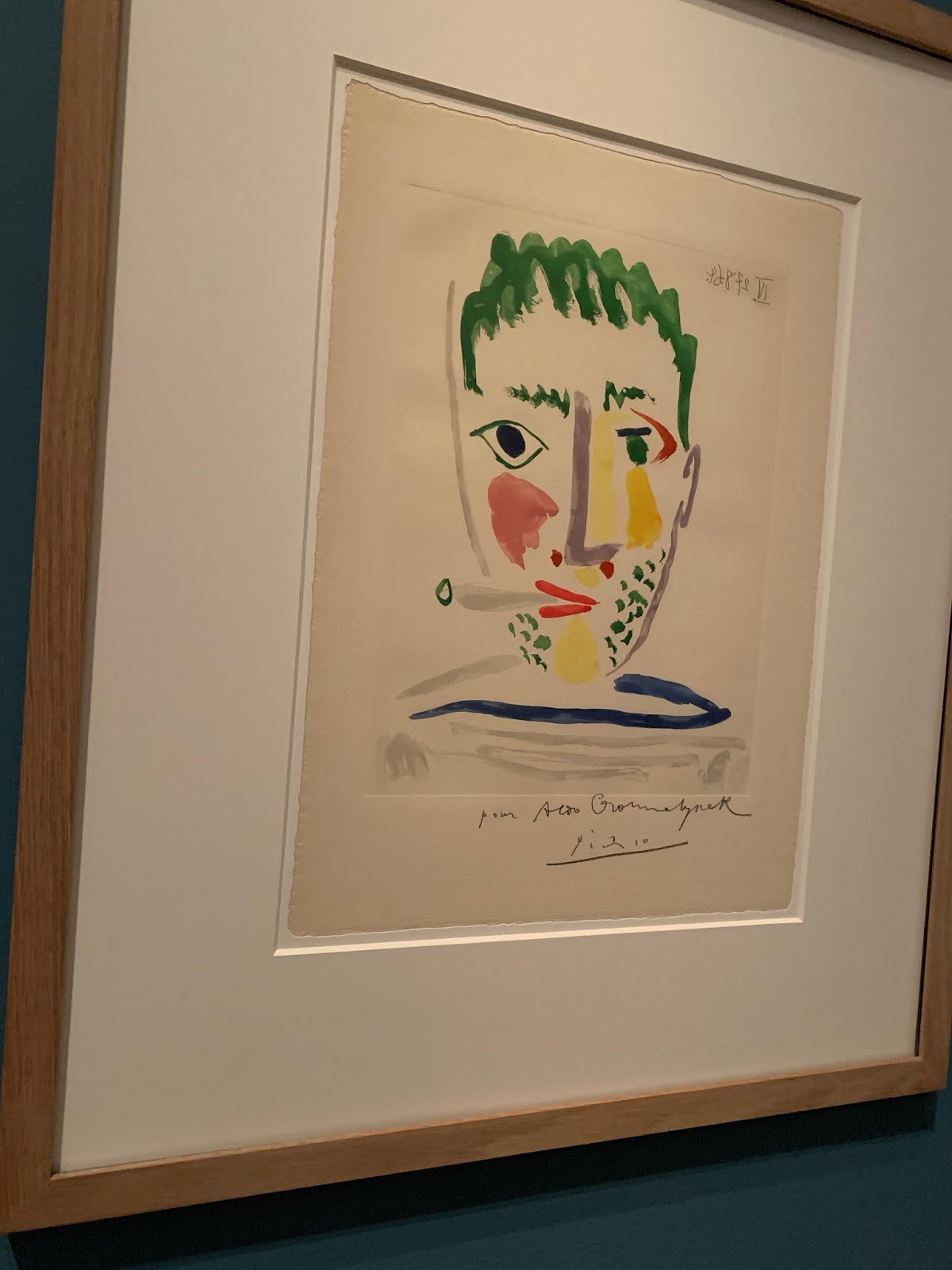
The Smoker, 1962

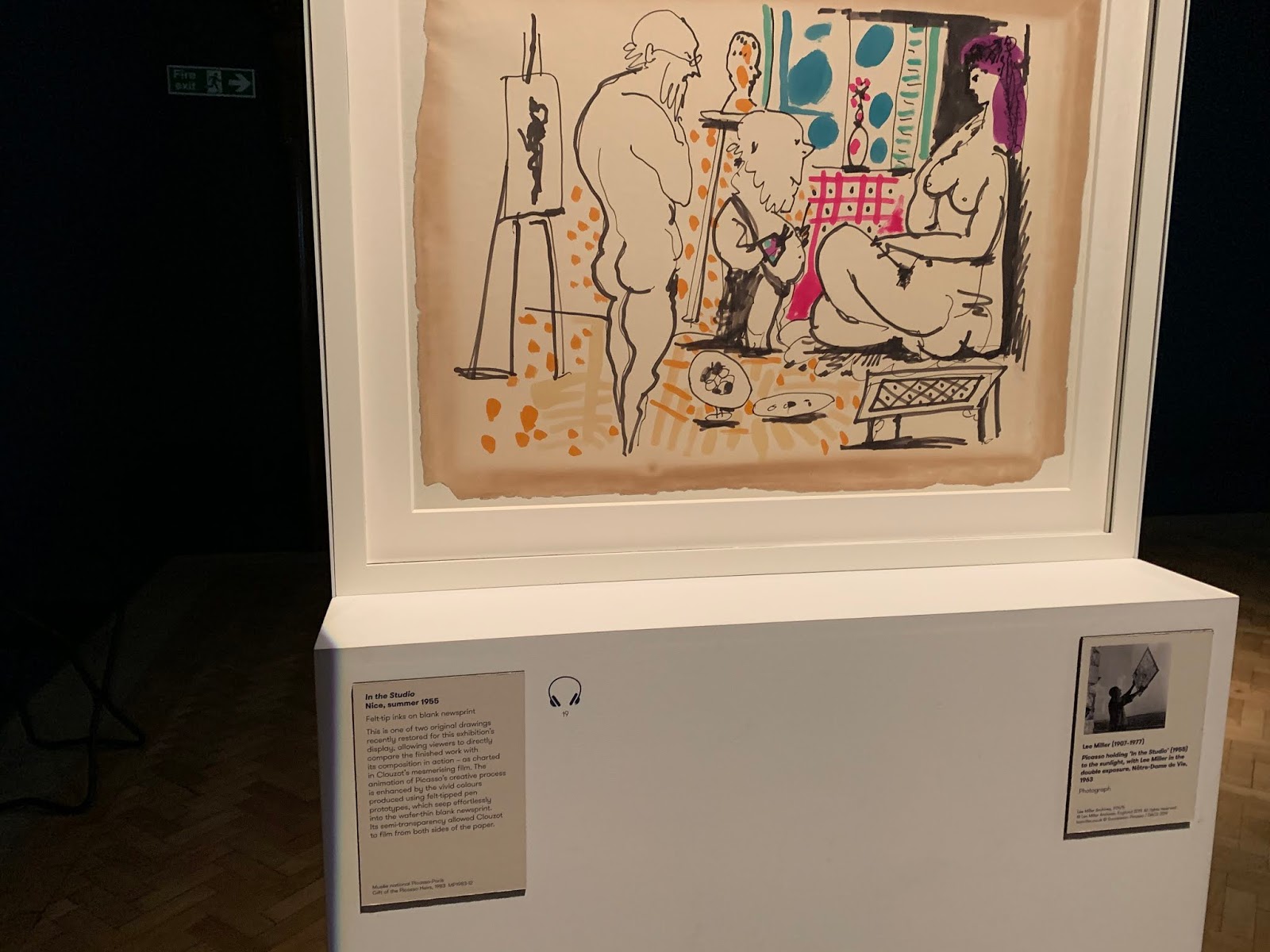
In the studio.

It took me four years to learn to paint like Raphael, but a lifetime to paint like a child. ---Pablo Picasso.

Most impressive was a video showing Picasso at work.  In a unique way, with the camera on one side of thin paper and the artist on the other side, we get to see the drawing appear magically.  I was also impressed with how this world famous artist took directions so guilelessly, almost meekly.  His one concern was his freehand art, content to let others handle the details.  Note also the intensity of his eyes and his concentration.  I had never seen anything like this.  It was so much more than simply a video of an artist at work, the likes of which you can find countlessly on youtube.  This was the soul of the artist captured on film.  But, this is not to say Picasso had no ego.  Quite the reverse, as with many celebrities.  How can you not when everyone near and far proclaims your genius.  His ego showed itself one evening at a dinner with friends, when instead of paying, he simply signed the check. One in his party asked if he was going to pay.   His response was words to the effect of, “My signature is worth far more than any dinner bill.”


I do apologize if the videos do not work. I have given them my best shot.

The exhibit at the Royal Academy of Arts was all encompassing and brilliantly presented.  A Picasso fan or not, one could not help but be impressed by the presentations of Picasso’s art and the clear and numerous explanations.   This was an enormous assemblage of both art and a beautifully presented story of Pablo Picasso, the man, the artist.

For better understanding, I offer a very short sketch of Picasso’s life.  He was christened Pablo Diego José Francisco de Paula Juan Nepomuceno Maria de los Remedios Cipriano de la Santísima Trinidad Ruiz y Picasso, expressing the names of saints and family.  He was born in Málaga, Spain, but the surname, Picasso, comes from near Genoa, Italy.  Picasso’s father was a painter and his first drawing tutor.

The family moved around a lot, as did Pablo as an adult.  Born in Málaga in 1880, he lived most of his adult life in France and died there in 1973.

He spoke both Spanish and French, having moved to France in 1904. He may also have spoken Catalan, since his parents moved to Barcelona when he was four.

Along the way to becoming famous, Picasso studied at a variety of art schools, yet moved in his own directions, the true sign of an artist.

Of course there are more photos! And a video!


Other studies for painting.  He did thousands over his lifetime.

This was done on paper, with ink drawing, changed many times, and then had paper with colorful designs pasted on here and there.

Plare at the Printing Press, 1969


Picasso had a fixation on the Minotaur, the mythical half man, half bull.

Country Dance, 1921, long after he developed Cubism.


Tuesday, August 12, 2014

From Barcelona to Montserrat


From Southampton, England, we sailed for three and a half days to the port city of Barcelona, on Spain’s east coast.  1726 nautical miles at a speed of 21 knots. 

For the uninitiated, a nautical mile is 6076 feet, as opposed to a statute mile, which is 5280 feet. A knot is one nautical mile per hour or 1.15 statute miles per hour.

The three days at sea were worth it.  Barcelona is a fabulous city and with over a million and a half residents, it’s Spain’s second largest, with about half the population of Madrid.

First off, I love Barcelona, or Bar-tha-lona, as the locals call it.  Spent many happy hours, running, walking, and crawling from tasca to tasca, in search of the perfect cup of Spanish red.  Turned out they were all perfect and got even better as the night wore on.

But, that was long ago, when I was young, nights were long, and adventurous women turned up like the pages of a favorite book.

Now, of course, all that has changed.  I am old.  Nights end before the moon lights up the sky, and I have been invisible to adventurous women for decades.  I’ve found, however, wine tastes even better over breakfast.

If you haven’t visited Barcelona make a plan.  Big. Expansive, yet a local feel that makes you long to wander the streets.  Las Ramblas, the major shopping and tasca-hopping thoroughfare.  All the Gaudi buildings and the as yet unfinished, Gaudi designed, La Sagrada Familia basilica, among others.


Gaudi's La Sagrada -still not finished

Details of La Sagrada

Another of Gaudi's fanciful buildings (on the right), this one an apartment.
By the way, what’s the difference between a basilica and a cathedral?  A basilica has been designated by the Pope as a very important church. A cathedral is where the bishop’s throne (cathedra) sits. It’s the main church of a diocese. A cathedral may or may not be a basilica.

A note on Gaudi, one of the world’s most inventive architects. His buildings are so fanciful, so different, they take your breath away.  Love the style or hate it, Gaudi was his own man.  When he began construction of La Sagrada in 1883, he was asked how long it would take to finish.  His famous reply:  “My client is in no hurry.”  No slave to monetary gain, he died a pauper, having been hit by a streetcar.

For more Gaudi, do not miss the Park Güell, as fanciful collection of building as you’ll find in the world.  But there is far more to the city than an architect’s fantasies.  The Picasso Museum plays homage to another favorite son.  Also, there’s the Olympic Stadium from the 1992 games and the Gothic Quarter, with edifices dating to the middle ages.

The name, Barcelona, comes from the family Barca, who ruled the region some 300 years before Christ.  No wonder it has remained a centerpiece of Catalonian culture.  2.8 miles of spectacular beaches, world class restaurants…nearly every year it boasts two or three restaurants in the world’s top ten…Barcelona is a place to be savored.

The endless avenues, guarded by heavy stone buildings, and romantic balconies, take you back to the late 19th century. Tall trees and greenery, strewn carelessly, yet artistically.


A Catalan Flag in a show of Independence
Stroll the waterfront.  Eat freshly fried calamari with a twist of lemon.  Drink a tinto (cup of red wine) or two.  Barcelona is a combo city.  Catalan. Spanish. Both languages inhabit the schools and the streets.  Big push for Catalonian independence these days, with Catalan flags draped from apartment balconies.

But, alas, the ship was only in port for a morning and afternoon.  Rack your brain, hop bus after bus, do your best….all in vain.  It’s impossible to see a city in a few hours.  Oh, you can see buildings and museums, but you can’t listen to the lilt of the language, smell the baking bread and morning coffee, watch the city awaken like a sleeping giant, dance into the evening, and see it drift to sleep like a weary child.

This trip, we decided to step outside the city and explore another of Catalonia’s wonders, Montserrat, perhaps the most famous mountain in Spain, known for its Benedictine Santa Maria de Montserrat abbey, convent, and home to the equally famous Black Madonna.

If you’re in the basilica at 1 p.m. (not in July or on Christmas), you can catch a free concert by the boys’ choir.  Yep, there’s a school here, high up the mountain.  Choir boys only.

The mountain is about an hour, northeast of the city and you’ll need to do your homework on how to get there.  Bus. Taxi. Train. Funicular. Cable car.


Montserrat means serrated mountain.  One glance tells you why.  Craggy and wild. Spectacular views of the city below.


The Catholic history of the mountain begins in 880, or so I’m told. It involves shepherd children, bright lights, angels singing and feelings of immense joy.  I don’t doubt it, having had those same feelings myself, under slightly different circumstances.  The roaming kids later invited their parents and a priest, all of whom shared the experiences.

In the same vicinity, in a cave, a statue of the Virgin Mary was found….no idea who found it.  However, it is now celebrated as The Black Madonna and is ensconced in the monastery’s basilica.  It’s not very big, but you can see it from the floor of the church, or stand in line to view it up close.


Outside the entrance to the basilica


Near the basilica is a wonderful museum that specializes in Spanish art, from early beginnings into the post-impressionists, and 20th Century artists.

On the road leading from a restaurant, up to the church, vendors sell kick-knacks, but also some very special foodstuffs, such as local wines, jams, and cheeses.  Tried several of the sheep and goat milk cheeses.  Superb.

You come away from Barcelona, wanting to come back for a week, or a month, or a year.  It has a Hemingway-esque air that invites you to slide into a sidewalk café, order a wine and a small plate of spiced shrimp, watch the people, write a novel, and live an artist’s life of late nights, and late mornings.


Barcelona is the lost friend you've always longed to find again.  You’ll go back.

Monday, April 28, 2014

There's More Than Cologne in Köln!

The World Renowned Dom in downtown Cologne

My wife and I took an overnight to Cologne, Germany.  Meeting old friends, seeing an old city for the first time.

I expected the usual:  old buildings, a cathedral, beer, sausages, and a view of the Rhine River.  What I didn’t expect was to be enchanted.  Cologne, or Köln (Kul-n) in German, sports the past like an old and favorite dress, yet has a young and vibrant feel.  People, young and old, stroll the cobblestone streets, stop for a beer at an outdoor pub, view the flowers and the majestic Rhine, and while away the time in some wonderful cafés.  The old city, Altstadt, is a walking wonderland of things to see and do.


Cologne is used to being both old and new and certainly adept at starting over.  An ancient tribe founded the city; then came the Romans in the first century and stayed for over four hundred years.  They built sewer systems, palaces, and baths, all of which are slowly being uncovered and displayed to the public.


The Roman World


Hard to believe this city was 95% destroyed in World War II.  On the night of 13 May, 1942, the first thousand plane raid hit Cologne.  90% of the population fled.

Between Roman times and the National Socialist era, a lot of folks took turns hammering this center of commerce that straddles the famous Rhine River.  Most, noticeably the French under Napoleon Bonaparte and later the French after the First World War, tried to make Cologne a permanent part of France.  The Brits had a lot to do with squashing both those misguided efforts.

Museums abound in this city, and two of my sudden favorites are the Ludwig and the Wallraf.  Art from every age, but I usually key-in on the late nineteenth and twentieth Century.  Impressionists.  Cubists.  Both museums feature names you’ll recognize, no matter your preference.  From Reuben and Rembrandt to Van Gogh, Renoir, Picasso, and Pollack, you’ll find them here.

Picassos Inside the Ludwig Museum

The large painting is an Edvard Munch inside The Wallraf Museum


For me, viewing art is not only a question of time, but of the ability to mentally digest what I’m seeing.  A museum is such an elaborate banquet of designs, styles, colors, and subjects.  Seeing all of it in one fell swoop is like trying to eat your way through the full menu at a Michelin Three Star restaurant.

My brother has taught me well. For every hour in a museum, there must be an hour on either side at a pub.  Ale cleanses the mental palate and renews your spirit for living.

Thankfully, Cologne is dedicated to enjoyment of beer, as evidenced by a word found few other places in Germany:  Kölsch.  This pale beer, with a taste much like a smoother lager, has found its way down thirsty throats for centuries.  Even today, Kölsch is strictly controlled through an agreement between members of the Cologne Brewery Association, known as the Kölsch Konvention.


The thing to remember when you park yourself at a café and order a Kölsch, is that tall, slim glass in front of you will be refilled again and again, until you either mumble to the waiter that “I dink I gad genuf…,” as the beer dribbles down your shirt, or you put your beer coaster over the top of your glass.  In Cologne drinking beer is serious and the waiters carry special little trays (Kranz or wreath) of little glasses of beer, designed both to cut down on the spillage and to serve dozens of customers at the speed of slosh.


Ok, you’ve had your beer and your museums and taken a look at the mighty Rhine River, but there’s at least one thing left.  You can’t leave this famous city without a glimpse inside the magnificent cathedral.  You’re thinking, “This is my second week in Europe and if I see another freaking cathedral, all this beer is going to trickle its way down my legs and between the cobbles on the street!”

Slow down.  This is not just another cathedral, but one of the most famous and majestic in all of Europe.  It’s full name is Hohe Domkirche St Petrus, or in English, High Cathedral of St Peter.  Best known as simply the Dom.  I’m not going to spoil the fun by giving you a full rundown.  Besides, you need more beer to really appreciate this edifice that’s been around in one form or another since the 13th Century.

Inside the Cathedral 


But, I will answer a couple of questions before you even ask:  Yes, the Dom was hit in World War II, but no it was not destroyed.  One reason is the suggestion that it made an excellent visual checkpoint for bomb runs into other parts of Germany.

And, who can think of speaking of Cologne without mentioning Eau de Cologne?  Giovanni Maria Farina, an Italian, launched the citrus-scented original here in 1709 and the collective cologne business has flourished ever since.  Yes, there is a cologne museum and cologne shops galore.

Don’t’ know about you, but I think all this sightseeing calls for another beer.  Now, if that waiter would just hurry up!