 |
| Entrance to the old Bow Street Distillery |
 |
| Courtyard of the Bow Street Distillery. Note the old copper 'pot' still. |
Before you’re admitted to the exclusive Irish Whiskey club,
you have to answer a few invasive questions. What is Celtic and what is Gaelic? How do you say ‘Cheers’ in Irish? How do you pronounce Celtic? What time do you go to work and is your wife alone?
Careful! The eternal salvation of your slushy,
spirit-drinking soul depends on your answers.
Because I am of a generous Spirit, so to speak, I’ll sneak you my copy of the Cliff
Notes:
In Ireland, Gaelic is the language, Celtic is the race. But you can also say Celtic languages,
which encompasses Scotch, Welch, and several others. So how do you say ‘cheers’ in Gaelic? Sláinte! That’s pronounced ‘slant-cha’ and it
means health.
Only kidding about your wife. Monogamy was meant to save Men from hell-on-earth.
How do you pronounce Celtic? Damn this is getting tough. American basketball fans always say ‘Sell-tic.’ The Irish and everyone else in the
known world says ‘Kelt-tic.’ So,
ya gotta decide, Punk. Do ya wanna
be a man of the world, drive fast cars, drink good whiskey, and be very close friends with gorgeous women, or do you wanna
grow up to be a basketball fan? …hurry up, Punk, the clock’s ticking…
Next, let’s get some nasty little secrets out in the
open. Jameson is no longer owned
by an Irish Company. A foppish,
Frenchy firm, Pernod-Ricard owns the paperwork. Besides Jameson (Irish Distillers), you’d recognize a bunch
of other names P-R scarped up in their unscrupulous efforts to dominate the
spiritual world and look down their Gallic noses from a great distance. Should you want to further arm yourself
against this conspiracy, check this link and scroll down:
http://en.wikipedia.org/wiki/Pernod_Ricard
As a public service, I ask that you help us kick those
effete wine-swillers out of Ireland!
Send generous donations to stroudallover.blogspot.com. I faithfully swear that all money will
go directly to the Irish Whiskey Rebellion and that I will fight to the last
drop.
Some would say that because of international corporate
wheeling and dealing, Jameson is no longer truly an Irish whiskey. I say to that: Kiss my Blarney Stone. The French may own it, but the Irish
still make it.
Jameson has some other not so closely guarded secrets. John Jameson started making Jameson
whiskey in 1780, at the Bow Street Distillery in Dublin. No longer. In 1966 a bunch of Irish distillers joined forces and built
the Midleton Distillery in Cork, where all of Jameson is now distilled. The old Bow Street distillery has been
turned into a visitor’s center, where they give tours and tell the Jameson
story while you drink yourself silly.
They also offer ‘whiskey-tasting,’ which is a game of finding your
preference before your taste buds and the rest of your body goes numb.
One of the biggest non-secrets is that John Jameson was not
Irish. He was a Scotsman!
Into the old Bow Street Distillery. Get there early for the tours. They fill up fast, unlike the Guinness tours which are continuous. Just walking inside the old place is a treat. While you wait, there's a bar and a gift shop. Yep, they do sell their whiskey right here!


 |
| Another use for whiskey bottles. |
Which brings us to the question of how Irish Whiskey and Scotch Whiskey differ? All
whiskey starts out pretty much the same.
Barley. Water. Yeast. Jameson also uses corn (maize). The barley is malted,
meaning drenched with water and allowed to sprout. Then it’s dried.
And here’s the main difference:
Scotch malted barley is dried using a peat fire, which imparts a smoky
flavor, with some variations in
smokiness. Irish malted barley is
dried in kilns, using pure hot air.
No smoky flavor. It’s then distilled to increase the alcoholic
content. With Jameson, it’s
distilled three times.
The maturing process is essentially the same. Jameson uses oak and oloroso sherry,
and port casks or barrels. Before
it’s bottled, the whiskeys are ‘vatted’ together to allow the flavors to blend.
Vatting still takes place in Dublin.
What’s the difference between a cask and a barrel? None. But there are differences between barrels. A Brit beer barrel holds 36 Imperial
gallons, or a little over 43 US gallons.
Cognac barrel = 79 usgal.
Bordeaux wine barrel = 59 usgal
Although Jameson does make a single malt variety, most of
their whiskey is a combination of malted mash combined with un-malted mash and
distilled in a pot still. Lots of
purists out there are going to call me on this and say there are a lot more
differences. Yeah, yeah, I know. And, in whiskey making, every little
change makes a difference in the final flavor, etc. I say, dry up and pour!
At the distillery, you can do a tasting or op for one of those phuu-phuu drinks with fruity things and mounds of sugar that ruins good whiskey. I'm keeping it a secret which way I lean.
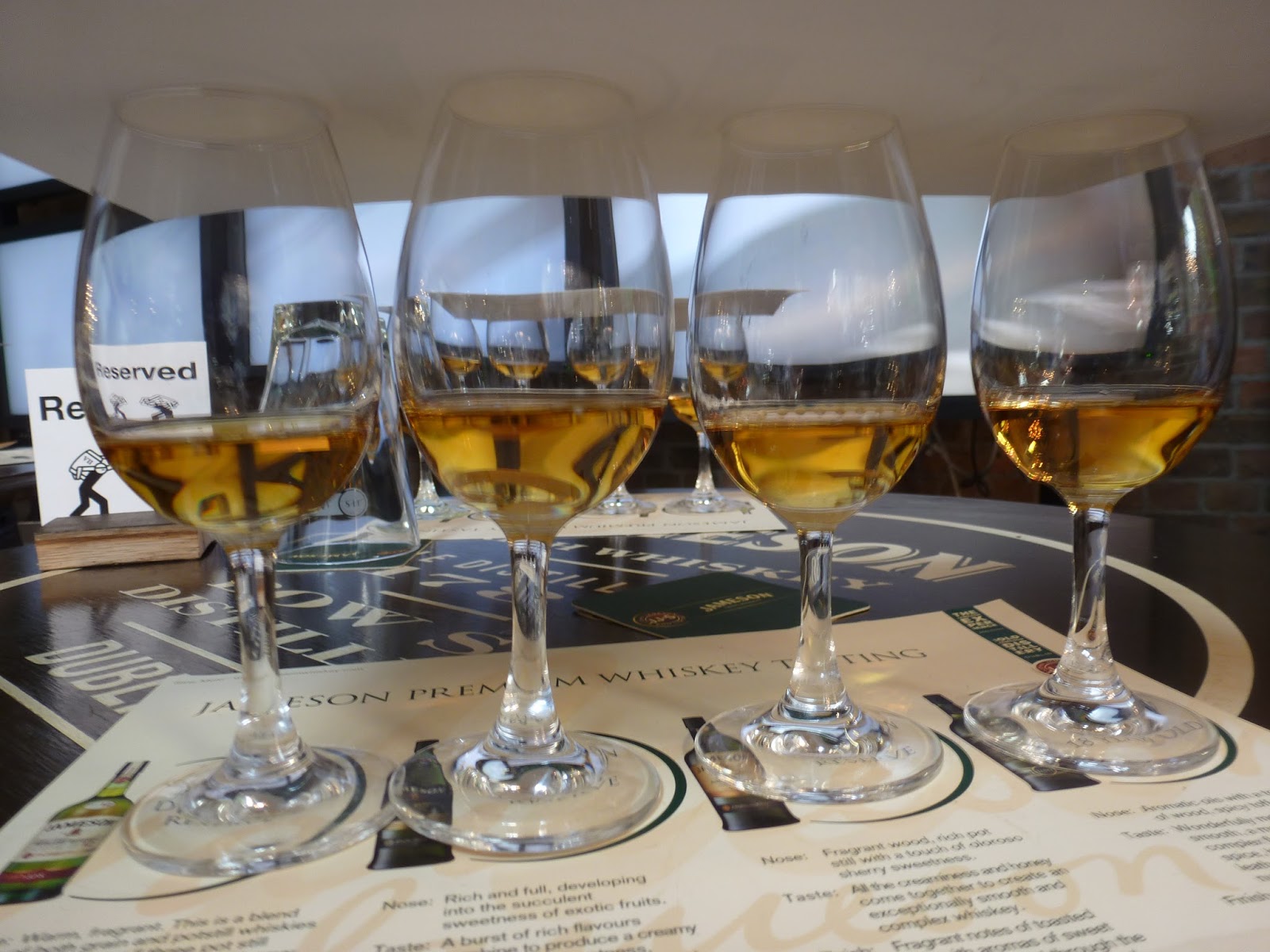 |
| The real stuff! |

 |
| Citrus and stuff |
 |
| Cherry and stuff |
Fast Facts:
Jameson is the 3rd largest single-distillery whiskey in the
world. Each year about 4 million
cases (48 million bottles) are sold world-wide, making it the best selling
Irish Whiskey!
Great, but what does it taste like? Just purchased a bottle of Jameson 12
year old. In a word,
fabulous. Smooth. Soft hints of the sweetness of sherry,
and the woodiness of oak. Notes of
cinnamon. The finish is smooth as glass, with full flavor and no burn. Taste, like perversion, is such a
personal matter that I hate to take a stand. Scotch?
Irish? I would never
denigrate the Scots and their superb whiskies. The breadth of flavors is extraordinary. But, for now, I’m sticking with Jameson
12 Year Old. Sláinte!

 |
| Smooth sippin'!! |


