Saturday, August 24, 2013

Tasting the Scotch in Scotland

On The Royal Mile

The magnificent Edinburgh Castle
Churches galore


Blowing the pipes.

Edinburgh, a fine old medieval town. Whining bagpipes, kilts, clans and Scotch whiskey.

Want to play the bagpipe?  Race around in a wool skirt?  Claim ancestry back to the Celts?  Mac this, Mc that?  I don’t want anyone checking my ancestry, or my credit rating.

On the other hand:  Want some smooth sipping aged malt whiskey?  Even the Judge is nodding. The defense rests.


Found just the place to sip some Scotch and learn trivia that’ll win you a bar bet or two. The Scotch Experience, a discrete four story building in downtown Edinburgh, in the middle of The Royal Mile.

“Honey, you go on ahead.  I’m just going to stop in here for a second.  Looks like a real educational opportunity.” 

That’s not a lie.  The Scotch Experience will fill you with more information than you can possibly digest before compete inebriation.

Step through the door, a lovely maiden sells you a ticket, and plops you in a rotating barrel. Just sit back and grab an insight into the three steps of making whiskey.

The Tasting selections, from smoky to sweet


Fermentation.  Ingredients are almost the same as beer.  Malt, water, yeast.  What is malt again?  Barley drenched in water, allowed to sprout, then dried and ground. Mixed with water and yeast, fermentation takes place.  To get a smoky flavor, they dry the barley with a peat fire.

Distillation. Separates the water from the fragrant alcohol, raising the alcohol content to about 70%.  See, if you hadn’t slept through Chem class…

Maturation.  Scotch Whiskey must be made in Scotland, using only barley, water, and yeast, and it must be matured no less than three years.  Most single malts are aged much longer.  The longer it matures, the less Scotch you have.  Evaporation takes about 2% a year.

Barrels of oak, first used for Bourbon or Sherry...then Scotch

How about ‘blended whiskies?’  Good question.  To create a blended whiskey, a master blender combines several Scotches, along with some so-called grain whiskey.  Grain whiskey comes from wheat, or other grains other than barley. 

Here’s a tip:  A blended whiskey carries the age of the youngest scotch used in the blend.


The age of the Scotch (time in the barrel) determines the flavor.  But aging is not linear.  I tasted The Dalmore 12 and 15 year old Scotches, then bought the 12 year old, finding it smoother and tastier.  Taste is individual, like the ideal temperature of bath water, or the size of the perfect breast.  With breasts, of course, opportunity trumps everything but getting caught.

Another tip:  Once a Scotch is bottled, the maturation process stops.  Cold.  A 10 year old bottle of Scotch forever remains a 10 year old bottle of Scotch, until it finally becomes an empty bottle of Scotch.

Geography.  There are five Scotch producing areas in Scotland:  Highlands, Lowlands, Islay (pronounced Eye-la), Speyside, and Campbeltown.

Tip:  Every minute, 2340 Bottles of Scotch are sold worldwide.  That’s about 20 bottles per second.


Here’s a quick tour of the four major areas, by flavor.

Lowlands:  Citrus, to an almost bread flavor.

Highlands:  Sweet, nutty florals.

Speyside:  Light to dark fruit, like Christmas

Islay:  smoky, sweet, possibly a light iodine finish

These are only hints. Expect dramatic variations and surprises.  In any case, the best place to begin your quest in the heart of Edinburgh, on The Royal Mile, at The Scotch Experience. 

The perfect glass for tasting.  Glencairn. Designed in 2006 and winner of The Queen's Award 

One wall of the 3400 bottle Scotch collectiion

Another wall of the collection

World's largest bottle of Scotch...five feet tall

But, there's more to Scotland than Scotch


“Honey, I’m fine.  Just a few more minutes.  Go ahead and finish the castle tour… visit the gift shop, go to the spa, get a massage, have your nails done.”


Tuesday, August 20, 2013

On Board Her Majesty's Yacht Britannia


On the bridge

note the enclosed railings to protect the royal skirt from breezes


Want to spend a couple of hours stepping back into times and styles of the middle to late twentieth century?  Have a fascination with royalty and things British?

Ever dream of having tea with “Her Majesty Elizabeth the Second, by the Grace of God, of the United Kingdom of Great Britain and Northern Ireland, and of Her other Realms and Territories, Queen, Head of the Commonwealth, Defender of the Faith?”

You can, you know.  Yes, you can …almost…

Tour Her Majesty’s Yacht Britannia, relax with visions of Princess Di and her kids;  have a pot of tea and fluffy, oven fresh scones.  Magical.  Childhood dreams. Visions of grandeur.  HMY Britannia. 

Sadly the Queen no longer has the privilege of gracing her decks, yet her presence is still here.  There’s a fragrantly pleasing air about the expansive teak decks, the spotless railings, the armchairs that beg for a sunny book.

Now moored in the Port of Leith, Edinburgh, Scotland, the price and chore of Britannia’s upkeep falls to a Scottish charity.  They do a splendid job.  Getting to the port is only a matter of stepping on a bus in downtown Edinburgh.

Let’s begin Britannia’s lengthy tale with the story of the ship itself. Commissioned by Queen Elizabeth in1954, and after 43 years of faithful service, the Labor government had the vessel decommissioned in1997 as a cost saving measure.  The government also declined to build a replacement.  To make matters even darker, Britannia’s last overseas voyage was to bring the last British Governor of Hong Kong, Chris Patten, and Prince Phillip back to the U.K., after the return of the former British colony to the People’s Republic of China.

Now, before you settle down to tea and a quick, but elegant bite, tour the ship and accustom yourself to ease and sea breeze.

In the 43 years of her service, the Britannia sailed over a million miles and served as the Queen’s family home, including several royal honeymoons, as well as a distinguished visitor center for such luminaries as Nelson Mandela, Bill and Hillary, Gerald Ford, and Ronald Reagan.  If the place looks more homey and less formal than one would expect, it’s because the Queen supervised every phase of the interior design, wanting to keep it a ‘country cottage’ décor.

Although voyagers were restricted to Royalty and Royal guests, the Britannia was a proud Royal Navy ship, complete with a crew of some 330 sailors and marines, including a Royal Marine Band and a compliment of Royal Marine guards. The Marines were only on board when the Royal Family was.

Other oddities:  The yacht was designed to be converted to a hospital ship, should the need arise.  During the cold war, it was also to be the Queen’s safe haven, flitting from craggy loch to loch in Northern Scotland, as protection from nuclear calamity.

Ready for a tea break?  Just a couple of more items:  The Queen and Prince Phillip had separate, adjoining bedrooms.  Easy to tell one from the other.  One was frilly and flowery, and the other stark, as befitting a Naval officer’s cabin.

When Prince Charles and Diana honeymooned onboard, he had a double bed installed in a guest room.  Very bright of him, although I’m sure it was a complication for Camilla.

Tea need not be boring
On to tea.  The café on the Royal Deck was certainly not a café in the Royal days, but now it’s a bright and sunny spot on the upper deck.  Waitresses in black and white take orders from the small, but elegant menu, and of course the drink selection is all you would expect, both hot, cold, alcoholic and non. Starched table cloths.  Flowers.  Sparkling china, glassware, silverware.

Being old school, meaning married, old, and a complete slave to tired traditions, we succumbed to tea and scones, complete with fresh strawberry jam and clotted cream.

Tea is never just tea
Culinary tidbits:  clotted cream is heavy cream (not ultra-pasteurized) heated several hours in a very low temperature oven, until clots rise to the top.  Here’s another:  the Brits called golden raisins sultanas. Our scones had both raisins and sultanas.

It’s hard not to linger.  Difficult not to order a second pot of tea, while luxuriating on a ship fit for a queen.  Ah, but times whisks away.

Another quick stroll around and it was time to be piped to shore, leaving behind a wonderful ship, which will unfortunately no longer proudly sail the seas.  Wish the government would’ve found another way to shave off a few pounds of fat. Want to see her back afloat?  Me too.  Meanwhile, you can walk the teak decks, stare at the Queen’s Rolls Royce Phantom and enjoy at least a brief brush with royalty.


The State Dining Room

Sunday, August 18, 2013

Live by Night by Dennis Lehane


“Some years later, on a tugboat in the Gulf of Mexico, Joe Coughlin’s feet were placed in a tub of cement.  Twelve gunmen stood waiting until they got far enough out to sea to throw him overboard…And it occurred to him that almost everything of note that had happened in his life – good or bad – had been set in motion the morning he first crossed paths with Emma Gould.”  So begins Live by Night, by Dennis Lehane.  You may have heard of him, or read Shutter Island, or seen the movie.  Dark.  Deep and dark, yet his characters grab you with their stretched equations of right and wrong.  With their flickering, daring lives.  

One thing that annoys me is when a book breaks its promises.  Sometimes it’s just poor writing.  Sometimes it gallops until the horse dies and the author just keeps flogging.  With Lehane, there’s no chance of either.  His prose races clean and crisp, his characters are razor sharp.  And the plot sizzles like a lit fuse.

The setting is Boston, in the middle of the Roaring Twenties.  Always wondered about that name.  Was it the 3-4 and 4-4 time jazz that rambled from speakeasies and leaked out onto the streets?  Or the shuffle of flappers bouncing along, doing the Charleston?  Maybe it was the illegal flow of the devil’s potions that nobody, not even the Congress, or the strong arm of the law, could dam up.  I think it was the roar of gunfire that swept the streets of every major city, including Boston.

Joe Coughlin was in the middle of it.  And when you live outside the law, there’s no coming back.  The police want to kill you.  Your partners want to kill you, but most of all your competition wants you cold and dead.

Lehane is right on target with Live by Night.  This book shoves you into the epicenter of danger and corruption, love and betrayal, good, evil, and everything in between.

If you liked Puzo’s The Godfather, you’ll sink your teeth into Live by Night.  Take a trip back to Boston in the 1920s.  Taste the rotgut booze, ogle the easy women, smell the cordite. Run for your life!


Friday, August 16, 2013

A Little bit of Ireland, A Lot of Guinness

If you don't acquire this taste, you'll never forgive yourself.


Dublin.  Only one thing you need to remember:  Guinness.  Oh sure, there’s a castle, a cathedral, a history that dates back to the murdering, marauding, plundering, pillaging Vikings.  There are the uprisings against British rule that led to independence.  Sorry, no time for all that, once I get beer on my mind.  Speaking of historic dates, only one of those you need to remember:  1759. 

Barley

Guinness and 1759.  They dovetail.  It was 1759 when Arthur Guinness purchased a run-down brewery at St James Gate and took out a 9,000 year lease, at 45 £ per year.  That’s what I call confidence.

All began over some burned barley.  Ever seen barley?  Ever tasted barley?  Know what the hell barley is???  Let’s set the record straight.  First off, you undereducated inebriate, barley is a grain and to see it growing, you wouldn’t know whether you were looking at barley or wheat.  Secondly, you swilling swine, you only need four ingredients to brew beer and barley is one of them.  The other three are hops, yeast, and water.  Guinness adds a bit of a twist, using both malted and un-malted barley.  What does malted mean?  It means the barley was drenched with water and allowed to sprout before being dried. 

A factoid:  Guinness uses 100,000 tons of Irish barley every year.

How about the water?  Legend has it that Guinness is brewed with water from the River Liffey, which flows right through the center of Dublin.  Legend has it wrong.  The eight million liters of water that flow through the Guinness Brewery each day comes from the Wicklow Mountains, right above the city. Wicklow water has a low mineral content, which is another thing in its favor.

Factoid:  Water, in brewing terms, is called liquor.


Then there are the other two ingredients:  Yeast and hops.  Unlike barley, hops grows in fifteen foot strands of greenery.  Harvested by cutting off great ropes of the stuff, it’s then fed through a machine that separates the little cabbage-like balls that will add spice and bitterness to the brew.

Yeast adds the magic.  The little yeast beasts multiply and feed off the sugar of the barley and hops to produce alcohol.  The Egyptians, of pyramid fame, first used yeast and no beer (or whiskey, for that matter) would be complete without it.  Different types of beers generally use specific strains of yeast, although frequent readers of my blog will know that the Belgians are content to use whatever yeast happens to drift in.

See how quickly you can graduate to being a well-informed drunk?  Education is everything.  Well, you also need confidence and foresight.  Those two got me stumped.  I can only do so much.

But, forget about me for the moment and get back to Guinness.  Arthur heard about a man who had over-roasted his barley.  But, instead of throwing it away, the man went ahead with the brewing.  That led to a solidly dark beer, sold inexpensively to porters working at the Dublin docks, hence the name for dark beer:  Porter.   Arthur did the brew one better and called his creation Stout Porter.  At St James Gate, they brew about three million pints ever day.  The porter part was later dropped and now in over a hundred and fifty countries people happily raise a glass of Guinness Stout.  It’s not for nothing that the saying goes:  There’s a little bit of the Irish in all of us.

The self-guided tour is a wonder in itself.  The old part of the brewery, with equipment dating back to the turn of the 19th Century, is rearranged, with huge photos and videos, running waterfalls, numerous descriptions of the brewing process and something I found particularly fascinating, a video of barrel makers at work.  Sadly, Guinness is no longer stored and taken to market in wooden barrels, but for centuries, men chopped and shaped oak, all by hand, and almost without measuring.  At the height of wooden barrel usage, 300 artisans turned out a thousand barrels a day.  A few decades ago, Guinness graduated to steel kegs.  Easier to produce and store and much easier to ship.


So, you’ve had your tour and are ready for the tasting.  Best place to do that is the 7th floor, offering not only a delicious pint, but also a panoramic view of the brewery’s 50 acres, and the entire city of Dublin.

50 acres of brewery....And Beyond!
 
Ok, I admit that Guinness, as black as ink and spiced with the bitterness of hops, is an acquired taste.  Matter of fact, it took me almost 30 seconds to acquire it, about half the time it takes to pull a pint.  The dark brew washes into the bottom of the glass and bubbles rush to the top, so tiny it’s almost like watching a dark kaleidoscope.  The barkeep adds a bit more.  You wait.  Then there’s the top-off and you’re ready to become a devotee of one of the tastiest and most storied brews on earth.  The Guinness team likes to say, besides everything else there’s a fifth ingredient in their brew, a little bit of


Arthur, who dreamed big in 1759 and
bequeathed his dream to all of us.

So here’s to you Arthur, and here’s to your creation.  Cheers! Or, as the Scots say, Slainte Mhor!


7th Floor Tasting Room

Pulling a Pint

...patience now...


Thursday, August 1, 2013

Heidelberg's Ritter Hotel: Spend a Night with The Knight


The Entrance 
Time to stroll...

A little wine...

some people watching...

Some light lunch at an outdoor cafe...
Please scroll down for pithy descriptions and even more photos...


Ah, Heidelberg, the home of a luscious old town (Alt Stadt) with centuries old buildings, walking and shopping galore and reeking of history.  Everyone knows about The Church of the Holy Spirit, dating to the 12th Century.  Used to be a basilica, and for a time was both protestant and Catholic, but since 1936 has been exclusively protestant.

You might not know that right across from the church is another building of interest, but only if you’re looking for a four star hotel, with a long history, and a a façade and interior right from a movie set.  Talkin’ about The Ritter Hotel, or by it’s full name, Zum Ritter St Georg.  Built by a cloth dealer in 1592, The Ritter (The Knight) was first mentioned as a guesthouse in 1681 and is possibly the only home to have survived the many wars that have swept through this city.  Louis XIV’s French army did a great job of wrecking the Heidelberg Castle that overlooks both the city and the Necker River, but somehow they missed The Ritter.  Probably raided the castle’s wine cellar and decided on ‘just one more’ before they stomped into town for pillaging and wenching.

History, check.  Grand hotel, check.  But aside from the awe, what’s special about The Ritter.  In a word, location.  Located on the main walking street, with its plethora of superb shops (chocolates, perfumes, tobacco, stylish clothes, jewelry, Christmas ornaments), and open-air cafes, The Ritter is a great place to stay and suck in the full experience of Alt Stadt Heidelberg.

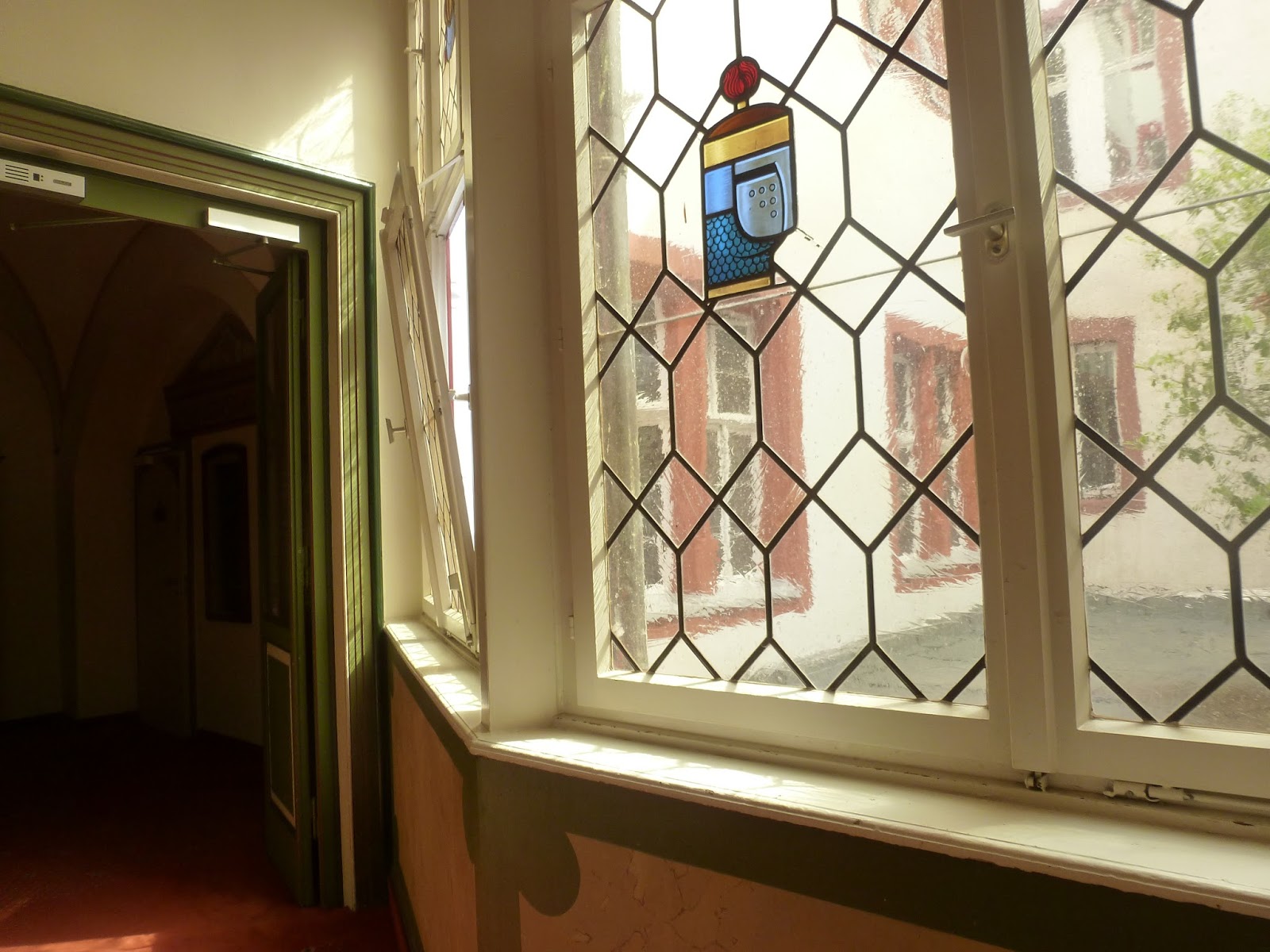
The Ritter’s small façade belays the expansive interior, with its winding corridors and good-sized bedrooms.  Small touches of stained glass here and there, bunches of fresh flowers, and solid wooden stairs let you feel the history of the place.

The bottom floor of the hotel is all dark wood, white tablecloths, and suits of armor.  When you look from the street, through leaded, beveled windows, it’s like looking into another world, another era. You'll also be looking at the restaurant. Although by all accounts the food is wonderful, we just couldn’t resist the open air cafes.

When you step out the Ritter’s front door, onto the cobblestones,  you find a wide walking street a couple of miles long, with prime spots for wine guzzling and people watching.  The old city's arms are wide open and The Ritter Hotel is a perfect base of operations.

Never fear.  The Ritter's modern touches, such as elevators, and internet help the weary traveler.  One thing I don’t understand, however, is why a luxury hotel would charge extra for internet, when many cheaper hotels offer it for free!

By the way, should you choose to take the train, there’s a Heidelberg Hauptbahnhof (main station), but also a stop for the Alt Stadt.

Spend a night, stay the weekend, spoil yourself at The Ritter and the wonders of Heidelberg.

huffin' n' puffin' on da River Neckar...

Bicycles are all over this university town 
The river is flows right by the city

View of the tower on the old bridge

Walking streets galore..

You'll find spots of beauty everywhere.


Inside The Ritter's dining room

This and the following shots are all inside the hotel