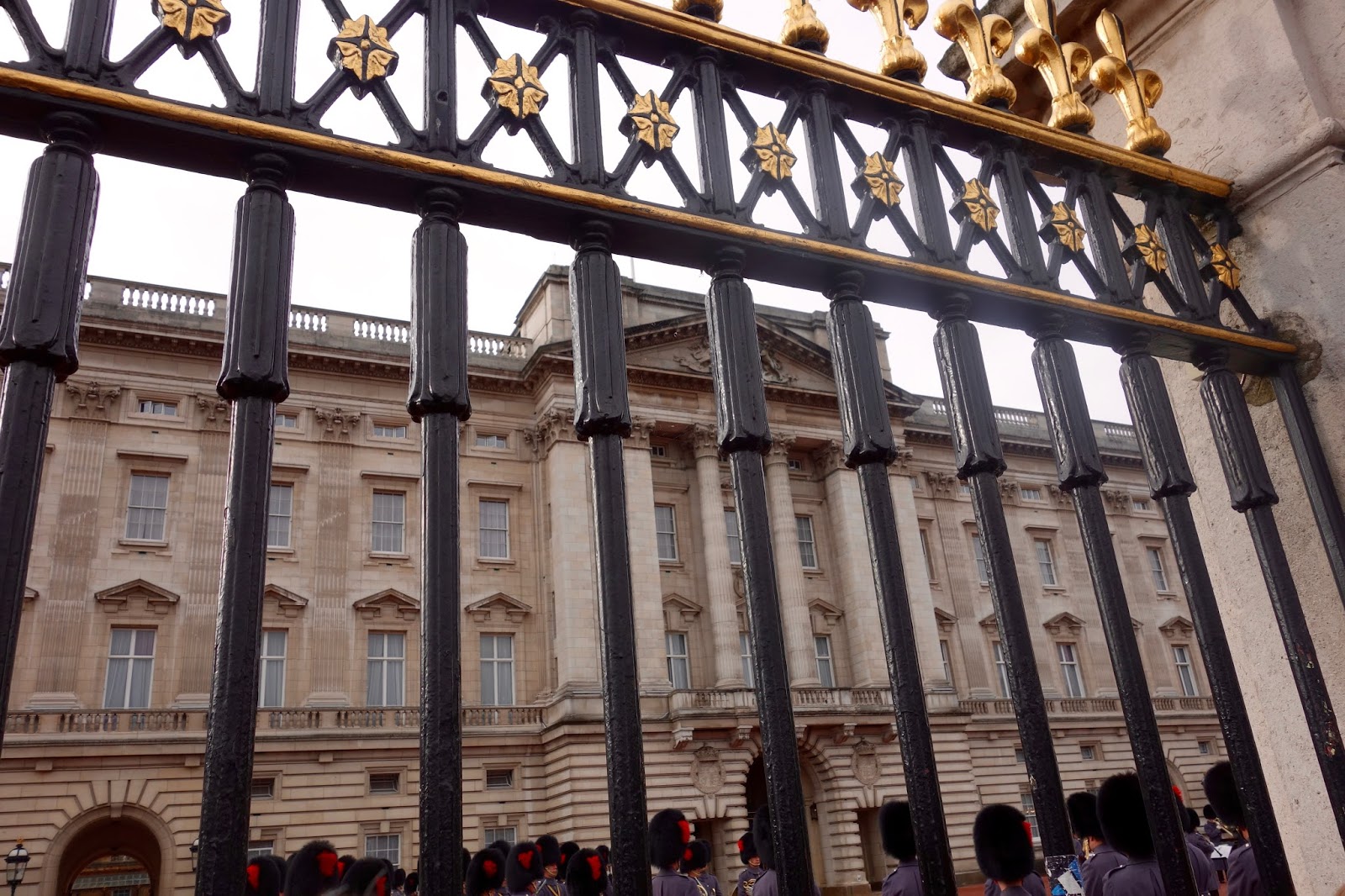
One of London’s great
experiences is seeing the Changing of the Guard. The splendid array of uniforms, prancing
horses, gold-tinged carriages, and stirring martial music brings the full force
of ceremony and tradition to life. It is
history. It is monarchy. It is splendor.
If you only see this one part of what London has to offer, you’ll carry
away a kernel of what it means to be British.
But, if you don’t know what
you’re seeing, it’s like walking into a library and saying to yourself: “Can’t read none, but the covers look reeeeel
purdy!”
Attention, friends, loved
ones, along with select family members, I’m here not only to enlighten, but to
turn all of you into paragons of knowledge, able to casually toss out facts to companions sharing your visit to the greatest city in the world. Stand by for your esteem to soar. Companions will hover close, and all will pat
your back and stand for a pint at the nearest pub.
Although the ceremony actually
takes place at three locations, Buckingham Palace, St James Palace, and Wellington
Barracks, let’s stick to the most well known, the changing at Buckingham
Palace.
First off, you need to know
the ceremony begins at 1130, but to really see what’s going on, get there an
hour early, otherwise there will be jostling and unkind words as you carelessly
force your way close enough to see more than a mouse standing next to a dinner
table.

Another good spot to observe
is from the raised steps of the Victoria Monument, directly in front of the
palace. This allows a better view of the
entry of the guards, bands, and horse guards.
Dates: April to July, the Changing takes place
daily.
August to March, it’s on
alternate days. Here’s the schedule for
the first months of 2017:
January – even dates
February- odd dates
March – odd dates
April – July – daily
“Ok, ok,” I hear the impatient
rascals in the crowd crying, “But what the hell am I seeing???”
I don’t mind your
semi-belligerent attitude because in your intemperate impetuosity, you have cut
to the heart of the matter.
Unfortunately, I can’t just blurt it all out. Patience lads and lassies! Let’s take this in manageable mouthfuls.
The Guards, also known as the
Household Troops, consisting of The Queen’s Guards (infantry) and Queen’s Cavalry are trained British Army soldiers, from five infantry
regiments:
The Grenadiers, Coldstream,
Scots, Irish, and Welsh Guards, plus two regiments of Household Cavalry, the
Life Guards, and The Blues and Royals.
The Household Guards date back
to 1660. You may remember from your
intensive study of English history, the English also had a civil war (some say
three wars) and King Charles I lost his head over it. With the reestablishment of the monarchy
under Charles I’s son, Charles II, the Household Guards were formed. Today the guards are known as The Foot Guards
and The Household Cavalry and the changing of the guards is known as Guard
Mounting.
In England, tradition is
stacked upon tradition. Here’s a quick
way to identify the different foot guard regiments by cap plume, buttons, and
collar insignia:
The Grenadiers: Most senior of the Guards. Began guarding King
Charles II while he was still in exile – recognized by a white plume on the
side of the bearskin cap and single button spacing. On the collar is the symbol of a grenade.

Coldstream Guards, the oldest
continually active regiment in the regular army, formed in 1650 and guarding
the queen since 1660 – red plume, two button arrangement. Collar badge is a garter star.

Scots Guards, no plume, three button arrangement. Collar badge is a thistle.

Irish Guards, St Patrick’s
Blue plume, four button arrangement, shamrock on the collar

Welsh Guards, tricolor white,
green, white plume, five button arrangement, leek on the collar.

What about the Household
Cavalry?

The Life Guards, red tunic,
black collar, and a white plume on their hat.
The Blues and Royals, blue
tunic, red collar, red plume.
Interestingly, not only the
five permanent regiments, but from time to time other British and Commonwealth
units provide guard service, including Royal Air Force, Royal Marines, and
Gurkhas (British Regiment made up of soldiers from Nepal). On at least one occasion (2008), soldiers
from 1st Battalion, Royal Malay Regiment, from Malaysia, a
non-Commonwealth country provided guards.

Now, on the guards’
duties. There are three places in London
guarded by the Queen’s Guard: Buckingham
Palace, St. James Palace, and The Tower of London.
While the Queen is in
residence at Buckingham Palace, there are four, Foot Guards in place. In her absence, there are two. Each tour of duty is two hours, with four
hours off. During the two-hour watch,
the guardsman (no females as yet in the British infantry) stand still no longer
than ten minutes at a time.
 |
| British Flag |
 |
| Royal Standard |
Another way to tell if the
Queen is in residence: If the British
Flag flies over Buckingham Palace, the Queen is NOT there. If the Royal Standard flies, she is there.
Tomorrow: Part II, filled with more curiosities.


