Saturday, December 27, 2014

Sip Some Tea and History at Twining’s in London


Why bother to find London’s oldest teashop?  Tea is tea.

Ah, my lads and lassies, there’s more to tea than meets the lips. History.  Romance. Wars. A clash of societies and turmoil within societies. Tea gathers the story of humanity in a tiny cup.

Think I’m overstating the case?  Take another sip and picture Charles II wooing a Portuguese bride, Catherine of Braganza.  While she may not have introduced tea to England, her own addiction to the beverage, and it’s subsequent wide spread popularity at court, made tea the drink of choice among the English aristocracy.  From there it spread, slowly, but constantly.  For a while, due to its extreme expense (a pound could cost a laborer nine months wages), only the wealthy enjoyed it.

Take another sip and contemplate the English-China tea trade and the Opium Wars.  After the Chinese emperor decreed that all foreign trade must be paid in silver, the English began importing opium from India and Afghanistan to sell in China and generate a flow of silver back to Britain.  Over the course of years (why burden my readers with one date after another?) the Chinese concern over the problems of opium addiction led to its ban.  By that time the British government had become dependent on the tax levied on tea in England.  Naturally they couldn’t sit idly by while the tea trade dried up. Hence the Britain vs China Opium Wars.

Think also of the Tea Act of 1773, which led directly to the American Revolution. We often think of it as a tax on tea, but it was not.  The circumstances are fascinating.


Since the happenstance of fragrant leaves falling into a Chinese Emperor’s cup twenty-five hundred years ago, tea’s journey has encompassed one-hell-of-a-lot more than foliage steeped in hot water.

Twining's in verse

Back to present day London and my quest.

Not sure how many tea companies there are.  Possibly thousands when you count the rivers of tea that flow through Asia.  But tea has become so associated with England that it’s hard to think of the country without picturing a teapot. Packaged in colorful tins, tea is sold in every souvenir shop. One brand you’ll find on nearly every shelf:  Twining’s.

But, popularity isn’t why I rode the Underground and strolled the slick, rainy streets of London, scurrying past the Royal Courts of Justice, and ignoring some delightful looking pubs.  I wanted to see and taste the storied beverage at the beating heart of English tea  - and the brand the Queen drinks.  Yes, Twining’s has a Royal Warrant.

The Royal Courts of Justice

The half-timbered building that looks Elizabethan, but isn't is a fine pub:  The George
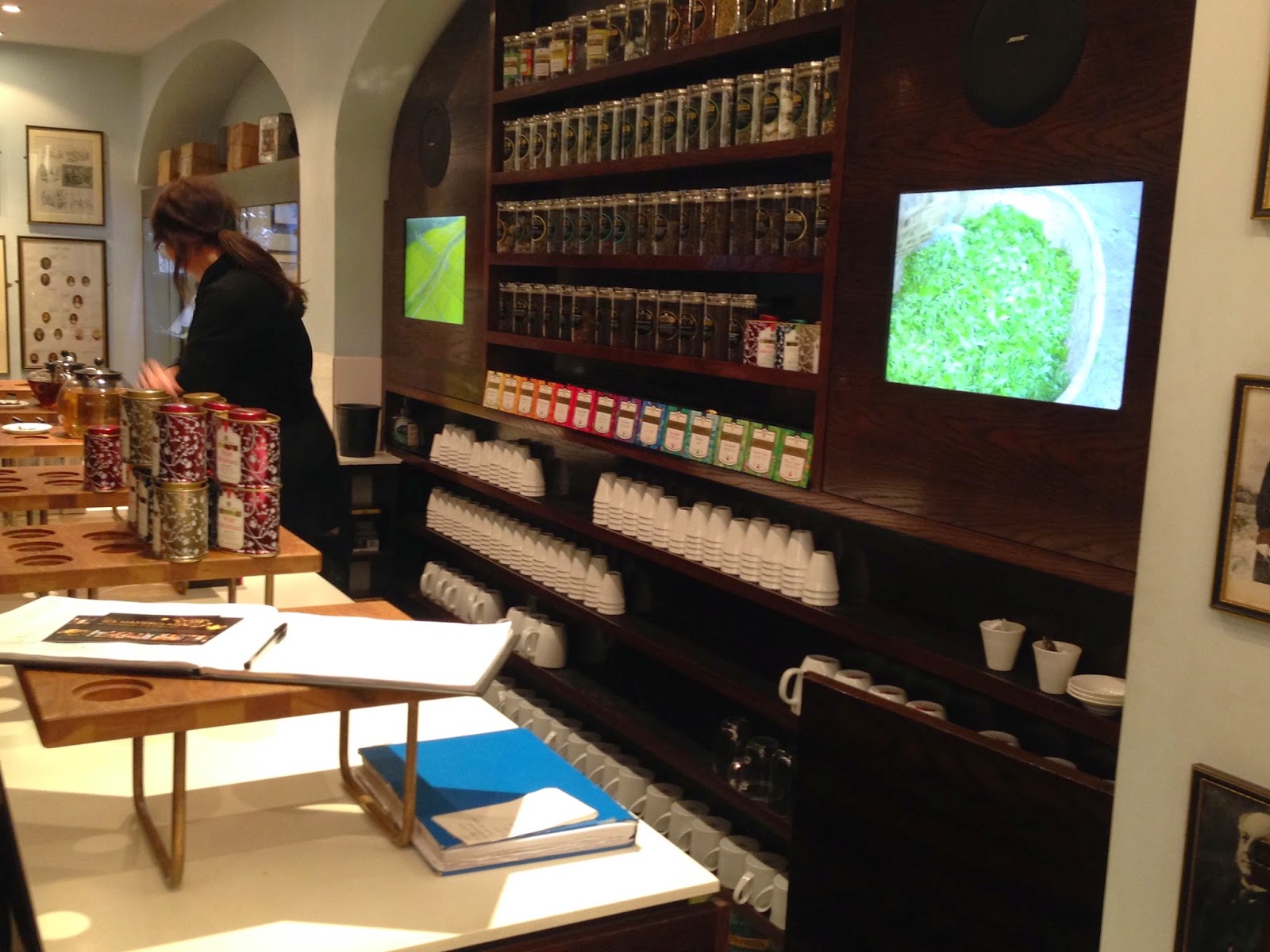
The narrow tearoom, proudly sits at 216 Strand, on the original site. It’s the oldest tea purveyor in London and a success story beyond most people’s dreams.


 Thomas Twining bought Tom’s Coffee House in 1706 and began selling bulk tea and coffee in 1717.  Twining’s still sports the fabulous white and gold entrance that was installed in 1787 by Thomas Twining’s grandson, Richard Twining.  Richard also changed the name of the shop to The Golden Lyon.  It’s is believed to be the oldest company to have traded at the same place and used the same logo. 

Yes, Twining’s was purchased by a conglomerate, but descendants of the family are still involved and Twining’s is still run like a family business.  There are only nine master blenders responsible for the buying and blending of all Twining teas.  So wherever in the world you drink Twining’s, it will taste the same.  But, I didn’t want to taste Twining’s just anywhere in the world!   

On your next trip to London, try it yourself.  Walk through the door and become enveloped by wild and exotic perfumes.  White teas. Green teas.  Black teas (accounting for 90% of the market).  Fruit teas.  Teas old and young, bundled and chopped, twisted, and poured.


 Drift toward the back of the shop, passing more jars and cupboards than you can count.  Stop and sniff a few.  In short order, you’ll reach the nirvana of tea: the tea bar.  A sweet young woman will enchant you with sips of this and that.  She may ask what flavors and aromas you like, whether you drink tea during the morning or at night, and if you prefer gentleness or bone-shaking strength.


Which brings us to caffeine.  Coffee or tea?  Tea leaves have more caffeine than coffee beans, however because tea is more diluted, a cup of tea has less caffeine than a cup of coffee.  Also, different teas have different amounts of caffeine.  The longer it is steeped, the stronger and more caffeinated it becomes.  Here’re some rules of thumb:  2 cups of tea = 1 cup of coffee.  2 normal colas = 1 cup of tea.  Black tea has about twice as much caffeine as green tea.  Only rules of thumb, folks!  Teas vary greatly.

Back to the tea Barista.  Based on your tastes, she’ll happily gather any combination of teas you request.  You can take a bag home of your own special blend.  Meanwhile, I suggest you do some more tasting.  After all, how often will you visit the oldest teashop in England?


***A little known, but interesting fact:  tea bags are an American invention. About 1908, Thomas Sullivan, a New York tea merchant, sent his customers samples in small, silk bags.  You can guess the rest.

Friday, December 26, 2014

‘Tis the Season To Be Drinking!


Ok, I know there’s more to the holidays than merry spirits.  But, an opportunity is an opportunity.

I’ve got two libations to show you that thrive in this festive season.  Both are from England (sort of), but approach merriment from two different sides of the Atlantic:  Gin and Rum.

Noticed that the distilled spirit pundits have begun to edge away from Scotch whiskey and toward other ways to celebrate?  The Scotch whiskey song has been played so often the CD is thin and the ears weary.  Now we’re seeing a breakaway into more fashionable quarters.  First, vodka (mostly the bottles, in my opinion) showed new colors, new designs, and newly enhanced prices. 

I’m beginning to see the same curtains being pulled back in two more interesting areas.  Come ‘on now!  Once you’ve added lime or other flavoring to Vodka, what more can you do?  Triple distilled, quadruple distilled.  Gonna move on to completely dehydrated vodka?  For me, if you say Tito’s, you’ve said all you need to say about vodka.

Enough beating around the juniper bush!  Let’s move on to two of my new favorites, the first being The Botanist, a gin from Scotland, and more exactly from the Bruichladdich Distillery on the Isle of Islay.  Yeah, but gin is gin, n’est pas?  Oh, bite your tongue! Your taste buds have been neutered.  Traditionally, gin is a neutral spirit, flavored with juniper berries.  The Botanist goes far beyond that.  Two species of juniper go into the mix, along with twenty-two other herbs, all but two of which are harvested in the local area by two botanists.

Fine.  But, does all this rigmarole make a difference in the flavor?  Yes. 

It’s not that I can take a sip and suddenly pronounce all the Latin names, but my taste buds get a whisper of gin, instead of a hard bite.  That’s true whether I’m slow-sipping a marvelous martini, or nursing a gin and tonic.  There’s also a certain amalgamation of flavors that both calms and satisfies.  When I tried my first gin and tonic made with The Botanist, my melodious remarks were:  smoooooth, and flavorful.  In fact, The Botanist is so smooth, I normally go 1/3 to 2/3, gin to tonic.  Then I add a twist of lemon.  Then I have a second and a third.  (about $35 a bottle in England)

In the realm of rum,  I was drawn to Pusser’s because it’s a vital part of naval history.  First a word about the name.  From 1655 to 1970, a British seaman was given a ‘tot’ of rum a day and the man who dished it out was the Purser, later corrupted to Pusser.  From wooden ships to steel hulls, the Royal Navy floated on Pusser’s.

What happened in 1970?  The Admiralty Board (The Secretary of State For Defense is Chairman) decided that rum had no place in a modern Navy.  I’m thinking the blokes actually doing the fighting didn’t get a vote.  After all, Pusser’s Rum only contributed to victory after victory over several centuries.  Good reason to change.  And, what direction has the British Navy sailed since.  Downhill is a good guess.  Not the seamen, I might add, just the Royal Navy, as dictated by government rogues. Today, the once might Royal Navy has only 19 surface warships, including 1 helicopter carrier, and 10 submarines.

On July 31, 1970, referred to as “Black Tot Day, men raised their glasses as a long, unbroken tradition of the sea was cast aside.  They could have been drinking to the demise of the Royal Navy as well.

Thank god, the Admiralty Board didn’t have a say in ringing this marvelous rum’s death knell!  It’s still the only rum blended in accordance with the exact
Royal Navy specifications in place in 1970.  And unlike many rums, there’s nothing artificial about Pusser’s, not color and not flavor.

I’ve had plenty of rum, mostly from Puerto Rico, but also from various other spots around the Caribbean. Why there?  Rum is made from sugar cane.  ‘Nuff said. Haven’t had any that were  undrinkable, but neither have I had one that stirred me, made me purse my lips and scream, “Ahoy!”

Pusser’s is special.  A deep caramel color.  It’s also smooth as glass.  Often I sip it straight, as I would any other fine whiskey.  I like to let the aroma surround me, and the taste gently fade at the end of each sip.


Pusser’s Rum is bottled in Barbados, in the British Virgin Islands*, from stills in both Trinidad and Guyana.  Barbados has a strong tie to the United States.  Most planters and most of the early slaves came to South Carolina directly from that island.  There are lots of other Barbados rums and I admit I haven’t tried another.  This one is enough.  Not sure if my heart and my taste buds could handle anything better.  Pusser’s makes several varieties.  I drink the 42% alcohol variety.  ($18 a bottle)


   * Yes, it says British Virgin Islands on the bottle, but in fact every country I mentioned is independent, since the 1960s.

Thursday, December 18, 2014

The Lemon Table – A Rare Collection of Stories


Speaking of London Bookstores, which of course I mean the bookstores I painstakingly gave you a glimpse of in the last blog.  What?  Haven’t read it yet?  Fie on thee!

For my loyal followers (those that have read at least one of my blogs), I offer a book I picked up at South Kensington Books.

A disquieting book, The Lemon Tree, a grouping of stories.  Not disquieting because Julian Barnes (Flaubert’s Parrot, The Sense of an Ending) tosses out porno-erotic words like fuck and cunt – which one would think reasonably go together – but because the stories dissect one of life’s great mysteries and tragedies, growing old.  Life slipping over the edge.

There’s love, of course, sweet days of splendor-in-the-grass, as Wordsworth put it.  There’s also rapturous sex and promises of wondrous days to come, promises that slowly fade with the seasons of life, so slowly that no one notices until the promise has passed and winter is upon us.

Love.  Barnes relishes the stages of love in ways you may or may not find comfortable. Fresh blooms morphing into limp petals, petals floating idly in a last attempt to live.  The water in the bowl, a tepid, malodorous mix of the dead and dying, until the stench is poured down the drain and all that remains is a white residue of that which has passed.

Getting old.  A collection of things we did, no longer do, or no longer can do.  Ah, the pity, the depth of anguish these stories evoke.  And yet, some of them rise above the fading light and fog-like gloom.

“A Short History of Hairdressing dances in the delight of every age.  “Hygiene” sparkles with wit.  “Knowing French” sports a lyrical attitude in the face of the fading light.

I don’t often read a book of individual stories.  Not sure why.  Perhaps a book, be it novel or non-fiction, lends itself to dreams that put us aside from our selves.  Stories are a jazz riff to a novel’s concert.  When I say stories, I’m talking about short stories and short, short stories, all the way up to short novellas. An odd thing about stories is that they lend themselves to movies more readily than a book of say five hundred pages.  With a book, a writer and director are compelled to trim and chop, to turn a tree into a single branch, or even a toothpick.

Some of the tales in The Lemon Table run to twenty pages or more, some stretch to only a few pages.  With one reading you can easily imagine a movie.  A story allows you to build, to amplify instead of chop.  A good story is distilled, almost like poetry.

No matter the length, Barnes does a superb rendition of character construction.  In ‘The Revival,’ a tale of unrequited love, the description is so often simple, “But thirty miles was all they travelled together.”  And yet, you feel the aging man’s anguish and longing, love for the sake of love and the sake of living.

Barnes’ writing is so beautifully descriptive that my imagination leads me on, even when my heart screams “You don’t want to know this!”

Evocative is a word that comes to mind.  Perhaps ‘mirror’ would be even better.

A big question:  Is the book uplifting or depressing?  On the surface it’s a little of both, until you realize the tone is a call to action.  Make of life what you will.  Don’t let precious time wither.  There’s plenty to be happy about.  Don’t wait.  Use your time well.  Love.  Travel. Celebrate.  Do all those things, with people who make your life worth living.

Julian Barnes wrote a remarkable collection of stories.  Read them.  Use them well.


Wednesday, December 17, 2014

Finding London Bookstores! An Adventure


Besides pubs and theater, other musts for any worthwhile, thinking traveler to London, are the array of not-to-be-missed bookstores.  I’m not talking about the grab a novel newspaper stands in the airports, or the thin selection in American malls.  London is blessed with tome filled islands of wonder that lure you inside and steal your hours, soaking in the smell of printed works, reveling in the atmosphere of rebounding knowledge, in the presence of brilliant minds.  Speaking of brilliant minds, in my benevolence, as you might guess, I have a few personal treasures to share.

Foyles Books on Charing Cross Road.  Five stories high.  There are Foyles outlets all over London.  But, you’re going to Leicester Square to pick up theater tickets anyway, so why not wander down Charing Cross Road, which is noted for its array of second hand bookstores.  Forget the musty stacks for now…although they do have the charm and elegance of gray haired men, with frayed cuffs and knotted ties.   Time is short.  Let’s keep going down a few blocks and step into the Foyles flag ship.

Used books on Charing Cross Road
Teenage brothers, William and Gilbert Foyle failed their Civil Service Exams and decided to sell their textbooks.  The rest of the story reads like a script for a Hollywood movie.  Bought used textbooks, sold them for a profit.  Opened a store, outgrew it, opened another, etc.  Finally settled in the current location in 113-121 Charing Cross Road (1929!).  See, even in a depression, there are those who roll their money to the bank in wheelbarrows!  Foyles has branches all over the world, but I always prefer the original.  By the way, Foyles is still family owned and operated.  (http://www.foyles.co.uk/about-foyles)


You step through the door into the world of books.  First thought.  This shop isn’t so big. Hahahaha…you’re only in the new book section, surrounded by a few thousand selections.  Traipse upstairs, or downstairs.  There are more worlds to conquer.  Now, get to it.


Hatchard’s  has been selling books from the shop on Piccadilly since 1797!  Prime location, right next to Fortnum & Mason.  Now owned by Waterstone, Hatchard’s is still a fabulous bookstore of high, polished-wood shelving, and there’s no way I can think of stepping into the food emporium next door before I gaze over a few new titles, and browse the never-ending stacks that stretch through fiction, non-fiction, art, travel, and god only knows what else.  It’s a wonderful place to get lost in your dreams.  Hatchard’s often features book signings, with significantly famous authors.  (http://www.hatchards.co.uk)


Daunt Books, 83-84 Marylebone High Street , is not easy to find.  (http://www.dauntbooks.co.uk) By the way, the street is pronounced Mar-lee-bone.  Nearby are Marylebone Road (huge), Marylebone Rd (small), and Marylebone Street (tiny) Follow my directions closely:  Take the underground to Marylebone Tube Station. (Baker Street Station is closer, but who knew?) Get out of the underground and up to the road.  Look perplexed.  I scratch my head.  Ask a few people for directions.  Watch them scratch their heads. Unfold my map and notice that London is a tiny dot, while the rest of England unfolds endlessly.  Notice the huge Landmark Hotel.  Race inside.  Get a better map from the concierge and let him mark the spot.  Walk down Marylebone Road until I’m blocks past Madame Tussaud’s.  This isn’t turning out well.  Did the concierge say to turn at Madame Tussaud’s?  Maybe.  Memory isn’t what it used to be after that last pub.  I wander the several blocks back to Madame T’s.  Turn at the spot I think I remember and find myself on Luxborough Street.  Keep walking he said.  I had several pints of beer an hour ago.  This is beginning to be troubling.  Rain with a chance of soggy socks.

Luxborough Street is a looooong street.  I pass the point of bladder control and am headed toward the abyss of self-control.  I hurry back to the Landmark Hotel, which is several blocks behind me, but offers the only faint hope I’ve got.

The Landmark gents room is a lovely place.  All polished marble and mirrors.  I spend an hour there, holding my own, idly watching people come and go as I continue to unleash a torrent of after-market beer.

I begin again.  Past Madame Tussauds and a hard right turn.  Looks familiar.  Oh, yeah, been here before.  Seems like only moments ago.  Luxborough Street, check.  Somewhere, the hip bone has got to be connected go the thigh bone.  I run into Crawford Street.  But, since this is a T intersection, I’m faced with a dilemma.  With great trepidation (and half my brain calculating how far it is back to the Landmark), I chance a left turn.  This may be the longest walk since Chairman Mao took his first step on the thousand mile journey.

My need to find Daunt Books has changed from sunny joy, to golden rapture (at finding a men’s room), to steel gray determination, to the red heat of passion.

I once again stop and ask directions.  The lady backs off a few steps and wraps her arms protectively around her child.  It’s over there, she points and I hear the click of her heels as she speeds the kid to safety.  Was it my tone, or the perhaps the way spittle flew in wide arcs?  It’s getting dark.  If this fucking place is closed…

I catch a glimpse of heaven.  The magic words, Marylebone High Street.  I ask again, just to be sure.  Daunt Books, I say so calmly I don’t recognize my own voice.

Right over there.  The man points across the street and down about fifty paces.

I race.  Blessed sweet mother of angels, it’s open!  I gander at endlessly long oak shelves, stare up at the high gallery, peel back a few covers, browse until my eyes ache.  Find tales I simply cannot live without. Daunt Books specializes in travel, but they have everything.  Although parts of the building date to 1912, the owner and the name date only to 1990, when the shop was purchased by a former banker, James Daunt.  No matter the date or pedigree, this is another London treasure.

It’s now pitch black outside and I have no remote idea how to trek back toward any known tube stop, or bus stop, or where I might find a frightened mother and child to clear the path ahead.

Ah, but all is well.  Diagonally across the street is a championship pub. Prince Regent, reads the sign over the heavy stone front.  Better yet, the bar is not crowded and they have my favorite, DOOM Ale on tap.  It may be raining outside, but in here it’s sunny as a warm day on the beach with a bosom buddy, and the gents toilet is only a short glance from where I’m celebrating with a few pints.


Before I finish this thumbnail sketch of London booksellers, I must mention one small bookshop that never makes anyone’s list.  South Kensington Books is just steps away from the South Kensington tube stop.  It’s small, it’s independent, but two things make it really special:  price and selection.  Most of the books, which include best sellers and many prominent authors, sell for half price or less.  We’ve all seen half-price bookstores, but I’ve never seen one that grabbed me and made me walk out the door with three books under my arm.  Only an iron will and the airline’s baggage limit stopped my free-fall toward financial ruin.


Don’t for a minute think the South Kensington underground station is out of the way.  Right on the Piccadilly, District, and Circle lines.  Very artsy, quaint area surrounding the tube stop, including pubs, coffee shops, restaurants, and ice cream parlors.


As was famously said, A man who’s tired of London is tired of life.


Remember this short list of bookshops.  They’re my favorites.