Showing posts with label England. Show all posts

Sunday, March 30, 2025

Three Nights in Oxford, UK


The Bridge of Sighs, named after the one inVenice


Took a three night trip to Oxford, and I don’t mean Mississippi, although they both have something in common. Oxford, Mississippi and Oxford, England both are college towns. 


Maybe one day I’ll write about Miss-iss-ippi, but this time I’m talking about pubs, fish and chips and a university that’s got 36 colleges, one of which, Balliol College (Ba-lee-aal) dates back to 1263, founded by a nobleman, John I de Balliol and is the oldest. Are there some young ones?  Yes, but I won’t get into youth and perhaps embarrassments. Read on.


An interesting spot, Oxford, and not just the University. Downtown Oxford is all stone buildings and museums and excellent restaurants and pubs as old as Shakespeare’s plays.  Matter of fact it’s said William visited The Crown pub (itself dating back to 1364). 


At Shakespeare’s time it was an inn, with drink and rooms for overnight travelers. No longer an abode for dusty pilgrims, but The Crown does have great food and Doom Bar, my favorite beer. Old style, pulled from the keg. You’ll find the pub down an alley, but no worries. A huge sign over the entry gives you a clue.  The Crown is now nestled in what was once the stables and outhouses. Careful where you step!


But by the way, English beer/ale/bitter, sometimes gets a bad rap from Americans, with unkind slander: It’s warm! It’s flat. 


The slanders are dead wrong.  Kegs are kept in the cellar, which is 55 to 60 degrees cool and instead of being pumped with carbon dioxide (CO2), British keg beer (often called Real Ale) gets a lighter touch of fizz from natural yeast.  For my taste buds, real ale is softer and tastier, and like a first kiss it’s surprisingly wonderful.


Ok, out of the pub and back to the 36 colleges at the University of Oxford. All 36 are autonomous, self-governing corporations within the University. There are other autonomous corporations within the University, all of which tend to be academic.


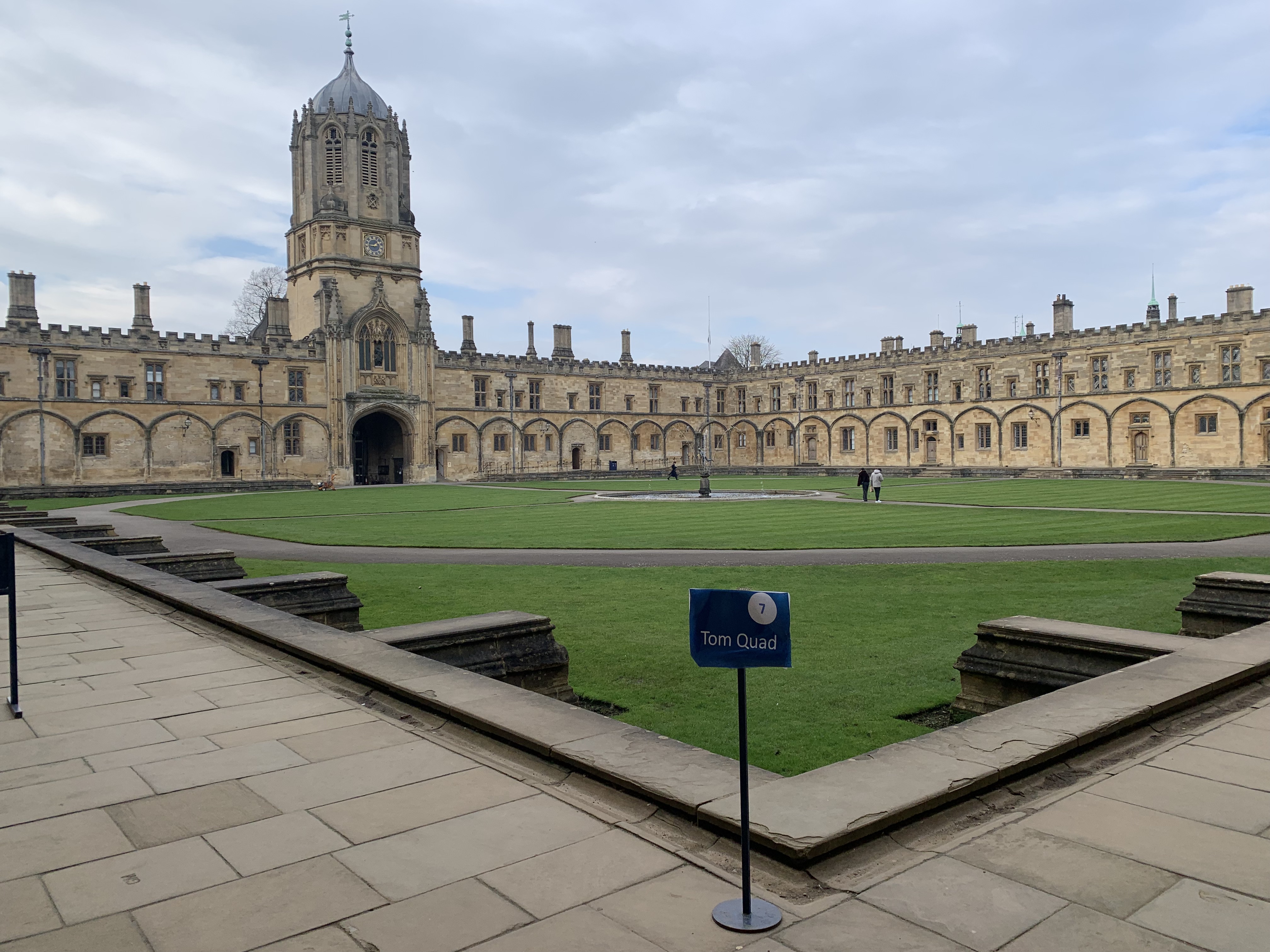
Yes, you can visit some colleges, but be sure the one you want to visit is open to visitors. Days and times vary. We visited Christ Church College, still a functioning church, as well as a college, and the seat of the Bishop of Oxford.


I could go on about things to see and do in Oxford, so I will! Another treasure is the Bodleian Library, begun in 1320 in the University Church of St Mary the Virgin. The church is still used for meetings, and over the centuries the library has expanded again and again. The original books are still there and are still in use by scholars since 1602. These days the library accepts every book printed in the UK and has for several centuries. At present, the library holds 13 million printed items. Besides the books, the architecture is magnificent, and something to see, inside and out. Also of note is the Divinity School is a part of the library.


Time to talk about a couple of museums, of which the Ashmolean is the most noted and most popular.  There you’ll find both an astounding array of art and archaeology. Surprised you’ll find the Ashmolean was founded by Elias Ashmole and donated to the University of Oxford in 1677? As you know by now, like Rome, Oxford University was not built in a day! Let me give you a taste of what you’ll find in this museum: The death mask of Oliver Cromwell and an Arab ceremonial robe owned by Lawrence of Arbia. The museum is right across the street from the Randolph Hotel.


From the front of the Ashmolean looking toward the Randolph Hotel


Another museum you don’t want to miss is the Pitt Rivers Museum. Filled with curiosities from countries and civilizations around the world.  You’ll find arts, crafts, weapons, ships and other startling things from tribes and areas of the world you never knew existed.  Take my word for it, this is not a hurry-up situation! I was astounded by the unique ways people have found to murder and slaughter fellow humans! Also, if you think tribes of Native Americans and those on every other continent lived quietly and in peace, think again.


After a day of walking, exploring and visiting pubs, it’s time to sit and rest in comfort. You’ll want to settle in at the five star Randolph Hotel. I just showed you a picture above. 


Too expensive? We paid $250 per night for a lovely room and a wonderful bar called The Morse Bar, from the Morse novels by Norman Colin Dexter and the TV series.  I could spend every evening in that bar, whether or not I chose to try out quality alcohol of every persuasion, served by wonderfully dressed bartenders, who treat you as though you were of the rich and famous.


The hotel opened in 1866 and has been refurbished along the many years, but still manages to keep the feel of elegance.  Your mission, should you decide to accept it, is to pull yourself away from the fantastic bar long enough to treat yourself and your loved one or at least someone to a high tea in one of the hotel’s lovely dining rooms. “Would you care to have another cup of glorious tea My Lady, or perhaps some dainty finger sandwiches and macaroons and other splendid sweets?”


Yes, I’m sure you would say yes, and then perhaps a flute of champagne? 


You’ll find there is more to England than London, although that too is special. Wonderful cities and ancient villages call the traveler and among the best of the best is the ancient university of Oxford.  Don’t race through it. Give yourself time to settle in and make yourself a slave to elegance and history and a new way of life. Oxford!


Things I didn’t mention that are worth a mention:


How to get there?  Ask at any kiosk or at the Heathrow Airport bus terminal for the bus to Oxford. Tickets cost about $30 to $40.  There is a bus that leaves every 20 minutes and in about 1 hour and 30 minutes drops you off in downtown Oxford.


If you're going from Oxford to London, there's another bus.


The Martyrs Monument (across the street from the Randolph Hotel):  https://en.wikipedia.org/wiki/Martyrs%27_Memorial,_Oxford


The Ivy, splendid for breakfast, lunch, or dinner


The Eagle and Child, the most famous pub in Oxford will reopen in 2027. 


Friday, March 29, 2019

Four Great English Pubs

Blackfriars Pub


Four Great English Pubs

I’ve often written about one of the great English institutions, the pub.  Few towns don’t have one and the cities are clustered with them.

Those unacquainted with the institution will immediately comment:  a pub is just another name for a bar.  Oh, how wrong you are!   Something you must do immediately is buy a plane ticket to London.  But, first read a few of my scribblings and acquaint yourself with what you’ve been missing.  After that, the necessity for a London trip will flash in bold print at the top of your mental list of things to do before you’re too old to drink.
London Pubs:


Oxford Pubs:


That’s enough to give you a glimpse of what’s to come.  Now for a couple of misconceptions I need to clear up. FIRSTLY, a pub is not a bar, it’s a place of comfort for social gatherings and a social leveler.  Men in suits and men in scruff of paint splattered pullovers and scuffed boots sit side by side to calmly sip a pint. Ladies of a certain age, dressed to the nines, may be at one table, while young things with tattoos and piercings may be at the table beside them. In a society known for levels of social order, the pub offers freedom in its clearest form.

As I saw on a sign in one pub:  Beer isn’t a matter of life and death.  It’s far more important than that!

A pub has a certain homey feeling, as though you’re sharing drinks and telling lies in a private club that anyone can join.

Now, about the beer:  I prefer the hand pulled variety, straight from the cask.  For my taste buds, it’s smoother and more flavorful.  British beers are neither flat, nor warm.  Casks are stored in the cellar, where it is always between 50 and 60 degree Fahrenheit, and when the beer is brewed, a natural fermentation and carbonation occurs, giving the beer a very light head when served.  Not the very fizzy carbonation of most German and American beers.  Brit beers go down smoothly, with an abundance of flavor.  Alcohol content is roughly 3.5 to 5.5%.

Now that we’ve gotten the preliminaries squared away, allow me to introduce you to four wonderful pubs: In London, BlackfriarsThe George, and The Footman.  In St. Alban’s,Ye Olde Fighting Cocks.

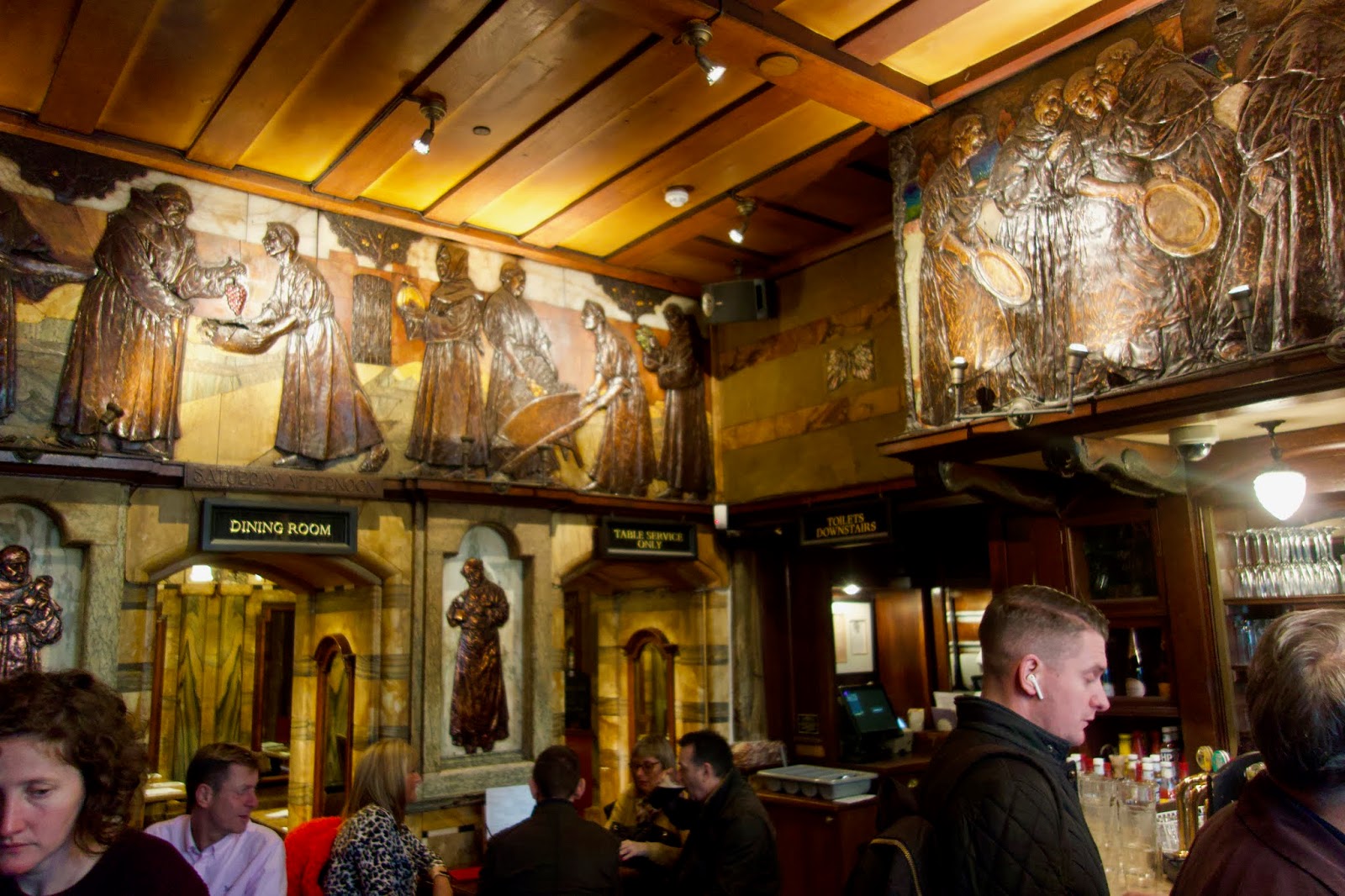
Blackfriars: One of London’s oldest pubs and certainly its interior is the most striking, with a profusion of marble, tiles, and large bronze bas-reliefs of monks doing their chores.  In short, from history and interior, it’s unique.


By the way, another misconception, this one in the English language, is that unique can be modified, as in very unique, or most unique.  Au contraire, mon ami, unique cannot be modified for the simple reason that it means one of a kind.  If something is one of a kind, it cannot be the most one of a kind.  There are other words like this, but let’s get back to Blackfriars.

Although it dates only from 1875, it was built on the grounds of a former Dominican friary (Dominican monks wear black cloaks).  Above the bar,  the monks are fishing and the accompanying saying is: Tomorrow will be Friday. At the entrance to the grotto, there’s another relief titled:  Saturday afternoon, with a portrayal of monks gardening. Dominicans are also called The Order of Preachers and the order dates to 1213.

Some other pithy saying accompanying other monks on other walls:  Don’t advertise, tell a gossip, with monks doing wash.   A good thing is soon snatched up, depicting monks carrying a trussed pig.  Another pithy saying is:  Haste is slow.
Now you know more than most of the patrons, so settle in, let the atmosphere penetrate and enjoy a pint….make that two.

The George: Be careful, there’s more than one The George, but the one you seek is London’s last surviving galleried coaching inn, in Southwark, near Boroughs Market. First mentioned in 1543 and rebuilt after the fire of 1677, it was also known as an inn-yard theatre, where Elizabethan theatrical productions were performed.  Not known if Shakespeare performed here, but we do know Charles Dickens stopped in for a coffee on several occasions, and included it in one of his novels, Little Dorrit.


Do grab a copy of a Charles Dickens novel and settle in for an afternoon of soaking in the atmosphere….or getting soaked in this atmosphere.  See, that’s another thing about an English pub.  You can grab yourself a pint and fritter away the time in dreams of greatness, for as long as you want.  Read.  Write. Draw. Let your imagination rip!

The ground floor is divided into three parts. The Parliament Bar was a waiting room for coach passengers, and the Middle Bar was a coffee room.  Upstairs is a restaurant.  Only half the Inn remains.  The gallery that faced the remaining part of the building was torn down to make room for a railroad warehouse. 

We went to Boroughs Market right before we ambled to The George.  We may have even stopped at another pub. Could have happened. 

You dare not miss the Boroughs Market.  It’s a stroll and eat affair.  Fresh oysters, salted beef sandwiches, best salted caramel ice cream I’ve ever lapped from a cone, and a huge variety of ethic food stands.  But, at the end of it, a man must have his pint! 

The Footman: Located in the Mayfair, in one of the most upscale areas in London, The Footman has a long history, dating to 1749 and has thrived under a long list of names to include The Running Horse, The Running Footman, and I Am the Last Running Footman, by which it was known when I first visited in the 1980s. So, what is or was a running footman? Those of the English wealthy class had any number of servants and lived in fine mansions and were driven places in luxurious carriages.  A running footman’s job was to run ahead of the coach, to pay tolls, and clear the way, which in old London was essential.  To tell the truth, new London is worse.  Traffic has only increased, now that even the drinking class has a horseless carriage.  Come to think of it, there are probably as many chauffeurs now as there were running footmen back then.


It was quiet when we visited; in fact, we got our pints, chatted with the friendly barkeeper, and pretty much had time to sit at the window facing the street and slosh beer as we watched a parade of Rolls Royces and Bentleys and a few Ferraris arrogantly drive by. Porches didn’t merit a second glance.  They really didn’t belong here.

Which brings us to Ye Olde Fighting Cocks, in St Albans, about 20 minutes by train from Paddington Station.  Why go there?  First off, Ye Olde Fighting Cocks is reputed to be the oldest pub in England.  I say ‘reputed’ because several pubs make that claim.


Reputed is a strange word. Does it come in a singular form. If the pub was reputed to be the oldest, did someone repute it? Anyway, this one’s only solid date is 1756.  But oldest or not, it’s well worth a visit. And, if you’re tall, prepare to duck and weave.  The old blackened beams overhead are a threat to anyone over six feet.  Also, it’s a country pub, which is a wonderful difference from spending the day dashing through the streets of London, dodging cars and cabs as you try to remember whether to look left or right when crossing.  If it had been a sunny day and a mite warmer, we would have parked ourselves outside.

We also made the pub a lunch stop and the food was excellent.  Not quite totally English, but my taste buds came from a family of serfs, and they begged for a burger and fries.  I tried to resist, but now that the taste buds were free, they did what they wanted.


St Albans

Much more to see in St Albans.  I found an antique shop and bought a lovely 19thCentury, cut glass pitcher for $20.  Try and do that in London.  On Wednesdays and Saturdays, St Alban’s has an open market.  And near Ye Olde Fighting Cocks is a huge park, which was once the site of the third largest Roman city in Britain.  Many of the old walls remain.  As you tour Europe, you quickly see why the history books refer to The Roman Empire and damn well mean it!

The park and site of the Roman city


Are you getting an inkling of why I like pubs so much?  Fabulous beer, yes, but also history and literature and markets and adventure. Pubs bring life to life!


Thursday, August 23, 2018

Stonehenge


Stonehenge

As both my faithful readers know, I’ve written about the ancient history of Britain.  The Celts owned it.  The Romans owned it. The Vikings owned it.  With the successful invasion of William the Conqueror (1066) the French owned it.  That may be a bit of an overstatement, since William (known as William the Bastard by his French foes) was not the King of France, but the powerful Duke of Normandy.  Still, the English court soon spoke nothing but French and the English language still reflects it. Also, those who spoke despairingly of William the Conqueror’s parentage soon lay decomposing in the cold ground.

Ok, good thumbnail  review, yes?  For something more thorough check these blog entries:

But, now let’s move back a few millennium and talk about the rocks on Salisbury Plain., a couple of hours by bus from London. Before even the Celts, another race or ethnicity or other PC vernacular came along, the Neolithic people lived all around the British Isles.  This was some 5000 years ago. Yes, even before your parents were born, kiddies. 

You’re probably mumbling, “Wonderful news for historians and archeologists, but what’s this pile of rocks got to do with me? “ You’re right. Go back to your video games.  For the rest of us, who enjoy mysteries and are fascinated by the world around us, and how the human species evolved, there are plenty of reasons.

Better tell you how Neolithic people fit in.  Stone age right?  Mainly no.  Stone age was the Paleolithic period, some 2.5 million years ago and Homo sapiens was only one of the species of humanoids and the only one that survived into the Neolithic Period.  The Neolithic Period is often called The Cradle of Civilization. Homo Sapiens began cultivating crops and animals.  The groups or tribes began to congregate.  When did this happen?  About 10,500 to 8000 years ago, put nobody can put a date on it.  The Stone Age morphed into the copper age and the bronze age and the iron age, but at different rates around the world, mainly Europe, East Asia, and the Middle East.  Technology was on a roll.  Houses. Pottery.  Metallurgy.  But, the roll was a slow roll.  In many parts of the world, South America and Australia for example, languished in Pre-History (unwritten history) until the arrival of Europeans.  In the case of Australia, there was no written language until the late 18th Century.

Now let’s move on to the world’s most famous circle of rocks, circa 2500 B.C.

Mysteries abound.  Who exactly were these people who built Stonehenge?  Why did they disappear?  How did they live? What’s important about Stonehenge?  With a visit you’ll find some answers, but also discover mysteries that still linger.  The most important mystery is:  Did they drink beer?

You can see the burial mounds and feasting mounds in the distance. 
One of the burial cylinders near the circle of stones.

I called these folks Neolithic, but scientists figure they lived at the cusp between the Stone Age and the bronze age.  These aren’t guesses.  Burial mounds surround the Salisbury Plain, many in sight of the famous stones.  Ancient people left numerous artifacts with their dead.

Archeologists found evidence of what the people ate.
Other spots apparently were used for feasts and celebrations and prove a treasure trove of cooking pots, old animal bones and skins, giving an insight into what the people ate, what clothes they wore and which things were important to them.  But, the ancient people give up their secrets slowly.  Every year the explorers of these remnants are able to tell us more.

What examination of the feasts sites is unable to tell us is if the ancients drank beer.  Well, dang, Honey, you call that a feast?  One thing we do know is that these people were lactose intolerant, but pots that once contained dairy products lead historians to believe milk was used to make milk derivations, such as butter, cheese, and yogurt.  How do they know this?  Caulk it up to microbiological examinations of pots.

Lots of misinformation about Stonehenge. Just one example:  For a hundred years or more, it was thought Stonehenge was a place for Druid ceremonies.  Problem is, the Druids lived in the centuries after the common era (CE or AD), some 2500 years after Stonehenge was built.  Still the idea persists.

How about the arrangement of the stones and where did the stones come from and how did they get where they are?


The construction appears to have taken about 1500 years, beginning with a big circle likely used for ceremonies involving burials.  I’m painting with a broad brush here, folks.  The stones were set in place between 2500 and 1500 BCE/BC.


Based on the types of stones, they came from Wales, some of them were moved over 150 miles.  Two types of stones, bluestones and sandstones.  Hard to see any blue in the bluestones, but I’m told when it rains there’s a blue tint.


As for the arrangement of the stones, archeologists and historians go with the theory that the arrangement is metrological, with the sun at sunrise shining over one stone at dead center and dead center through another stone exactly at the summer and winter solstice.


The summer solstice occurs on 20- 22 June, the longest day of the year, and the winter solstice occurs on 21- 22 December, the shortest day. Variations depend on time zones and where you live in the world.  Here’s a converter:  https://www.timeanddate.com/calendar/seasons.html

Now your know more than 99% of the people who visit this wonderful Pre-history.   Time for a beer!