 |
| Blackfriars Pub |

Four Great English Pubs
I’ve often written about one of the great English institutions, the pub. Few towns don’t have one and the cities are clustered with them.
Those unacquainted with the institution will immediately comment: a pub is just another name for a bar. Oh, how wrong you are! Something you must do immediately is buy a plane ticket to London. But, first read a few of my scribblings and acquaint yourself with what you’ve been missing. After that, the necessity for a London trip will flash in bold print at the top of your mental list of things to do before you’re too old to drink.
London Pubs:
Oxford Pubs:
Another London Pub: https://stroudallover.blogspot.com/2017/01/the-prospect-of-whitby-odd-name-great.html
That’s enough to give you a glimpse of what’s to come. Now for a couple of misconceptions I need to clear up. FIRSTLY, a pub is not a bar, it’s a place of comfort for social gatherings and a social leveler. Men in suits and men in scruff of paint splattered pullovers and scuffed boots sit side by side to calmly sip a pint. Ladies of a certain age, dressed to the nines, may be at one table, while young things with tattoos and piercings may be at the table beside them. In a society known for levels of social order, the pub offers freedom in its clearest form.
As I saw on a sign in one pub: Beer isn’t a matter of life and death. It’s far more important than that!
A pub has a certain homey feeling, as though you’re sharing drinks and telling lies in a private club that anyone can join.
Now, about the beer: I prefer the hand pulled variety, straight from the cask. For my taste buds, it’s smoother and more flavorful. British beers are neither flat, nor warm. Casks are stored in the cellar, where it is always between 50 and 60 degree Fahrenheit, and when the beer is brewed, a natural fermentation and carbonation occurs, giving the beer a very light head when served. Not the very fizzy carbonation of most German and American beers. Brit beers go down smoothly, with an abundance of flavor. Alcohol content is roughly 3.5 to 5.5%.
Now that we’ve gotten the preliminaries squared away, allow me to introduce you to four wonderful pubs: In London, Blackfriars, The George, and The Footman. In St. Alban’s,Ye Olde Fighting Cocks.
Blackfriars: One of London’s oldest pubs and certainly its interior is the most striking, with a profusion of marble, tiles, and large bronze bas-reliefs of monks doing their chores. In short, from history and interior, it’s unique.

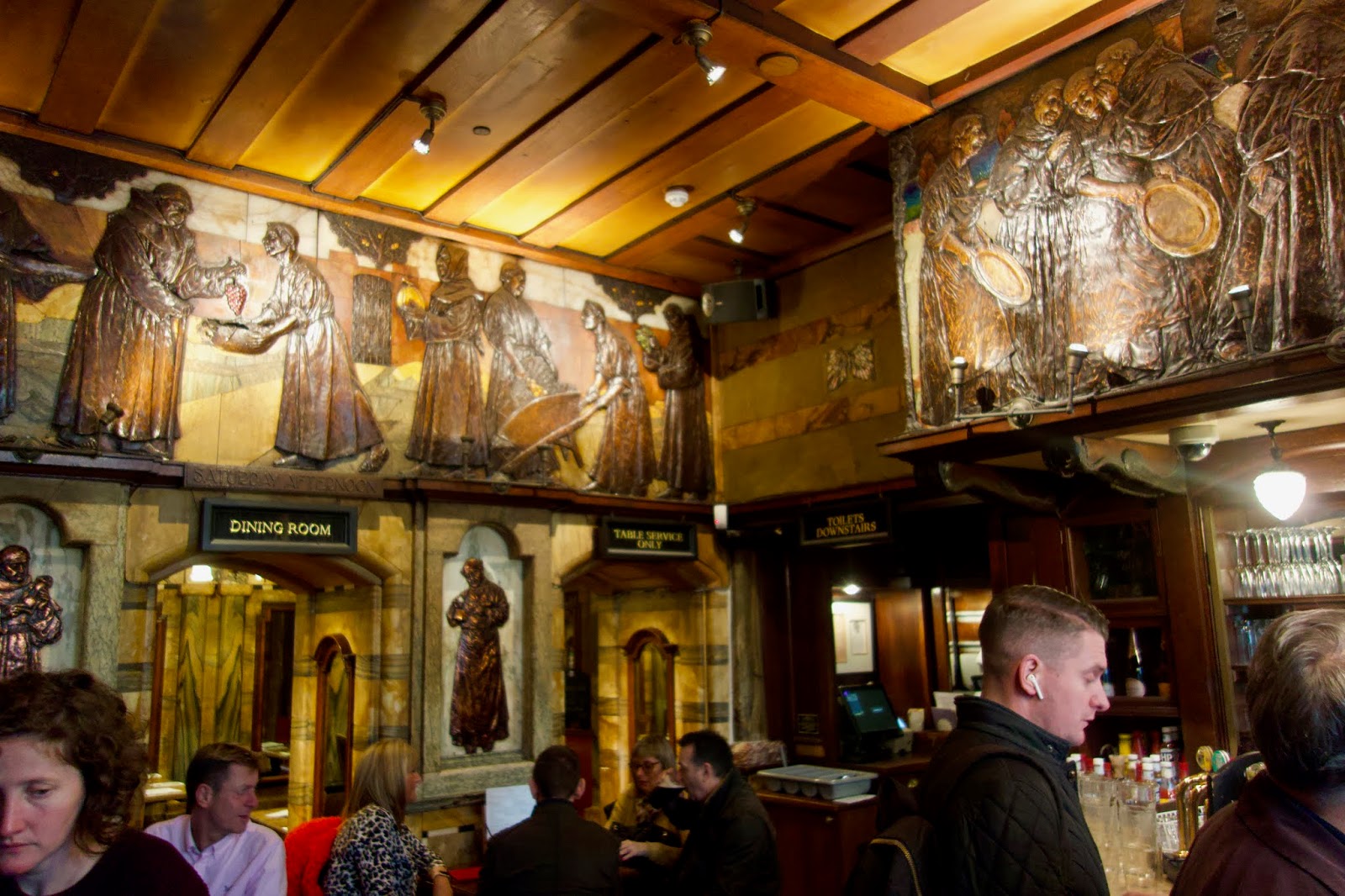

By the way, another misconception, this one in the English language, is that unique can be modified, as in very unique, or most unique. Au contraire, mon ami, unique cannot be modified for the simple reason that it means one of a kind. If something is one of a kind, it cannot be the most one of a kind. There are other words like this, but let’s get back to Blackfriars.
Although it dates only from 1875, it was built on the grounds of a former Dominican friary (Dominican monks wear black cloaks). Above the bar, the monks are fishing and the accompanying saying is: Tomorrow will be Friday. At the entrance to the grotto, there’s another relief titled: Saturday afternoon, with a portrayal of monks gardening. Dominicans are also called The Order of Preachers and the order dates to 1213.
Some other pithy saying accompanying other monks on other walls: Don’t advertise, tell a gossip, with monks doing wash. A good thing is soon snatched up, depicting monks carrying a trussed pig. Another pithy saying is: Haste is slow.
Now you know more than most of the patrons, so settle in, let the atmosphere penetrate and enjoy a pint….make that two.
The George: Be careful, there’s more than one The George, but the one you seek is London’s last surviving galleried coaching inn, in Southwark, near Boroughs Market. First mentioned in 1543 and rebuilt after the fire of 1677, it was also known as an inn-yard theatre, where Elizabethan theatrical productions were performed. Not known if Shakespeare performed here, but we do know Charles Dickens stopped in for a coffee on several occasions, and included it in one of his novels, Little Dorrit.


Do grab a copy of a Charles Dickens novel and settle in for an afternoon of soaking in the atmosphere….or getting soaked in this atmosphere. See, that’s another thing about an English pub. You can grab yourself a pint and fritter away the time in dreams of greatness, for as long as you want. Read. Write. Draw. Let your imagination rip!
The ground floor is divided into three parts. The Parliament Bar was a waiting room for coach passengers, and the Middle Bar was a coffee room. Upstairs is a restaurant. Only half the Inn remains. The gallery that faced the remaining part of the building was torn down to make room for a railroad warehouse.
We went to Boroughs Market right before we ambled to The George. We may have even stopped at another pub. Could have happened.
You dare not miss the Boroughs Market. It’s a stroll and eat affair. Fresh oysters, salted beef sandwiches, best salted caramel ice cream I’ve ever lapped from a cone, and a huge variety of ethic food stands. But, at the end of it, a man must have his pint!
The Footman: Located in the Mayfair, in one of the most upscale areas in London, The Footman has a long history, dating to 1749 and has thrived under a long list of names to include The Running Horse, The Running Footman, and I Am the Last Running Footman, by which it was known when I first visited in the 1980s. So, what is or was a running footman? Those of the English wealthy class had any number of servants and lived in fine mansions and were driven places in luxurious carriages. A running footman’s job was to run ahead of the coach, to pay tolls, and clear the way, which in old London was essential. To tell the truth, new London is worse. Traffic has only increased, now that even the drinking class has a horseless carriage. Come to think of it, there are probably as many chauffeurs now as there were running footmen back then.


It was quiet when we visited; in fact, we got our pints, chatted with the friendly barkeeper, and pretty much had time to sit at the window facing the street and slosh beer as we watched a parade of Rolls Royces and Bentleys and a few Ferraris arrogantly drive by. Porches didn’t merit a second glance. They really didn’t belong here.
Which brings us to Ye Olde Fighting Cocks, in St Albans, about 20 minutes by train from Paddington Station. Why go there? First off, Ye Olde Fighting Cocks is reputed to be the oldest pub in England. I say ‘reputed’ because several pubs make that claim.


Reputed is a strange word. Does it come in a singular form. If the pub was reputed to be the oldest, did someone repute it? Anyway, this one’s only solid date is 1756. But oldest or not, it’s well worth a visit. And, if you’re tall, prepare to duck and weave. The old blackened beams overhead are a threat to anyone over six feet. Also, it’s a country pub, which is a wonderful difference from spending the day dashing through the streets of London, dodging cars and cabs as you try to remember whether to look left or right when crossing. If it had been a sunny day and a mite warmer, we would have parked ourselves outside.
We also made the pub a lunch stop and the food was excellent. Not quite totally English, but my taste buds came from a family of serfs, and they begged for a burger and fries. I tried to resist, but now that the taste buds were free, they did what they wanted.


 |
| St Albans |
Much more to see in St Albans. I found an antique shop and bought a lovely 19thCentury, cut glass pitcher for $20. Try and do that in London. On Wednesdays and Saturdays, St Alban’s has an open market. And near Ye Olde Fighting Cocks is a huge park, which was once the site of the third largest Roman city in Britain. Many of the old walls remain. As you tour Europe, you quickly see why the history books refer to The Roman Empire and damn well mean it!
 |
| The park and site of the Roman city |

Are you getting an inkling of why I like pubs so much? Fabulous beer, yes, but also history and literature and markets and adventure. Pubs bring life to life!


