Showing posts with label Black and White photos. Show all posts

Thursday, August 25, 2022

Charleston in Black and White


Charleston in Black and White


I’d wager all three of my faithful readers have been to Charleston, South Carolina.  All who have visited this lovely old city already know you can’t absorb the sense of it or savor it, or feel out each cobbled street or plumb its secrets in one day or one week, or even in a year.  


On my last trip I took a barrage of photos, but in this very short portrait of Charleston in Black and White, I don’t attempt the impossible. I only offer seeing Charleston at a glance. Thinking you can get a taste of the Holy City would be akin to dining once in Paris and supposing you can fathom the intricacies of French cuisine. Julia Child would laugh in your face.


Before we get to the photos, let’s take a short stroll through Charleston’s history


Charleston dates back to well before the American Revolution, when Charles II of England ceded all the land south of Virginia to eight nobles, know as the Lords Proprietors.   I’m not going to name them all, but some names you’d remember, such as Lord Anthony Ashley Cooper, Ashley and Cooper now being the names of the two rivers that frame the peninsula that contains the oldest part of the city.  I’ve included photos of several houses that are on the tip of the peninsula known as The Battery. Some date back to the Revolution, but sadly I do not know the ages of each.


As you might guess, Charleston, once known as Charles Town, has layer after layer of dusty history.  Along with New York and New Jersey, South Carolina had the most major battles of the Revolutionary War and from 1780 to 1783 was occupied by the British Army.


As a side note:  There is the Royal Navy and the Royal Air Force, but the British army is simply the British Army.


Back in the days of yore, decades after the War for Independence, Charleston thrived, mostly agriculturally with crops of indigo and rice, and then with the biggest crop of all, cotton.  All were dependent on slave labor.


The War of 1812 bypassed Charleston in terms of battles, but South Carolina did supply men and material


And as the federal government expanded its powers, one South Carolinian leapt into the thick of the politics of the central government versus states rights, John Caldwell Calhoun.  He was the Vice President under two presidents, John Quincy Adams and Andrew Jackson.  He also served as Secretary of State under President John Tyler.  Without going into details, Calhoun fought hard for Southern institutions, including slavery.  (You might want to read about the Nullification Crisis and the Compromise of 1820.)


Within a couple of decades, the Civil War erupted (also known as the War Between the States…and in the south, as The War of Northern Aggression).  It was Charleston where the first shots of the war were fired at the federally manned Fort Sumter in the middle of Charleston Harbor.


Sometimes I find history is more digestible on a personal and fictional level.  For the Civil war, The Red Badge of Courage, by Stephen Crane, and for the French Revolution, A Tale of Two Cities, by Charles Dickens. For Charleston’s history, check out Charleston, by John Jakes.


Enough blather, maybe?  Time for you to see what I saw on my recent trip to the wonderfully historic city of Charleston, South Carolina.


A Wonderful Coffee House


Graveyard near St Phillip's Church


These houses are all in the area called The Battery


Sunday, June 21, 2020

Photography and Culture

A French woman shopping

Photography and Culture

Living and traveling in Europe opened my eyes to photography, and my simple mind, not only to new experiences, but to different cultures. What the natives may have found ordinary, I found extraordinary and exciting.  That included not only the objects and places that are magnets for tourists, but the everyday life of the people and how they lived.

For one thing, unlike the ripped clothes and flip-flops, in a style that I term homeless chic, the Europeans dress much more nicely. Both women and men care how they look. In Paris, a friend and I strolled past a group of seven or eight young men, sipping wine and chatting.  My friend whispered, “All of them could have been straight out of GQ!”  She was spot on.

The Italians can’t talk with their hands in their pockets.  The French tend not to smile, but drink lots of wine.  Doesn’t mean they’re not polite. While shopping for cheese and vegetables and sausages in a large market in Metz, France, I regretfully left my cheese purchase behind on the counter.  Several lengthy corridors connected the vast market, each corridor lined with booths.  After I’d strolled perhaps a hundred yards, stopping to shop along the way, a woman came running up to me with my package of carefully wrapped cheese.  “Monsieur, perhaps you have forgotten this.”  She said it very politely, but without ever breaking a smile. 

Until you get to know them, Germans are as formally correct as bankers  who don’t want to loan you money, and prefer quart sized glass mugs of beer.  Southern Europeans kiss and hug a lot, even meeting casually.  Germans and the English, never.  It simply is not done.

But some things the Europeans have in common. In every country in Europe, dining is taken seriously and the wait staff is always correctly and properly trained. They are polite and efficient, but understand you didn’t come in their restaurant to make a best friend for life.

Socially, not very often do you see people sitting together glued to their mobile phones.  Although I did see a young couple in an elegant café in London doing just that.  They weren’t dressed that well either. My first thought was, “They must be Americans.”

Europeans converse.  Meals are not mere acts of plunging food into their open maws, with each bite large enough to feed a family of four.  Meals are opportunities to socially engage.

Yes, you can find all that in America, but from what I’ve seen it’s much more rare.  Can you imagine holding a dinner party where the women all wear dresses and the men wear sports coats?  Alas, we Americans have fallen into the depths of inelegance and worship at the temples of raggedy clothes and super-sized fast food.

So, yes, I found Europe excitingly different and grew to love meeting friends for wine in quaint cafés where conversation was the object and no one would be caught dead in flip-flops.

I hope my array of black and white photos allow you to see what I saw. 


Italian fashions


Wall poster in Bari, Italy


Traffic in London


A rainy day in Metz, France


Ordering at the Red Oxen in Heidelberg, Germany


French conversation.


Elegance is always sexy, truly sexy.


Outdoor café in Colmar, France


Even a petit déjeuner at a sidewalk café is served with style.


Thursday, April 30, 2020

Back to Black & White Part III


Book shop at The Royal Academy of Arts, London

Back to Black & White Part III

In my first article on B & W, I gave you a link to introduce you to the Golden Ratio, but just in case you spent most of your time cleaning the house, pouring whiskey, and trimming your petunias, I’ll give you a VERY brief executive summary.  See, I know my three faithful readers very well, and if you’re not yet in that distinguished circle, please don’t forget to subscribe!


Back to the Golden Ratio.  Fun to know about because it’s everywhere in nature.  Most commonly called the Fibonacci Spiral, it a ratio of 1.68 to 1, I’m sure you’re seen it in the spiral of seashells and fiddle head ferns, among other places.


But the ratio doesn't have to be a spiral.  A ratio is a ratio.  Check out your arm.  Inside elbow to wrist is about 1.68 the distance and wrist to fingertip is 1.  It’s a ratio all manner of artists have used for centuries.  Why?   The ratio directs the eye and makes art of every sort more interesting. Here’s an example of a famous photo by Henri Cartier Bresson.


More often, photographers use the 3 thirds method of sitting up a shot, but the golden ratio is used by the pros, so you may want to give it a try.

Now, let’s take a look at more of my Black and White photos, including one I took of a staircase in St. Paul’s Cathedral in London.  St. Paul’s, as most of you know, was designed by Britain’s most famous architect, Sir Christopher Wren. (1632-1723, Astronomer, arcthectict, mathematician, anatomist, physicist.)

St Paul's, London


Beaune, France


Daunt Books, London


Brussels, Belgium


Pickering Place, London, once known as Stroud's Court


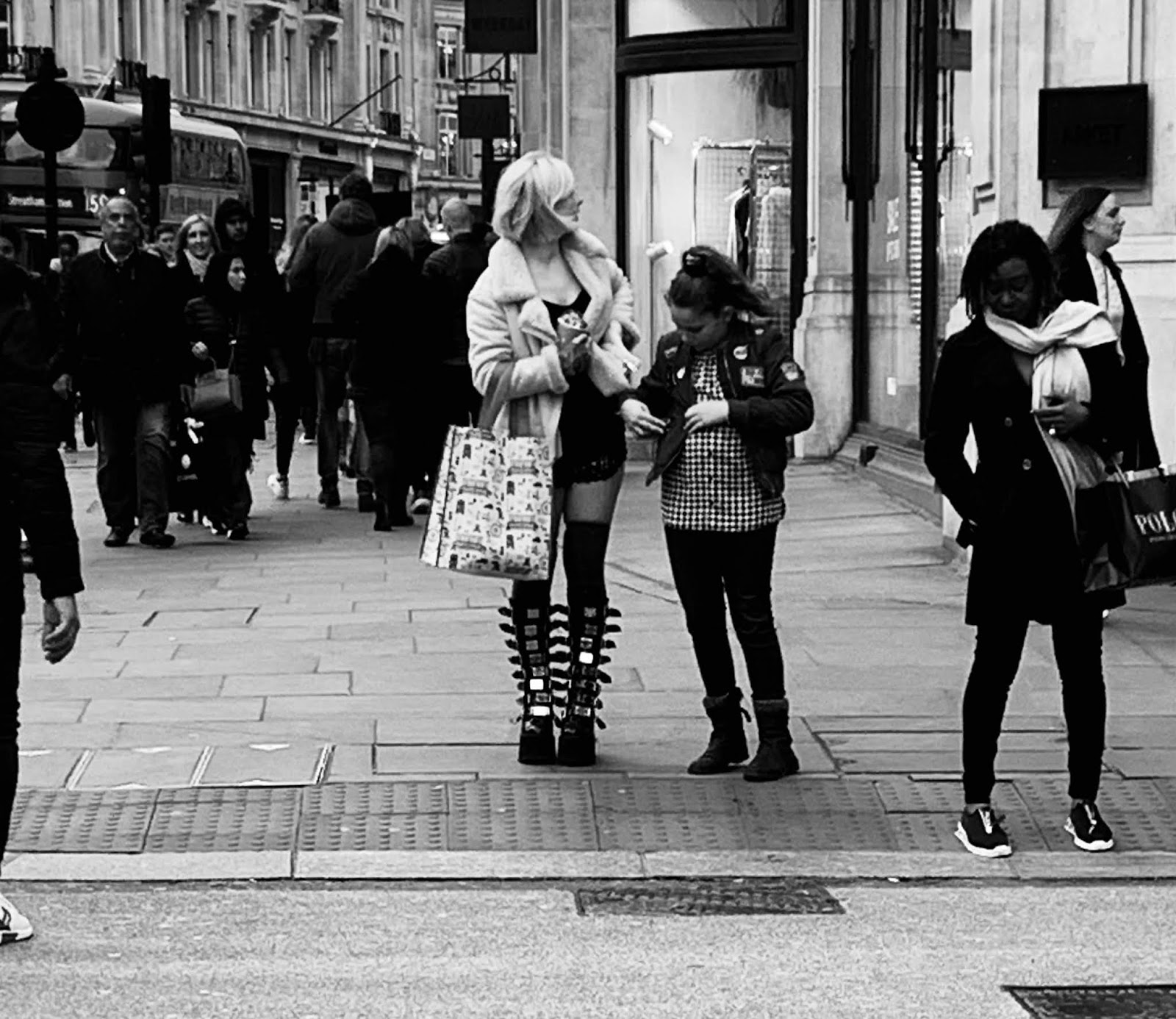
Oxford Street, London


Hope you enjoyed seeing the photos and enjoyed the drama on my efforts at black and white photography. 

Want to read and see more? Travel. Recipes. Short fiction. Poetry. History.  Subscribe!