Showing posts with label Charleston South Carolina. Show all posts

Wednesday, August 31, 2022

Charleston by John Jakes


Charleston by John Jakes


John Jakes is well respected for his books and especially for his wonderful talent for telling a good story.  You may remember his famous trilogy, The North and The South, which is not only a terrific book, but was made into an outstanding TV series.


His writing style is so very personal, peering into the lives of friends and families, with twists and turns that draw you into the chasms of history and make you love some family members and despise others.  Charleston is such a book.  Plots and schemes abound, touching on the good and bad nature of man.  Can’t have a good book without villains, but also with good people who do bad things, and others doing good things that lead to the dark edges of both good and evil.


I get to Charleston fairly often, and walk the streets hearing names and seeing places that give me pause, as if I should know more, just can only peck at pieces of incomplete knowledge.  You can’t really know a city until the names of streets and areas mean something to you, otherwise you’re just another blank-brained tourist, snapping photos, going to a restaurant someone told you about, passing building and homes that look old.


I was on a tour, years ago, and not in Charleston, when the tour guide pointed out the window of the bus and called out, “Out the left side, you’ll see an old church. You might want to take a picture.”  Oh, goody.


Did you know the first shots of the Civil War were fired at the Federal fort, Fort Sumter, that still sits in Charleston Harbor?  You do?  Good for you. Maybe you even visited the fort. Even better. (Several places claim to be from where the first shots were fired and who fired them.)


But, John Jakes’ book dives much deeper, beginning with the colonial days and the birth of the United States and how Charleston was captured and Red Coats roamed the streets and made the laws and how Charleston had both rebels and British loyalist citizens.  How was the city run under British occupation?


And moving along by the decades, what about slavery?  Were there many slave holders and what kind of compromises keep the states together before leading to secession?  Historical figures play a prominent role, but so do the fictional families that walked separate side of those same sidewalks you’re walking now, looking for some iced tea and shrimp and grits.


Many things are touched on that lead us right into today’s headlines.  Charleston has had many rough times and been occupied by very unfriendly forces, yet the country and the city and the state and the people somehow survived.


Charleston is one of our nation’s oldest cities and one of the most fascinating.  How it all worked out through times of glory and strife, or if it did, and how it did, is intertwined with fiction and history, by the heroic scope of John Jakes’ novel, Charleston.  A bit over five hundred pages, I was glued to every page, happy and angry and hopeful.  Took me only four days to finish this fabulous tale of a wonderful city.  And, by the way, I’m not the world’s fastest reader!

Thursday, August 25, 2022

Charleston in Black and White


Charleston in Black and White


I’d wager all three of my faithful readers have been to Charleston, South Carolina.  All who have visited this lovely old city already know you can’t absorb the sense of it or savor it, or feel out each cobbled street or plumb its secrets in one day or one week, or even in a year.  


On my last trip I took a barrage of photos, but in this very short portrait of Charleston in Black and White, I don’t attempt the impossible. I only offer seeing Charleston at a glance. Thinking you can get a taste of the Holy City would be akin to dining once in Paris and supposing you can fathom the intricacies of French cuisine. Julia Child would laugh in your face.


Before we get to the photos, let’s take a short stroll through Charleston’s history


Charleston dates back to well before the American Revolution, when Charles II of England ceded all the land south of Virginia to eight nobles, know as the Lords Proprietors.   I’m not going to name them all, but some names you’d remember, such as Lord Anthony Ashley Cooper, Ashley and Cooper now being the names of the two rivers that frame the peninsula that contains the oldest part of the city.  I’ve included photos of several houses that are on the tip of the peninsula known as The Battery. Some date back to the Revolution, but sadly I do not know the ages of each.


As you might guess, Charleston, once known as Charles Town, has layer after layer of dusty history.  Along with New York and New Jersey, South Carolina had the most major battles of the Revolutionary War and from 1780 to 1783 was occupied by the British Army.


As a side note:  There is the Royal Navy and the Royal Air Force, but the British army is simply the British Army.


Back in the days of yore, decades after the War for Independence, Charleston thrived, mostly agriculturally with crops of indigo and rice, and then with the biggest crop of all, cotton.  All were dependent on slave labor.


The War of 1812 bypassed Charleston in terms of battles, but South Carolina did supply men and material


And as the federal government expanded its powers, one South Carolinian leapt into the thick of the politics of the central government versus states rights, John Caldwell Calhoun.  He was the Vice President under two presidents, John Quincy Adams and Andrew Jackson.  He also served as Secretary of State under President John Tyler.  Without going into details, Calhoun fought hard for Southern institutions, including slavery.  (You might want to read about the Nullification Crisis and the Compromise of 1820.)


Within a couple of decades, the Civil War erupted (also known as the War Between the States…and in the south, as The War of Northern Aggression).  It was Charleston where the first shots of the war were fired at the federally manned Fort Sumter in the middle of Charleston Harbor.


Sometimes I find history is more digestible on a personal and fictional level.  For the Civil war, The Red Badge of Courage, by Stephen Crane, and for the French Revolution, A Tale of Two Cities, by Charles Dickens. For Charleston’s history, check out Charleston, by John Jakes.


Enough blather, maybe?  Time for you to see what I saw on my recent trip to the wonderfully historic city of Charleston, South Carolina.


A Wonderful Coffee House


Graveyard near St Phillip's Church


These houses are all in the area called The Battery


Saturday, November 28, 2020

Charleston's 39 Rue de Jean


I was excited to escape the daily routine and get back to Charleston, South Carolina, one of my favorite cities.  Charleston is filled to the brim with a fascinating history, from the founding of the United States to the present, along with fabulous architecture, seaside scenery, old markets, plantations, and mouthwatering restaurants. 


I’ve been going to this city for the best part of fifty years and eaten in both the upper crust, coat and tie establishments, and the smoke-filled-sawdust-on-the-floor barbecue joints.  And as my three faithful readers know, I’ve written about several of them in this blog.


Lately, when I visited the Holy City…wait a sec, holy city?  Oh, I know you’re begging for some details, and answering that question is a good start.


Charleston was established in 1680 (by Royal Charter of King Charles II) and moved to its present downtown location in 1783.  The old site is still well marked, and about a couple of miles north.


Since its founding, Charleston’s been known for its tolerance for all religions and boasts many historic churches to prove the point.  The most famous of which is The Huguenot Church, founded by French Protestants who fled France when Louis XIV revoked the Edit of Nantes and revived the persecutions of non-Catholics.  Matter of fact, it’s the only Huguenot church in the U.S. and still uses the French liturgy, but in English.


With a French religious flavor, it’s only natural that one of the best restaurants in this well-preserved old city has a French name, 39 Rue de Jean.  As you may guess, it is located at 39 John Street.   If you don’t feel like guessing, it’s still at 39 John Street.


But, more than a French name, 39 Rue de Jean has an atmosphere that rivals that of restaurants in another of America’s French influenced cities, New Orleans.


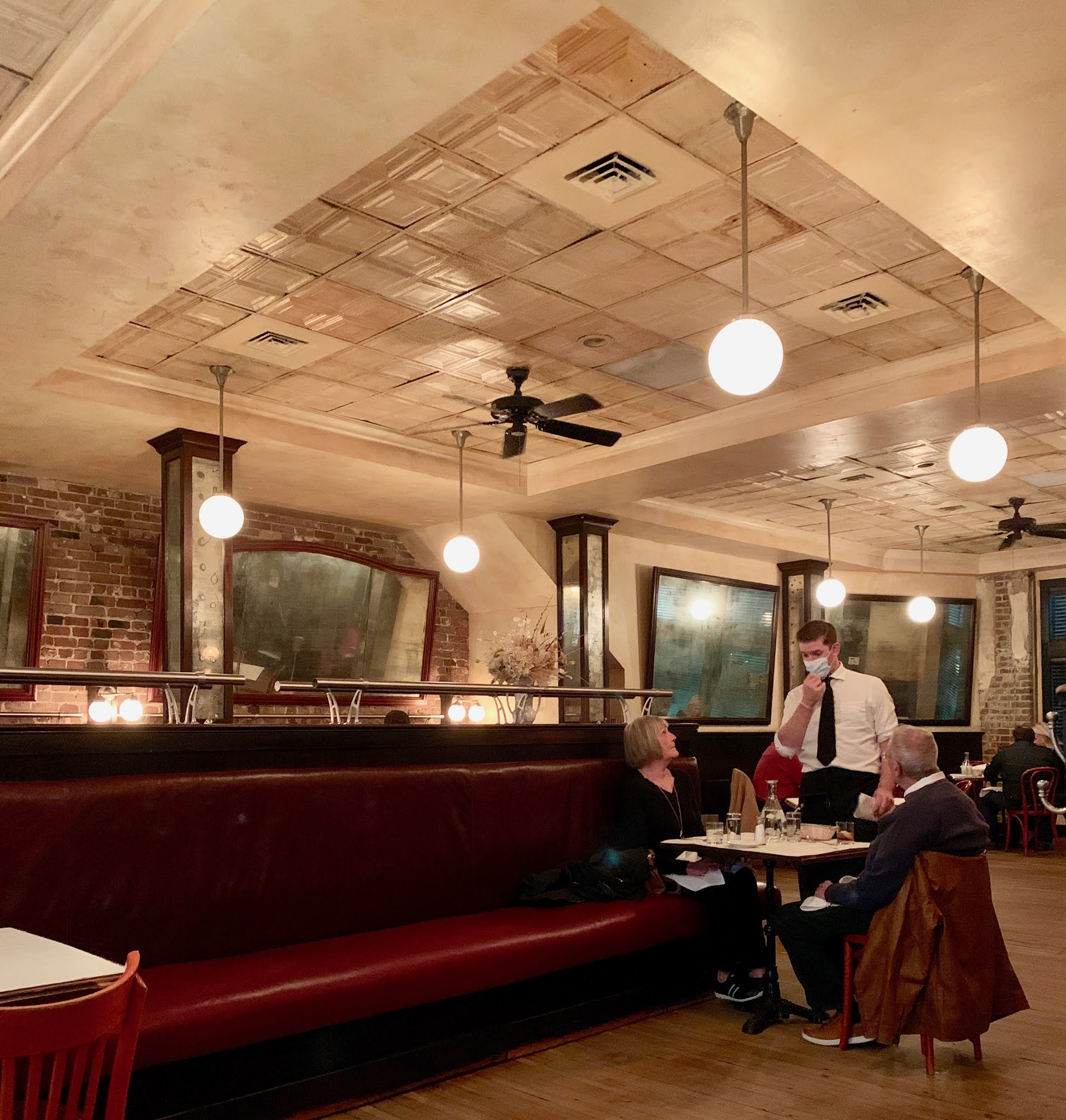
Large, 18th or 19th century mirrors line the walls, chairs at the tables have a French café flair, the bar is gloriously dark and long, and best of all, the menu is a compilation of delicious French fare.


I admit to being something of a secret snob.  My companion differs.  “Not so secret,” she says.


Well, ok, I admit it, if being a snob means appreciating a well-trained, polite wait staff, dressed in traditional black and white, and who know the details of everything on the menu.  And, perhaps I should mention bartenders who mix from scratch, know how flavors fit together, and in my case, know how to make an excellent Manhattan, served straight up in a delightfully chilled martini glass.


Ok, you’ve gotten the French ambiance of modulated voices, lowered lighting, antique, tinned ceilings, and a wonderful wait staff.  Now it is time to speak of the reason we came to this fine establishment: the menu.  Firstly, we shared a plate of Hunters Gnocchi, featuring house made duck fat gnocchi, rabbit sausage, wild mushrooms, goat cheese, and arugula, all afloat in a buttery wine sauce.  


For the main course, I opt …(yes op is present tense and opt is past tense, despite what the bad news bearers of horrid English proclaim)… for a nearly fork tender, Angus steak with a mound of herbed butter, and crisp frites on the side, along with a delightful glass of pinot noir.


My dinner companion and designated chauffeur ordered trout almandine in brown butter, covered with gently fried almonds, and served over a soft potato purée and crisply tender haricot verts (green beans) on the side.  And, of course, no French meal would be a meal without a fresh baguette, although in the American style, fresh butter was also offered.


Ok, buddy, you thinking, you’ve impressed us with your uncompromising command of French, tossing out words like rue and Jean, and them hardy cut beans.  But, how about the taste!


I judge the excellent meal thusly:  if I walk away saying to myself, mighty chef that you are, you couldn’t have done better at home, then it was an excellent meal.  This meal was excellent!  And added to that, the French ambiance, a worthy Manhattan, and superb waiter, Aaron, made this a special evening.  To top it off, we shared a Lemon Cream Torte with strawberry coulis.


And of course we finished with an espresso.


Bientôt encore j’espère! Or, in gooder English, Damn I wanna do this again!


Monday, October 29, 2018

Edmund's Oast Brewing Company


Charleston is just above the name, Atlantic Ocean

Lots more to do in Charleston than drink beer....at least I think so.


Edmond Oast's Brewing Company

Breweries used to be huge conglomerations of steamy buildings, that cast the odor of hops and barley like a thin fog.  Picture trucks rolling in and out laden with aluminum kegs, brick walls and heavy metal gates. It’s still that way for the big boys.  Want a beer, don’t knock on a brewery door; go find a bar or a pub. Still true for the largest brewers.

But these days a city may have a half dozen or more micro brewers and brew pubs, that brew and sell right on the premises.   I’ve been to a dozen or more and never found a bad one, unless you count those few who insist on blasting music, with a backbeat loud enough to rearrange your circadian rhythm.

This is the golden age of beer!  Step into a micro brewery or brewpub and you’ll find ten to twenty (or more) different kinds of beer, all of them on tap.  I.P.A. (India Pale Ale) is the current fav of the youthful multitudes. Not mine.  I’m a solid friend of the smooth, the subtle, the tasty, without the bitter grind of hops found in the I.P.A.s.  Where to find such a brew.  Short answer:  England.

But, now I have another answer:  Charleston, South Carolina at the Edmund’s Oast Brewing Company.   Under South Carolina law brewpubs cannot sell beer outside their four walls.  But breweries fall under a different law that allows for more expansion. I saw cans of Edmond’s Oast, Lord Proprietors Mild at Whole Foods, which is what first led me to The E.O Brewery.  Edmund’s Oast does both, with two two locations, a restaurant and the brewery. The restaurant (called simply Edmund’s Oast) wasn’t open when we schemed to slake our thirst, but Edmund’s Oast Brewing Company opened at 11 o’clock and what’s brunch without a brew?  Off we went to 1505 King Street Extension and stepped into a high ceilinged warehouse of a brewery, with at least 30 to 40 taps and Old Puffery, a 4% English style ale that’s poured straight from the cask. At 4%, it’s smooth as glass and something any Englishman would be proud of.  Cool. Clean. Very little fizz.


Speaking of Englishmen, the first name of the brewery (and restaurant) comes from Edmund Egan, an English brewer who came to America in the 1760s and continued to ply his trade successfully to the extent that he gave monetary support to those who fought the British.  He became known as “The Rebel Brewer.”

How about the second part of the name?  Oast is evidently an old English word for an oven used to dry hops.  I say ‘evidently’ because I outlandishly plagiarized without doing my own research.

The Mild is more than mildly addictive

So what other brews do they offer?  The Lord Proprietor’s Mild is my favorite and I admit to downing a full pint, then coming back the next day for a pint and a third day as well.  Rich and deeply golden, Mild is 3.5% alcohol and goes down as smoothly as a newlywed’s negligee.  Here’s another secret about The L. P.’s Mild.  It’s brewed with tea from Charleston’s (and the nation’s) only tea plantation.


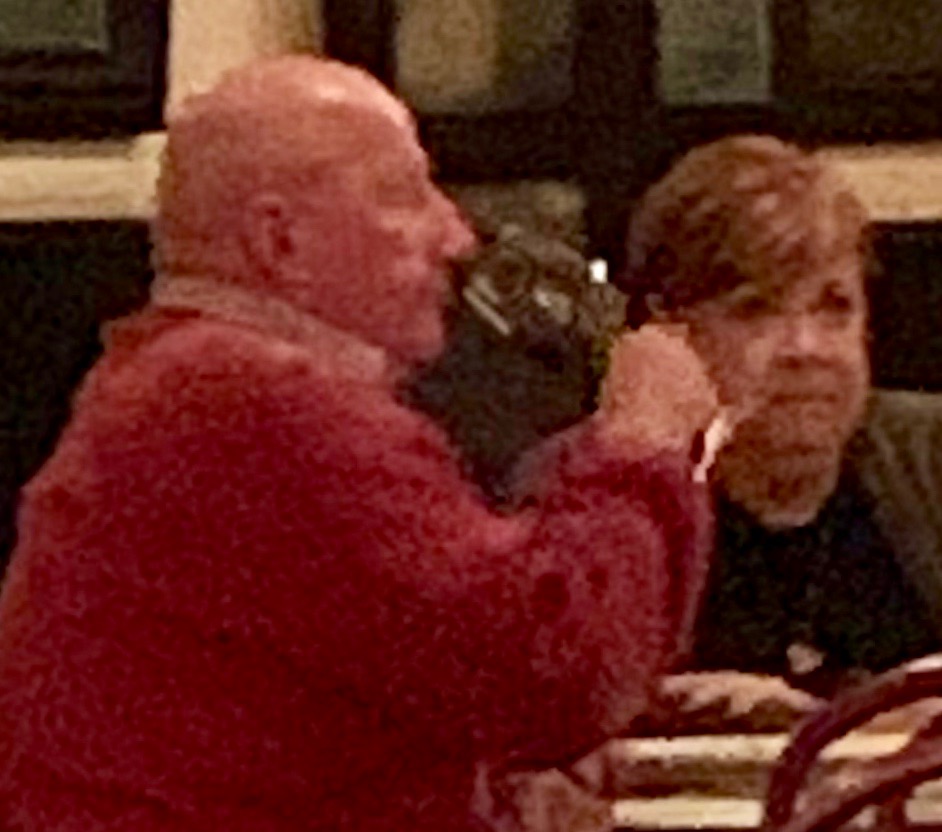
But even with fine beers and an atmosphere that makes you stamp your feet and scream like a wildcat for another pint, a pub is not a pub without barkeeps that know their stuff and can chat for hours about brewing and flavors.    Let me drop a few names:  Jocelyn (above left), a dark haired lass who can quote scripture and verse on every aspect of the brewer’s art, and David who knows as much as Jocelyn but doesn’t have her smile, which could sell a thousand kegs before you finish your first pint. Nicole (behind David) is also right in there, a cute sprite of a lass, whose smile and demeanor catches your attention immediately. These three, along with some others, will answer your questions, taking shoptalk to the level of an art form.

It’s no wonder my companion (also an Anglophile) and I came back three days in a row.


The dress is casual and yet, even in this industrial style venue, it’s definitely a ladies’ and gentlemen’s place to come and converse and tip a wonderful pint or two.  The selection of brews is so enormous I will show you a photo of the chalkboard menu, without even attempting to name each brew.


Does Edmund’s Oast Brewing Company also serve food.  Yes indeed. A stone pizza oven sits in the background and I know first hand the fries are crunchily delicious!  But, boys and girls, I came for the beer.  Three times.


And the next time I’m in Charleston….


Wednesday, November 1, 2017

Rutledge Cab Co. Charleston, SC


Time for some Americana.  Yes, I am still American, even though I live in Europe and I love BBQ joints and burger joints. 


But, let’s make a distinction. There are burger joints and then there are special burger joints.  The Rutledge Cab Co snuggles neatly into the second category.  I was there on a packed Monday night for a half priced burger. First time, but I’ll go back.  


Huge, crowded bar, but well stocked and quick service. Couple of guys eating at the bar offered to slide down and make room.  It was that kind of group.   Fairly long wait for a table, that with the milling crowd and everybody sipping, I had some interesting conversations with some new close friends and waitstaff who were interested that I was interested.  Always nice to meet people who are enthusiastic about what they do.

“So do your enjoy waiting tables?”

Bright smile, nice pony tail.  “Yessss!  It’s so much fun! I’d work here for free!”

“Well, good.  I’ll remember not to leave a tip.”

“I’ll remember not to put in your order.”

Followed by much laughter and a wink.   

Makes me wonder what it’s like on a normal night when the beef burgers are ten bucks.  No matter, I would pay full price for a thick burger, cooked medium and stacked with lettuce, tomato and onion on a soft bun, accompanied by thin, crispy fries.


Find a good burger joint and you’ve found the heart of America.  Older, well-dressed men and women.  Ripped jeans and tattooed youngsters who punctuate every other word with ‘like.’  Every ethnicity.  Everybody smiling and chatting.  Don't’ believe all the bullshit in news. It’s America! How can you not like it?


Here’s the web site, so you an check out the full menu.  http://rutledgecabco.com/


Friendly crowd.  Friendly wait staff.  Friendly is good in my book.  And the food is delicious.