I was excited to escape the daily routine and get back to Charleston, South Carolina, one of my favorite cities. Charleston is filled to the brim with a fascinating history, from the founding of the United States to the present, along with fabulous architecture, seaside scenery, old markets, plantations, and mouthwatering restaurants.
I’ve been going to this city for the best part of fifty years and eaten in both the upper crust, coat and tie establishments, and the smoke-filled-sawdust-on-the-floor barbecue joints. And as my three faithful readers know, I’ve written about several of them in this blog.
Lately, when I visited the Holy City…wait a sec, holy city? Oh, I know you’re begging for some details, and answering that question is a good start.
Charleston was established in 1680 (by Royal Charter of King Charles II) and moved to its present downtown location in 1783. The old site is still well marked, and about a couple of miles north.
Since its founding, Charleston’s been known for its tolerance for all religions and boasts many historic churches to prove the point. The most famous of which is The Huguenot Church, founded by French Protestants who fled France when Louis XIV revoked the Edit of Nantes and revived the persecutions of non-Catholics. Matter of fact, it’s the only Huguenot church in the U.S. and still uses the French liturgy, but in English.
With a French religious flavor, it’s only natural that one of the best restaurants in this well-preserved old city has a French name, 39 Rue de Jean. As you may guess, it is located at 39 John Street. If you don’t feel like guessing, it’s still at 39 John Street.
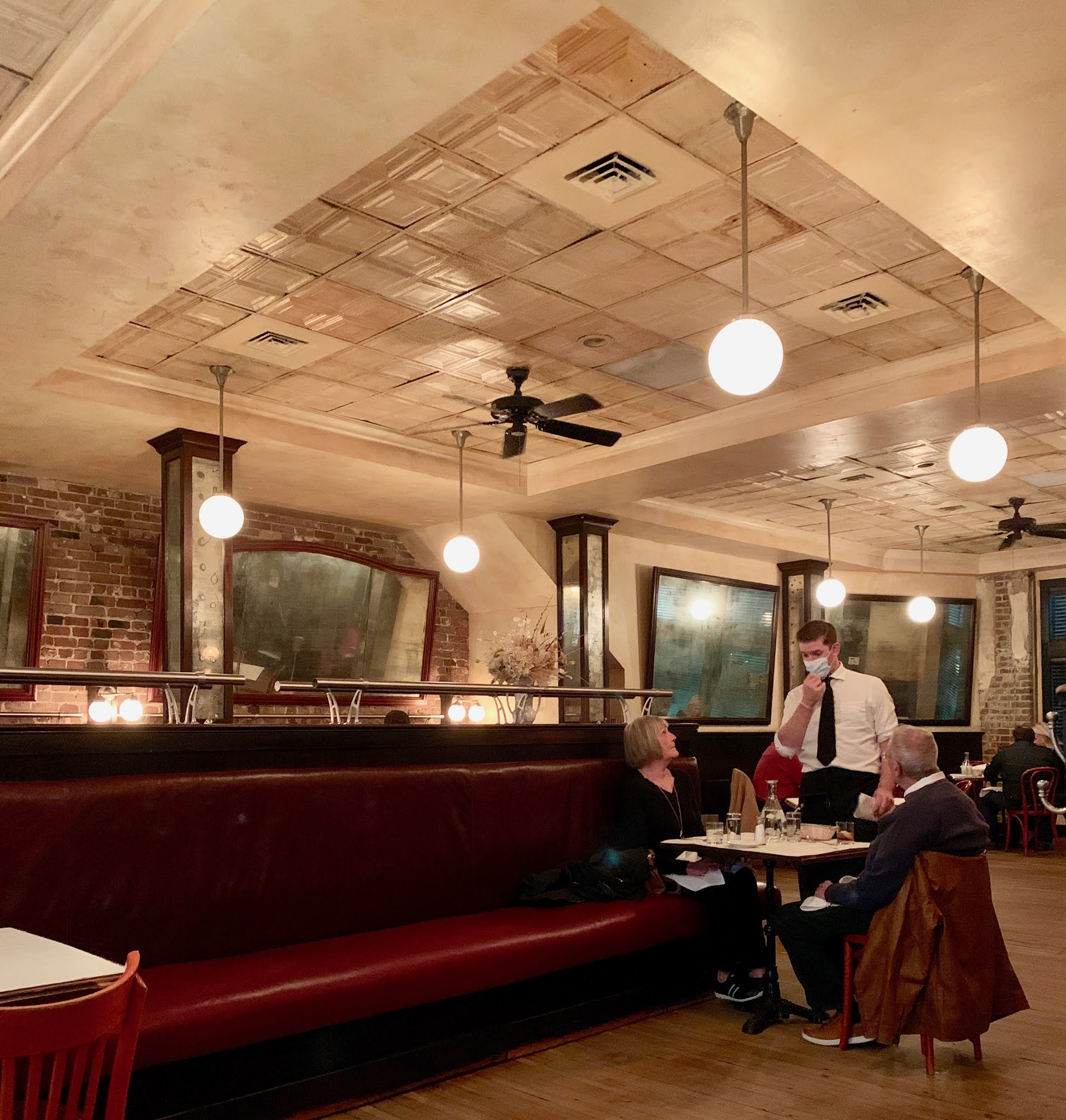
But, more than a French name, 39 Rue de Jean has an atmosphere that rivals that of restaurants in another of America’s French influenced cities, New Orleans.


Large, 18th or 19th century mirrors line the walls, chairs at the tables have a French café flair, the bar is gloriously dark and long, and best of all, the menu is a compilation of delicious French fare.

I admit to being something of a secret snob. My companion differs. “Not so secret,” she says.
Well, ok, I admit it, if being a snob means appreciating a well-trained, polite wait staff, dressed in traditional black and white, and who know the details of everything on the menu. And, perhaps I should mention bartenders who mix from scratch, know how flavors fit together, and in my case, know how to make an excellent Manhattan, served straight up in a delightfully chilled martini glass.


Ok, you’ve gotten the French ambiance of modulated voices, lowered lighting, antique, tinned ceilings, and a wonderful wait staff. Now it is time to speak of the reason we came to this fine establishment: the menu. Firstly, we shared a plate of Hunters Gnocchi, featuring house made duck fat gnocchi, rabbit sausage, wild mushrooms, goat cheese, and arugula, all afloat in a buttery wine sauce.

For the main course, I opt …(yes op is present tense and opt is past tense, despite what the bad news bearers of horrid English proclaim)… for a nearly fork tender, Angus steak with a mound of herbed butter, and crisp frites on the side, along with a delightful glass of pinot noir.


My dinner companion and designated chauffeur ordered trout almandine in brown butter, covered with gently fried almonds, and served over a soft potato purée and crisply tender haricot verts (green beans) on the side. And, of course, no French meal would be a meal without a fresh baguette, although in the American style, fresh butter was also offered.

Ok, buddy, you thinking, you’ve impressed us with your uncompromising command of French, tossing out words like rue and Jean, and them hardy cut beans. But, how about the taste!
I judge the excellent meal thusly: if I walk away saying to myself, mighty chef that you are, you couldn’t have done better at home, then it was an excellent meal. This meal was excellent! And added to that, the French ambiance, a worthy Manhattan, and superb waiter, Aaron, made this a special evening. To top it off, we shared a Lemon Cream Torte with strawberry coulis.

And of course we finished with an espresso.

Bientôt encore j’espère! Or, in gooder English, Damn I wanna do this again!