Showing posts with label Herculaneum. Show all posts

Friday, November 29, 2019

Naples and the Best Pizza Ever!


                            Naples and the Best Pizza Ever!

When you wander the streets of Naples, you never know what’s going to turn up.  Not saying you should take a pass on such historic sites, as Pompeii and Herculaneum.  And as all three of my faithful readers know, I’ve written about both. 


BUT, neither should you neglect a stroll through both the wide avenues and narrow alleys.   On a recent trip, we stopped for a gelato in Naples’s famous Galleria, a palace of a place in the heart of the shopping area. 


Not quite true.  I had a gelato.  My companion had a chocolate martini.   There-in lies one of the glories of Europe.  Sit down at a wonderful gelato parlor and sip a chocolate martini and nobody bats an eye nor offers a discouraging glance.  Europeans view alcoholic beverages as savory delights to make the afternoon sparkle.  Americans often view them as a shameful participation in a mind-altering dance with Satan and all his henchmen.

In fact, Americans tend to be more guilt-ridden in general.  But, we were in Italy, so sinfulness took to the wing and bothered us not at all, while I gobbled gelato and my companion cheerfully sipped her delightful gift from the twin gods of chocolate and alcohol.

After that it was more strolling and a bit of shopping and staring at the artistic and architectural features of this grand city.

By mid afternoon, hunger raged within us.  We left the major areas and turned down a narrow street filled with neighborhood shops of every sort.  Hardware shops with windows filled with power tools, and electrical shops that had flashing light bulbs, and household shops packed with brooms and buckets spilling out onto the street. We were no longer in downtown Tourist-ville.


As we walked uphill, a very thin man approached us sporting old shorts, a loose shirt, a straw teardown hat, a five-day stubble, and carrying a menu.  He suggested vociferously that we eat at his friend’s restaurant.  Well, why not?  So we followed him up a block and turned a corner onto an even narrower street.  On the corner was a tiny place, with three tables on a fenced-in porch.  We were barely separated from the well-worn and well-traveled street.

The thin man disappeared and a waiter suddenly appeared.  His name was Vincenzo, which was a good start.   So Italian!  V stood about five feet tall, had a beautiful smile and welcomed us in perfect English.

“So, Vincenzo, where did you learn to speak English?”

“I lived in Miami for six years.”  Immediately followed by,  “May I offer you a little something to start and perhaps a bottle of wine?”

Knowing nothing about native Neapolitan wines, we went with Vincenzo’s suggestion.  First sip of this white wine made me think I’d made an error. Then the appetizer arrived, small plates of pasta, dressed simply with chips of roasted tomato and bits of garlic.  Delicious!  And what was more, the wine was a perfect accompaniment!


What would we think about some fresh sardines?  Hey, bring ‘em on!  V walked the five paces across the street to the neighborhood fishmonger’s.  From our table we watched the fresh catch transfer from fishmonger to Vincenzo.  


Within ten minutes we had freshly fried sardines in front of us, with a simple pizza margarita and more pasta on the way.  If you haven’t tried them, freshly fried sardines, with a squeeze of ripe lemon are crunchily delicious. You eat them head and bones included.


As soon as we’d finished, Vincenzo arrived almost immediately with the rest of our meal.  The pasta was similar to the appetizer and also just as delicious.  BUT, the pizza was the star of the show!  Naples is known as the home of pizza, so we expected a very good pie, but this was better than good…far better, with only four ingredients on top of the crispy edged crust…. fresh tomato sauce, cheese, basil leaves and a light olive oil.  Simple is often best and it was the best pizza either of us had ever tasted.  No other pizza, before or after has come close to the delicacy Vincenzo brought us.


For one thing, fresh ingredients are always better and with fresh tomatoes, there’s no need to add dried herbs, or garlic, or anything else.  For another thing, only a stone oven, with the pizza in the middle, surrounded by a hot wood fire, brings out the best of a hand made crust.  By design, the dough is baked unevenly, just barely done in the center, but charred on the edges.  You simply cannot duplicate this in a conventional oven any more than you can duplicate pit barbeque without the pit.

Some months later, I still think about that pizza with reverence and passion. 

So, I hope you’ve learned my lesson:  Walk the back streets, listen to the thin man in shorts, and when the Italian waiter selects your wine, go with it!  And, if you’re in Naples, don’t be afraid to sip a chocolate martini for breakfast and later stop in at a tiny restaurant that serves pizza!


Tuesday, September 24, 2019

Back a Couple of Thousand Years: Herculaneum


Our excursion to Naples took us to Herculaneum, another of the cities destroyed by the eruption of Mount Vesuvius in 79 A.D.  Unlike Pompeii, which is more or less out in the countryside and some two-thirds uncovered, Herculaneum is in the middle of a suburb of Naples, only about twenty minutes by van from the center.  Which brings us to the most startling difference:  The archeological dig of Herculaneum is surrounded by modern, populated apartment buildings stacked like building blocks.  Directly under those apartment buildings is more of the ancient city, yet to be discovered.


Not entirely surrounded by apartments.  This view faces the sea.

Standing at the edge of a deep hole, you gaze about ninety feet into a huge pit and see the ruins of the stone city.  A long, wide ramp leads you down.


Interesting why there’s such a difference in elevations. I’m not an archeologist, just a star struck gazer of antiquities, so forgive me for painting with broad brush strokes, very possibly mishandling expert phrasing, and glossing over important points.  In a word, the difference in elevations is mud. 

Time for an explanation.  Pompeii was much nearer Vesuvius and during the eruption was pummeled by a destructive showers of stones, some as big or bigger than basketballs.  

The citizens left in Pompeii were pelted and the city smashed.  Even those who found shelter inside their homes had roofs crash down on them. There was no escape. Then came the molten lava, leaving the city entombed for a few hundred years.  Fortunately, most of the population had already read the tea leaves and moved away.  Of 20,000 souls living in Pompeii, only about 2,000 perished. 

Unlike the much larger Pompeii, picture Herculaneum as a seaside resort for the rich. Well prior to the eruption, the wealthy of Herculaneum evacuated, but some staff and merchants stayed and died.  About 300 died along the waterfront and you can still see the skeletons, frozen in their agony.

If not the eruption, what drove the populations of both cities out of town?  In years prior, several earthquakes rattled both cities, but the earthquakes alone didn’t cause the population to flee.  The quakes burst water pipes and left the city without a steady supply of water. 

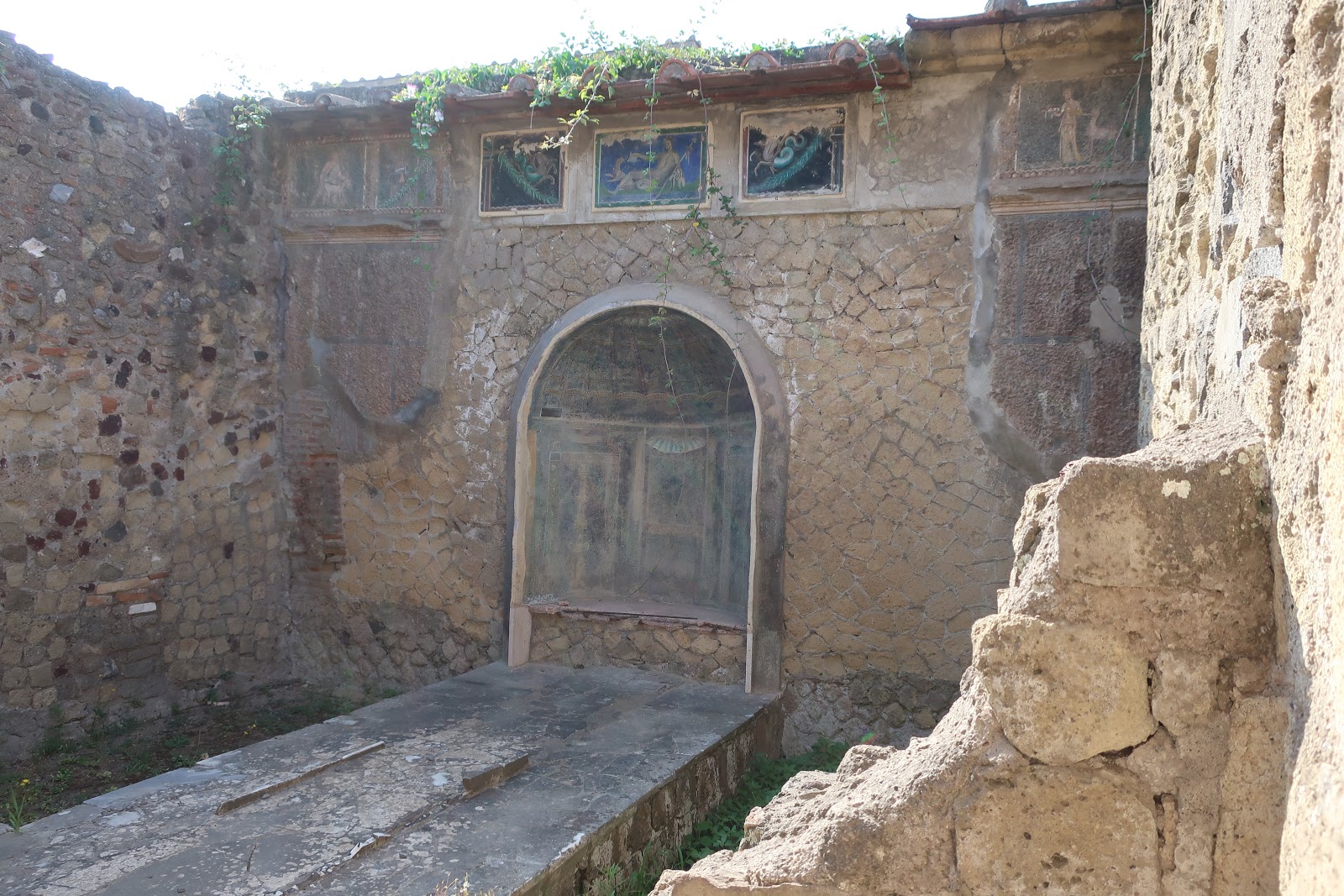
We’ll leave Pompeii for a moment and concentrate on Herculaneum.  Herculaneum was what today we would call a resort town.  Many of the homes were owned by the very wealthy and prior to the eruption the city was at the edge of a cliff, overlooking a beachfront.  Within the stone homes, there were interiors decorated with huge frescos, spacious dining rooms and living rooms, most with open gardens and some with steam rooms.


The city itself had street side shops selling wine and olive oil, fruit and prepared meals.  Under the main streets, ceramic sewer lines carried away wastewater.

The wide set stones allowed rainwater runoff.

The source of the city’s drinking water was some sixty miles away, flowing to Herculaneum via an aqueduct, supplemented with underground cisterns that stored rainwater. 

But, when the niceties and necessities of life disappeared, the rich and most other thirsty people felt the immediate need to leave town.

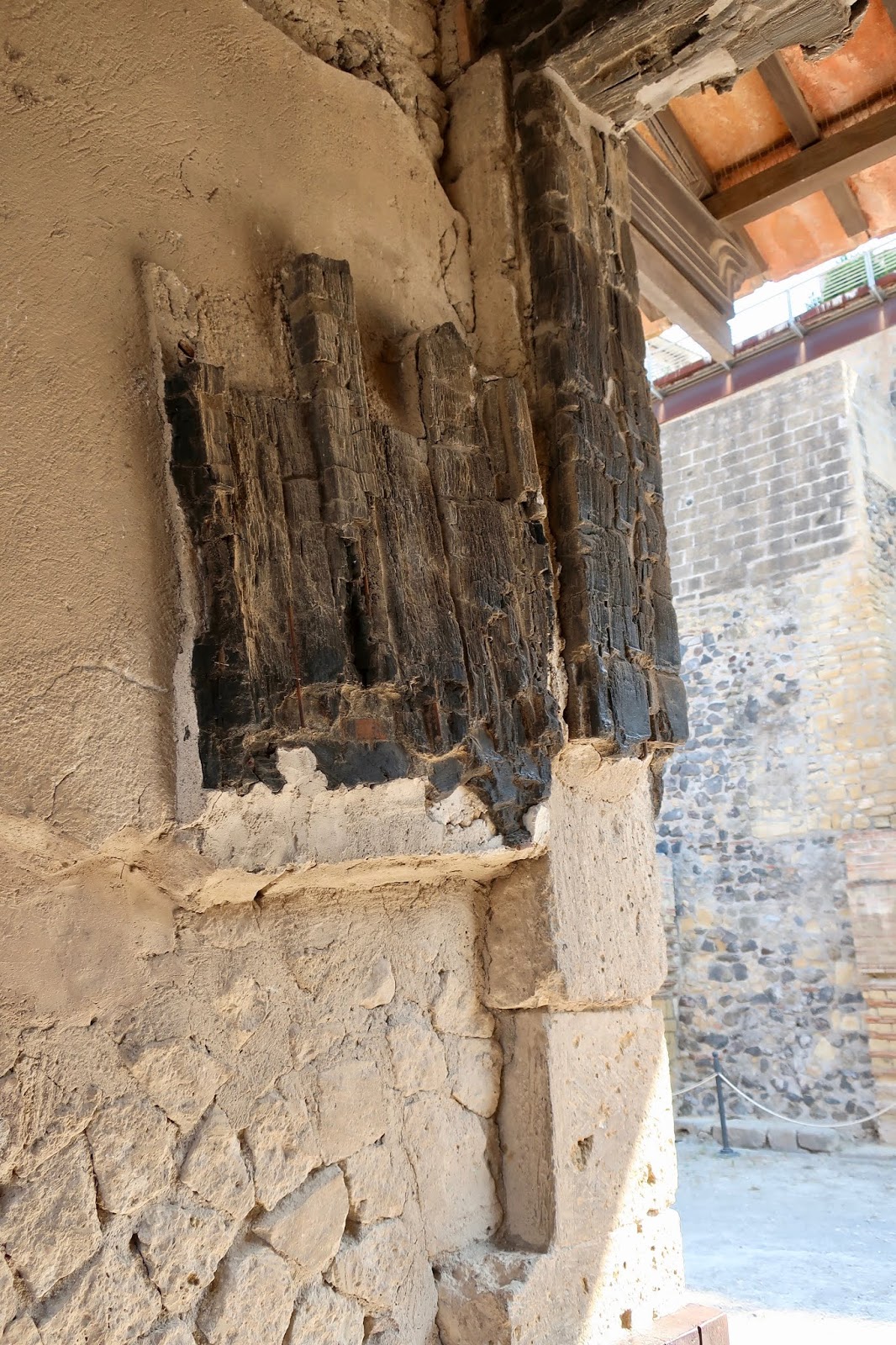
Also, the volcano’s destruction treated Pompeii and Herculaneum differently.  In Herculaneum, winds of up to 60 miles per hour, heated to about 400 degree Fahrenheit, swept the city, killing everyone left and even those on the beach hoping for a last minute rescue.

Some 2000 year old scorched timbers.

Next came a viscous slide of hot mud, combined with stones and earth gathered on it’s way down. Mudslide after mudslide followed.  Not only was the city buried under some 90 feet of mud and debris, but the mud also covered the cliff overlooking the beach and up to a mile into the Mediterranean Sea.

About the excavation:  Herculaneum was re-discovered some ten years prior to Pompeii, both of them in the mid-eighteenth century.  In the case of Herculaneum, a man was digging a well and uncovered antiquities.

Early excavations were haphazardly done by neighbors and fortune seekers looking for valuables.  Then came work ordered by the King of Naples, who also apparently plundered marble and such for his palace.

As you can guess, digging through centuries of mud was no easy task, but easier than digging though centuries of lava rock, as was the case in Pompeii.

As I said, there is more of Herculaneum to be discovered in the surrounding area. Archeologists have dug tunnels and exposed bits and pieces.  Unfortunately, because of the surrounding and highly populated neighborhoods, Herculaneum may never be fully exposed.

Old ruins?  So what?

The more you see of the ancient world, the more you begin to understand history itself is built in layers, many of which will never be uncovered.  We know something of the Greeks and the Romans, but less about the civilizations that came before.  Like much of science, archeology and anthropology and the many other ‘ologies are a road of continuing discovery and a constant quest for knowledge of the human past.

Even as amazing as they are, when we walk the streets of Pompeii and Herculaneum, we are also walking on the graves of even earlier peoples. 

Seeing and learning more of the Greeks and Romans is a worthy start to seeing and gaining insights into our own, modern world, as well as appreciating the remarkable development of prior civilizations.  As has been said, we progress greatly, but only because we stand on the shoulders of giants. 

Note the scorched walls.