Showing posts with label Mt Vesuvius. Show all posts

Tuesday, September 24, 2019

Back a Couple of Thousand Years: Herculaneum


Our excursion to Naples took us to Herculaneum, another of the cities destroyed by the eruption of Mount Vesuvius in 79 A.D.  Unlike Pompeii, which is more or less out in the countryside and some two-thirds uncovered, Herculaneum is in the middle of a suburb of Naples, only about twenty minutes by van from the center.  Which brings us to the most startling difference:  The archeological dig of Herculaneum is surrounded by modern, populated apartment buildings stacked like building blocks.  Directly under those apartment buildings is more of the ancient city, yet to be discovered.


Not entirely surrounded by apartments.  This view faces the sea.

Standing at the edge of a deep hole, you gaze about ninety feet into a huge pit and see the ruins of the stone city.  A long, wide ramp leads you down.


Interesting why there’s such a difference in elevations. I’m not an archeologist, just a star struck gazer of antiquities, so forgive me for painting with broad brush strokes, very possibly mishandling expert phrasing, and glossing over important points.  In a word, the difference in elevations is mud. 

Time for an explanation.  Pompeii was much nearer Vesuvius and during the eruption was pummeled by a destructive showers of stones, some as big or bigger than basketballs.  

The citizens left in Pompeii were pelted and the city smashed.  Even those who found shelter inside their homes had roofs crash down on them. There was no escape. Then came the molten lava, leaving the city entombed for a few hundred years.  Fortunately, most of the population had already read the tea leaves and moved away.  Of 20,000 souls living in Pompeii, only about 2,000 perished. 

Unlike the much larger Pompeii, picture Herculaneum as a seaside resort for the rich. Well prior to the eruption, the wealthy of Herculaneum evacuated, but some staff and merchants stayed and died.  About 300 died along the waterfront and you can still see the skeletons, frozen in their agony.

If not the eruption, what drove the populations of both cities out of town?  In years prior, several earthquakes rattled both cities, but the earthquakes alone didn’t cause the population to flee.  The quakes burst water pipes and left the city without a steady supply of water. 

We’ll leave Pompeii for a moment and concentrate on Herculaneum.  Herculaneum was what today we would call a resort town.  Many of the homes were owned by the very wealthy and prior to the eruption the city was at the edge of a cliff, overlooking a beachfront.  Within the stone homes, there were interiors decorated with huge frescos, spacious dining rooms and living rooms, most with open gardens and some with steam rooms.
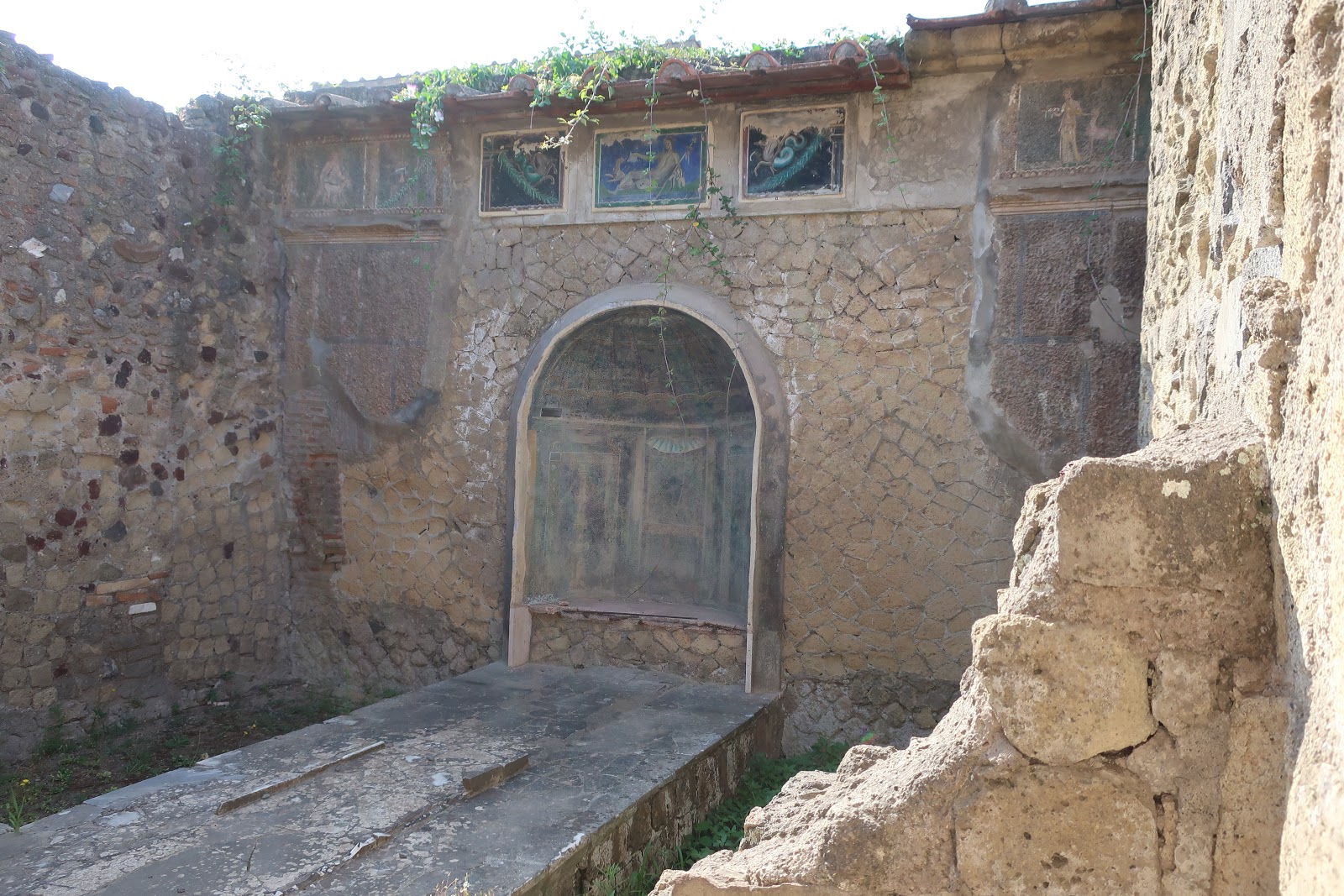


The city itself had street side shops selling wine and olive oil, fruit and prepared meals.  Under the main streets, ceramic sewer lines carried away wastewater.

The wide set stones allowed rainwater runoff.

The source of the city’s drinking water was some sixty miles away, flowing to Herculaneum via an aqueduct, supplemented with underground cisterns that stored rainwater. 

But, when the niceties and necessities of life disappeared, the rich and most other thirsty people felt the immediate need to leave town.

Also, the volcano’s destruction treated Pompeii and Herculaneum differently.  In Herculaneum, winds of up to 60 miles per hour, heated to about 400 degree Fahrenheit, swept the city, killing everyone left and even those on the beach hoping for a last minute rescue.
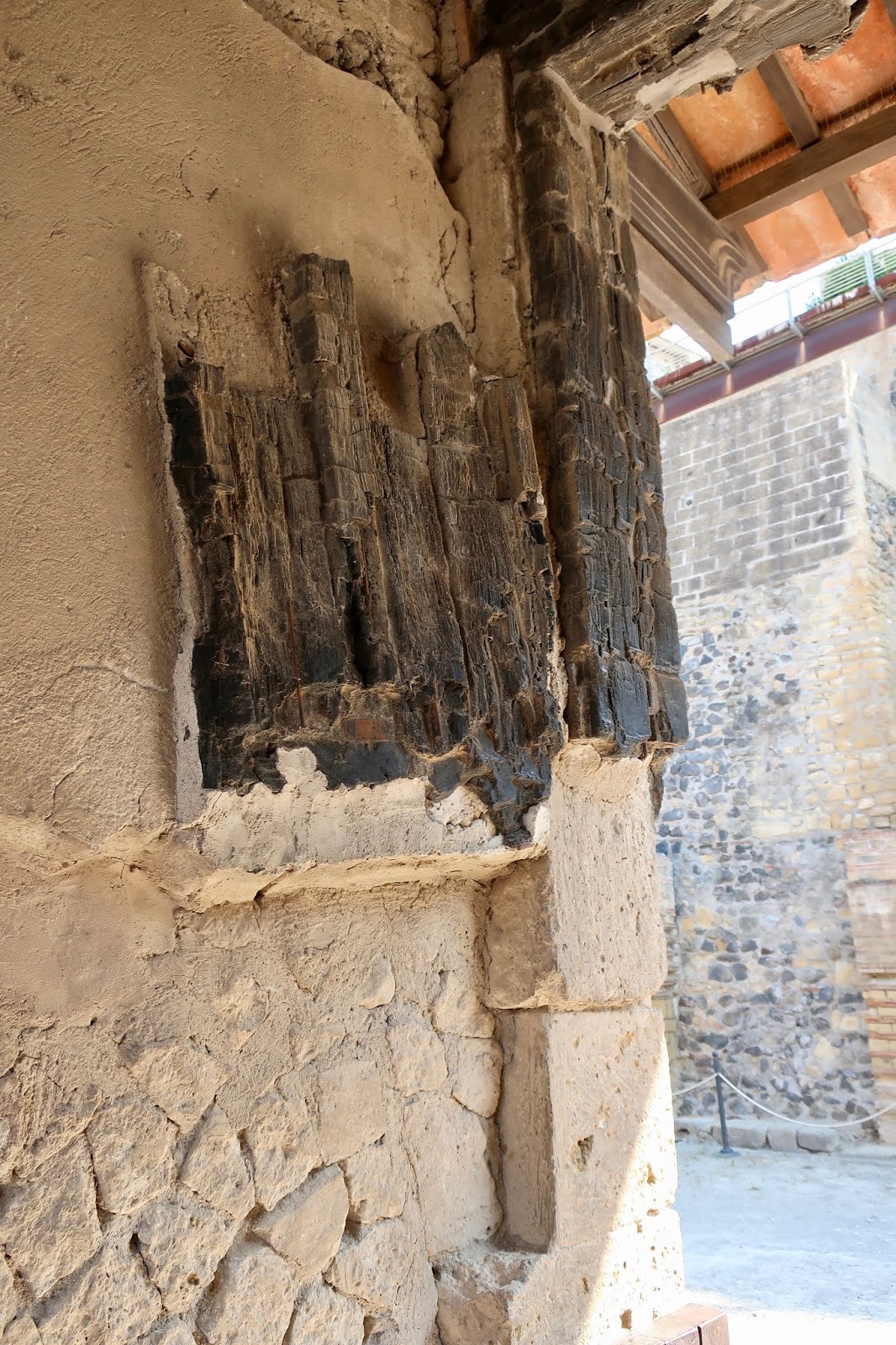
Some 2000 year old scorched timbers.

Next came a viscous slide of hot mud, combined with stones and earth gathered on it’s way down. Mudslide after mudslide followed.  Not only was the city buried under some 90 feet of mud and debris, but the mud also covered the cliff overlooking the beach and up to a mile into the Mediterranean Sea.

About the excavation:  Herculaneum was re-discovered some ten years prior to Pompeii, both of them in the mid-eighteenth century.  In the case of Herculaneum, a man was digging a well and uncovered antiquities.

Early excavations were haphazardly done by neighbors and fortune seekers looking for valuables.  Then came work ordered by the King of Naples, who also apparently plundered marble and such for his palace.

As you can guess, digging through centuries of mud was no easy task, but easier than digging though centuries of lava rock, as was the case in Pompeii.

As I said, there is more of Herculaneum to be discovered in the surrounding area. Archeologists have dug tunnels and exposed bits and pieces.  Unfortunately, because of the surrounding and highly populated neighborhoods, Herculaneum may never be fully exposed.

Old ruins?  So what?

The more you see of the ancient world, the more you begin to understand history itself is built in layers, many of which will never be uncovered.  We know something of the Greeks and the Romans, but less about the civilizations that came before.  Like much of science, archeology and anthropology and the many other ‘ologies are a road of continuing discovery and a constant quest for knowledge of the human past.

Even as amazing as they are, when we walk the streets of Pompeii and Herculaneum, we are also walking on the graves of even earlier peoples. 

Seeing and learning more of the Greeks and Romans is a worthy start to seeing and gaining insights into our own, modern world, as well as appreciating the remarkable development of prior civilizations.  As has been said, we progress greatly, but only because we stand on the shoulders of giants. 

Note the scorched walls.


Tuesday, July 14, 2015

Pompeii: Swallowed by the Gaping Mouth of Hell


The Temple of Jupiter, with Mt Vesuvius in the background

Around mid-day, sometime between 24 August and 24 November 79 A.D., Mount Vesuvius awakened like an enraged god, shooting flames and ash miles into the air.  Scientists estimate the rate of rock and pumice at about 1.5 million tons per second, showering the countryside with six inches of ash every hour.

This wasn’t the first time Pompeii’s number had come up.  People in the area were used to tremors and even terrible earthquakes, one of which destroyed the city in 62 A.D.  By the time Mt Vesuvius erupted, the city was mostly rebuilt and apparently things were back to normal, the occasional tremor included.  Normality brings with it apathy, or at least a quietude that erases the specter of alarm.

Brings to mind people building houses on California hillsides, then being astonished at the next mudslide.  Or, maybe Florida coastal residents saying, “Hurricanes?  That’s soooooo last year.”

It’s not that Pompeii had no warning.  But, when you build a city next to a volcano, rumblings are as ordinary as your wife’s latest headache.

What warnings?  Earth tremors came first, then pillars of billowing steam, heated to over 2000ºF, coating the sky, only to condense, and turn to heavy rain, creating super-heated mud.  Then came the eruptions.

But, unlike some readers may suspect, lava did not flow into Pompeii, nor did the citizens immediately race to safety.  The sister city of Hurculaneum, on the other side of the volcano, was swallowed in an avalanche of hot mud, but accounts suggest Pompeii got pelted by ash, sending residents into their homes to wait out the worst.  Bad move. Soon the ash rained down in bigger chunks, along with rocks.  Roofs began to collapse.  Rain brought a thicker coating of ash.

People broke for the river Sarno, along roads leading anywhere away from the volcano.  Wasn’t the time to pack two bags and ring for the porter, but there are accounts of slaves bearing their masters out on sedan chairs.  Some travelers were caught on the roads when the gaseous winds swept through, poisoning everything that breathed.

Here’s a brief account by Pliny the Younger, describing the race to safety with his mother:

“Ashes were already falling, not as yet very thickly. I looked round: a dense black cloud was coming up behind us, spreading over the earth like a flood. 'Let us leave the road while we can still see,' I said, 'or we shall be knocked down and trampled underfoot in the dark by the crowd behind. 'We had scarcely sat down to rest when darkness fell, not the dark of a moonless or cloudy night, but as if the lamp had been put out in a closed room.

You could hear the shrieks of women, the wailing of infants, and the shouting of men; some were calling their parents, others their children or their wives, trying to recognize them by their voices. People bewailed their own fate or that of their relatives, and there were some who prayed for death in their terror of dying. Many besought the aid of the gods, but still more imagined there were no gods left, and that the universe was plunged into eternal darkness for evermore.”

After two full days of devastation, it’s a wonder that out of a population of some 20,000 people, estimates are that 90% escaped. 

And what of those left behind?  They and their city rested for some 2000 years.  Real excavations began in 1860 by Giuseppe Fiorelli.  He was the first to discover gaps left by organic matter and to pour plaster of Paris into the gaps, thus preserving the images of people and animals who died so long ago.  Obviously, excavations continue, but out of the entire city of some 150 acres, only about 2/3 have been uncovered.  There are plans afoot to leave most of the rest, to preserve the area for future generations to uncover.


Here are some things to think about.  Mt Vesuvius is one of Europe’s active volcanoes and last erupted in 1944.  An American Air Base was nearby and quickly evacuated, except for 18 aircraft, which were destroyed.  There’s more coming, folks, but nobody knows when.

Pompeii is about 5 miles from Mt. Vesuvius.  Naples is about 15 miles away, but that’s the heart of Naples.  Parts of the city are much closer.
Why is Pompeii such a big deal?  Lots of ruins spread around Europe.  Yes, but this was an entire city trapped in time.  Conjecture turns to certainty when you uncover a virtually untouched city.  Everything from homes to businesses, to customs, courtesies, dress, even diet comes to light.  How did they worship?  How did they live?  What amusements entertained them?  Pompeii answers these questions and more.

The remains of a 'fast food' stand, Roman style.

The collection of daily articles would fill several warehouses.

One more question:  Why did people build a city so close to an active volcano?  Lots of answers.  The closeness of the River Sarno made an ideal location for trade.  In addition, volcanic soil is apparently agricultural heaven.  As any realtor will tell you…location…well you know the rest of the jingle.

Lemons from near Pompeii 
I had an odd experience, walking the stone streets of Pompeii.  My visions seemed almost real.  People passing in the streets on their way to here and there.  Commerce and the life of the city passed before me.  Look, I know the half bottle of Grappa at lunch helped, but still…

Enjoy the photos, realizing one trip is simply not enough to photograph everything.  Miles of streets went undiscovered on my first visit.  It won’t be my last.

The Basilica, which was not a church, but a place for banking and legal matters.

Part of the ceiling in the public bath.

Entry to the public bath.

The soldiers and gladiators quarters. 
Some of the many homes uncovered.

A main street, flanked by shops.

More homes.


The small amphitheater, used not only for entertainment, but also public meetings.

A figure on the wall of the small amphitheater.