Showing posts with label Roman. Show all posts

Tuesday, October 17, 2017

Biking On The Mosel River


Sometimes when I write for my blog, it takes several hours, but today, writing about the Mosel River, it just flows.

You see, last weekend, I went for a lengthy biking excursion with friends.  Ok, they weren’t real friends, just fishermen who chased me when I grabbed their poles.  My legs got a workout.  Only kidding.  I really do have friends.  They really do bike.  I borrowed my wife’s bike, which is single speed, with big tall handlebars right out of Easy Rider, decorated with fine spots of artistic rust.  I wore jeans, tennis shoes and a baseball cap.  Yes, I flaunted the fashionistas who decked themselves out in two thousand dollar touring bikes, custom filled helmets, Spandex biking clothes by Yves Laurent, riding gloves and specialty riding shoes for which several sheep gave their lives.  But, did I mind the angry stares that screamed, “For God’s Sake man, can’t you at least wear designer jeans?”  Nope. I go for Wranglers that have been twice dyed indigo blue.  My ball cap is a custom creation of previously sweaty afternoons and the crush gained through years of careless use.  I strive for originality.  Some would call it grunge.  I pay no attention and make them buy their own wine.

But, enough about me and my keen sense of fashion. Let’s chat a moment about one of the most glorious rivers in the world and definitely the finest region for Riesling wine.  If the wine merchants on the Rhine River disagree, ignore them.


At The Beginning:  The Mosel’s source is about 2400 feet (715 meters) high in the Vosges Mountains of France.  Bet you thought the Mosel was strictly a German river.  Mais, non, mes amie!  Matter of fact, only 142 miles (208 Kilometers) of it’s 334 mile (544 Kilometer) length is in Germany. Another 24 miles (39 Kilometers) is a shared border between France and Germany.  It flows into the Rhine at Koblentz.  Luxembourg also gets a little share.


So, where does the Mosel River (Moselle in French) rank among the largest rivers in Germany?  So glad you asked. Goes like this: Danube, Rhine, Elbe, Oder, Mosel.  But most lists include the full length of the rivers, not just the German portions.


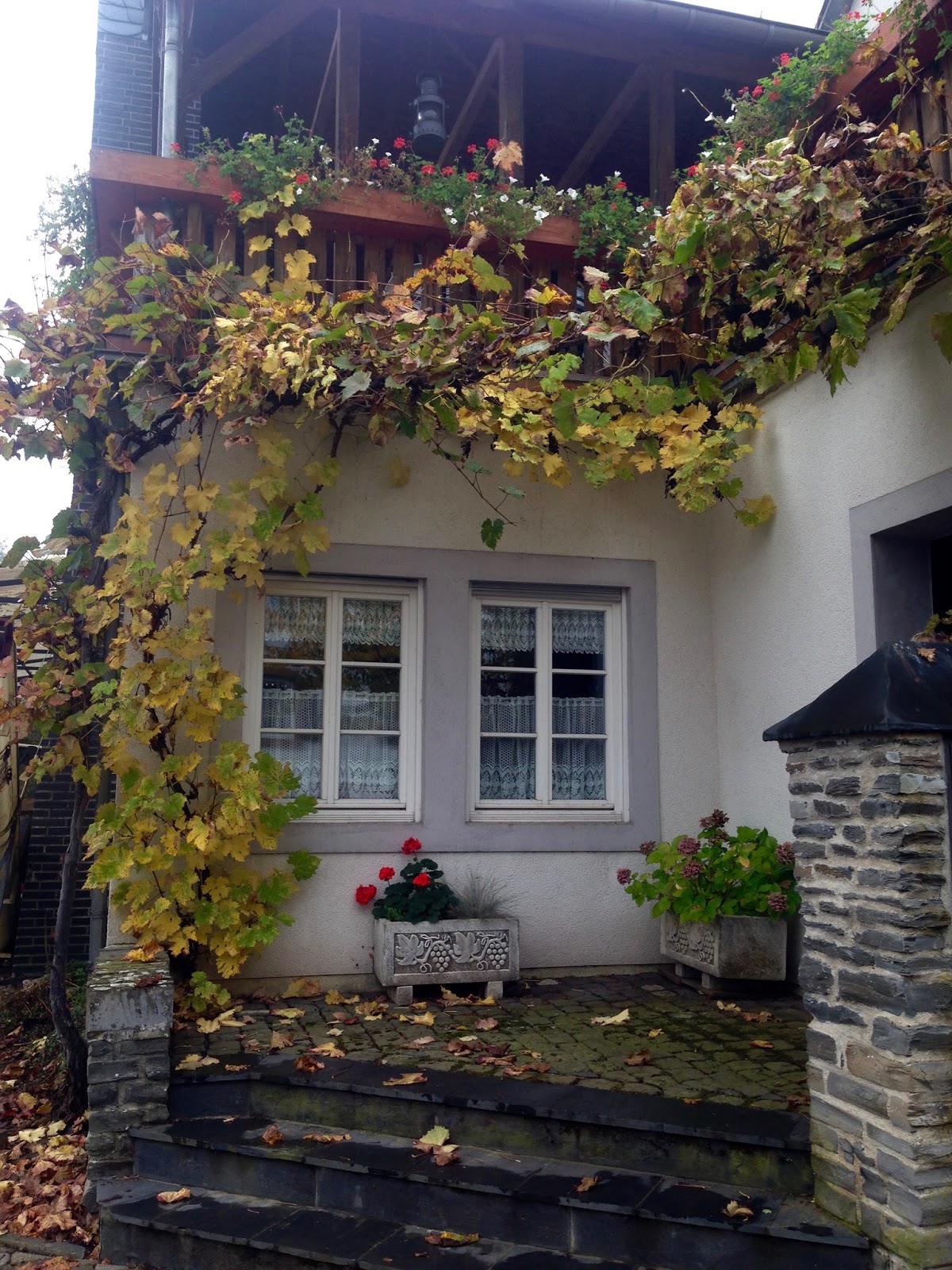
Ok, let’s chat for a moment about wines. Forget which German region produces the most, or most famous, or any other superfluous balderdash. Those just don’t matter and for my taste, the Mosel ranks numéro un, or Nummer Eins.  I love the soft flavors that are often attributed to the shale in the soil.  Ride your bike along the river and you’ll see stacks of slate, and if you look closer at the vines, it looks as if they are planted in gray gravel.


Most of the vines that run up and down the steep hills and over the flat lands produce Riesling grapes and overall, the valley is planted with 90% white grapes, of which 61% are Riesling.

Feel like tasting?  Seems like every five feet there’s another vintner offering Wein Probes, wine tasting.  Maybe every five feet is a bit of hyperbole, but I swear you’ll find ten or more vintners in even the small villages that line the route.  Some offer free tasting and others want a very small payment.  Yes, there are sparkling wines as well as a few reds.  Most wines price out at $4 to $7 per bottle, for some of the best white wines in the world.

And guess who first planted grapes in this region?  The Romans, of course.  As you drive or ride along the river, you’ll see signs that point to a Roman villa here or there, or ruins, or other artifacts.

But, most of all, taking a bike trip for a couple of hours through the lazy, beautiful curves of the Mosel is a treat that soothes your senses.  Admire the steep slopes, gaze across the green valley almost totally dedicated to wine.  Why deprive yourself? No need to make this painful.  After biking a mile or two, stop for luscious wine or a spot of lunch.  Oh, yeah, punish me. And at none of the places you’ll stop will you find a dress code.  Pick a Roman god to thank for that.


Thursday, September 17, 2015

Bath, A Jewel of an English City!


A typical street in Bath, England, with typical English weather.

When you think of the city of Bath, England, what comes to mind?  Drawing a blank?  Can’t get past the tower of London, Big Ben, and beer?  I sympathize.  Fortunately, I am here to enlighten you with a very brief overview of the glories of this uniquely delightful English city.

Bath, England:  Romans, Georgian Architecture, Jane Austin.  Pick just one and you’re in for a lifetime of blissful study.  We picked all three and ran ourselves raged in our five day, four night stay.  Yeah, you might say, but I don’t read, don’t like architecture, and who the hell is Jane Austin?

To that, I say, you are absolutely right to enjoy some reruns of The Flintstones, swilling a cold beer and munching a bowlful of grease laden, overly salted chips.  By the way, that’s chips in the American version.  Chips in the English version are what Americans call French fries. The Brits call our chips, crisps, a word difficult to say after you finish your first six pack.

Crisps are crispier than crinkled crumpets.  And by the way, what the Brits call crumpets, we call English muffins and what they call muffins….oh what the hell, change channels and pop another cold one.

But, for those worldly folk who travel to far places, and whose sweep of mind spans all forms of knowledge, let’s briefly explore Georgian architecture.

Bath is an almost perfectly preserved Georgian city.  By the way, what does the term Georgian architecture mean?  Well, first you have to know who George was.  From 1714 to 1830, a succession of British monarchs were named George, Georges I, II, III, and IV to be exact.  You may remember George III, the monarch during America's War of Independence.

An example of Georgian architecture....found all over the city.

And what is the style?  Some would say, exact symmetry.  Evenly spaced windows of the same size, chimneys on either end of the house, smaller dormer windows above. Pediments over the front entrance and windows.

When you stroll through this Georgian wonder of a city, you may notice some large bricked up windows.  Mark those down to the ‘window tax,’ another clever nonsensical result of government spending more money than it was bringing in.  To figure the tax on a house, the taxman counted the windows. This bit of governmental detritus floated from 1696 to 1851, and was dubbed ‘Daylight Robbery.’

A closeup of apartments on The Circus

The Circus


A view from No. 1 Royal Crescent

The Royal Crescent.  No 1 is on the far right.

I told you everything in Bath is close.  The Circus and The Royal Crescent are only a couple of blocks apart.

Every street in Bath is a testimony to the Georgian style, but some you must not miss are The Royal Crescent (No 1 is open to the public), and The Circus, a fabulous array of Georgian townhouses.  As you may know, originally Circus meant circle or ring (Latin).  Hence, modern circus tents are usually round, and we also have the nautical and aviation term circumnavigation.  In London, there’s the famous Piccadilly Circus, a vast traffic circle in the center of the city.

A view of the Roman baths.  Open for bathing until 1970!

The famous Pump House, next to the Roman Baths, and featured in a couple of Jane Austen's novels.
On to the Romans.  The Romans built a temple here in 50 A.D. and dedicated it to the Celtic goddess Sul and the Roman goddess Minerva, the goddess of healing.  Clever these Romans, to incorporate a local god along with their own.   The Romans named the city we now call Bath, Aquae-Sulis, the waters of Sulis.

Soon after, the Romans built an elaborate bath on the site of hot-springs, whose waters had been noted for centuries for their healing powers.  The baths and associated museum and displays are the best curated Roman remains I’ve seen, and that includes those in Rome.  The repair, uncovering, and upkeep are stories in themselves, and the results are a master’s class in Roman civilization and a Roman’s daily life.

Inside The Abbey


The Abbey's ornate ceiling.

Another place to visit is the world famous Bath Abbey, or as it’s officially known The Abbey Church of Saint Peter and Saint Paul. It’s an Anglian church now, but it’s history dates to 757 A.D. and an Anglo-Saxon monastery.  The Normans pulled it down to build a Norman cathedral.  In next few centuries, Norman edifice fell to ruin, and was then rebuilt to become a Catholic monastery, only to be ruined in 1539 when Henry VIII ordered monasteries dissolved.  Repairs began 70 years later and finished in 1874.


Pulteney Bridge, also showing the weir (lower right corner), a method of flood control.
Don’t miss The Pulteney Bridge, one of only a few bridges in the world lined with shops.  Completed in 1774, it crosses the River Avon.  What's another bridge with shops?  Come on, you travel junkies!  The Ponte Vechio in Florence, Italy, of course.

Shopping?  Oh, yeah, let’s get to that.  Bath is number one on my list for shopping areas.  Bath Street, in the old downtown is just the start of a bee hive of name shops, specialty stores, and bargain spots.  We had tea at Waterstone’s Books, at 4-5 Milsom, in the heart of the downtown.  Café W is known for it’s selections of local produce, including cookies and cakes.  The staff is friendly and since it was near closing time, the wait-staff passed out unsold pastries to all the patrons.

 The closeness of all the sights and shops and pubs makes Bath an ideal city for strolling.  Walk a few steps, see a major attraction, walk again and have tea, then a couple more blocks and you're at another attraction.  Perfect!

Ok, ok, now what about Jane Austin?  Sorry folks, that’s for another day, another blog, but soon…


And remember:  More yet to come, with closer looks at the Roman Baths, No 1 Royal Crescent, Pubs, and tea emporiums.  Oh, yeah, Bath is a small wonder world!

Getting there:  Trains leave from London's Paddington Station every 30 minutes for the hour and a half trip.


Wednesday, September 2, 2015

Ephesus: An Ancient City More Grand than Pompeii


We took a cruise to the Eastern Mediterranean last summer (July 2015) and one of the most interesting stops was Ephesus (Efes in Turkish).

Your first question (you’re going to have a lot more):  What the hell is Ephesus and if I’ve already seen Pompeii, why would I want to go there?  Gather ‘round studly, well-traveled men of the world, and glamorous, sophisticated ladies.  Glamorous ladies, feel free to find a spot on my knee, while your husbands tremble with jealously.

The ancient city of Ephesus has many ties, not only to antiquity, but to the Bible.  Yes, it’s in Turkey, just below Izmir, but it was a Greek city, founded a thousand years before Christ, and it may have been a Hittite settlement even earlier.  Then came the Romans. The Middle East is like that.  A wedding cake with too many layers to count.  You can only take a bite at a time and in the limited time we were there, about a six-hour tour, all you could do was lightly nibble, like a tiny, sunburned mouse on a 30 second diet.

Hot?  Oh lordy!  Talk about needing some slaves with fans.  I should have brought a Camel Pack, or a six pack of Efes Beer, brewed in Istanbul.

But, enough about my dehydration. How big was Ephesus back in the Greek/Roman days?  Some 300,000 people.  It was often referred to as the Gateway of Asia.  In fact, back in the shadows of antiquity, it was the fourth greatest city of the world, after Rome, Alexandria (Egypt), and Antioch (Syria).

We walked in, marveling at rubble, reconstructed edifices, and cobbled streets. Recognizable names sprang out of our guide’s mouth and we chewed on those for a bit.  St Paul probably wrote here and he certainly preached in the great amphitheater more than once.  He had a close call when merchants who made their living selling magic charms of The Goddess Diana (Artemis in Greek) thought he was cutting into their business and took it personally. 

It is believed that St John wrote his Gospel here. (see the following photos)

The Ruins of the Church of St John


The Amphitheater
The amphitheater at Ephesus offers one of the best microcosms of Greek and Roman life. How do archeologists know the size of an ancient city?  A rule of thumb:  Take the number of people the amphitheater held and multiply by ten.  Not exact, to be sure, but the amphitheater was in many ways the focus of social life.  Discussions, political and philosophical, athletic contests, gladiator fights, live theater, and executions all took place here. 

Not into the Biblical and historic aspects?  Ok.  Sting and Elton John played the ancient amphitheater and after one raucous performance, when powerful speakers the size of tanks threatened to make the walls come tumbling down, the government put a limit on volume.  Other cities could take a lesson.

The Arcadian Way. In the distance is the Library of Celsus

Cleopatra and Mark Anthony strode the flagstone-covered main street, the Arcadian Way.  At one time it was a hundred feet wide and even today it’s impressive.  It's startling to realize your Nikes are striding along exactly where famous Roman sandals trod.

Onward, with far more to see. There are elaborate terraces where the rich lived, and even now many of the delicate tiles and frescoed walls survive.  For a long time, these homes were not excavated because archeologists hadn’t devised a means of protecting them from the weather.  Now the whole area is tarp covered and digging continues.  A walkway allowed us to wander up the side of the digging and permitted a god’s eye view of  the wonders from top to bottom.  Below us, archeologists in ones and twos dusted and cleaned, reclaiming the past.  Much more activity here than in Pompeii.
 (see the following photos)


Note the archeologists at work.


One thing you will not see is the Temple of Artemis (Diana), which was four times the size of the Parthenon in Athens, and one of the Seven Wonders of the Ancient World.  The Goths destroyed it in 268 A.D.  It may have been rebuilt, but another John, St John Chrysostom (a noted anti-Semite) led an angry mob in 401 A.D. to finish the job.

Immediately, you find yourself asking:  What were the other six Wonders of the Ancient World?  Second question:  Where the hell is my guidebook?  Gotcha covered, bro.  The Great Pyramid of Giza (still standing), The Colossus of Rhodes, Lighthouse of Alexandria, Mausoleum at Halicarnassus (all three destroyed by earthquakes, Statue of Zeus (like The Temple of Artemis purposefully destroyed), and The Hanging Gardens of Babylon, which may or may not have existed.

The Library of Celsus
Back to Ephesus’ stone streets.  A most impressive structure is the façade of the Library of Celsus, built to hold some 12,000 scrolls.  Completed around 135 A.D., 130 years later earthquakes and fire wrecked it, and a thousand years after that, a similar catastrophe completed the destruction.  Archeologists reconstructed the face of it in the mid 1970s.

I’ve given you just a few tidbits, a small hors d’oeuvre at a banquet of archeological and historical delights.  If you enjoyed Pompeii, you’ll suck up Ephesus like an alcoholic historian. Both cities lead you back thousands of years, into the still beating hearts of lost civilizations.

Applause follows.  Light kisses on the cheek from the glamorous, sophisticated ladies.  Boisterous slaps on the back from the well-traveled men of the world.

The Temple of Hadrian as it looks today


The Temple of Hadrian as it once looked.

Remains of the Roman (and Greek) baths.