Showing posts with label wine. Show all posts

Saturday, April 27, 2019

Buying Wine in the Alsace


Buying Wine in the Alsace

If you’re driving to Alsace to buy wine, the first thing you’ll notice is it’s kinda sorta different from Germany and kinda not. Alsace is in France, n’est pas?  Sometimes even the French don’t know.  In 2011, the then President of France, Nicolas Sarkozy, when speaking to a group of French farmers in Alsace, mentioned that he was in Germany and the farmers booed.   Good reason.


A field of rapeseed flowers
Read about the benefits of rapeseed oil:  https://www.naturalfoodseries.com/9-benefits-rapeseed-oil/

Are you familiar with Alsace? Perhaps you remember from your high school modern European history class. Alsace and Lorraine ring any bells? Those two French provinces have bounced back and forth between France and Germany for the last hundred years and several wars: 

1870-71, the Franco-Prussian War.  This time France, under Napoleon III, attacked Prussia seeking an easy victory and renewal of his declining power.

Of course, as with all wars, this one was much more than the simple explanation I just gave you.


Result:  Prussia and a coalition of German states bloodied the French nez. Germans captured Paris. Bismarck rode on the back of this victory and was able to bring together a united Germany.  Germany annexed Alsace and half of Lorraine, along with the city of Metz.  Sacre Bleu!

1914-1918, World War I, The War to End All Wars. That would be funny except for the millions of military and civilians who were killed or left homeless.

The Result:  France got back the territory it lost in the Franco-Prussian War.  Merveilleux!

1939-1945, World War II. Germany overran France and conquered most of Europe, Alsace and Lorraine included.  German control lasted until the end of the war.  In 1947, Alsace voted to remain a part of France.  

Now you know why when you drive into the French province of Alsace on a bright sunny day, with nothing on your mind but satisfying your lust for the grape, you continue to see the names of towns that are definitely German:  Oberhausbergen, Bischheim, to name only a couple.  The people in Alsace not only speak French, but also Alsatian, a Germanic dialect.  And, it’s not difficult to also find German speakers. As some wits have put it, Alsace is not quite French and not quite German either.


But, on to wine! Vive le raisin!

A hint about Alsatian wine, with more to follow.  Riesling grapes are grown on both sides of the Mosel river, in Germany and France, yet the wines taste remarkably different.  Same with the Pinots.  Soil? Sun? Temperatures?  Those much smarter than I have unsuccessful tackled that conundrum. 

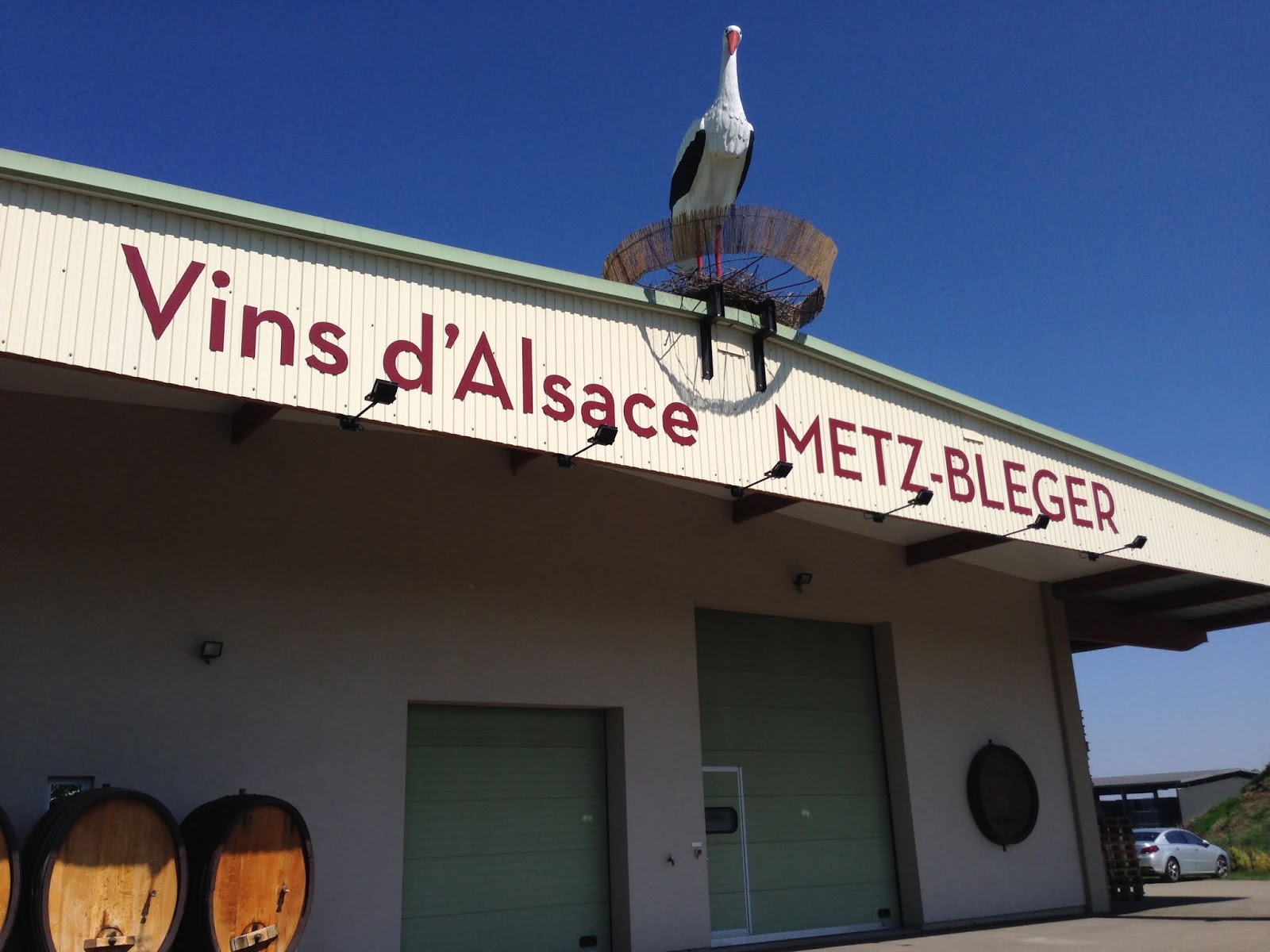
Years ago, while wandering off the beaten path, we happened upon a winery that turned out to be a lasting favorite.  As I’ve noted before, wine taste is personal, often depending on your age (yes, taste buds do change) and what appeals to your palate.  Not to overstate it, but a wine you swear by may not be a wine I would choose.  Magazines that rate wine?  Ignore them and taste for yourself.

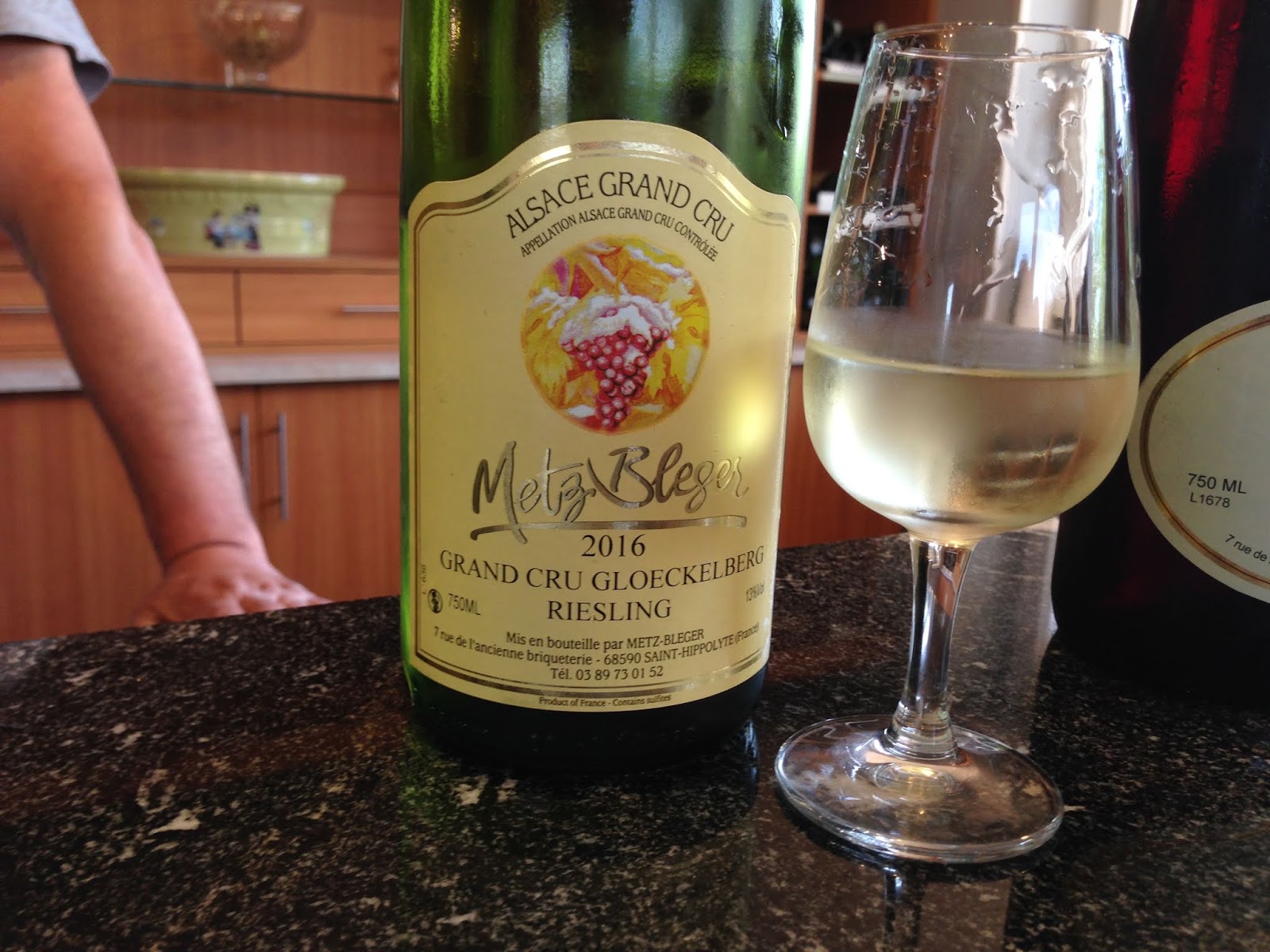
The Metz Bleger vineyards produce a number of vintages: Pinot Noir (of various descriptions), Pinot Gris, Pinot Blanc, Riesling, Gewürztraminer, Sylvaner, Moscato, and Alsace’s sparkling wine, Crémant.


As I said, there are various qualities and styles of each, so when we began tasting, the tasting lasted for an hour or more.  This was an afternoon of “Yes, thanks, I will taste another,” which all too quickly devolved into “Jes tinks gimme a new grass….glass.”  You want to sell wine, take a lesson.  These folks loaded over 200 bottles in our trunk and backseat.  Fortunately, my companion took tiny sips, as though Queen Elizabeth had gently placed a white-gloved hand on her shoulder.

Such fortitude and iron will!


Ok, fine, you’re thinking, but what about the wine, aside from the obvious, that in a game of taste buds vs brain power, it’s checkmate by the taste buds every time.


In general, what I like most about Metz Bleger wines is their smoothness.  Most of the vintages subdue the harshness of heavy tannin, in favor of pure enjoyable flavor.  The range of sweetness is remarkable, from the dry, but still roundly finished Pinots, to dessert white wines.

My personal preference is the half dry.  I don’t like to lick my lips and then have to brush away the dust, but neither do I prefer wines that are too flavorfully light.  There are some dry whites that attract me, because in the French whites the tannin is almost always subdued.  And in the proper context, I can also relish a delightfully sweet desert wine….but only a glass.


Is it too much for us to suggest wines have personalities?  I’m thinking of a white that adds sparkle to the summer day as you sit by your garden and watch the flowers dance in the light breeze, or a pungent red that warms the heart as you sit by the fire on a frigid winter evening and gaze at the flickering flames.

I like to think of the wines of Metz Bleger, as the beauty of sunshine and a comfort on cold winter nights.  That must be why we keep going back!


Monday, November 19, 2018

Sankt Martin's Fest


Sankt Martin’s Fest

Travel is an interesting concept and fairly new.   Used to take months to get to Europe from the New World. Three generations ago, as a young man, my grandfather rode from Florida to South Carolina on a mule.  The U.S. was mostly rural.  Travel meant going to the closest big city, only ten or twenty miles at the most.

Now we hop on a jet and go from the heart of the United States to London in about seven hours. Another hour and a half gets us to Berlin or Rome.

Somehow, local travel has become less attractive, or maybe we just take it for granted.  A shopping trip.  A local museum that’s not as grand as the Louvre or the Prado.  Bragging rights to how far we've been and sights that eclipse the local venues.

For me, living and traveling in Germany is different.  I don’t feel the need to go far. Maybe it’s because I’m an American and everything is new. A fest that’s been going on for centuries is a fresh flower in my traveling garden.  It may be only an hour away, but it’s an adventure.  Which brings me to the village of Sankt Martin and their yearly festival honoring the saint.


A lovely old town.  Solid stone buildings.  Flowers decorating every window ledge. Cobblestone streets. Sights that make your camera click every few paces.  Streets clogged with smiling people and baby strollers, the scent of roasting chestnuts and grilled Bratwürst permeating the air.  Vintners, with doors thrown wide, serving half liters of their best, at prices less than you’d pay for a small glass of vin ordinaire in the States.  But, all is not just Brats and street food.  Wide doors of old hewn oak open to sprawling arrays of foods, from potato dumplings to wild boar goulash and fried schnitzel and heaps of vinegary potato salad.


But, it’s not just a festival of plentiful food and drink.  There’s a deeper reason the town opens up every year and with a name with ‘saint’ in front of it, of course it has its roots in the Catholic faith.  Germans are not ashamed their open faith may offend. No prohibitions on whole towns celebrating this saint or that.

But, now, let’s get more specific.

Martin was a Roman soldier who ripped his cloak in half to share with a beggar during a snowstorm. While he slept, he dreamt of Jesus and later became a bishop.  In the past, on 11 November, the tradition used to signify the end of the seeding of wheat and the killing of fatted cattle for  Martinmas beef.  Didn’t see any cattle being slaughtered, so it wasn’t the Christian version of Ramadan.  But, each year the celebration continues.

People flocked for the food and librations and at the local Catholic Church, riders came for the blessing of their horses.


Although the town of Sankt Martin carries his name, the celebration carries through many parts of Germany and France.

Of course for me, it’s always the people.  We sat at a long plank table to enjoy Würst und Schnitzel, potatoes in many forms, and luscious green salads, along with pint sized glasses of red wine.  Our table neighbors heard us speaking English and thus ensued a long conversation of their son who lives in the U.S. and questions about what brings us to Germany.  My wife is a teacher and so was his wife, seated across from him.  Her husband and I sat in silence as teacher-talk took over.

Then it was time for another conversation with the folks on the other side of us and when they left, yet another conversation, all the while switching between German and English and a smattering of both when one of us lacked the vocab.

Often, when friends come from the States to visit, they have their hearts set on visiting the whole of Europe.  “How long do you plan to stay?” we ask.

“Oh, about a week and we want to go to London and Berlin and Rome and Madrid.”

“How about we drive an hour down the road?”

They look disappointed. But, wait until they taste the wine and meet some Germans and suddenly their thirst for travel blossoms and that photo op in a slew of big cities will never again quench their thirst.


Under the green lights of a Weinstube, here's a famous sweet and soft St Martin's pretzel.

Yes, the grapes are already harvested, but this is still wine country!


Saturday, March 10, 2018

The Romance of the Romans


The Roman Empire in 117 A.D.


The Romance of the Romans

The Roman Empire took its time to disintegrate and we can argue about exactly when and exactly how, but let’s leave that for another day and place our vote for 476 A.D. , when Romulus, the last Roman Emperor, was overthrown by a Germanic leader, Odoacer.   After some 1500 years, the Roman Empire was no more, but of course that includes the time the Empire was split into east and west.  If you want to only consider the time it was what we think of as the united Roman Empire, then it lasted just over 500 years..

So, Rome is not worth thinking about, right?  Surprise, surprise!!  There are still vestiges of Roman life and Roman culture all around us.

Take the Romance languages for example that all emanated from Latin:  French, Spanish, Italian, Portuguese, Romanian and Catalan. The widespread of Romance Languages means through the centuries, at least linguistically, Roman influence has stretched, not only around the Mediterranean region, but North and South and Central America, along with parts of Africa!  Wait, I forgot to mention the Philippines.   Yep, don’t forget Spain owned the Philippines for decades.  I met a Filipina/American in Japan and asked her if she spoke Tagalog or Filipino and she said, no. “On our island we spoke only Spanish.”


“Oh yeah?” you say, what about English?  Glad you mentioned that. Linguists say that English, although called a Germanic language, takes 65% of its words from French!  Just one example:  all the words ending in …ion are written the same in French and English, but pronounced differently.  As the French Prime Minister George Clemenceau  (1841-1929) famously said, “English is just badly pronounced French.”

But is there nothing more than language?  Nothing more???? Are you kidding?

We still use the Roman Gods.  Really?  Yep.  In the days of the week.

The Romans copied the Babylonians in naming some of the days of the week after heavenly bodies, which we still use today. 

Monday – Moon Day  (Luna)  

Sunday – Sun Day (Sol invictus)

And the Roman threw in one of their own for Saturday.  Saturn. 


As you know from the phrase, all roads lead to Rome, the Romans built a lot of roads all over the Empire.  Hundreds, if not thousands of them still exist and often are in use today, although you may not realize it.  Some have been paved over.  In all the Romans built over 250,000 miles of roads, with over 50,000 miles of them paved.

Roman Roads in only one small part of Germany


And not just the roads, but so much more.  Go to Segovia and see the huge aqueduct that was in service and still moving water to the city until the early 1970s. Take a look at Hadrian’s Wall in the north of Britain.

Aqueduct in Segovia, Spain

How about place names?  Rome, of course is still Rome, and Londinium we know as London, and look at the very name of Britain, from the Latin, Britannia.!

Parisiorm is now Paris.  In Spain, Segovia is still Segovia.  The list goes on and on.

Let’s not forget the foods and animals the Romans introduced wherever they went.  If you missed it on a previous blog, read through the Romans in Britain and you’ll spot fruits and vegetables galore.


Did you know our own sense of the rule of law is based heavily on Roman law?

The rights of personal property.

The validity of contracts.

The right to vote.

The right to pay taxes.

The right to appeal and the legal status of corporations.

An accused person had the right to a defense and was innocent until proven guilty.


Here’s something dear to your hearts:  Wine!  Look along the Rhine and Mosel valleys in Germany, the notable vineyards in France (Bordeaux) and Italy and even Spain (Rioja).  I haven’t begun to name them all.  Romans believed wine was essential to life and everyone drank it, even the poor Romans and the slaves.

“There with the wine before you, you will tell of many things.”  Ovid, Roman Poet, 43 B.C. – 17 A.D.  Husbands and wives should remember this!

“The great evil of wine is that it first seizes the feet.  It is a crafty wrestler.” Titus Maccius, Roman playwright (254 -184 B.C.)

Something you might not know about Rome:

The Colosseum was not called the Colosseum when it was built (between 72-80 A.D.), but Amphitheatrium Flavium after the two emperors who build it.  Around 1000 A.D. the word Colosseum came into use, but even then it didn’t mean the building itself, but an enormous statue of possibly Emperor Nero.  The statue has since disappeared.

The city has grown taller.  If you visit some of Rome’s major sights of antiquity, you’ll notice you have to walk down. The Forum and the Pantheon are good examples.

Look around and you’ll soon find, the Roman Empire may have fallen, but many of the buildings, the language, and the Roman ideas live on.
 
Now I think it’s time to drink a little wine and think about that.


Monday, February 19, 2018

Friday Night at Issimo


Friday Night at Issimo

Ya got a favorite go-to spot for Friday nights?  Sure you do.  Me too. Friday night spots are special, without a lot of planning.  Your fav spot dances into your mind; you invite a couple of friends and order some wine and noshes….hey, what else do you need?  One of my favorite spots is a small Italian deli in Homburg, Issimo.  You know that Italians are famous for their appreciation for family.  And when you walk through the door at Issimo, you’re immediately part of the family.

What’s special about it?  Glad you asked because I can tell you what makes any Friday night place special, yours and mine.  Friendly staff is number one.  It’s a place where the manager and wait staff call you by name and always throw smiles at you as you walk through the door.  Of course, you also greet them by name!

At Issimo, we know Franco and Vecenzo, Afërdita, Sylvia, and Leonardo.  How come?  They’re friendly enough to invite conversation. Always smiling.  The men shake my hand, the women give me hugs.  It’s only about two minutes before I have a glass of wine in my hand.  I don’t get that kind of welcoming service at home.


Second things that are mandatory for a fav are super food and wine.  At Issimo you can count on every wine, every cheese, every olive and slice of bread being wonderfully delicious.  Yes, it’s all from Italy and the staff knows what part of Italy it came from because they picked everything out and didn’t just order it from a supplier.  For the wine, you tell any of them your taste and it’s as if they know your taste buds better than you do.  It’s that way with the food as well.  Parma ham is not just a style, it came from Parma and not just any ham from Parma.  Issimo’s Parma ham is a tenderly cured and thinly shaved piece of ham that crosses the palate as a gift from the heavens.


Third requirement is atmosphere.  In my case, an Italian deli should feel like Italy.  Issimo is in Germany, but there’s nothing phony about it. No plastic rounds of cheese or plastic sausages hanging over the counter.  Step through the door and inhale deeply.  Yep, this is the place.

But, it’s like that with any fav place, right?  A hamburger joint should feel comfortable and welcoming and have the smoky smell of burgers and fries.  In a BBQ joint, your nose should lead you there and your clothes better smell like BBQ when you leave.

At Issimo, with the whole package of staff and food and atmosphere, this is Friday night as it should be. Great wine and cheese and ham and even better conversation.  Politics?  No way.  This is the time to chat about books you’ve enjoyed, and places you’ve been, and places you want to go, and the fine points of where this and that wine came from.

At Issimo it’s more than a Friday night, it’s a special Friday night.  Just like yours, right? Saluti!