Showing posts with label Crémant D'Alsace. Show all posts

Saturday, April 27, 2019

Buying Wine in the Alsace


Buying Wine in the Alsace

If you’re driving to Alsace to buy wine, the first thing you’ll notice is it’s kinda sorta different from Germany and kinda not. Alsace is in France, n’est pas?  Sometimes even the French don’t know.  In 2011, the then President of France, Nicolas Sarkozy, when speaking to a group of French farmers in Alsace, mentioned that he was in Germany and the farmers booed.   Good reason.


A field of rapeseed flowers
Read about the benefits of rapeseed oil:  https://www.naturalfoodseries.com/9-benefits-rapeseed-oil/

Are you familiar with Alsace? Perhaps you remember from your high school modern European history class. Alsace and Lorraine ring any bells? Those two French provinces have bounced back and forth between France and Germany for the last hundred years and several wars: 

1870-71, the Franco-Prussian War.  This time France, under Napoleon III, attacked Prussia seeking an easy victory and renewal of his declining power.

Of course, as with all wars, this one was much more than the simple explanation I just gave you.


Result:  Prussia and a coalition of German states bloodied the French nez. Germans captured Paris. Bismarck rode on the back of this victory and was able to bring together a united Germany.  Germany annexed Alsace and half of Lorraine, along with the city of Metz.  Sacre Bleu!

1914-1918, World War I, The War to End All Wars. That would be funny except for the millions of military and civilians who were killed or left homeless.

The Result:  France got back the territory it lost in the Franco-Prussian War.  Merveilleux!

1939-1945, World War II. Germany overran France and conquered most of Europe, Alsace and Lorraine included.  German control lasted until the end of the war.  In 1947, Alsace voted to remain a part of France.  

Now you know why when you drive into the French province of Alsace on a bright sunny day, with nothing on your mind but satisfying your lust for the grape, you continue to see the names of towns that are definitely German:  Oberhausbergen, Bischheim, to name only a couple.  The people in Alsace not only speak French, but also Alsatian, a Germanic dialect.  And, it’s not difficult to also find German speakers. As some wits have put it, Alsace is not quite French and not quite German either.


But, on to wine! Vive le raisin!

A hint about Alsatian wine, with more to follow.  Riesling grapes are grown on both sides of the Mosel river, in Germany and France, yet the wines taste remarkably different.  Same with the Pinots.  Soil? Sun? Temperatures?  Those much smarter than I have unsuccessful tackled that conundrum. 

Years ago, while wandering off the beaten path, we happened upon a winery that turned out to be a lasting favorite.  As I’ve noted before, wine taste is personal, often depending on your age (yes, taste buds do change) and what appeals to your palate.  Not to overstate it, but a wine you swear by may not be a wine I would choose.  Magazines that rate wine?  Ignore them and taste for yourself.

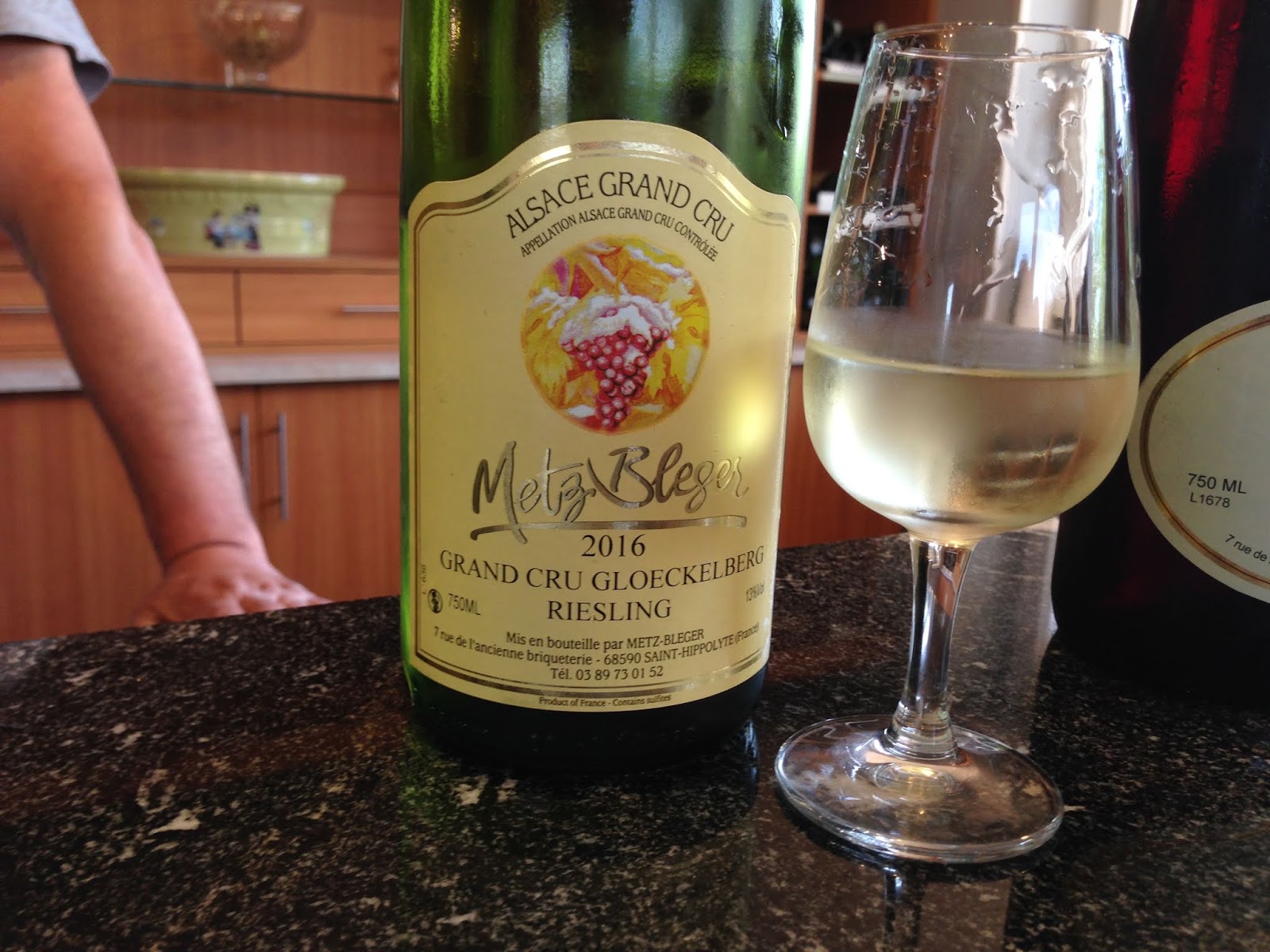
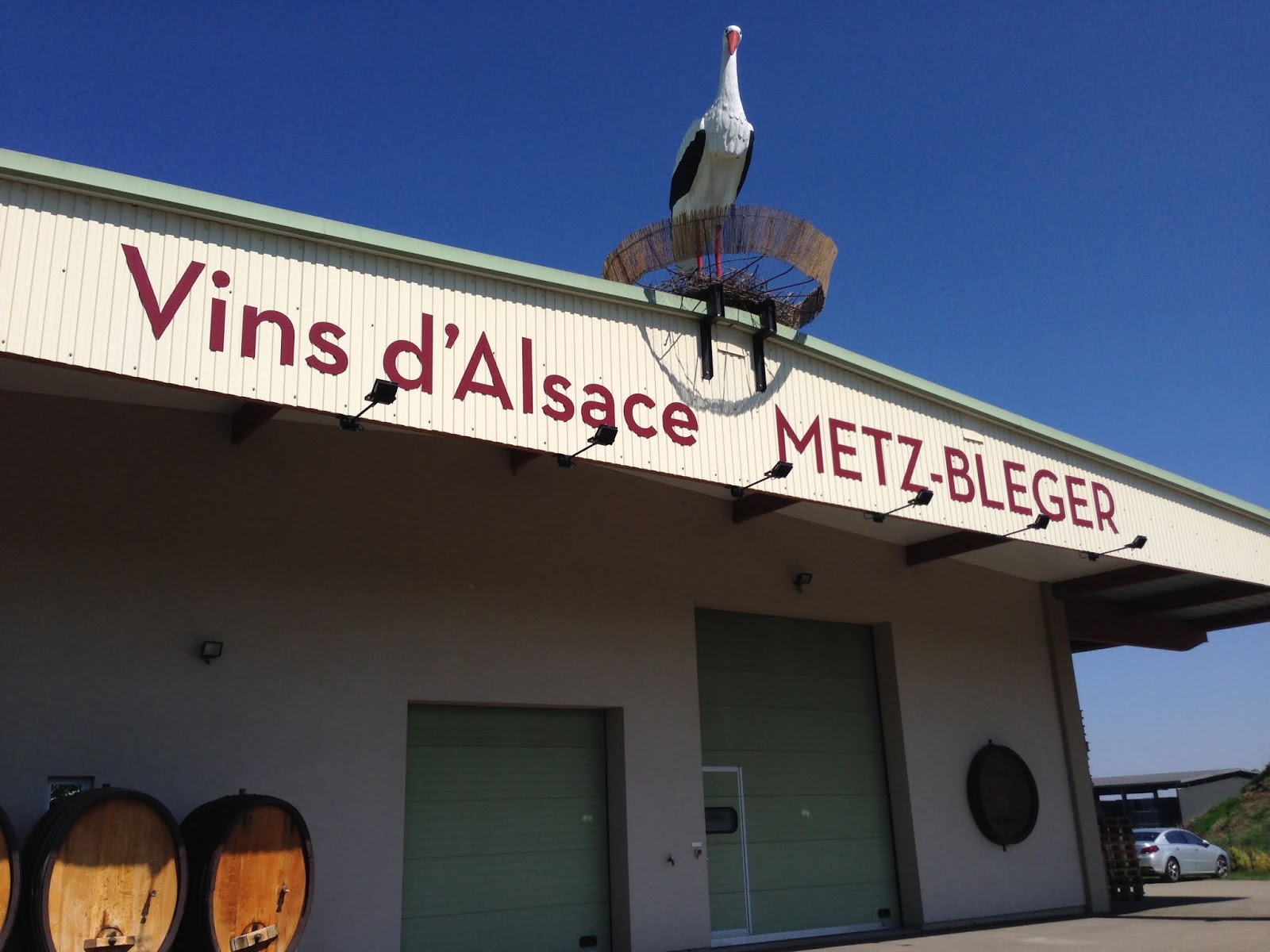
The Metz Bleger vineyards produce a number of vintages: Pinot Noir (of various descriptions), Pinot Gris, Pinot Blanc, Riesling, Gewürztraminer, Sylvaner, Moscato, and Alsace’s sparkling wine, Crémant.


As I said, there are various qualities and styles of each, so when we began tasting, the tasting lasted for an hour or more.  This was an afternoon of “Yes, thanks, I will taste another,” which all too quickly devolved into “Jes tinks gimme a new grass….glass.”  You want to sell wine, take a lesson.  These folks loaded over 200 bottles in our trunk and backseat.  Fortunately, my companion took tiny sips, as though Queen Elizabeth had gently placed a white-gloved hand on her shoulder.

Such fortitude and iron will!


Ok, fine, you’re thinking, but what about the wine, aside from the obvious, that in a game of taste buds vs brain power, it’s checkmate by the taste buds every time.


In general, what I like most about Metz Bleger wines is their smoothness.  Most of the vintages subdue the harshness of heavy tannin, in favor of pure enjoyable flavor.  The range of sweetness is remarkable, from the dry, but still roundly finished Pinots, to dessert white wines.

My personal preference is the half dry.  I don’t like to lick my lips and then have to brush away the dust, but neither do I prefer wines that are too flavorfully light.  There are some dry whites that attract me, because in the French whites the tannin is almost always subdued.  And in the proper context, I can also relish a delightfully sweet desert wine….but only a glass.


Is it too much for us to suggest wines have personalities?  I’m thinking of a white that adds sparkle to the summer day as you sit by your garden and watch the flowers dance in the light breeze, or a pungent red that warms the heart as you sit by the fire on a frigid winter evening and gaze at the flickering flames.

I like to think of the wines of Metz Bleger, as the beauty of sunshine and a comfort on cold winter nights.  That must be why we keep going back!


Monday, October 19, 2015

La Bonne Auberge: A Jewel in the French Culinary Crown


La Bonne Auberge  (The Good Inn) sits unobtrusively in a drab suburb of Forbach, France, so close to Germany you can only tell you’ve crossed the border when the roasty smells of wurst and beer disappear.  Suddenly, it’s France and just as suddenly the food changes, and you’ve left behind the tried and true meat and potatoes. My German friends won’t like to hear this, but you haven’t just stepped up a rung, you’re on a different ladder, surrounded by ambrosial clouds.  I always say, the French can teach anyone how to eat.  At La Bonne Auberge even the French can learn a thing or two.

In this small inn, one does not eat; one dines amid the tinkle of sparkling crystal and glint of polished silverware.  Awarded a Michelin Star some time ago, it’s never lost that distinction.

A word about the Michelin star system for American readers:  One Star:  So amazing, you will insist on telling even complete strangers you happen to pass on the street.  Two Stars:  It’s here where God’s angels gather for a meal.  Three Stars: God has a permanent reservation, and the waiters call him by his first name.  That’s according to those who do the rating. 

My rating system is different, but what do I know?  FYI:  I’ve visited many Michelin starred restaurants.  And what is it I look for?

My ultimate question:  Would I return, even if my credit card were full and my bank account low?  For La Bonne Auberge, the answer is:  Three thumbs up and the next round is on me!!

Another question:  Would I invite a friend to join me and still pick up the bill?  For La Bonne Auberge the answer is:  It would have to be a friend who not only knows what Dom Perignon is, but knows how to spell it.  In other words, a close friend and congenial gourmet, with table manners worthy of a prince or princess.

Still another question:  Would I walk away thinking I could have done better?  After a meal at La Bonne Auberge, the answer is NON, NON, et NON.

Want to read some more specifics about Michelin Stars?  http://www.andyhayler.com/star-system

Isabelle (standing), a woman with a compelling sense of color and design,  and Lydia, whose bright eyes and warm smile shower you with imagination, innovation and culinary courage.

Let’s get to the meat of the matter.  Two sisters, Isabelle and Lydia both own and run La Auberge, with help from significant others.  They began circa 1980 or 81, when Isabelle was 19 and Lydia 21.  To clean things up in your mind, Isabelle is the sommelier, and maître d’, and interior decorator.  Lydia is the innovative magician in the kitchen. 

In Lydia’s case, Chef is far too bland a word.  What she brings to the kitchen is ingenuity, imagination, and sensuality that take your breath away with each glance and each bite.

La Bonne Auberge is more than a restaurant, much more.  Part artist’s atelier, part elegance, part design studio, and above all a dining experience that leaves you speechless, as you eat and sip your way from one part of paradise to another, each step of which is narrated by Isabelle’s lyrical voice.

You think this is just a restaurant?  Are you mad?  Insane?  This is culinary heaven, a lifetime event.   Ok, now you’re sure I’m exaggerating.  Point of fact, the two old friends who took me to luncheon at La Bonne Auberge last visited the inn some 25-30 years prior.  We were greeted at the door as visiting royalty.  Yes, everyone remembered my friends’ names!  Of course, we got kisses on both cheeks and warm embraces on the way in.


As we were seated, our eyes swiveled at the wonder of the interior.  Aperitifs appeared.  Lightly flavored Crémant, Alsace’s delightful rendition of sparkling wine.


“My how the place has changed,” one friend remarked.  Yes, it has.  Old photo albums quickly appeared at our table.  Thirty years ago, the restaurant was beautiful and pleasant, but ordinary.  Now, Cinderella has turned into a princess.  Now La Auberge is an elegant gallery of art in all its many forms.  In addition to the incomparable foods and dishes, huge canvases, alive with color, fill every wall.  Statues and ceramics.  But, rather than go on raving like a man who’s just won the culinary lottery, I’ll let the accompanying photos speak for the artistry that is La Bonne Auberge.

New York, with skyline and Central Park


Every detail, even the chair covering is exquisite


I'll come back in the Spring and enjoy the garden.


No detail is too small for Isabelle's practiced eye.

An olive tree grows in the central atrium.
I dare not attempt to name all the dishes or ingredients from Séduction, the six-course chef’s selection on the extensive menu.  The six courses include at least three or four individual tidbits in individual sauces.  Sacre bleu! In the French manner, portions, small and dainty, politely graced our china plates. 


The American appetite always growls for more … and faster.  The American appetite is indescribably foolish.  Relax. Sip the wine.  Enjoy Lydia’s artistry, as she fills your eyes with wonder and treats your taste buds divinely.  Listen attentively to the elegant descriptions provided by Isabelle.  Savor the silky blends of flavors you had never even considered before today.


Too vague?  Ok, let’s look at the mushroom plate, which the French call Cep, the Italians call porcini, the Germans Steinpilzen, and Americans call, ‘them brown mushrooms with big caps.’  Even this simple fare is graced with aromatic sauces that bring alive the woodland wonder of freshness and flavor.


Or the shrimp plate.  Only three shrimp, but you cut them time and again, relishing the small bites that capture the flavors of fig and mint and others whose names are forever lost to my mental acuity, but forever remembered by my palate.

From left to right:  Foie Gras wrapped in pasta, minced beef with beef liver, chicken gizzards

Oh, hell yeah!  1995 come alive once more!

Sorbet, accompanied by desiccated eggplant (aubergine) skin, encrusted with sugar.

Smoked trout in a melange of diced fruit and vegetable.


How dare I so rudely cut into these works of art???  I dared.
When the meal ended, both Isabelle and Lydia and company joined us for a few minor miracles of sweetness to accompany tiny cups of espresso.  We lingered for another hour or more amid laughter and conversation.  Believe me, you will too! Push aside the Michelin ratings.  Banish them.  This is dining at it’s very finest, an enjoyment of food and friendship that will last a few hours, but cling to your memory forever.  La Bonne Auberge.  

After lunch sweets.
No, there is no Internet site.  Isabelle does not accept that a wonderful dining experience rests on the click of a mouse.  Call her.  Listen to her voice.  Let her listen to yours.  Start with the human contact that will lead you back to La Bonne Auberge again and fill your dreams in between.

‪15 Rue Nationale, 57350 Stiring-Wendel, France

‪+33 3 87 87 52 78

Even the color and design of the small rugs capture your attention.

An Inn you will never forget!

Sunday, January 26, 2014

Crémant - the sparkling path past Champagne


Let’s chat about Crémant, those sparkly French wines from regions other than Champagne.  Specifically, I have four bottles, two each from Burgundy and Alsace. Crémant de Bourgogne and Crémant de Alsace.

I could write all day and all night about wines from Burgundy and the Alsace, but that would severely impact my drinking time, and yours.  And you'd end up like one of those effete jazz aficionados who can talk your ear off about rhythm, but can’t keep a beat with a tin drum and a jackhammer.

Let’s keep the blather to a trickle, concentrate on Crémant, and pop some corks!  But, I know you want to impress the sweet thing you’re sharing your bottle with, so here’s a “leeetle beet” about what you’re drinking, so you can make a good impression before you start to drool and pass out.

Scan this map of French wine regions and realize we’re having a chat about Burgundy (centered on the city of Beaune, pronounced Bone) and Alsace (whose capital is Strasbourg).


Alsace is especially noted for white wine, from a variety of grapes. But in the past twenty years, the bubbly versions have grown by leaps and vines.

Same may be said of Burgundy.  Although in Burgundy, reds rule the viniculture and the bubbly output does not reach that of Alsace.

The word, Crémant (Cray-mont).  The Frenchies are huge on protecting the sanctity of wines from specific regions.  Can’t call a bottle of bubbly ‘Champagne’, unless it comes from the Champagne region.  Can’t call brandy ‘Cognac’ unless it comes from the Cognac region. Not at all sure American companies follow these rules.  Pretty sure I've seen sparkling wine from California labeled Champagne.  Don't get me started on American food and beverage companies...

We do something similar with bourbon.  According to many international agreements, bourbon must be made in the United States to be called bourbon.  Tennessee distillers chose to call their whiskey, Tennessee Whiskey.

No reason I can see why Detroit and Idaho shouldn’t jump on the elitism bandwagon and insist on exclusivity with ‘Car’ and ‘Potato.’

But, back to Crémant.  How is it made?  Same way Champagne is created. But, another caveat.  Wine makers from other regions cannot call  it méthode champenoise, so they say the ‘methode traditionelle,’ meaning the same thing.

1.    Age the grape juice in wooden casks (minimum of 9 months)
2.   Bottle it
3.   In each bottle, add a mixture of wine, sugar, and yeast for a second fermentation, which produces carbon dioxide bubbles
4.   Rotate the bottles to permit the dead yeast cells to float to the top for extraction
5.   Add a wine, sugar mixture to control the final result

We’re going to taste, sip, gulp, and ingest great quantities of Brut (3 bottles) and one bottle of Demi-Sec.

Brut = very dry
Sec = dry
Demi Sec = medium dry

Fashionable to lean toward Brut, which means as much sense as wearing your hair like Brittany Spears, or buying a watch after seeing a celebrity’s wrist on a billboard.

Don’t pass on the Sec and Demi Sec out of a misplaced loyalty to fashion, or preconceived notions.  Of the four wines, each of them had different flavors, and aromas. I thoroughly enjoyed each of them.

On to the Crémant!  One bottle each of Turckheim (Brut, Alsace), Wolfberger (Demi Sec, Alsace), and two bottles from Burgundy, both Brut and from the vintner Veuve Ambal. (http://www.veuveambal.com/en/our-history.php#/Histoire?Rubrique=HistoireMarieAmbal)  Wasn’t intentional to have two from the same spot, but they turned out to also be very different, and nicely balanced, without a hint of harshness.

Turckheim (Brut) – Light and fruity, with an uncluttered fragrance(almost invisible nose). Perfect with desserts and balsamic flavored salads.

Veuve Ambal (Brut) – A noticeable tart smoothness, with fruit undertones, and a very light nose. This is ‘tart’ without curling your tongue, or wrinkling your lips.

Marie Ambal (Brut) – Full bodied, slightly tart.  Will stand up well to steaks and other roasted meats. Want to concentrate your taste buds on the grape and not be distracted by fruit flavors?  This is the one!


Wolfberger (Demi Sec) – fruity, with a beautiful nose.  In both the nose and the flavor, hints of citrus and pear.  As with many Demi Sec, this one has a rounded finish.  With or without food, this is a nice sip.


I often hear people say they are not fond of Champagne. The chalky soil of that region does induce a strong and not always comforting flavor.  Acquired taste, one might hint.  But when you think of sparkling wine, don’t stop with Champagne. Crémant offers a full spectrum of flavors, most of them softer due to the granite soil.


The skinflint in my genes also tends to genuflect at the altar of price.  Feel free to mix in more tangled metaphors.  Crémant may be purchased at a fraction of the cost of Champagne, and to my taste, loses nothing in the bargain.  Total cost for these four bottles was about $25.  I say, “Pop another cork!  Drink up!”