Showing posts with label Sparkling Wine. Show all posts

Wednesday, April 29, 2015

Looking For Sekt In All the Right Places


An eclectic group of Germans and Americans gathering for Sekt!
Everyone knows if you want to call a sparkling wine Champagne, it better be grown in the Champagne region of France.  Other places call it other things. Even in France, if it’s not from Champagne, it’s usually called Crémont.   In Germany, it’s called Sekt, and comes in the usual array of dry, extra dry,etc.  But, even within those general descriptions, there’s a lot of variety.  Different grape varieties, different soils, different amounts of rain and sun, and most of all, different vintners.


Last Saturday, I wandered vineyards on the hillsides overlooking the widest part of the Rhine River (the famous Rheingau region) and tasted a river of delicious Sekt.  Barth Wein und Sektgut is a family run affair, covering 30 hectares. How big is a hectare ?  Funny you should ask.  I had the same question.  1 hectare = about 2.5 acres  Yeah, fine, but I wasn’t born next door to a barn.  How big is an acre?  43,460 Sq Ft, or 4,047 meters, both of which are about the size of a football, or soccer field, but not quite as long.


As both of my faithful readers know, 30 hectares on German vineyards are spread out all over the place, a patchwork result of literally centuries of wine growing.  Vineyards are bought and sold, children split up their inheritances, and so forth.  Barth’s vineyards are no exception.  Not sure exactly how far apart their hectares wander, but the tour took four hours, including a short stop for lunch.   If you’re using a pedometer, that’s 7000 paces, more or less.  Tours are only twice a year, spring and fall.  And, with the first two hours entirely on gentle to steep hills, make sure you’re reasonably ambulatory.

In our wandering, we paused six times, both to hear about a particular area, check out the soil type, and sample Sekt from grapes grown right where we were standing. There were Riesling Sekts, both Brut and Extra Brut, Pinots: Ultra, normal, and Rose.  In short, Barth offers an excellent Sekt to suit any palate, all from grapes grown on 100% organic vines.

What about the taste?  Dry is probably the most popular, even among those whose lips have never touched sparkling wine.  News travels.  Barth’s Sekt Ultra, made from pinot noir grapes, is quite dry, full bodied, and with a fruity nose.  The Riesling Brut, on the other hand, is lightly touched with sweetness, equally full bodied, and with a creamy finish.  Which is best?  Well, you’ll have to answer a few questions and then draw your own tasting conclusions.  Are you drinking the Sekt with a meal, or just lounging on the beach enjoying the bikinis?  If it’s the latter, the choice really doesn’t matter, does it?


This Wein und Sektgut family is particular!  Many of the vines are over fifty years old, but there are also new plantings.  Soil management is of equal concern.  Some years vineyards lay fallow.  Quality is always at a premium.  If a crop doesn’t meet Barth’s high standards, grapes from that hectare will not be used for wine or Sekt.

Interesting facts about Barth Sekt:

-       50% of Barth’s product is sold through direct retail, the rest is sold to secondary sellers, such as restaurants, and also exported around the world.  That means you can probably find Barth wines where you live.

-       It’s not unusual to see wild boars harvesting grapes, depending on how much food they can find in the nearby woods.

-       Not all finished bottles are labeled right away.  Some remain unlabeled until they are shipped abroad and then labeled to meet the laws of the importing country.

-       The Rhine flows generally south to north, but where the Barth vineyards are located, the river flows east to west.

-       Having plots of land in different areas means Barth’s separate hectares have different soil compositions and therefore produce different flavors, even when growing the same variety of grape.

-       Riesling has always been the most popular variety, but now that tastes have changed, Rieslings are grown not only for sweeter wines, but for dry and extra dry Sekt as well.

-       Each year, grape vines are lightly trimmed and the vines trained on wires to grow flat instead of straight up.  This allows more sun, and also allows the wind to dry the grapes and prevent fungus.

-       Using the traditional methods of production, Sekt is allowed to ferment in the bottle for as long as 24 months (two fermentations) and turned (riddled) a quarter turn by hand for a month before the yeast is removed (disgorged).


-       During bottled fermentation, the bottles are capped rather than corked.

-       For the normal bottles, disgorging is done with a mechanical device, but with the larger bottles, it must be done by very quick hands.
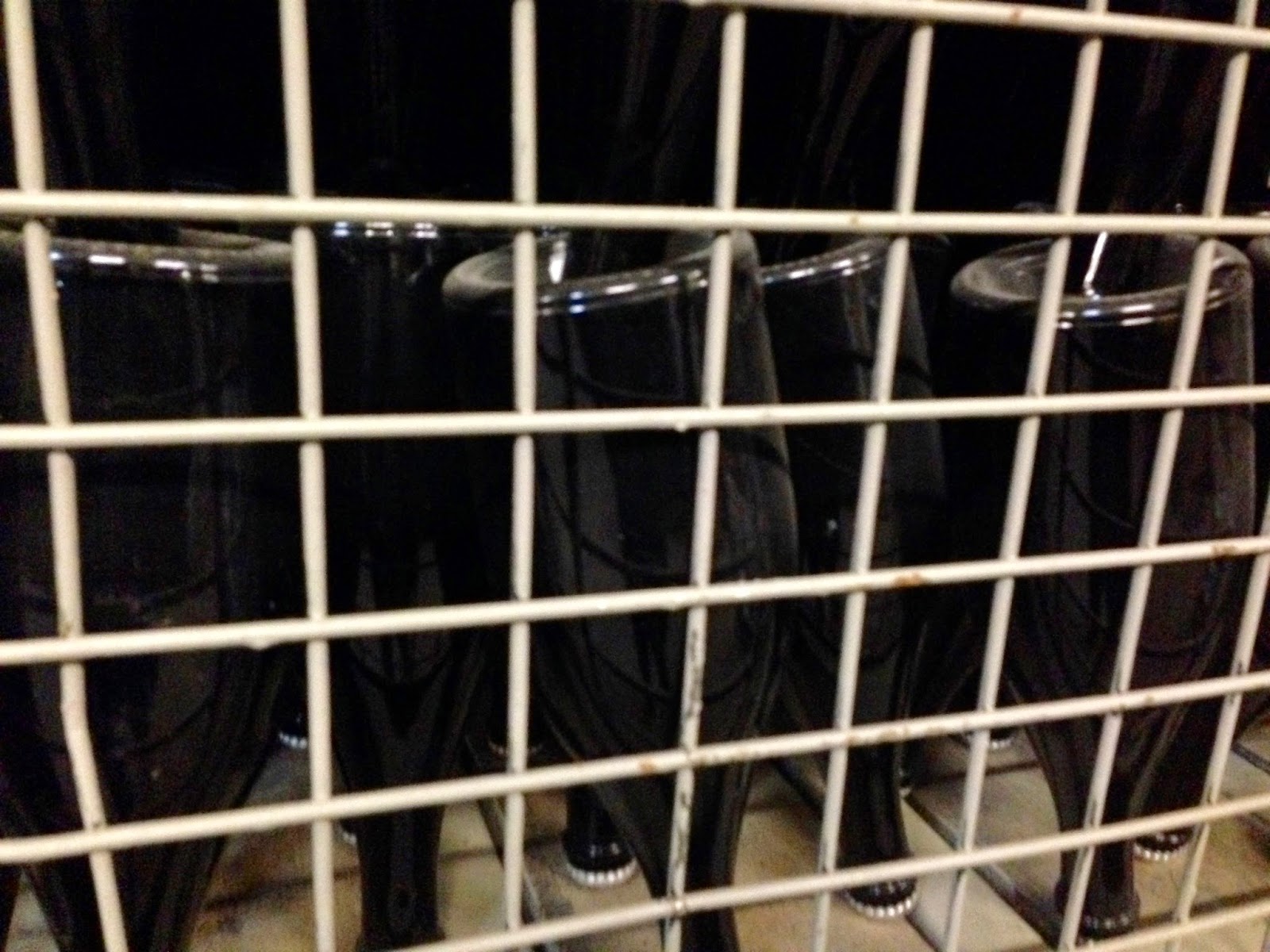
Sekt ready to be disgorged.

-       Easy to tell which bottles are being readied for disgorging.  They’re standing on their heads, allowing the yeast to collect near the cap.

No better way to spend the day, wandering vineyards overlooking the majestic Rhine River and sampling Sekt from one of the region’s great Sekt producers.

As Barth notes on their brochure, “Wine is our discipline, sparkling wine our masterpiece.”  That’s not an exaggeration.  Just ask anyone who’s tasted their Sekt.

Want to read more and explore upcoming events at Barth Weingut?  http://www.weingut-barth.de


Initial fermentation:  looking for 6 psi.

The final result of thousands of hours of work:  Sunshine in a glass!


Sunday, January 26, 2014

Crémant - the sparkling path past Champagne


Let’s chat about Crémant, those sparkly French wines from regions other than Champagne.  Specifically, I have four bottles, two each from Burgundy and Alsace. Crémant de Bourgogne and Crémant de Alsace.

I could write all day and all night about wines from Burgundy and the Alsace, but that would severely impact my drinking time, and yours.  And you'd end up like one of those effete jazz aficionados who can talk your ear off about rhythm, but can’t keep a beat with a tin drum and a jackhammer.

Let’s keep the blather to a trickle, concentrate on Crémant, and pop some corks!  But, I know you want to impress the sweet thing you’re sharing your bottle with, so here’s a “leeetle beet” about what you’re drinking, so you can make a good impression before you start to drool and pass out.

Scan this map of French wine regions and realize we’re having a chat about Burgundy (centered on the city of Beaune, pronounced Bone) and Alsace (whose capital is Strasbourg).


Alsace is especially noted for white wine, from a variety of grapes. But in the past twenty years, the bubbly versions have grown by leaps and vines.

Same may be said of Burgundy.  Although in Burgundy, reds rule the viniculture and the bubbly output does not reach that of Alsace.

The word, Crémant (Cray-mont).  The Frenchies are huge on protecting the sanctity of wines from specific regions.  Can’t call a bottle of bubbly ‘Champagne’, unless it comes from the Champagne region.  Can’t call brandy ‘Cognac’ unless it comes from the Cognac region. Not at all sure American companies follow these rules.  Pretty sure I've seen sparkling wine from California labeled Champagne.  Don't get me started on American food and beverage companies...

We do something similar with bourbon.  According to many international agreements, bourbon must be made in the United States to be called bourbon.  Tennessee distillers chose to call their whiskey, Tennessee Whiskey.

No reason I can see why Detroit and Idaho shouldn’t jump on the elitism bandwagon and insist on exclusivity with ‘Car’ and ‘Potato.’

But, back to Crémant.  How is it made?  Same way Champagne is created. But, another caveat.  Wine makers from other regions cannot call  it méthode champenoise, so they say the ‘methode traditionelle,’ meaning the same thing.

1.    Age the grape juice in wooden casks (minimum of 9 months)
2.   Bottle it
3.   In each bottle, add a mixture of wine, sugar, and yeast for a second fermentation, which produces carbon dioxide bubbles
4.   Rotate the bottles to permit the dead yeast cells to float to the top for extraction
5.   Add a wine, sugar mixture to control the final result

We’re going to taste, sip, gulp, and ingest great quantities of Brut (3 bottles) and one bottle of Demi-Sec.

Brut = very dry
Sec = dry
Demi Sec = medium dry

Fashionable to lean toward Brut, which means as much sense as wearing your hair like Brittany Spears, or buying a watch after seeing a celebrity’s wrist on a billboard.

Don’t pass on the Sec and Demi Sec out of a misplaced loyalty to fashion, or preconceived notions.  Of the four wines, each of them had different flavors, and aromas. I thoroughly enjoyed each of them.

On to the Crémant!  One bottle each of Turckheim (Brut, Alsace), Wolfberger (Demi Sec, Alsace), and two bottles from Burgundy, both Brut and from the vintner Veuve Ambal. (http://www.veuveambal.com/en/our-history.php#/Histoire?Rubrique=HistoireMarieAmbal)  Wasn’t intentional to have two from the same spot, but they turned out to also be very different, and nicely balanced, without a hint of harshness.

Turckheim (Brut) – Light and fruity, with an uncluttered fragrance(almost invisible nose). Perfect with desserts and balsamic flavored salads.

Veuve Ambal (Brut) – A noticeable tart smoothness, with fruit undertones, and a very light nose. This is ‘tart’ without curling your tongue, or wrinkling your lips.

Marie Ambal (Brut) – Full bodied, slightly tart.  Will stand up well to steaks and other roasted meats. Want to concentrate your taste buds on the grape and not be distracted by fruit flavors?  This is the one!


Wolfberger (Demi Sec) – fruity, with a beautiful nose.  In both the nose and the flavor, hints of citrus and pear.  As with many Demi Sec, this one has a rounded finish.  With or without food, this is a nice sip.


I often hear people say they are not fond of Champagne. The chalky soil of that region does induce a strong and not always comforting flavor.  Acquired taste, one might hint.  But when you think of sparkling wine, don’t stop with Champagne. Crémant offers a full spectrum of flavors, most of them softer due to the granite soil.


The skinflint in my genes also tends to genuflect at the altar of price.  Feel free to mix in more tangled metaphors.  Crémant may be purchased at a fraction of the cost of Champagne, and to my taste, loses nothing in the bargain.  Total cost for these four bottles was about $25.  I say, “Pop another cork!  Drink up!”