Showing posts with label France. Show all posts

Monday, April 26, 2021

A French Love Story, or is it?


Café Maurice spills out on the broad, cobblestone street, with wooden café chairs and round, white marble tabletops on thin cast iron legs, protected from traffic by decorated concrete blocks painted a dark pink, with white lettering on the street side that spelled out the name. 


Helmut Silvester, attired in light colored slacks, whose creases could be used for felling trees, white shirt and blue sports coat, scratched his brain, his pen poised to continue. The story that plagued him was clear yesterday, but today, the bright fire dimmed into smoky ashes. Happens sometimes.  Ideas are as perishable as midnight dreams, or a woman’s love.


Maybe that was the problem. Citrina left him, without a hint of conversation, only a hurriedly scrolled scrap of yellow, ruled paper left among the ceramic nick knacks on the mantel. “This isn’t working.”


He'd bought her a box of beautifully engraved note cards  from Gaubert’s in La Place Dauphine. She could have used one of those.  Was he only worth a ragged piece of foolscap?


A sense of loss, a feeling of desperate loneliness slowly faded, but far from being replaced by calmness, his mood had become an impending storm.  The tide was turning, rolling onto the beach with a vicious roar.


She wasn’t worth the trouble!  Visions danced. Nothing was ever good enough for her.  The episode with the bracelet he’d bought her for her birthday.  Wrong color?  Gold with delicate streaks of silver when he should have known she only wore gold?  The dishes in the sink she plagued him about?


Ah, but the firm thighs, the happy breasts, the…none of that mattered now.


The waiter must have seen his building agitation, the promise of either harsh words or a crashing sweep of the arm across the small table.


“Perhaps Monsieur would care for a Cognac?”


Helmut glanced at his watch. “An Armagnac.”


“Très bien, Monsieur.”


He did need a drink, but drink could bring on a bout of melancholy.  That was what he didn’t need.  He’d finish his café au lait, polish off his Armagnac and take a walk.  Perhaps that might keep the dark dog of depression from pulling at the leash.


Helmut had problems.  First off, he was American, born and raised, unlike his parents. The second problem was his name, which fit well with his Austrian ancestry, but not so well with his workmates at Hendric & Thatcher.  Helmut morphed into Helmet Head, 

and then into simply Helmet. His countrymen could be so crude.


He was reasonably good looking, even with thick-lensed glasses, unruly brown hair, and an aquiline nose.  His French was reasonably good, unlike some of the swine he worked with.  His office was fairly small, but during this fine spring weather the window looked out on a row of green leafy trees that lined the rather charming ribbon of street some four stories below, or three stories if you used the continental habit of not considering the ground floor in the numbering system.  Poor old ground floor was a nothing, a zero. Perhaps it was, with its barren look of four brass elevator doors and an unnecessarily large, semi-circle reception desk. Had to do something to fill up the space, but certainly not important enough for it’s own number.


Helmut had a genius for numbers, almost instantly absorbing seemingly complicated company financial reports.  He could tell at a glance if numbers were fudged, if new earnings were overstated, and his cat-like agility could spot if a company was up to its knees in cement and about to be pushed overboard.


The stories he wrote as a sideline were also quite good, or at least good enough to be published in small, rather obscure literary magazines.  “I’m a writer,” was mostly good for conversation and a free drink in culture crazed Paris.  He knew the conversation by heart.


“And where might I find your work, monsieur?”


“In le this and la that magazines.”


The coffee had grown cold, much as his story had.  He took another sip of Armagnac, licked his forefinger, used it to touch a large flake on the small white plate, and brought it to his mouth, then shoved the plate aside, yet still staring at what was left of his croissant.  It wasn’t the buttery roll that drew his attention, but the color of it. The woman in his story was a blond, or was she?  How should he describe her hair?  What would you call the color of a croissant? Faded blond? Brownish blond?


“Monsieur?” asked the white-jacketed waiter.  He hadn’t even noticed him approaching.


“Encore un café, s’il vous plaît.”


“Et Armagnac?’


“Oui, merci.”


No need to hurry on this delightful Paris morning.


The waiter delicately balanced a small steel tray holding the snifter of amber liquor and a fresh cup of café au lait.  “Merci,” Helmut said, and with a nod, the waiter turned and walked away, stopping once to have a short conversation with the woman at another table.


Hearing the feminine voice, Helmut glanced up.  The woman three tables away had the same color of hair as his character, or so he supposed.  Perhaps he should ask her.  But what would he say?  Just noticed your hair and wondered what the hell color is it?  Croissant beige? Lightly moldy cheese?  Radiance of urine?  Ah, the anger was still with him and he had to discard it, or end up with a story unprintable and destined to be sweep by the wind through a beggar’s alley.


Perhaps he should start off lightly.  “Hi, they call me Helmet. Does that hair have a touch of jaundice?  And, do you often go out in public?  Wig makers on strike?” Gotta shake that anger!


Instead, he finished his petit-déjeuner, glanced once more in her direction, and strolled the three blocks to his office.  After the second small snifter of confidence builder, he’d forgotten about the story or the character, sat down at his desk and delved deeply into a yearly report.  It left him perplexed. It wasn’t that the numbers didn’t align, but that they did.  There’s always a flaw, a sin of omission, or a vagarity that the sharp financial eye will see. Normally, it’s nothing.   You read the year’s projection and disagree with that future earnings will be 5.1%.  You do the figures, or take a recent string of mildly bad news and come out with 5%.  Nothing more than the reader being less optimistic.


The next morning, he called the office, asked if anything were pressing and told the secretary he’d be in by early afternoon, then hurried off to his usual café, and ordered the usual croissant and milk coffee.  He noticed the same woman seated at the same table as before.  He studied her face and took a few notes for his story.  While his pen scratched the paper, a shadow crossed his table. He looked up.  The woman at the other table stood there.  He stood up quickly, wiping his lips and leaving his white napkin on the table, he greeted her politely,  “Oui, madame?”


“Bonjour, monsieur.  I saw you looking at me, but not quite looking at me.”


“Was I?  A thousand pardons.”  He gave a quick mea culpa nod of the head.


“You seemed to be studying me.  Have we met?”


“I don’t believe I’ve had the pleasure.”


“You’re Helmut Silvester, are you not?”


“At your service, madame.”  His Austrian genes almost made him click his heels.


“Helmut Silvester, the writer, oui?” 


The question stunned him. He hesitated for one beat, two.  “The very same, madame.”  He offered another nod, as though accepting a knighthood from the queen.  But, the moment he said it, the shadow of suspicion crept in.  This meeting could not be by chance.  She obviously knew who he was before she approached.


As if reading his mind, she said, “I’m Julianne Baton, an editor at Esprit, and I like your work, your flair for the dramatic and with a philosophic bent.”


“Je suis débordé, madame.” I’m overwhelmed.  Esprit was the crème de la crème of Paris’ literary press.


She paid no attention to his modesty.  All writers were politely modest at first, before they turned into self-centered pricks, just like the lover who lived with her until the day before yesterday, when he glared at her, tossed his clothes in a suitcase and walked out the door of the small apartment.


She continued, “We are both swept up in the morning rush, but would you care to join me for dinner?  If Jean-Marie is free, he may join us.”  Jean-Marie?  Jean-Marie Domenach?  The director of Esprit? 


“Avec plaisir, madame!” he said, surprising himself by replying without a stammer. 


Up close she really didn’t look that bad.  In fact, her face showed a certain charm; her smile had already brightened his day. 


There’s something about French women.  A strong elegance, yet with an underlying soupcon of sexiness that can carry over into their eighties. This woman wasn’t even half that age. It’s a je ne sais quoi.  The way they walk.  The way their hands move with expressive grace. 


“If you’ve got a bit more time, we could have another Armagnac,” he said.  It befuddled him that he’d suggested so quickly, and in such a low tone, as if they could follow libations with a trip with the stairs to his apartment.


She surprised him, with a quick smile  “I prefer Cognac, even though c’est un peu tôt.”


“Yes it is a bit early, but I need not be at the office until afternoon, and even then…” leaving things implied but unsaid, in the French manner.


“Nor do I monsieur.” 


Her hair was beautifully blond after all, just like the woman in his story.  


Tuesday, June 25, 2019

Colmar Deux in Jingles


Colmar’s not so very far
If you’re driving in a car.
If you’re walking, ‘nother story
Feels like you’re in purgatory.


She’s got those nice, long legs and she’s really really neat
You can see that fanny twitching as she’s walking down the street.
The guys all think she’s sexy, but her momma knows she’s sweet,
And when it comes to sweetness, well the guys just can’t compete.


A water pitcher on the roof,
Oh, my, it seems so aloof.
With a garden near or far.
I wonder how it’ll ever get thar.


Blue shoes do amuse
But not at all what I would choose.
I would choose the browns and blacks,
For they would go with all my slacks.
Although ordinary they may be,
If not for others, they suit me.
Still the blues do amuse.


I would rather watch a fowl,
Whether sparrow or an owl,
As they flutter in the wind,
…I’ve no idea how this will end!


I ate French bacon once or twice
And I found it very nice.
And I ate some salad, too
As you knew that I would do.
For I can never get enough
Of this Frenchy, savory stuff.


Darkest chocolate tempts my taste.
I will let none go to waste.
Spoon by spoon I pop it in
And then I pop some more again.
They say dark chocolate by the ounce,
Cures some ills I can’t pronounce.
So I gobble once again,
For chocolate is the body’s friend.


Now my stomach’s full of beer
I think I’ve made it very clear.
I may drink some wine or brandy
In fact the bottle’s very handy
And since the beer has left me full
My stomach needs a little lull
It's not the fault of brew alas,
But hand and eye that filled the glass.
And left me in this awful state
Of wanting more, but forced to wait.

Saturday, April 27, 2019

Buying Wine in the Alsace


Buying Wine in the Alsace

If you’re driving to Alsace to buy wine, the first thing you’ll notice is it’s kinda sorta different from Germany and kinda not. Alsace is in France, n’est pas?  Sometimes even the French don’t know.  In 2011, the then President of France, Nicolas Sarkozy, when speaking to a group of French farmers in Alsace, mentioned that he was in Germany and the farmers booed.   Good reason.


A field of rapeseed flowers
Read about the benefits of rapeseed oil:  https://www.naturalfoodseries.com/9-benefits-rapeseed-oil/

Are you familiar with Alsace? Perhaps you remember from your high school modern European history class. Alsace and Lorraine ring any bells? Those two French provinces have bounced back and forth between France and Germany for the last hundred years and several wars: 

1870-71, the Franco-Prussian War.  This time France, under Napoleon III, attacked Prussia seeking an easy victory and renewal of his declining power.

Of course, as with all wars, this one was much more than the simple explanation I just gave you.


Result:  Prussia and a coalition of German states bloodied the French nez. Germans captured Paris. Bismarck rode on the back of this victory and was able to bring together a united Germany.  Germany annexed Alsace and half of Lorraine, along with the city of Metz.  Sacre Bleu!

1914-1918, World War I, The War to End All Wars. That would be funny except for the millions of military and civilians who were killed or left homeless.

The Result:  France got back the territory it lost in the Franco-Prussian War.  Merveilleux!

1939-1945, World War II. Germany overran France and conquered most of Europe, Alsace and Lorraine included.  German control lasted until the end of the war.  In 1947, Alsace voted to remain a part of France.  

Now you know why when you drive into the French province of Alsace on a bright sunny day, with nothing on your mind but satisfying your lust for the grape, you continue to see the names of towns that are definitely German:  Oberhausbergen, Bischheim, to name only a couple.  The people in Alsace not only speak French, but also Alsatian, a Germanic dialect.  And, it’s not difficult to also find German speakers. As some wits have put it, Alsace is not quite French and not quite German either.


But, on to wine! Vive le raisin!

A hint about Alsatian wine, with more to follow.  Riesling grapes are grown on both sides of the Mosel river, in Germany and France, yet the wines taste remarkably different.  Same with the Pinots.  Soil? Sun? Temperatures?  Those much smarter than I have unsuccessful tackled that conundrum. 

Years ago, while wandering off the beaten path, we happened upon a winery that turned out to be a lasting favorite.  As I’ve noted before, wine taste is personal, often depending on your age (yes, taste buds do change) and what appeals to your palate.  Not to overstate it, but a wine you swear by may not be a wine I would choose.  Magazines that rate wine?  Ignore them and taste for yourself.

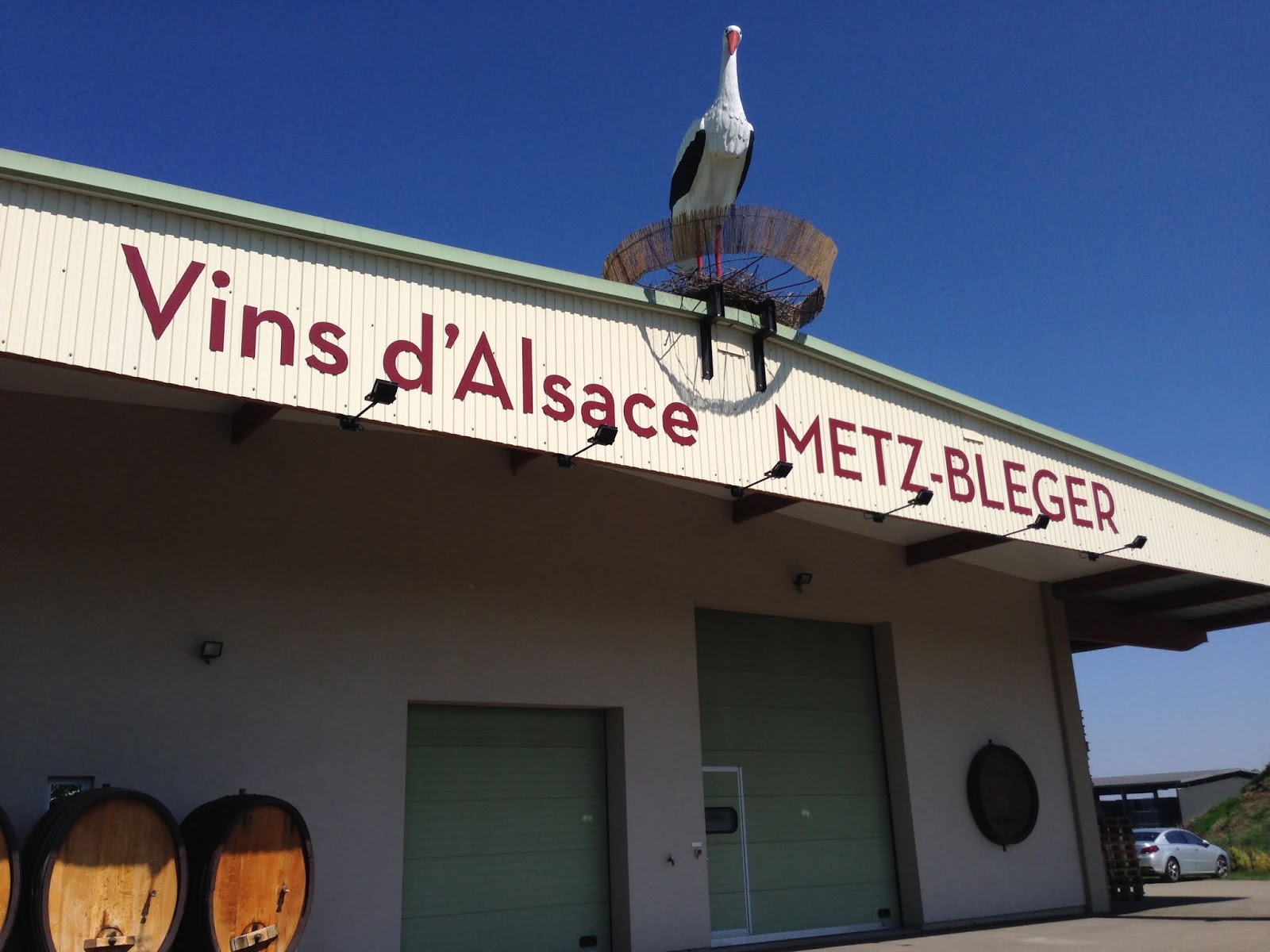
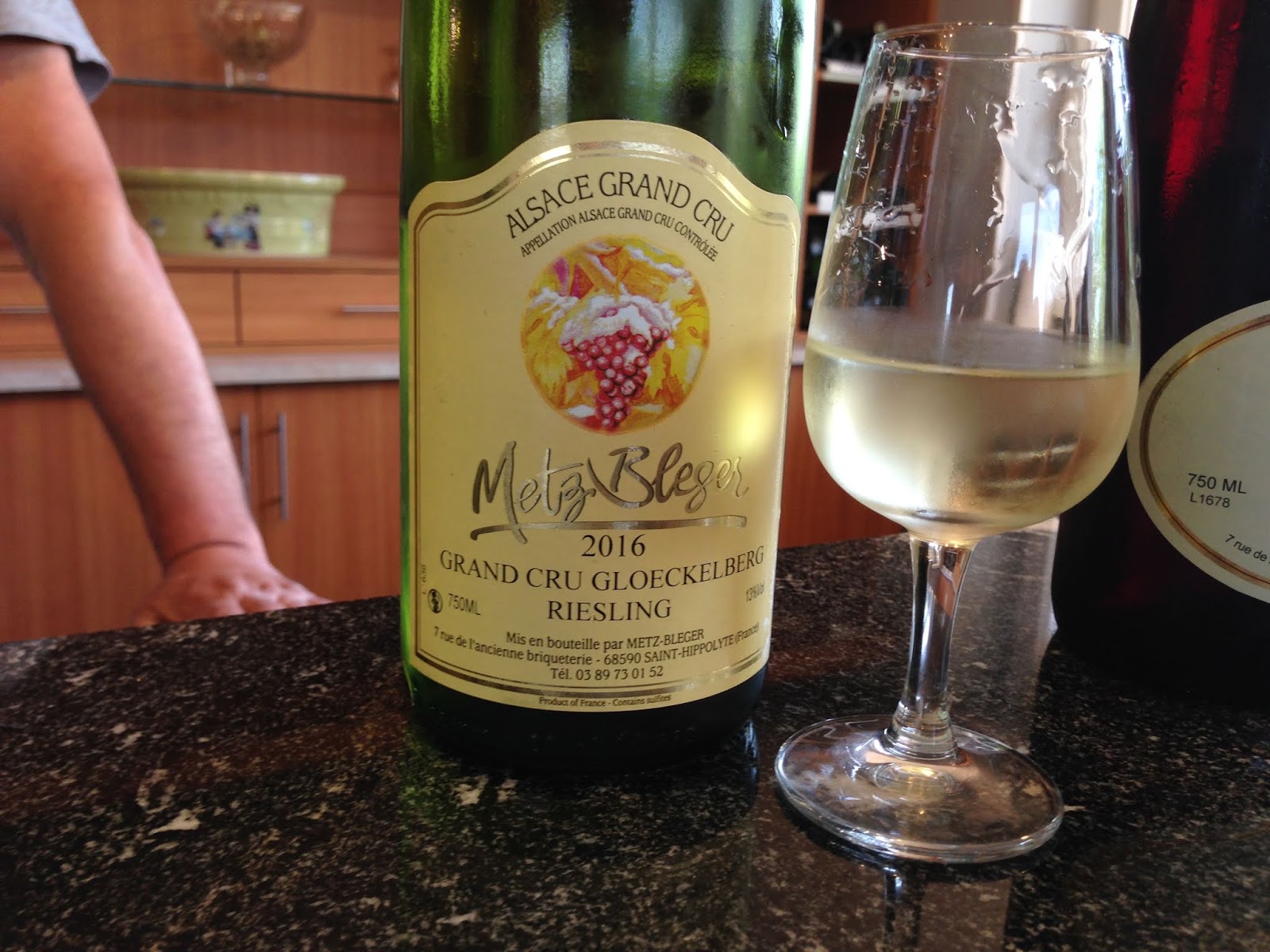
The Metz Bleger vineyards produce a number of vintages: Pinot Noir (of various descriptions), Pinot Gris, Pinot Blanc, Riesling, Gewürztraminer, Sylvaner, Moscato, and Alsace’s sparkling wine, Crémant.


As I said, there are various qualities and styles of each, so when we began tasting, the tasting lasted for an hour or more.  This was an afternoon of “Yes, thanks, I will taste another,” which all too quickly devolved into “Jes tinks gimme a new grass….glass.”  You want to sell wine, take a lesson.  These folks loaded over 200 bottles in our trunk and backseat.  Fortunately, my companion took tiny sips, as though Queen Elizabeth had gently placed a white-gloved hand on her shoulder.

Such fortitude and iron will!


Ok, fine, you’re thinking, but what about the wine, aside from the obvious, that in a game of taste buds vs brain power, it’s checkmate by the taste buds every time.


In general, what I like most about Metz Bleger wines is their smoothness.  Most of the vintages subdue the harshness of heavy tannin, in favor of pure enjoyable flavor.  The range of sweetness is remarkable, from the dry, but still roundly finished Pinots, to dessert white wines.

My personal preference is the half dry.  I don’t like to lick my lips and then have to brush away the dust, but neither do I prefer wines that are too flavorfully light.  There are some dry whites that attract me, because in the French whites the tannin is almost always subdued.  And in the proper context, I can also relish a delightfully sweet desert wine….but only a glass.


Is it too much for us to suggest wines have personalities?  I’m thinking of a white that adds sparkle to the summer day as you sit by your garden and watch the flowers dance in the light breeze, or a pungent red that warms the heart as you sit by the fire on a frigid winter evening and gaze at the flickering flames.

I like to think of the wines of Metz Bleger, as the beauty of sunshine and a comfort on cold winter nights.  That must be why we keep going back!


Tuesday, August 21, 2018

Saverne, A Beautiful Town in Lorraine


Saverne, France

Located in Lorraine, in the Zorn valley, just an hour and a bit more from the German border, the picturesque town of Saverne has a long and sometimes bloody story to tell.

Never heard of Saverne?  Didn’t make your top ten?  Well, make room for it, even if you’re just looking for a day trip. Saverne harbors a fabulous shopping street of half-timbered buildings, sidewalk cafes and a picturesque promenade along the Rhine-Marne Canal (competed1853).


Matter of fact, the canal is the reason we visited Saverne.  Friends had rented a boat for a few days of canal cruising.  Being landlubbers by nature, except on cruise liners where wait staff, attired in black and white livery, come to the poolside to offer to slake your thirst with a martini, we skipped the boat trip and drove straight to Saverne for French Cuisine, wine and more wine on the back deck of our friends’ rented vessel and an overnight stay at L’Hotel Europa.

Waiting our turn.

Into the Lock

When the wine began to run low, I wandered off the boat with a friend and discovered the wonders of the shopping street.  You see, in my family, we don’t play by the rules.  Being restless by nature, I’m the shopper and my significant other would rather loiter in a sunny deck chair and sip more wine.

But, I had a good reason for slipping away.  Not only did we need a few more bottles of wine, but because we also found the stash of brandy
woefully inadequate.  Then there was the need to pause to sip a coffee and practice our French, also woefully inadequate.


But, is there more to Saverne than a half-timbered shopping street and copious quantities of vin?  Yes, as a matter of fact.  For one, there’s the Chateau de Roan, which professes to be a huge museum with a collection of Roman and Celtic artifacts. The building has a long history, too.  Too long to go into and a long list of Cardinals and Princes who once called it home would be wasted on my two faithful readers. Old Castle build in 1417, still preserved, burned several times and rebuilt several times, the last rebuild was 1790.


Romans here?  C’est entendu!  Everywhere you go in Central Europe, the Romans have already come and gone. With a thousand years of history, the Romans built a spider’s web of major roads, many of which are still used, even if the original stones have long been covered with modern materials.  In Roman times, Saverne was known as Tres Tabermae Casaris, or Ceasar’s Three Taverns. Through common usage and a need to shorten conversation the name morphed into Saverne. 

Why were the Romans here?  Simple, Saverne sits at the base of a route through the Vosges Mountains and this spot on the Zorn River was the perfect spot to change a wagon’s oxen for the steep climb over the mountains.

But even the powerful Romans had their troubles and a collection of German tribes, the Alemanni  (hence the French word for German, allemand, and Germany, Allemagne)  overran the Roman settlement and destroyed the town.  Emperor Julian drove the tribes out and reestablished Roman control, as well as rebuilding the town.

But this wasn’t the only time the town suffered, the biggest being the Thirty Years War (1618-1648).  Short version, Catholic states in the loosely formed Holy Roman Empire, versus every Prince and nobleman who wanted their people to be Protestant, devolving into who would rule central Europe, the Hapsburgs (mostly Germany/Austria) or France.   The Thirty Years War was not trivial, with devastation over vast areas and more than five million casualties.

Then, of course we come to the Franco-Prussian War and Alsace and Lorraine becoming German, then becoming French after WW I, then German in WW 2, then back to France in the aftermath of WW II.

German soldiers patrolling the streets of Saverne circa 1871


So do the people speak French and German?  Yes, but mostly French and also English.  When the exchanging of money for goods is the object, learning a few languages is suddenly easy.  Learn or stave is a wonderful motivator.

Ain’t it nice to know something about the city you’re visiting?  That done, it’s time to pick out a restaurant and do some French dining.  Lots of good restaurants to pick from.  If nothing else, follow the crowd!  We were only in Saverne one night, so I do not have a favorite.

Just one of the many wonderful restaurants, many of them on the shopping street.


Nice also to stop in a market. Lucky it was market day.  All across Europe, but especially in France, market days are wondrous.


I heard a French housewife say, she wouldn't buy vegetables without dirt on them

 
But, here is a cardinal rule for France, whether shopping or dining or stopping at a café for a coffee.  The first word out of your mouth EVERYTIME should be Bonjour, otherwise you are being unintentionally rude.  But, how the dickens do you pronounce it? YouTube makes it easy!

https://www.youtube.com/watch?v=1ifvpfobEdc

Cafe by the canal.

Same Cafe

City Hall

Boy meets dog.  Dog is delighted.

Entry to City Hall