Monday, September 19, 2016

Lunch in the Great Outdoors: A Culinary Walk


Like to eat delectables, walk a few miles (or kilometers) breathing fresh, country air, and sloshing down some smooth-as-silk local wines?  Not talking about your backyard BBQ, or the shady park down the street.  I’m talking out in the fields where the buffalo roam…or at least a herd or two of cows, under a blue sky, with temps in the 80s Fahrenheit or the high 20s Celsius.

On such a beautiful day, it’s time to stroll and concentrate on: Good wine. Good food. Good company.

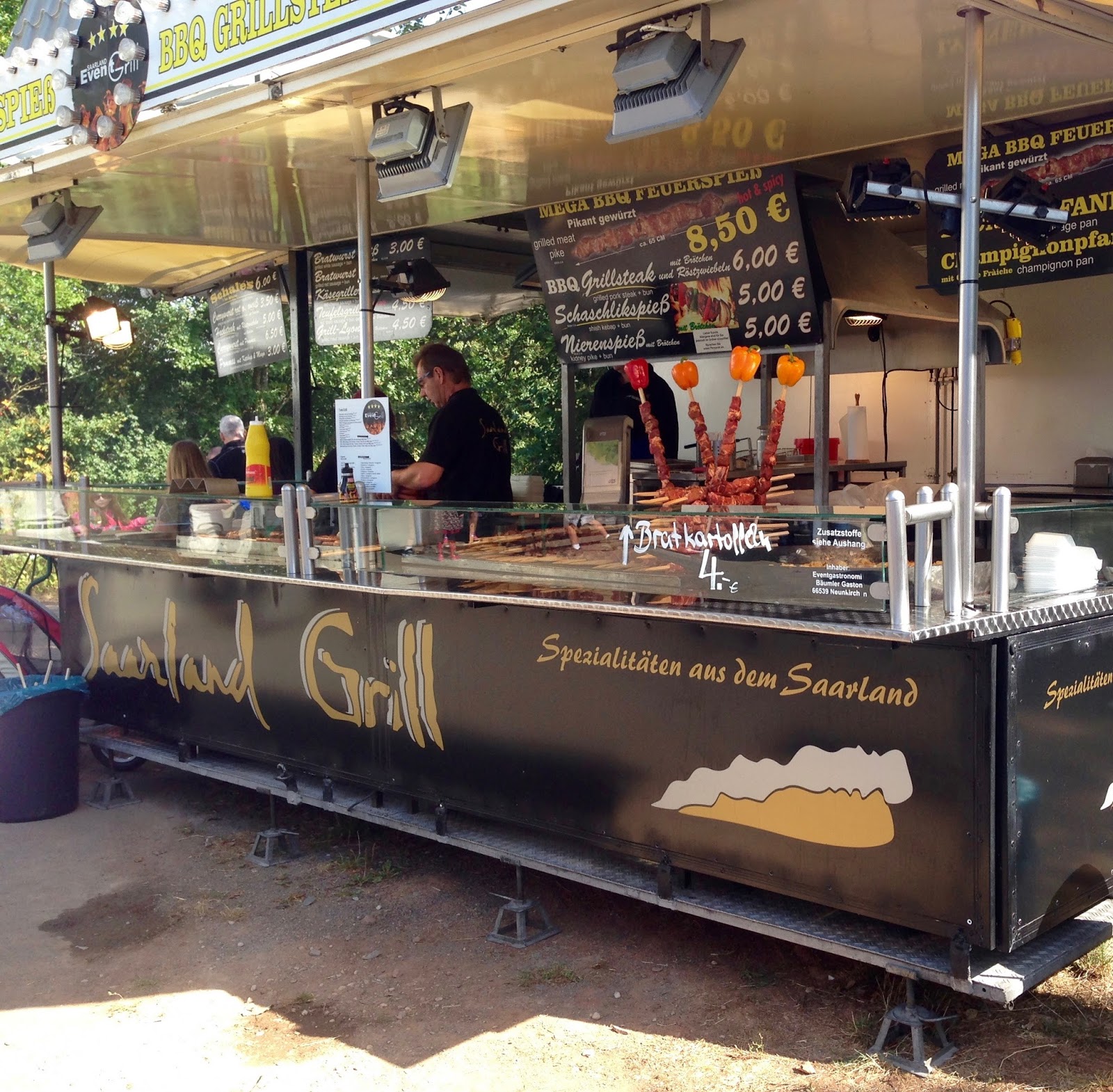
Germans are some of the most social people you’ll ever find.  And to prove it, they organize weekend walks that take you up and down hills, through fields and small towns, over bridges, even in the rain and not so rain, always with an over abundance of Food, Wine, and Beer!  On this particular afternoon, there were stops every half-mile or so, to take a breather from hiking, slack the thirst and gnaw some solid fixin’s.  Like what?  Grandmother’s pancakes slathered with vanilla-cream sauce. 
Grandmother's Pancakes

Barbecue pork that would made this southerner weep with joy.  Blackened chicken sandwiches with ancho mayo, better than anything I’ve tasted in New Orleans.
Blackened Chicken

 Succulent, planked salmon, with dilled sauce. Big chunks of grilled steak on a stick. And, oh my goodness the libations!  White, Rosé, Red, Sparkling, mixed.  Prost!


All of this cast against the splendor of endless, emerald green, rolling fields, bright blue skies, puffy white clouds, and the blessing of golden sunshine.  On this day, there were eight stops, each offering wine from different vintners and mouthwatering foods from culinary artists.  Like your wine dry?  No problem.  Sweet?  Ditto.  Maybe you prefer a wine watered down with fruit and soda, or a fresh mint concoction called a Hugo.

Make your own Hugo:  Muddle a few fresh mint leaves in a glass, add sparkling wine and elderberry syrup to taste.  Fill 'er up with ice and garnish with a slice of lime. 

Hugo!

Add to that, the serendipity of meeting friends, and spontaneous conversations with strangers who rapidly become new friends.  Met so many people!  Interesting conversation with the owner of Big Boys of Germany barbecue company.

“You must try some of my pulled pork.”
“Sure, but I warn you, I’ve had barbecue from all over the south.”
“Come with me and look at this.”  He leads me to the rear of the stand, where his grill (the size of a small tanker truck) must have had five or six hundred pounds of steaming pork.  He lifted the side and I marveled at the rotating shelves of foil wrapped roasts.  
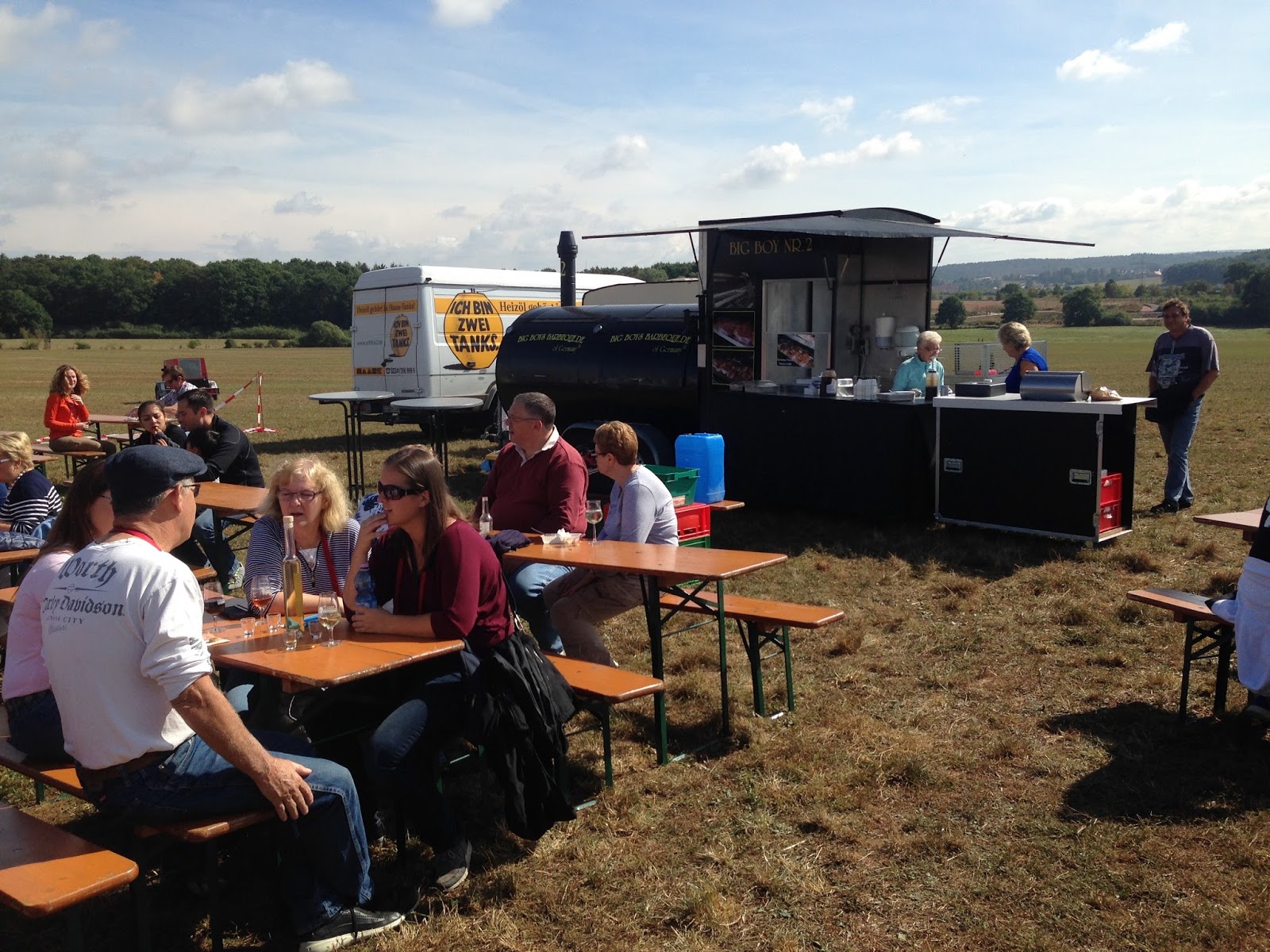
Only one of the two huge chambers
Then he explained, “I wood-smoke my meat for six hours, then I wrap it and steam it for another fourteen hours.”
“What kind of wood?”
“Cherry.”

Naturally, I can’t back away from the challenge.  Oh my goodness!  As tender and succulent as your first girl friend!  Well, maybe I over stated it a bit, but nevertheless…  I told him it was the best pork barbecue I’d ever tasted.  Full flavor of pork and seasoning, the meat falling apart, without a touch of dryness.  This was pulled pork exactly as it should be.


The glory of these wanderings is something that makes Germany a wonderful place to live. These Volksmarches, or Wanderungs, are a German institution. From early spring to late fall, there are a few every weekend, and no matter where you live in Germany, you’ll find one nearby.  This one was a Kulinarische Wanderung, or Culinary Walk, but even if Culinary is not in the name, there will be plenty of wonderful delights to eat and drink.

It’s no secret, as a group, Germans like to get out and wander the forests and fields. The weather doesn’t matter much.  No matter where you live, if there are forests, there are walking and biking trails. I’ve seen elderly Germans, pushing walkers as they trek through snowy drifts.  As the saying goes, wherever you find two or more Germans with similar interests, you’ll find a club.  On the organized walks, when you add food and drink, the club goes public and gets ebulliently large.

Ah, these are the splendid days that make you wish the day would never end, but when it does, the sparkling memory makes you look forward to tomorrow!


Monday, September 12, 2016

Introducing Bobby Hackett! My favorite Trumpet Player


This is an intro to my favorite trumpet and cornet player, Bobby Hackett.  But, I have to warn you, listening to Bobby Hackett is an addictive step back into the nostalgic era of big bands, when melody and virtuosity counted, when drums were only a part of the ensemble, when romance drifted through the air like the sweet fragrance of honeysuckle, and “making love” expressed the tender emotions of being in love.  Nowhere is this more evident than in Hackett’s version of “Embraceable You.”

With melody written by George Gershwin and lyrics by his brother Ira, to get into the romance of this song (that has been recorded by almost every jazz musician and singer you can name), you need to first hear the words before listening to Bobby Hackett’s incomparable instrumental arrangement.  So, here’s Billy Holiday in a recording from circa 1944:


Now, experience the enchanting sound of Bobby Hackett, as he plays all around the melody, permeates your soul and makes you want to hold the girl of your dreams in your arms and hope the music never ends.


I mentioned he played trumpet and cornet, very similar, but different instruments.  The first thing you notice is the cornet is shorter, more compact.  A second difference is the cornet’s tube that begins to expand just past the mouthpiece, while the trumpet’s tube doesn’t expand until the lead-in to the bell. But, bear in mind trumpets and cornets also come in a variety of shapes.


As with many musicians of the time, Bobby played other instruments.  After a dental procedure that left him unable to play the horn, at least for a while, he joined the Glenn Miller Orchestra to play guitar, as well as playing short trumpet solos on such songs as “String of Pearls.”

In the 1950s, Hackett was the trumpet soloist on many of Jackie Gleason’s full orchestra, easy listening albums.  Here is My Foolish  Heart with Bobby Hackett playing the eloquently understated trumpet solo in his seemingly effortless, inimitable style.


Robert Leo “Bobby” Hackett’s musical career covered the big band and jazz era from the 1930s through the 1950s.  Mention big names and you’ll find that Bobby Hackett played with all of them, as well as on movie soundtracks.  Bennie Goodman.  Glenn Miller. Andrews Sisters.  Fred Astaire. Tony Bennett, Dizzy Gillespie.

It’s no wonder his music lives on.  His lyrical trumpet lightens the day and even when the music is over, it plays in your heart.  Want more?  YouTube has plenty.  Also online at jango.com


Friday, September 9, 2016

The Castle of Mey: A Jewel in the Shetland Islands


The Queen Mother in a small part of her extensive garden.


One thing I’ve learned about cruising:  You can’t remember much.  It’s one of the reasons I prefer short excursions.  I’ve tried the all day and half day trips.  I end up tired and longing for a man in a white coat to approach me by the pool and ask politely, “Shall I make that a double, sir?” I may remember one or two places well, but the rest fade like fog in the black of night.

On the other hand, when I find a jewel, every detail sticks in the memory.  Ephesus, Pompeii, the winding streets and crystal blue water of Cinque Terra.  On our last cruise, a couple of our stops were in the Shetland Islands in the far north of Scotland.  Yep, we saw greenery, and got to pet Shetland ponies, but the thing I remember vividly is The Castle of Mey.  Why the name?  Mey is a nearby village.  Why is the castle of such interest?  Read on.


If you’ve traveled in Europe you’ve see scores of castles, big, small, ruins, historic, fanciful, overlooking valleys, and even a model for Walt Disney’s Disneyland.  Each splendid in its own way, but how much do you remember.  Come on, cough up a few details!  Not easy, is it.  So why would I remember The Castle of Mey?

I’ll begin with a few details about the long and storied history of the place, although recent history is what really sticks.  The castle was built between 1566 and 1572, but enlarged and changed many times over the years.  In 1952 something special happened.  By then it was dilapidated and the gardens fallen into neglect.  The U.K.’s most northern castle was slowly withering away under the onslaught of time.  Fortunately, Queen Elizabeth The Queen Mother, widow of King George VI who had died a year earlier, fell in love with Mey and bought the castle and surrounding lands.

Does George VI ring any chimes?  His brother, Edward VIII, famously abdicated to marry the American divorcee Wallis Simpson.  George VI reluctantly accepted the crown in 1936 and was the King of England throughout the Second World War.

But, let’s get back to the castle.  Why would The Queen Mother buy it?  Surely the last thing the royals needed was another castle.  Well, yes and no.  They own nothing and to very loosely paraphrase The Queen Mother: I had never owned a home and wanted something that was mine.  Strange words from someone who everyone assumes wanted for nothing.

I warn you right away that photos inside the castle are not permitted, probably for security reasons, since Prince Charles calls The Castle of Mey home for a couple of weeks from the end of July to the first part of August.  I’ve heard it said he comes for grouse hunting.  As a consequence, any photos I’ve used of the interior are taken from public sources.
 
The Extensive Gardens


The first thing that caught my attention was the garden.  Perhaps it was because on a Lilliputian scale, I like to call myself a gardener.  These are no little plots, or a couple of tidy rows of blooms. The castle gardens are vast and segmented.  In the largest part, well-trimmed hedges divide and separate, making every turn in the path a new and often unexpected delight.  Flowers galore.  Row upon row of vegetables.  Wild grasses and more flowers.

Now that the Queen Mother is gone (Elizabeth Angela Marguerite Bowes-Lyon : 4 August 1900 – 30 March 2002) what need is there for vegetables?  I understand the preponderance of flowers, just for the beautification of the castle and grounds, but vegetables?  Yes, they are still used when Prince Charles is visiting, and also in the visitors center café, as well as being sold locally.  When The Queen Mother lived here, she took great delight in gardening and the plantings, although changed, still reflect the reach of her green thumb.

What interested me most was the answer to the question, what was she like?  By all accounts, The Queen Mother was a wonderful person, easily approached and easy to converse with.  It’s no wonder she was often called ‘the smiling Queen.’ In the First World War, she personally cared for wounded soldiers.  After moving to The Castle of Mey, her social schedule continued unabated.  The dining room and guest bedrooms seldom stayed empty.  Nor were the locals neglected.  She met many of her neighbors.  During a walk by the sea, only 400 meters away, she met a local lady.  They sat on a bench for a chat and The Queen Mother enjoyed it so much, they resolved to meet again and did every summer.

In my estimation, there is much evidence she craved the common touch, a sense of normalcy after all those years of fulfilling duties and living life in a glass bowl.  The Castle of Mey offered a respite where she could be comfortable and although it was larger than most houses, it was home. 

Despite her royal duties, The Queen Mother continued to spend her summer vacations here from August to October.


You feel the human touch from the moment you enter.  Not grandiose or the product of an interior decorator, the décor is more homey than elegant, the kind of place you’d like to sit and read, or play cards and chat.  Even the dining room, while clearly formal, has a certain hint of informality.  Both the interior and the castle grounds pay homage to a woman of the world who had never lost the human touch, or the need for it.


There’s another story of The Queen Mother that plays to her love of people and deep understanding of human nature.  One evening, some of the guardsmen who protected her played a little joke.  They’d purchased a small stuffed “Loch Ness Monster” and astride each other’s shoulders, they placed ‘Nessie’ on the curtain rod above the living room drapes.  On discovery, the household staff wondered how they would ever get it down.  But, when The Queen Mother spied it, she laughed and said it should stay where it is.  You can almost picture the twinkle in her eye.  After all, she was awash in close relatives, male and female, so she well understood that boys will be boys.  She accepted that.  Relished it in fact.

So, where did I get all these stories?  Google?  Bite your jaded tongue.  Of those who guide you through the 12 rooms that are open to the public, most knew The Queen Mother well, serving as domestic staff, or even delivery boys.  They bring to life the humanity of the royal, yet humble woman who tended wounded soldiers, raised daughters (one who became Queen), supported her husband through the rigors of a long, brutal war, yet craved the common touch.  The Castle Mey is a testimony to that stout heart and gentlewoman, Elizabeth Angela Marguerite Bowes-Lyon, Queen Elizabeth The Queen Mother.

So, who owns the castle now?  The Castle of Mey Trust, a registered Scottish charity owns it and is responsible for its upkeep.

By the way, if you and eleven of your well-heeled friends would like to stay for a long weekend, the castle is available (all bedrooms except The Queen Mother’s) for only £50,000 ($66,521) or a bit over $5500 per person.

The Queen Mother's bedroom