Showing posts with label Southern Italy. Show all posts

Wednesday, May 1, 2019

Back to Bari: La Tana del Polpo (The Octopus Lair)


La Tana del Polpo  (The Octopus Lair)

The best restaurant we visited in Bari, Italy, is on a narrow, cobblestoned back street. 


You would probably walk passed the plain and completely understated and yellowed signs on either side of  the old double doors, that announce:  La Tana del Polpo.  Trattoria di Mare.  Spaghetteria. Don’t think any of my three faithful and world-traveling readers need translations of the last two.


How in the world did we find this place?  It’s quite easy.  First you find a couple of English femmes, mother and daughter, who speak Italian.

No, they do not hang out on street corners, waiting to help the helpless.  You have to actually strike up a conversation and end up spending a pleasurable two days with them before they let you in on one of the best seafood restaurants in the ‘Seafood City’ of Bari, Italy.


The place was filled with natives, which is always a good sign.  And even with its humble location and atmosphere, the restaurant required reservations.  That’s also a good sign!

The place was packed! The waiters hustled!  The noise level was enhanced by the normal shrieky strain of Italian voices and waving of hands.

Speaking of Italian voices, have you ever heard two or three middle aged Italian men chatting, sitting at outdoor bar-tables on a narrow street, with high stone walls and excellent acoustics?  Sounds very much like the discussion will end with the forfeiture of a life or two.

The fast paced chat is actually:

-      This beer is so ordinary, I don’t think I can finish the whole six pack!
-      Giuseppe, when you say that, I know I have to guard my beer!
-      If a calf drank this, the poor little thing would think he suckled on the wrong nipple!

What it sounds like to the non-Italian to hear Italians practically screaming:

-      You mamma so big she needsa bench in the confessional!  Da priest smella her breath and say, Please don’ta bringa you dog in here!
-      Oh yeah? Two plus two in you house makes 1 ton.
-      I be kind and use a sharp knife to take you balls off!
-      Careful you don’t cut you sister’s face!

But, in La Tana del Pulpo, the conversation is more modulated, like a train coming through the station, but not blowing its whistle.  

The waiter approaches, passes out menus and asks if we want something to drink.  He was giving us the benefit of the doubt.  
“Wine and keep it flowing!”

 “So, you want a bottle?”
 “Yes!  And three glasses! And bubble water!”
“And la bella signora con gli occhiali e i capelli alla moda?”  (The beautiful lady with glasses and stylish hair?)

Yes, we were in Italy, where lucky-in-love is not a hope, but a mandate.

Soon splendid appetizers arrived, of which the octopus salad was the star of the show.  I’ve never cared much for octopus.  I’ll always eat some, but find other choices more appealing.  HOWEVER, we all tore into this vinegary-tender gift from the sea as if a farmer had called out, “Last one to the trough starves!”


Also, the razor thing salmon carpaccio, around chunks of tuna melted in our mouths.


How about the wine?  A superb regional wine from the Primitivo grape. Have you tried a Primitivo?  Some call it Zinfandel by another name.  Not so.  Maybe first cousins, but not at all the same.  To my taste buds, Primitivo carries a more lush flavor and a fruitier nose. In fact, if a bottle says Primitivo, I’m going to try it, even if the label doesn’t ring any chimes.


And the main course?  Spaghetti alle Vongole (Spaghetti with clams). Outstanding!  I ordered sole and have never had a better grilled fish! Lightly charred and ever so tender! A fresh slice of lemon squeezed over the fish....Mamma Mia!  

One of the more adventurous members of our newly formed clan, ordered spaghetti darkened with squid ink, and with chunks of fat shrimp in a wonderful cream sauce.

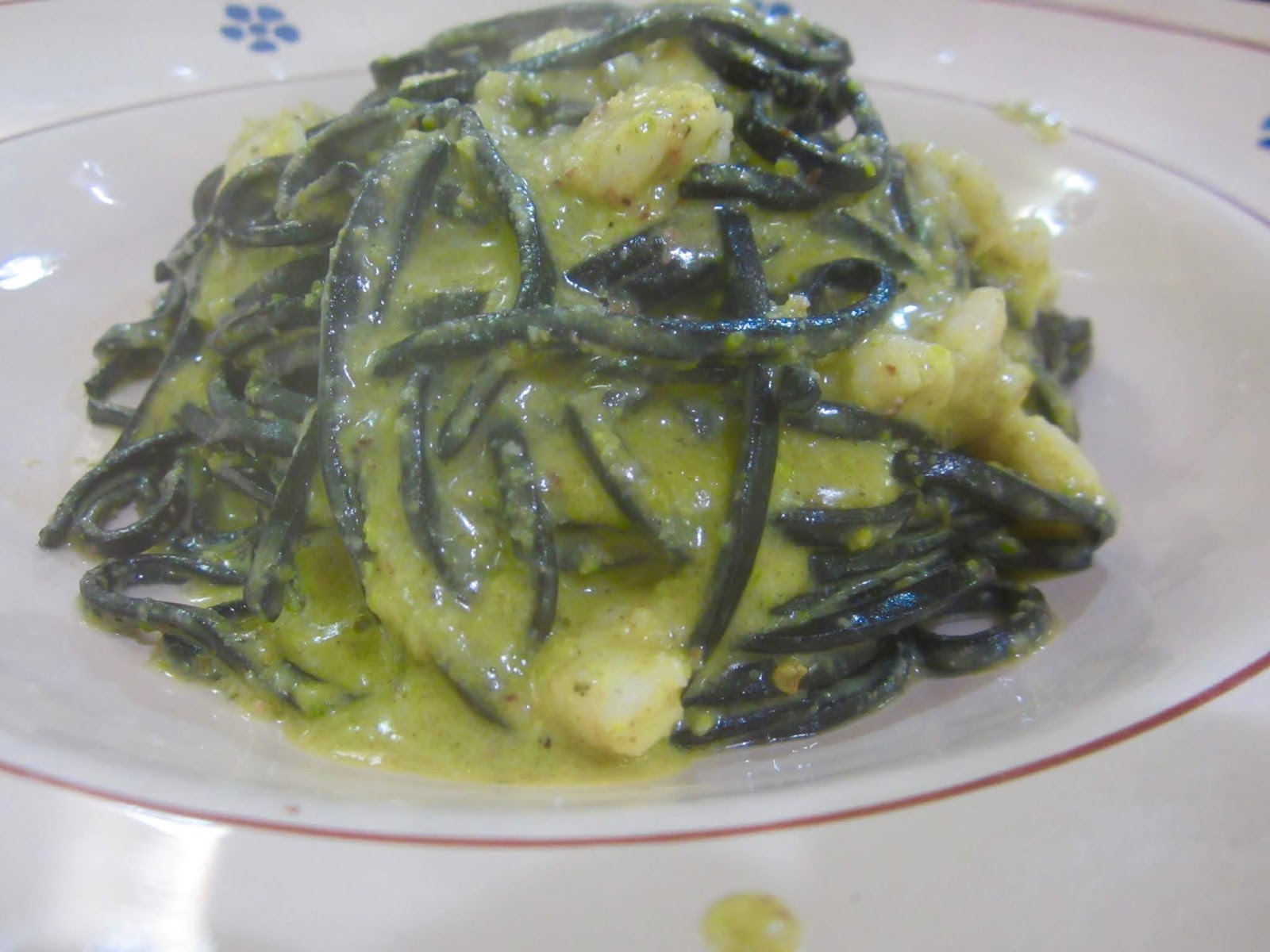


The food at La Tana del Polpo is so very good and fresh….as a matter of fact, a waiter brings out a platter of freshly caught fish for you to choose…    If  you not sure what you want, let the waiter make the choices, as he did for us with the octopus salad.  No matter what you order, it’s going to be superb.

Afterwards, the four of us wandered off for a nightcap, a fitting end to a day of adventure and an evening of fabulous seafood in a restaurant I would happily visit often!


Thursday, April 25, 2019

There are few cities like Matera, Italy


There are few cities like Matera.  

I’ve visited many of the famous and grand cities of Europe and written copiously. So, what makes Matera, Italy, in the province of Puglia so special? It is the third oldest city in the world, after Aleppo, Syria and Jericho.  Jericho is in the West Bank, taken by Israel in the six-day war, but later given back to Palestinian control.

Sassi di Matera has had a tumultuous history, with wars and conquests over centuries.  I could give you a list, but the thing that really stands out is that Sassi di Matera – the old part of the city - has been inhabited by humans for perhaps 9000 years.  The first folk were stone-age troglodytes, meaning they lived in multitudinous caves lining the sides of a river, which is now a stream at the bottom of a deep gorge.

But, since few of us can identify with troglodytes, the more modern history of the city goes like this.

With modernity came improvements.  Cisterns to collect rainwater are under many of the houses that were built into and around the caves.  Today in Sassi di Matera, it’s no longer possible to actually visualize that caves are there.  White colored stones held together by mortar frame the caves, providing more comfort and obscuring what lies beneath.  Streets paved with stones run everywhere. In some ways, walking the streets, with the odd alleys and steep stairs leading to upper levels, the Sassi seems more like a warren than a city.


We found one home that is a museum cave-house and shows how people lived right up until the early 1950s. It was a peasant community, with most work done in the fields as laborers and shepherds.

The museum interested me because of the extent of the cave and how different hollows expressed the division of labor.  Improved cave homes were in many ways small and private factories, with rooms where leather was tanned and medicine was made and food was cooked.  Other rooms had spinning wheels and looms, or blacksmith equipment.


The Catholic Church held much of the town’s real estate.  You can still see hewn stone over many of the doorways that once signified church property.

Poverty was also rampant, possibly because the rulers at the time established a law benefiting large landowners. Property was left to the eldest son, and prevented him from dividing it and selling off smaller chunks.  This was unlike the north of Italy where large estates could be broken up, leading to arable land being more equitably divided.  

By the 1950s, poverty was an epidemic in Matera and in 1952, the Italian government, in an effort to deal with what was then considered dire living conditions, forcibly moved upwards of 16,000 residents to other places.  With the city deserted, brigands and smugglers moved in to bring back the banditry that had existed a century before.

Italy as a united country has existed a relatively short time, hence the peculiarities and differences of older laws in the north, south, and central areas.  Here is an interesting, progressive map that show how Italy slowly united from 1829 onward.

Click on the colorful map on the right hand side, about half way down.

What was life like in the ‘Sassi’ in the more recent past?  Antonio Niccoleti’s father lived there and had strong memories of the place he called home.

“My father has some very dark memories of the Sassi.  But he also has nostalgia for its social life. People lived outside in their vicinato,  or courtyard, which was like a tiny piazza.  There would be children playing, men gossiping, and women shelling peas with their neighbors.  They helped each other in every difficulty.”

But as with many other places in Italy, Sassi di Matera’s age and history eventually saved it.  Little by little, men with foresight saw the future as a tourist opportunity, and moved in to rehabilitate the old city. Now the old section, Sassi di Matera is once again populated and seems to be thriving, with the old section of Sassi connected to the new city of Matera.

Wander the streets of the old city and you’ll find shops and homes and all the things that make a city live and breath.  Stroll farther, to the cliff overlooking the stream and you’ll have a distant glimpse of many of the caves used as home thousands of years ago.


Just yesterday, I watched birds pecking for food in our garden and it occurred to me that humans were once just like the birds, with their days spend searching for food, and the difference between life and death a precarious, day to day struggle.

Sometimes we need to look back, not only to the times we lived through, but to how our forefathers lived and even beyond the time of written history.  By looking backward, we suddenly appreciate how far humans have come from the days of the troglodytes, when everyday living was a simple struggle for survival.

For me, Matera was a wonderful place to take that backward glance. And afterwards, when I sat in a comfortable seat on a train taking us back to Bari, I reflected on the relative luxury of our modern world.  The struggle for living is for many of us, not the struggle of our ancestors.  I won’t step off the train in Bari, knowing I’ll have to sharpen my stone tipped spear if I want supper, or trek up and down a steep hillside for a drink of water.

No, I’ll simply go to a nice bistro, order a variety of dishes, sip some delicious wine, pay the check and go back to my very comfortable hotel.

As I said, sometimes to appreciate today, you have to look back…sometimes thousands of years back. Matera.


Friday, April 19, 2019

Bari to Alberobello


The train trip from Bari to Alberobello takes about 1hour and 40 minutes.  The trick is, finding the right ticket office.

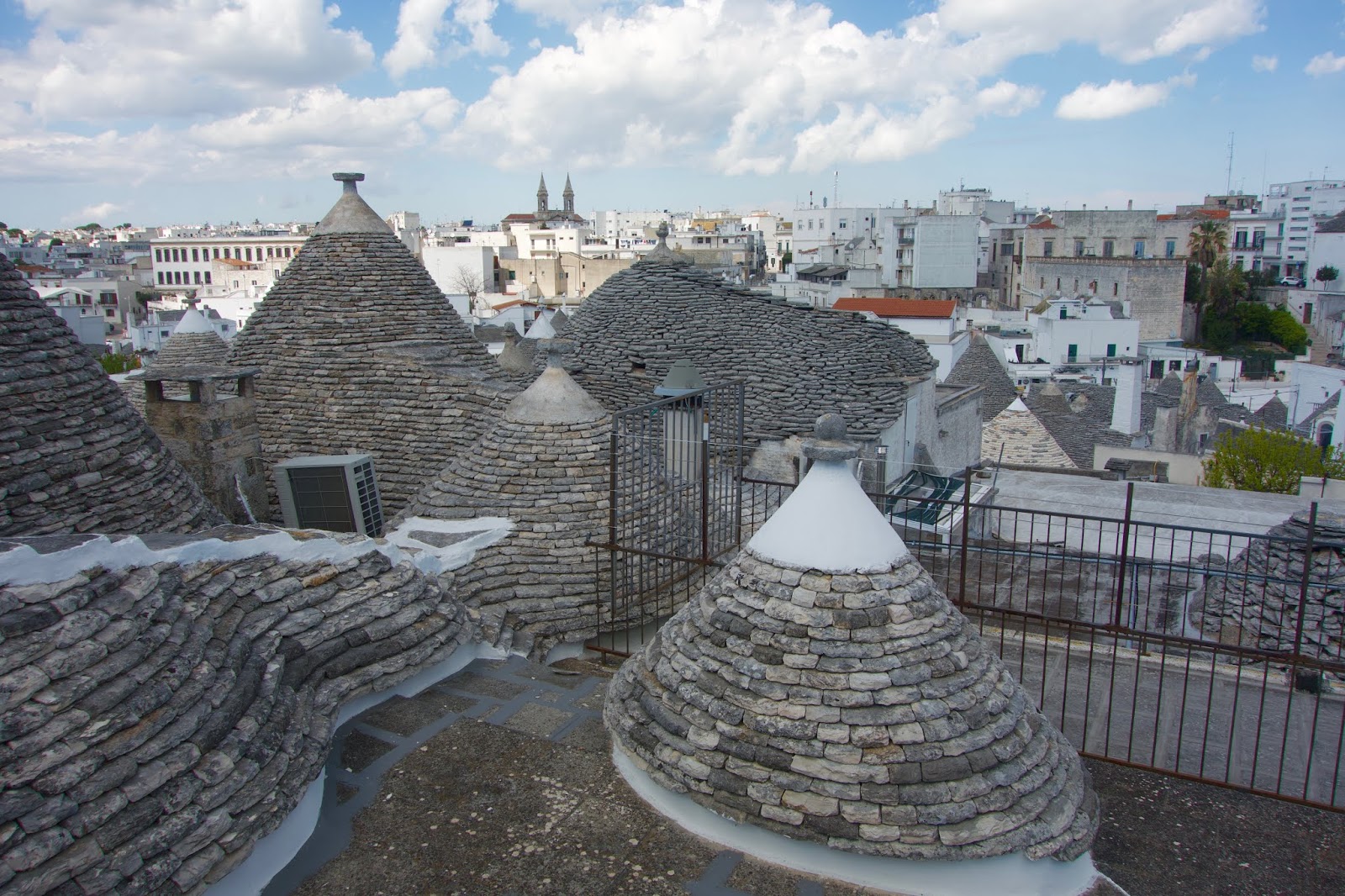
Alberobello seemed like a good destination to slosh down some wine and see the trulli, those pointy roofed houses found only in this part of the world and one of the main tourist attractions in the Bari area. Alberobello is also a UNESCO world heritage site.

Good news.  Trains leave every hour. 

Tried the main train station. Uhhhhh…no.  A kind ticket clerk sent us across the way to another ticket office.

High hopes, but this was also a losing lottery ticket.  Another kind ticket clerk sent us next door to a café. Really?  Yep, you go through the café, down a hallway and a small office on the right sells the tickets. The ticket seller also told us platform 11 was the one we needed.  We purchased round trips, just in case there were two or three ticket offices at the other end.

More trouble.  We walked the entire length of the hallway, with stairs clearly marked for each platform. No platform 11.  Was this to be like Platform 9 ¾ from King’s Cross Station to Hogwarts?

Wait a sec, there’s a stairway at the end of the hallway that leads outside.  We took the stairs to the right.  Nothing, but a sidewalk and a busy city street.

Let’s try the stairway on the left.  Presto. Kinda.  With blind luck we walked up the stairs to the outside and found another open doorway that lead to platform 11. Nothing marked, but everyone else seemed to be headed that way.  Not only safety in numbers, but truth in numbers.

But, was this the correct train?  Perplexity so close to success is no more comforting than almost passing a final exam.  Several Italian passengers seemed as perplexed as we. For the record, one of our company was fluent in Italian. We milled about.  We stepped toward the train, then backed away. Finally, a pretty young woman assured us this was the correct train to Alberobello.  Audible sighs of relief.  A herd of equally perplexed folk boarded with us.

Ah, the sweet bliss of discovery, the comfort of the lost and confused being rescued.

The train was clean and comfortable.   We chatted and waited for the conductor to grab our tickets. Never happened.  Like the London subway system, tickets are checked at automatic turnstiles at the end of the journey.

It was nearing lunchtime when we hit the pavement at Alberobello, but despite our eagerness to find the trulli, we stopped for wine.  But, some broke ranks and went for gelato.

As we sat and sipped or licked, we noticed a tall tourist pulling out one of the stones from the roof of a trullo.  “What the……..????  Has he lost his mind?”  Apparently he had.  He replaced the stone and pulled it out again…and again.  Then his equally mentally decrepit wife showed up and he couldn’t wait to show off his new talent.  Just as all four of us were about to race over and make a citizens arrest, he and the wife wandered off, possibly to find another roof. 

Trullo or trulli requires a bit of explanation.  Trullo is singular. Trulli is the plural.  But, due to Tourist ignorance and the abundance of these dwellings, the whole place is often referred to as Trulli.


As we noticed, gazing out the windows of the train, this is rocky county.  Lots of low stonewalls, with white rocks scattered like popcorn in the vast open fields.

As you might imagine, the trulli are also constructed of stone, mostly round, but the occasional four sided abodes, but all with conical roofs.

How in the world did this get started?  Well, back in the bad old days of the 15thCentury, when King of Naples dictated that any new settlement was to be taxed, the peasants of this area…who may have been poor, but not stupid…..began building houses that could be quickly disassembled.   Stacked stonewalls, without mortar, and roofs that were also stacked. The interior layer of the roof was built using voussoir technique and an outer shell of stacked sandstone, pointed slightly downward, much like stone shingles.  As the tourist so kindly demonstrated, the roof tiles are not mortared either.

Now, I suppose you are dying to know what voussoir means. Wedge shaped stones that when properly fitted together to form a dome, press on each other and do not collapse.  The Romans used the same technique on bridges and aqueducts. (see illustration).


At the top of the a trullo roof ,the builder almost always put a carved bit of sandstone, as a capstone and also as a bit of advertising.  The trullis do not normally have windows, but there is a vent on the roof.


You’ll notice the white walls are now smooth.  In follow-on centuries, when life was a bit more certain, trulli began to have the walls, inside and out, plastered and painted. All the trulli we saw in Alberobello were painted white and also had Christian symbols painted on the roofs.


However in the countryside those trulli, that served for livestock or grain storage, were still bare stone.


Some people still live in the Alberobello trulli.  You can tell by the newly installed windows and doors.  Other trulli have been converted to shops that sell trinkets, ceramics, baskets, and hand woven table linens, as well as paintings and statues.

One thing we all noticed, the people of Alberobello are cordial and friendly.  I’m not just talking about the merchants, but everyone.

Makes for a nice visit. And by the way, the wine was delicious. We trulli enjoyed ourselves.