Showing posts with label World War I. Show all posts

Saturday, September 11, 2021

Generational Progress And the Way of the World


Generational Progress


Sometimes I sit and wonder about how the world has changed, especially through the lives of the last few generations of my family, although this is in no way a history of my family, only quick glances at the world when my grandparents were born, my mother and father, and I were born.  Wondering is par for writers and idiots, but as Mark Twain said of idiots and politicians, I repeat myself.


My thoughts on the changing face of America begins with my maternal grandmother, born in 1882.  Let’s take a snapshot of her world.  No electric lights (Edison and Tesla were still fighting it out), no telephones, no radio, or TV, or airplanes.  Indoor plumbing for running water and indoor toilets were only for the rich.  Even in the city, cold water in homes and apartments was the norm, and central heat was only for the wealthy. 


Only the elite went to college and the vast majority were men.  There were few female doctors and lawyers.  The first female doctor in America was an English woman, Elizabeth Blackwell, who earned her medical degree in 1849 at Geneva Medical College (NY) Later it became a part of Syracuse University.


In my grandmother’s time, the south was totally segregated and not much better in the north. When we think of segregation, we immediately think of black Americans, but segregation was a lot broader than that and included a large variety of Caucasians, such as Italians, Jews, and Irish.  Race riots were all over the land, and one of the biggest was in New York City, as well as New Orleans, and more sprinkled across the south.  Prominent blacks, such as W. E. B. Du Bois, berated another prominent black, Booker T. Washington, in a way we could now refer to as “being too white.”  Help wanted signs frequently included “Irish Need Not Apply.” Jews were banned from joining many private clubs, and anti-Semitism was rampant.  One of the biggest anti-Semites was Henry Ford.


Chester A. Arthur was President, after the 1881 assassination of President Garfield, shot by a disappointed office seeker.


What did America’s map look like?  Montana, New Mexico, The Dakotas, Arizona, Wyoming, Washington, Alaska, Hawaii were all territories. The last two states, Alaska and Hawaii didn’t achieve statehood until 1959.  Hawaii was the last.


The Wild West was still wild. Sioux and Apache wars did not end until around 1890.  The Battle of Little Big Horn was fought in 1876.  The famous outlaw, Jesse James, was shot and killed on April 3, 1882.


About this time, one of my friend’s grandmothers was sitting on a fence at her home in north Georgia, when Indians rode up on horses and chatted with her.


Speaking of horses, during this time, New York City had a big public heath problem with the thousands of horses used for every mode of transportation.  The streets often clogged with horse manure.  Dead horses often lay for days where they fell, because it was easier to dismember them and haul them away after they were stiff.  Imagine the smell and the problem of keeping shoes and clothes clean!


Other personalities who shared my grandmother’s birth year:  Franklin D Roosevelt, Virginia Wolf (writer), Robert H. Goddard (Rocket Designer)


And if you think Covid was a sweeping, global terror, just glance at the Spanish Flu of 1917-1918, which swept the globe, causing 25 to 50 MILLION deaths.


It’s worth mentioning that World War I changed the face of the globe.  The Austrian-Hungarian Empire disappeared.  The Russian Empire collapsed and was replaced by the Soviet Union. Europe was rearranged with different boundaries, as was the Middle East and Africa.  The world still suffers from European politicians redrawing the world’s maps.


Speaking of the Spanish flu, yes, I get my flu shot every year, and have been vaccinated against Covid, and will gladly take any vaccination that prevents death and disease.  Maybe you don’t.  If not, I congratulation you for one who faces death head on!  Fight on, brave warrior!


My mother’s father was a doctor and died treating a huge number of flu patients.  She was not yet three years old when he passed away.   But, before you trace my mother’s steps, let’s look very briefly at my fraternal grandparents’ world.  They lived in various places, including Georgia and Florida, where my father was born in 1918.  His parents, my grandparents, rode a mule from Georgia to a small town in South Carolina, where my grandfather started a laundry business. A decade later the Great Depression fell out of the sky, sweeping up my mother’s and my father’s families in a starving, pinch penny world.


But the Great Depression was not all bad news.  It sometimes brought out the best in people.  A man walked into my grandfather’s laundry and asked if he would wash his shirt and dry clean his suit.  He said he was going for a job interview and would come back to pay the bill.  A few months later, the same man pulled up in a car, came in, thanked my grandfather and paid the bill.


My mother was born in 1916 and my father 16 months later.  The First World War had just concluded when a second disaster stuck, this one economic.  They grew up in the heart of the Great Depression.


Yes, the Great Depression was deep and wide and became the first of many life lessons for my parents’ generation. My folks were some of the lucky ones who always had food on the table. My paternal grandfather had a spacious backyard garden, which he plowed with a plow pulled by a mule.  My paternal grandmother, like many other wives of the period, seldom shopped for canned foods at a grocer’s, but instead she canned everything that came from my grandfather’s garden. As a child, I remember her pantry still stocked with row after row of glass jars of red tomatoes and green beans. 


Of course, from my parents’ time and into mine, glass jars of milk were delivered door to door, at first by horse drawn wagon, and in my time by a milk truck.


Known as Black Tuesday, the world’s stock markets crashed on October 29, 1929.  For those who think the stock market is only for the rich, know this:  with the stock market crash, international trade soon dropped by more than 50% and unemployment in the United States rose to 23%!  Just picture your neighborhood of a hundred homes, with 25 of them suddenly driven to poverty.  By 1933, the nadir of the worst economic dip in the history of the industrialized world, 25 million Americans were out of work and about half the country’s banks had failed.  Hard earned savings?  Gone and forever forgotten.  A good lesson here:  When industry fails, people starve.


Yet several companies were born and thrived in the same period.  Just to name an array:  Hewlett Packard, KFC, Publix, Disney.


In my parents’ years, they faced not only the Great Depression, but another World War, and this time it truly did span the globe.  World War I, the war to end all wars, was mostly fought in Europe, with some in the Middle East and African colonies.   In World War II, the Japanese controlled much of Asia and Germany controlled Europe.


So, what was the source of my parents’ generational success?  Home. Family. Love.  All of which taught responsibility and determination. In my opinion, if you take away those three, failure is almost assured.  There was one other factor:  faith.  I’m speaking of faith in the broad sense.  It could be founded in religion, but perhaps not; perhaps it was faith in each other, with parents teaching their children and children having faith that their parents would always be there.  And parents had faith their children would do the right thing and remain a vibrant part of the family.


In my mother’s case, although her father died before she knew anything of the wide world, she had older siblings and an extended family to lead her and nurture her.


But, let’s go back to the broad brush strokes.


There were plenty of tech advances, and many are those things my grandparents never would have even conceived of.  In 1903, the Wright Brothers would begin the trek from an Ohio bicycle shop, to the sands of Kitty Hawk, North Carolina, a first tentative step into the jet age. 


With the onset of the age of the automobile, there were few rules.  As a third grader, my father drove his father’s laundry truck, after my grandfather strapped blocks of wood on the clutch and brake and gas pedal so my Dad’s feet could reach them.


As a teenager, my father got his first airplane ride in a biplane, flown by a barnstormer, a former World War I pilot.  Later on, Dad, along with thousands of others, would fly heavy bombers and drops millions of bombs around the world against our World War II adversaries.  After the war, he would fly jets.


Air transportation blossomed and little by little took over for passenger travel.  Still, it was a familiar world.  As a youngster, my parents had no worries sending me alone by commercial air to visit a friend.


All of you are familiar with modern tech conveniences, so I won’t belabor those, but will add a few lines about other common items that crossed the line between my parents’ generation and mine.   For brevity, I’ll use a list, most of which involve transportation:


The rise and decline of long bus trips.


The rise of jets, especially for international travel and the rise of international travel itself.


The rise of general (private and corporate) aviation.


The near abandonment of lengthy train travel.


The decline of the family, with fewer and fewer solid marriages and more and more children being raised in single parent homes.


More and more large American cities with serious crime rates.


Rise of the anti-gun culture, not always without reason, I quickly add.  When I was a child, in rural areas, teenagers might walk to high school with a rifle, shoot a few rabbits on the way, and park it in the principal’s office until school was out.  No one can imagine it now.  Does that mean good people are suddenly bad, or are there more bad people on the streets in cities and towns?  I have no definitive answers, but I do have some theories I prefer to keep to myself.


Fewer and fewer meals are eaten at home.  That also means there are fewer and fewer discussions at the supper table.


The rise of the TV dinner and the resultant lack of familial conversation.


Obesity has risen to such astounding levels, that in America, it’s almost the norm.


More people seem to hate the rich, especially the people who want to be rich and with it, the rise of the consumer class to staggering levels.


But, let’s mention some good things:


A university education is available to almost everyone, including men and women of every race and creed.


Jobs are plentiful and opportunities are wide open.  Just look at the huge companies that have risen in the past 25 years. And in this age of Covid, check out the multitudinous Help Wanted signs.


Competition has allowed unknown companies to beat the big guys.  The Kresge Company morphed into KMart and was then eclipsed by Walmart and Target, which have been battered by Amazon.  The American automobile industry has been given a bloody nose by the Japanese and German and Korean car companies.


Polaroid and Eastman Kodak have fallen and in fact, the photographic film industry has nearly disappeared with the rise of the digital camera and its spring-off, the smartphone camera.


TV came on the scene….pardon the pun,  in the early 1950s.  Radio drama disappeared.  I still remember the Lone Ranger and the call of Hi Ho Silver!  Away!  And the question:  Who knows what evil lurks in the hearts of men?  THE SHADOW KNOWS!


For the most part, American middle class income has kept up with inflation.  Lower incomes have decreased slightly.  But, as I always say, income is not the main thing.  The main thing is how much you can buy with it.   With that in mind, our income has pretty much kept pace with the rise of food prices. Cost of cars also tracks well.


In my opinion, if we look to rugged lives my grandparents had, including the ever-present foils of nature, life has gotten less and less harsh over the last three generations. But, are our lives better?  My answer is:  Yes and No and the No part worries me.


Thursday, June 18, 2020

Why 1914? by Derek Robinson


Why 1914? by Derek Robinson

In a previous article, I explained the importance of knowing about World War I, the fracture of Europe, the downfall of empires, the appalling loss of life on all sides, the resultant echoes that still resound today.  But there are also important lessons.  Going to war is complex and I suspect the backstory the author illuminates, in varying forms, applies to most wars.   

In his marvelous book, Why 1914?, subtitled The Causes of the Great War, Robinson goes into the ins and outs of how and why the war occurred. If that sounds dry, then you haven’t read any of his other books.  The man is a genius storyteller and he takes little at face value. This book may be history, but it’s not bogged in the drudgery and clichés of your high school or college history class.  This is story telling at it’s best. And what a story!  This book is not just for history buffs, it’s entertainment for everyone with an inquiring mind!

Let me give a quick, if slightly inaccurate analogy of the almost inexplicable complications.  Let’s say you’re desperate for food and head to an Italian restaurant.  But, wait a minute, the menu is in German!  You do your best in ordering, but when the dishes come out, they’re Mexican.  The wine you ordered is some strange brand of cola.  The first waiter spoke English, but now he’s gone and your new waiter speaks only French.

But, you know what?  If you’re starving, truly starving, you don’t care!  You just want to eat!  And Derek Robinson’s premise is, the countries in Europe, for a number of reasons, were starving for war.

“But, wait a minute”, you’re saying, “I know from my history class that an Austrian prince was assassinated by Serbs and when Austria went to war, all the alliances just naturally followed, and nobody could stop it.
Ever ask yourself the questions:  Why could nobody stop it?  Why were they so ready for war?  War is not an instant decision.  It takes preparation.

Here are some things to consider:  All the crowned heads of Europe were cousins.  The King of England’s grandmother, Queen Victoria, was German. A daughter of Queen Victoria was married to the Russian Tsar; Kaiser Wilhelm of Germany was another cousin, and so on.   They all knew each other and liked each other and visited each other.

As for the pre-war alliances, they changed so often it was difficult to keep track, and the strength of the alliances varied like a sine curve.

What makes Why 1914? so effortless to read is it’s an unlikely story of going to war and so fascinatingly told, going behind the headlines of the times to tell the background of an impossibly convoluted tale that eclipses any film by the Marx brothers.  It’s more like a badly made Grade B movie, poorly acted, with a tangled, and unbelievable plot.

Derek Robinson reveals so many details that will make you shake your head and at times laugh out loud.  Laugh at such a serious subject.  No, it’s not the subject, but the incredibly incompetent characters themselves.

NEVER have I read a more complex tale, so well told!  The pages turn like you’re reading a novel.  A Great Novel.

Want a copy?  Here’s how: delrobster@gmail.com, or www.derekrobinson.info.  He is also on FaceBook.

Wednesday, June 10, 2020

World War I, 1914 -1918, and the Death of Joyce Kilmer


World War I, 1914 -1918 and the Death of Joyce Kilmer

I’m confident my three faithful readers know that thousands of books have been written about the First World War, which had been called The War to End all Wars and the years after was referred to as The Great War.  

Before you think I shall attempt to drag you through the deep mud of history, I assure you I will not.  My purpose is to give you a few pertinent facts that may be useful for cocktail conversation and then to plunge you into the death of the poet, Joyce Kilmer at the Second Battle of the Marne.

“Why bother?” you may well ask.  A bit over a hundred years ago!  No longer relevant. Right?

First of all, the First World War led to the Second World War.  Secondly, the war introduced an array of technology that led to killing on a scale never before seen.  Thirdly, it was the first time the United States became deeply involved in a European war. Fourthly, the First World War saw more U.S. casualties 320,518) than any war except for World War II (1,076, 245) and The Civil War (1,031,881). 

And let’s not forget the war caused the breakup of the Austro-Hungarian Empire, the breakup of the Ottoman Empire, and the rise of Soviet Russia.


Ok.  Good facts.  But, important now?  Read on.

Another salient point is, although it is called a World War, for the most part, World War I was a European War, although the big powers’ colonies supplied some troops to the war effort and opposing colonies also fought on a smaller scale.

Lasting effect of World War i:

The Sykes-Picot agreement, between Britain and France, first begun in 1916, was directly responsible for the current hodgepodge of boundaries in today’s Middle East and the resultant troubles.

Let’s look at the belligerent in World War I:

Entente Powers: Britain, France, Russia, and later the U.S., and their allies

VS

The Central Powers: Germany, The Austro-Hungarian Empire, Turkey (Ottoman Empire), Bulgaria, and later Italy

Both sides had various smaller allies and colonies.


Note: The Austro-Hungarian Empire and Austria-Hungary were the same country and often referred to by either name.

A very simplified version of salient points:

1914: Archduke Ferdinand of Austria-Hungary and his wife were assassinated by two nationalist Serbs.  The traditional tale says the assassination started the war.  In my opinion a simplistic version, at best.  The Balkans had been a powder keg for years, with Austro-Hungary in the middle of the disruptions and previous assassinations left and right.  The turmoil prior to the war is fascinating and may I recommend Why 1914?: The Causes of the Great War, by Derek Robinson (see note at the bottom to find out where to get a copy.)

1914: Germany attacked France, pretty much as they would do in the Second World War (1939-1945), only this time the French stopped them at the First Battle of the Marne.

That’s the thumbnail, but what’s fascinating is how quickly the dominoes fell! It’s as if everyone was already prepped for war and eagerly awaited the crack of the starter’s pistol!

28 June 1914 - Assassination of the duke
28 July – Austro-Hungary declares war on Serbia
1 Aug – Germany declares war on Russia
1 Aug – Germany and the Ottoman Empire (modern day Turkey) sign a secret alliance treaty
2 Aug – Germany invades neutral Luxembourg
3 Aug – Germany declares war on France and Belgium denies permission for Germany to cross its border
4 Aug – Germany invades neutral Belgium

These countries had declared their neutrality:  The Netherlands, Italy, Sweden, Denmark, Norway, Switzerland, Belgium, Luxembourg.

4 Aug – United States declares its neutrality
5 Aug – Montenegro declares war on Austria-Hungary

I could go on and on, but you can see the tangled spaghetti of alliances from the very beginning of World War I.

In very simple terms, when the French and British forces stopped the German advance, the war became a stalemate and quagmire into which millions of men were used as cannon fodder. 

The United States declared war on Germany and the first American troops landed on 26 June, 1917.  In total, America would send two million soldiers, of whom over 53,000 were killed in combat and another 60+ thousands died from other related causes.

The United Kingdom and France and Germany and Austria-Hungary lost even more. To give you an idea of the scope of hostilities, at the Battle of the Somme, some three million men took part, with over one million casualties. But numbers are just numbers and don’t tell the story of misery and death for four bleak years, of men’s bodies torn apart and being gassed and coughing up blood and unable to breathe.  In the trenches they died of disease and lack of medical care and something called trench fever.


On the Russian front, 4 June to 20 Sep 1916, the count of dead and wounded rose to 2,317,800

In the final offensive, 8 Aug to 11 Nov 1918, the slaughter claimed 1,855, 369 casualties. 


The slaughter went on until 11 November  1918.  The Peace Treaty of Versailles was signed on 28 June 1919, after the victors worked out the details at a lengthy Paris Peace Conference.

Now let’s move to the Second Battle of the Marne and Joyce Kilmer’s death.


The Second Battle of the Marne, like the first battle of the same name that started the war, was a German offensive.  It proved to be the last major German offensive and was a decisive victory for the French, English and American forces.  It was also the battle where Joyce Kilmer was killed. The war ended about 100 days later.


Joyce Kilmer’s Death:

Kilmer enlisted in the New York National Guard and was assigned to the 69th Infantry Regiment, better known as the “Fighting 69th”, which later became the 165th Infantry Regiment.  Kilmer rapidly rose to the rank of Sergeant and at first was a statistician, but wanted to be part of the action.  On 7 March 1918, 22 men of the 165th were in a dugout when the German bombardment began and the dugout collapsed.  19 of the men never made it out alive, in spite of a determined rescue effort.  In their memory, Joyce Kilmer wrote a poem, which began:

In a wood they call the Rouge Bouquet
There is a new made grave today.
Built by never a spade nor pick,
Yet covered with earth ten metres thick.
There lie many fighting men, 
Dead in their youthful prime,
Never to laugh nor love again
Nor taste the summertime.
For death came flying through the air
And stopped his flight at the dugout stair
Touched his prey and left them there.

Kilmer’s desire for more action was realized when he was transferred to the military intelligence branch of the regiment in April 1918.  Today military intelligence is mostly a desk job, far from the front.  Not so in World War I.  Intelligence staff was often farther forward than the main body of troops, crawling forward through the mud to search out and report back about enemy troop movements. Today  we would call them forward observers. 

He wrote to his wife that his new job “promised a double dose of glory and thrills.”  On 30 July 1918, Kilmer volunteered to go with Major “Wild Bill” Donovan’s battalion, which was sent forward to lead the attack.  Sergeant Kilmer led a scouting party to find the position of of a German machine gun.  When his comrades found him later in the day, at first they thought he was asleep or just staring over the top of a small hill, where he had possibly crawled for a better view.  But, when they called to him and he didn’t answer, they went closer and found him dead of a sniper bullet to the head.  He was 31 years old.

The French government awarded him the Croix de Guerre.   He is buried at the Oise-Aisne American Cemetery and Memorial in France, just across the road and stream where he was killed.

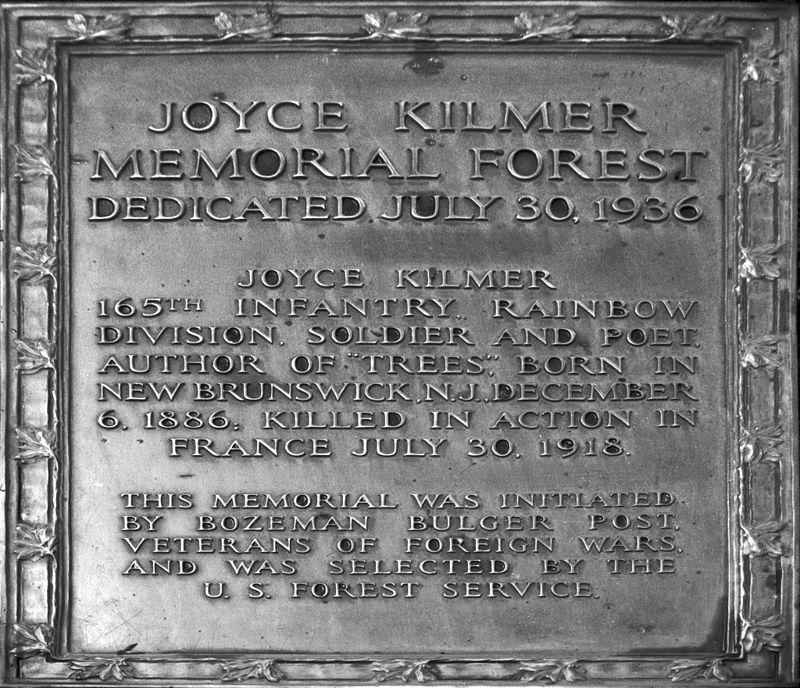
A forest in North Carolina dedicated to Joyce Kilmer
The Oise-Aisne American Cemetery in northern France
In a final note on the importance of World War I to our modern culture, the war, with its extravagance of carnage and the horror of the trenches, where so many lived in the slop of mud and died from disease and bullets and the explosions of often days of cannon fire raining death from on high, western literature was changed forever. Besides Kilmer, any number of renowned writers and poets from every nation served their time in the trenches, watching men die amid the slaughter. No longer would the literature of warfare be charged with heroic tales, spirited by nationalism.  A comment attributed by Union General William Tecumseh Sherman in the American Civil War, “War is hell,” had become even more real.  Both victors and vanquished had killed each other on an unrelenting scale of millions. No longer did writers and poets write from a distance.  They had been there. They knew.

Unfortunately, this proved to be only a taste of the fires of hell that was yet to come.

Note:  Where to buy a fabulous read about World War I.  Why 1914 ?, by Derek Robinson, one of my favorite authors, whose flying novels of World War I I have written about previously.  www.derekrobinson.info, or write him at delrobster@gmail.com.  He is also on FaceBook.


Sunday, December 6, 2015

The Churchill Factor by Boris Johnson


Just when you thought everything possible had been written about Winston Leonard Spenser-Churchill, Britain’s wartime leader, along comes another rewrite. 

Not so fast, friends and neighbors, liberals and conservatives.  Johnson approaches the Churchill mystique from a different direction, interweaving Churchill the man, the politician, the writer, and world player par excellence.  Johnson has got the background for it, himself a Member of Parliament, noted journalist, and Lord Mayor of London.

When I took Modern European History in high school, in what I now realize was the tyranny of the clock on the wall, teachers simply did not have the luxury of painting broad sweeps of history with more than a thin coat of watercolor. “You see,” they would say (with the textbook backing up every sharply pronounced syllable) “Napoleon did this and then he did that and that’s why Italy came to be united and the French hate the English and the Hapsburg Empire crumbled.”  I scribbled feverishly, knowing that for reasons unknown, scraps of that pronouncement would appear on the final and I would have to use a trusty No. 2 pencil to prosaically regurgitate.

Although the keepers of the holy historical script did their best, to the seventeen year old mind, the prolonged soliloquies did nothing more than describe the historical road in terms of long, unblemished freeways.

What Johnson does with The Churchill Factor is to give you a tour of the potholes, the resurfacing, the twists and turns and knotty reasons why the historical road is a curving, winding journey, and seldom smooth.  Historical twenty-twenty hindsight aims a bit high and too straight, catching only the occasional glint of the sun.  Johnson gets you down where the asphalt smokes and the steamroller driver screams at the dump truck driver, and the engineers step in to keep things going and the whole things costs ten times what was promised.

First elected in 1900, Sir Winston’s political career, with more highs and lows than a Disneyworld rollercoaster, lasted until 1964, the year before he died.  Two World Wars that set Europe in flames, along with brushfire wars here and there, along with the decline and fall of the British Empire were only a few of the roadblocks that marked Churchill’s journey.  Yes, he was First Lord of the Admiralty a couple of times, and Prime Minister twice, but he also was a conservative (Tory), turned liberal (for twenty years!), turned conservative.  He was a hero, a goat, a hero once again, and unthankfully voted out of office after what would come to be known as his greatest triumph, only to be voted back in six years later.

Did you realize the British Empire at its zenith was six times larger than the Roman Empire?  Did you know Winston Churchill, as a conservative, built the foundations of the modern British welfare state?

You can’t be in politics for well over sixty years and not make enemies, who were once friends, and once again returned to being so.  How in the world can your supporters suddenly despise you and your enemies admire you?

Was the wartime cabinet all Tories?  Not in the least.  As the war clouds formed over Europe and threatened very existence, did all of Churchill’s compatriots fall in line behind him and his stand against the blackness that was Nazi Germany?  Nope.  Then how in the world did he manage to become Prime Minister in 1940, when his enemies were many and his friends few?  It’s a crooked, rock-strewn story and Boris Johnson tells it well.

The Churchill Factor is not a dusted off rendition of what you read in high school.  It’s a polished page-turner that reads like a thriller.  And that’s exactly what Winston Churchill’s life was, a thriller.  He stumbled badly.  As modern speech would have it, he was many times ‘thrown under the bus,’ but he prevailed.  His will and insight and humor and indefatigable energy never failed him, even when those around him dismissed any thought of his rising again.

Churchill humor.  Well there were a lot of things he said and a lot of things he didn’t say that he got credit for saying.  Lady Asquith:  If I were your wife I would poison your tea.  Winston: Madame, if I were your husband, I would drink it.

Or how about Winston in the men’s room?  Someone knocks on the door and announces:  Mr. Churchill, The Lord Privy Seal is here to see you.  Winston:  Tell him I’m sealed in the privy and can only handle one shit at a time.

No, those are not direct quotes.  Read the book for goodness sake!  Don’t expect me to do all your work for you, especially not after Boris Johnson has already done it and done it well.

One proviso:  Best to read this book on a Kindle or Pad because Boris Johnson is an Englishman and the English vocabulary is upwards three times larger than the standard American vocabulary.  Much easier to push on the word and have a definition pop up than to have to perpetually thumb through a dictionary.


But however you read The Churchill Factor, you’re going to enjoy reading a great book about one of the great figures of the 20th or any other century.  What a story!