Showing posts with label baguettes. Show all posts

Wednesday, December 9, 2020

Let’s Make Cuban Bread = Hagamos Pan Cubano


Let’s Make Cuban Bread = Hagamos Pan Cubano


Ok, my fellow bread makers, let’s mostly follow the recipe for baguettes, add a few changes and make some Cuban bread.  Why would we want to do that? you calmly ask, while sipping a Cuba Libre.


Cuba Libre? What’s in that concoction and why the funny name?  Came from Cuba, of course and means Free Cuba, a term adopted around 1900, when the Coca Cola company set up shop in Cuba after Cuba was freed from Spanish domination in the Spanish American War of 1898.  As you can guess, the war set U.S. vs Spain, the results of which also saw the Philippines ceded to the U.S. 


As a side note, you may get a surprise when you ask for a Cuba Libre in Spain. The Spaniards make them with either rum or gin. 


Three years after the war, 1901, Cuba became independent and the U.S. gained a naval base, Guantanamo, in perpetuity. 


Just in case you’re interested, the Philippines gained full independence on July 4, 1946.


Ever had a Cuban sandwich?  If the answer is no, I can understand your semi-reluctance.  But, if you have tasted that deliciously crunchy melding of cheese and pork and sauces, pressed into each bite, you’re ready to follow me to bread makers’ heaven, no questions asked.


Maybe you want to review how to make baguettes.  Happy to help you out:  https://stroudallover.blogspot.com/2020/11/oh-those-baguettes.html


Now that you’ve finished your review, take a peak at those additions that will turn baguettes into Pan Cubano!  Oil. Sugar. More yeast.


Lista de Ingedientes:


3 cups flour (bread flour or all purpose flour)

1 ½ teaspoons salt

½ package of yeast

¼ vegetable oil

¼ cup sugar

1 ½ cups very warm water

more oil for greasing the finished loaves.


Las Instrucciones:


Place all the dry ingredients in your food processor and blend for a moment or two.


Add the oil and hot water.  Blend until you have sticky dough.


Take the dough out of the processor and put it onto a scattering of flour.  Knead slightly and form into two cylindrical loaves.  Oil them well, cover with a tea towel, and place on a baking sheet.  Put the baking sheet in a cold oven, turn on the oven light and let the bread rise for a few hours.


Heat the oven to 450ºF.


The loaves may spread out a bit as they rise.  Put them back on a floured surface and reshape, if necessary, although I leave them a little flatter than baguettes.


While the oven heats, place the loaves back on the baking sheet,  give them another coating of oil, and let them rise uncovered a second time.


Put a pan of hot water on the bottom shelf of the oven. When the oven reaches 450º, slide the loaves onto the top shelf.


Bake for 15 minutes, or until the loaves are golden.


Cuban bread, sliced, buttered and toasted is a treat with your morning coffee, but if you want the full mouth-watering effect, make yourself a Cuban sandwich.


Ingredients for a Cuban sandwich:


Cut about four inches off a loaf of Cuban bread, then slice it horizontally.  Add sliced baby Swiss cheese, sliced ham or roast pork or both, sliced chicken or turkey, pickles and any sauce you favor.  I like to spread Mojo sauce on both slices of  the Cuban Bread. Mojo is available at many supermarkets, or on Amazon.


Spray some vegetable oil in a hot skillet, put the sandwich on the skillet and press hard.  When the bottom side is toasted, turn it over and press again.  The ham and such should be hot and the cheese melted.


Personally, I like to eat mine with a café con leche, which is more or less like a café au lait, half a double espresso and half scalded milk.


Friday, November 20, 2020

Oh, Those Baguettes!


Oh, Those Baguettes!


France is known for wine and cheese, but when sipping your wine in a small street-side café and your attentive waiter silently places a small basket of freshly sliced baguette on your table, wine takes a momentary holiday.


Baguettes are the quintessential French bread. Yes, even more than the croissant. Baguettes are ubiquitous. Never changing.  And, oh how they bring back the memories, from many sparkling days in Provence to the side streets of Paris’ left bank to the fabulous covered market in Metz.


Each morning, in nearly every town, you’ll see small bread trucks, filled to the brim, with drivers in short brimmed caps and blue, workers smocks, unloading fresh armfuls at restaurants and cafés large and small, celebrated and humble.


But did you know in France there are several types of baguettes?  A larger, thicker baguette style loaf is called a flûte or flute, but it sounds more like flit when the French say it.  Then there’s a shorter, thicker one, called a bâtard or bastard.  And naturally there’s a skinny style called aficelle or string.


Where did the baguette originate?  No one seems to know, but lots of stories persist. Some say Napoleon insisted bakers invent a loaf that was more easily carried by soldiers.


As I suspect, even my drunk and unruly readers realize the baguette is not only prevalent in France and French speaking regions such as Belgium, and Switzerland, but around the world.  In Vietnam (once a French colony) they add rice flour. In the U.S. you can find multigrain and sourdough perversions!  “Mon ami, I spit upon this ignoble bowing before the world of fashion.”  


In today’s commercial world baguettes have become well known all over. You don’t have to be French or speak the language to enjoy them, or to make them. 


But, until now, to get the best baguettes you have always had to travel to France. No longer!  I will show you the true path that you can follow in your own kitchen, be it ever so humble.  Vive la baguette!


Faisons un Baguette ou Deux!

(Let’s Make a Baguette or Two!)


Few choose to believe, but I don’t make any recipes that are very difficult.  And this recipe is no exception to my code of simplicity.


Four Ingedients


3 cups unbleached all purpose flour, or use bread flour

1 teaspoon salt

¼ teaspoon yeast

1 ½ cups very warm water


I use my food processor.  Put in the flour, salt, and yeast.  Pulse to mix the dry ingredients.  Now add the very warm water.  Turn on the processor and mix until a dough forms.


Put the dough on a well floured surface and cut into two equal parts.  Form into two baguette shapes and then flatten them out.


Fold the two long halves into the middle and shape.  Spray a baking sheet with oil, add both baguettes, and cover with a dishtowel.  Allow to rise for a few hours.


Note:  I put the covered baguettes in my oven and turn on the oven light.


When the dough has risen, you may find that it has spread.  Just tuck in the sides to reform and put some slashes across the top.  Heat the oven to 450ºF or about 232ºC


When the oven is hot, put a pan of hot water on the bottom rack.  Put the baguettes on the top rack and check after 20 minutes, add more time if necessary.  


Note:  The water helps to crisp the crust.


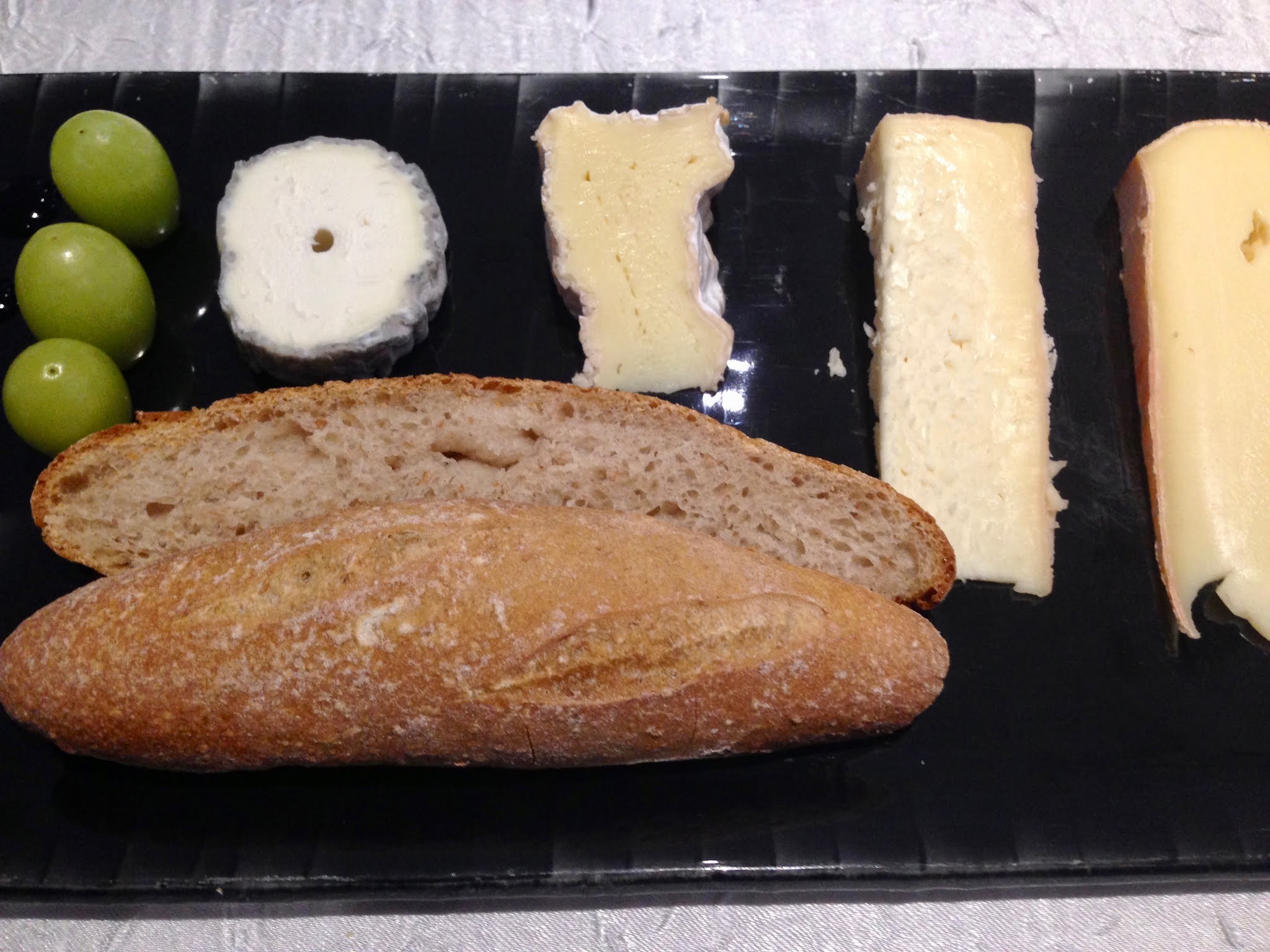
Now, assuming you have already opened the second bottle of wine, it’s time to bring out the cheese tray and few grapes.  But let the baguette loaves rest for 15 minutes before slicing.  The French don’t butter their slices, but I do!  Á votre Santé!  Cheers!