Showing posts with label garden. Show all posts

Sunday, April 17, 2016

In Baden Baden on the Lichtentaler Allee


Care to take a little stroll with me?  Such a beautiful day.  Perhaps a little juice of the grape before we stride?  Oh, I like your spirit, and I know just the place.  You say you require some discretion, querulous husband and all that?  A sheltered garden perhaps, out of view, where we can unburden ourselves and discard the cares and woe of nuptial complications?  Now you’re smiling.  Such a lovely smile, too.  I don’t know the man, but he really doesn’t deserve you.

Please, let’s sit a moment or two in this small hideaway, decked out in white café tables and chairs, blessed by the radiant sun.  There on the rolling hill! …see the pink and white blooms of a Japanese cherry?  Oh here comes a breath of wind, splattering the air with pink and white snow.  I do love the springtime.

Doesn’t this Riesling offer a beautiful nose.  Clean and refreshing.  Hints of rose, with a touch of apple and Mirabella plums. Rolls easily on the tongue.  And your tongue is so beautifully pink.  Now you’re blushing.  Blush all you want, my fair flower.  You’re laughing?  No, no, really.  You are enchanting.


Yes, the wine was delicious and the company even more so, but now let’s walk.  I’m so glad you decided to join me.  Have you been on the Lichtentaler Allee before?  If you’ve been to Baden-Baden you almost certainly have.  


Magnolia Galaxy
One of the most beautiful walks in the world, a combination of garden path, rippling river, and arboretum, with majestic mansions to the right and grand hotels to the left.


As you notice from the small nameplates, these trees are from all over the world, from slim and dainty Japanese Cherries, to voluptuous camellias and magnolias, to majestic redwoods and sequoia.

You’re walking in history. The Lichtentaler Allee  has been a place for walking and contemplation for over 360 years.  A few notes of interest.  The Allee began in 1655 as a simple path to connect the town of Baden with the Lichtentaler Cloister (1225).  Then came the Grand Duke’s castle gardener in 1839, who saw exquisite possibilities in the 2.3 kilometer (1.8 mile) trail along the river Oos (pronounced Ooze).  Suddenly a simple trail blossomed, literally, into a luxuriant profusion reminiscent of English parks and gardens.
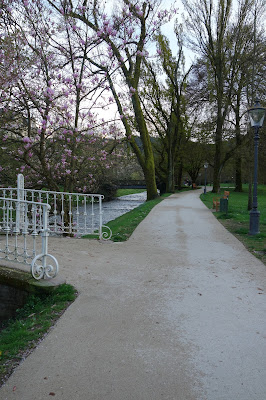


Notice the many lacy footbridges, each of them different, all of them a paragon of graceful beauty, much as you are!


Look at that towering sequoia!  No doubt it will never feel the sharp bite of an axe. 


And the ducks and birds flutter about so shamelessly friendly.  Look, these mallards walk up to within inches of our feet.  And there, that multi-hued mandarin male, just skimming the water!  Flies like the wind!


Mandarin Ducks

Are you game for continuing all the way to the Cloister?  Yes, it’s still in use and inside the walls there is a small café.  I believe the nuns are Trappists, but on my visits I never met one, or if I did, she wasn’t wearing a habit.  The abbey advertises there are guest rooms and the abbess offers an invitation for guests to work and pray with the sisters.


The Cloister Entry

The courtyard

We’ll sit awhile at the café, then wander back for perhaps another wine before you rush back to your husband.  No rush?  Even better.  I’m almost sure we can find something else to do. 

Hahaha…it’s happened again!  Oh, I do love that blush!


Tuesday, June 2, 2015

Monet's Garden: A Masterpiece of Color and Design


The famous arch in the Upper Garden


Usually I write a pithy commentary, but not today.   I’ll write very little and allow the photos to tell the real story.  After all, Monet’s Garden is not about writing, but about color and light and capturing ever-changing images.  You just think you’ve seen a garden.  The grounds of Monet’s hideaway in Giverny will overpower you with the form and sheer immensity of color.

Upper garden to the left, lower garden to the right.


The Garden is actually two gardens, the upper garden (The Clos Normand), closer to the house, with overflowing rows and mounds of blossoming color.  Across the road (via underpass walkway) is the lower garden (The Water Garden), a woody and bamboo paradise of green, placid ponds strewn with lily pads, bridged with emerald arches evocative of Japanese styles, and in the afternoons the wondrous croaking of hundreds of frogs.  It was here that Monet painted the famous (and numerous) water lily studies.


Why so many?  It takes a little fuzzy explaining, rather like explaining why you swooned over a brassy red head yesterday, but today your heart belongs to a timid brunette.

That’s not as far fetched a metaphor as you’d imagine.  Lighting was the thing in Monet’s (and the impressionists’) mind.  Study a tree, for example.  Green, right?  Well, yes, as well as some black and brown, even among the foliage.  As the sun passes, you glance back and suddenly see whites and yellows and four shades of green.  But, it’s a just green freaking tree!  Different times, different lighting, different viewpoints.


Intuitively we recognize this.  Hollywood developed an industry around employing light and perspective to turn ordinary people into glamorous stars of the galaxy.

As has been said many times, Impressionism’s lifeblood is capturing an impression, a glimpse, a mood.  Light and gray shadows decorate a white house, yet even those grays and their shapes change in the rising and fading light of day.

As a matter of fact, Monet’s observations led him to assert that colors change every seven minutes.  With his water lilies, he tried to capture the changes, the impressions of the light as the sun swept across the sky, and the clouds danced between heaven and earth.  A mammoth task and one that led him to construct a huge ‘water lily’ studio and produce a prodigious array of massive canvases.


Want to know more about the basics, including opening hours (and months) for the garden, as well as how to get to this fabulous spot that should be in every art lover’s bucket of paint?

What is not said is that if you’re an artist (starving and talent optional), tickets are available that let you have the garden to yourself after 6:00 p.m., when the curators drive the riff-raff out and leave the immense gardens to budding Monets until the witching hour of 8 p.m..   We had a group of eight and other than another group of similar size, we painted alone, often not within sight of one another.

Is that the end of my story?  Heavens no!  There are tempting French meals to discover, Monet’s house to explore!  All within a short walk down the main street of the tiny village of Giverny.  Come back when I tell the rest of the story of my visit.

A quiet respite in the upper garden, The Clos Normand


Thursday, April 25, 2013

Here Comes Spring

Our unknown tree

The trees flowers are luscious folds of pink and white

Lacy green appearing...

Cherry blossoms


How do we know when spring finally bursts through the eternal winter?  Vernal Equinox? When the center of the sun is aligned directly with the equator?  The guy who tells you that is the same one who claims happiness is the absence of severe abdominal pain.

Technically.  Don’t you hate that word?  On 20 March it is ‘technically Spring.’  Yeah, and technically this year I was up to my technicals in snow. Snow ain’t Spring on my calendar.  Ya gotta have showers and flowers and sunshine and be able to sit outside with your shirt off, and it shouldn't be a frozen nipple experience.

We’re racing toward the end of April here in the heart of Global-Warming-Europe.  Therefore, we’ve technically been in Spring for over a month.  Yeah and technically your granny is a virgin, since the limit on prosecution for unlawful intercourse is 20 years.  Don’t quote me on that, especially to your granny.

But, solar assistance has finally arrived.  It is about 60ºF/15ºC.  Leaves appear as green and delicate as gauze, fluttering with the gentle breeze through the forest.  Cherry trees are showers of white. Butter colored daffodils bob their little heads in surprising places.  Time to collect those dandelion greens for salad.  Tulips popped through the earth and are racing for the sun.

In my backyard’s wild garden, an unnamed tree  (any help would be greatly appreciated) has burst open its huge white, pink tinged flowers.  Birds and bees float by in abundance.  For every flower it seems there are three overachieving bees.

Have you ever wondered about that expression, usually followed by a sly wink?  The birds and the bees.  Birds I can understand.  They sing, warble, call to any sweet someone in earshot.  They build nests together.  Figure out what goes where and keep the world supplied with baby birds.

But bees?  First off, the ones we see are normally females.  Secondly, they work their little bee-hinds off until they buzz their last and float away to that big hive in the honey colored sky.

I guess that’s what the expression means:  Take time to procreate, but otherwise continue to work your ass off.  To me that’s not springtime either.  Springtime is the time to lighten up.  Have another beer with the guys.  Lie about your misspent youth.  Ogle that vision of loveliness that just wiggled past.  Live a little.  What your wife doesn’t know won’t hurt you.

And above all, enjoy the sunshine and flowers.


Erica or heather


Monday, July 9, 2012

Treasures In a Wild Garden

An overview, with a wheat field behind


Even the weeds can be beautiful!


More beauty weeds


Ever hear of a wild garden?  I hadn’t either until we moved to Germany.  Every garden I’d ever seen, behind someone’s home, or in professionally done landscape, all had a carefully cultured look.  Flowers placed just so.  Plenty of rich tilled soil between the plants.  Weeds banished; the palate of the garden a broad stretch of lawn, so manicured it appears to have been measured, then trimmed with scissors by an anal-retentive barber.

But, what if you can’t find an out of work anal-retentive barber?  These days you may have better luck.  Most barbers I’ve had the misfortune to meet lately were electricians the day before, and ‘factory trained’ mechanics the week before that.  Wanna see the scars on my misshapen pate?

Why do you keep diverting my attention?  Let’s get back to gardening.  While I appreciate the care and effort of the traditional hedgerow flower garden, I don’t like to cut the lawn and now that the sons are grown, I no longer have to set up plastic water slides, soccer goals, or badminton nets.   But…..and this is a biggie….I know first hand you can still pass a football around a wild garden.

How do you get from a conventional to a wild garden?  Like anything worthwhile, it takes time, experimentation and work.  I can mention all the common advice.  Read. Ask advice from experts at your garden center.  Go to gardening blogs.  Without too much trouble you’ll find the basics for a layout and for plants, but it’s not like laying down turf.  Some plants thrive in one spot or another.  Often it’s tough to imagine how big or how small the varieties are that you’re planting.  Also, don’t think for a moment that a wild garden means no maintenance.  Some flowers thrive, others die and leave bare spots that are soon filled with obnoxious weeds.   You’ll also find that not all weeds are obnoxious.  Some are delightful wild flowers, such as poppies and Queen Anne’s Lace. 

From the photos, you’ll see a mix of blowing grasses and large pockets of color.  It’s fine to spread the color around, but for my money, you need to have large bursts of a single color as anchors.

You may also want to be careful about which kinds of high grasses you plant and where you plant them.  Some non-native species sink deep, deep roots and once they take hold, you’ll never get rid of them.  Other species, such as bamboo, send out runners that will quickly overtake entire portions of your garden.

But, in the end, a wild garden is much more than a garden.  It’s also a haven for birds, and small animals.  Even the occasional rabbit, or pheasant may make it their home.

There are other reasons a wild garden is more to my liking these days.  First of all, it’s a living piece of art, a canvas that changes with the seasons, never returning to exactly as it was.  Every year, as the dark, bare skeletons of winter’s trees take on their spring greenery, and flowers go from brown stalks of yesteryear to promises of beauty, and bees begin their never ending flights to my garden and home, the wild garden marks the new birth of my world.

I sit outside and see the daily changes.  Purple flowers here, waving grasses there, buds of yellow, once again burst though the long winter’s blanket of grays and blacks.

A wild garden is not for everyone. Some folks cannot get past the work they’ve put into a perfect lawn.  Others dwell on the open spaces with the echoes of their children’s voices and the promise of their grand children’s voices to come.  Believe me, I understand.

But, when we moved to Germany, so many memories did not get packed with our furniture and such.  The lawns of yesterday are smiling ghosts of the past that only live in a father’s heart.  Perhaps those ghosts would not permit a new lawn, with small voices that will never come.

Now I need to feel as one with nature, to share the sun, to watch the children of the flowers grow and blossom.  Perhaps it soothes the soul, and keeps alive other seasons in my life.  The lawns are gone, but the voices still ring.  And after all, beauty remains.


Lacy, flowing tops of some tall grasses

Different shades of green and waving grasses.