Showing posts with label impressionism. Show all posts

Monday, January 30, 2017

The National Gallery: Australian Impressionists


InsideThe National Gallery

Yes, I’m going to talk about one of the great art museums in the world, but first let’s chat a bit about London itself.

One thing that makes London so easy to visit is the transit system.  Subways, buses, taxis are all available, convenient, and very affordable.  But, another thing that’s even better is that you can easily walk between many attractions.  Five minute walk too much?  Drop into a pub and refresh yourself.  Consider it a stroll between pubs.  I do.

Let’s say you’ve just taken the Piccadilly Line to Leicester Square to buy some discounted theater tickets.  From there you can walk six minutes in one direction and you’re in Piccadilly Circus, with the famous statue of Eros at it’s epicenter, and where the finest of London’s shopping streets, Oxford, Piccadilly, and Regent Streets branch out like the spokes of a wheel.

The famous Covent Garden is only seven minutes away.

From the balcony of The National Gallery looking into Trafalgar Square

Walk another direction for six minutes and you’re in the equally famous Trafalgar Square, with its heroic column holding a statue of Admiral Lord Nelson.  You’ll pass The National Portrait Gallery on the way, which is also well worth a stop.  From Trafalgar it’s a quick walk to The Strand for more shopping, some famous restaurants (Simpson’s on the Strand) and the famous Savoy Hotel.  Pop into the American Bar for a drink and a gander at all the photos of the celebrities who’ve imbibed there.  Maybe you’d like to visit the parade ground for the Queen’s Cavalry, and stroll past Number 10 Downing Street, home to the Prime Minister.  Fourteen minutes, max.

Honestly, we’re only talking about a few easy steps from one perfect spot to another.

When you enter, don't forget to look up!

But, while we’re in Trafalgar Square, let’s walk up the short staircase to The National Gallery.  Free admission and open over 360 days a year.  What’s special about The National Gallery?  One of the most famous art galleries in the world.  Name some painters you like, or that your art teacher mentioned while you thought about the cute blond at the desk across the room.  Rembrandt?  Van Gogh?  Monet? Michelangelo?  Bells ought to be clanging!  They’re all there, from the old masters to the French Impressionists and beyond.

The current special exhibit is Australian Impressionists.  Yes, there is a fee for the specials.

Let’s digress and talk about the Impressionists.  I thought they were all French, sez you.  That’s what I thought too.  Boy was I wrong.  The French are only the most well known.  You might like to know (because of your insatiable thirst for knowledge) that the label impressionism began as a satirical term by an art critic writing for a Parisian newspaper, as in “It’s not really art, just an impression.” The strict judges of the French art establishment wouldn’t let Monet, Renoir, Pissarro. Cezanne, Degas and others, enter the prestigious events at the Académie des Beaux-Arts.  Not to be stifled after being turned down several times, the artists formed their own group and had their own exhibit.  The public went wild.  Seldom does the establishment know what the public wants.

What freed artists from the old rules?  One thing was the invention of the camera (1814) and by the 1860’s it was in wide use. Remember Mathew Brady and his famous American Civil War photos?   No longer did artists have to paint an exact replica of what they saw. 

What was different about the Impressionist paintings?  The artists used lighter colors, feathered brush strokes, and faintly recognizable forms.  They also had a passion for painting en plein air, meaning outside, which allowed them to paint as the natural light changed during the day.  As light changes, color changes. Ever see an exhibit of Monet’s Water Lilies?  He painted dozens of gargantuan canvases, attempting to capture the changing light, a reflection of how he viewed the same scene.  Monet found that light changes every seven minutes.  We intuitively know that the day grows lighter, then darkens, but every seven minutes? You can easily test it yourself with a camera and a watch. 

But, enough dallying.  Let’s get to the Australian Impressionists, and specifically the four artists on exhibit, which runs through 26 March 2017.  You don’t want to miss it.  The word I use to describe these paintings by Tom Roberts, Arthur Streeton, Charles Conder, and John Russell is:  Astounding!

What’s so special about the Australian painters?  For me, even more than the French impressionists, they bring a scene to life.  You find yourself stepping into the painting to feel the swirling dust, to smell the cows, and hear the sound of a rippling stream.  But, endless discussion of paintings is as sleep inducing as slugging through the rules of Ping Pong, so let me stop there and just offer some poor photographic evidence of what I mean.  Photos weren’t allowed in the museum and stern faced attendants saw to it, so I had to scavenge on the internet.

I have asked myself, what is it about the Impressionists that over a hundred years later still grabs people and makes them stare and dream?  My answer is: unexpected encounters that pull you in and brand your memory.  The Impressionists were experimenters, changers, collaborators, switching from one style to another, merging reality and dreams.  Even today they still represent freedom of expression.  No rules except eyes, light, and a paintbrush.

And the style and feeling weren’t exclusive to the French.  John Paul Russell painted along side Van Gogh, and in fact was the only Australian artist to be directly in touch with Monet.  Yes, these men and women in many ways broke down the walls of art.  They were slaves to shifting light and ambient hues, and shameless copiers who borrowed from each other.

These photos in no way do justice to the paintings. But, they give you an idea of how the artists captured the raw roughness and stark beauty of turn-of-the-century Australia.  You just gotta go see the actual painting for yourself! 

Charles Conder:  A Holiday at Mentone

Arthur Streeton:  Fire's On!

John Russell:  Rough Sea

Tom Roberts: Winter Morning After Rain

Tom Roberts:  Bourke Street West

The National Gallery, Trafalgar Square, London!  Somebody in your party lukewarm about art museums?  Use this to entice them:  Pubs are close, very close, before and after.


Saturday, June 6, 2015

Claude Monet's House at Giverny


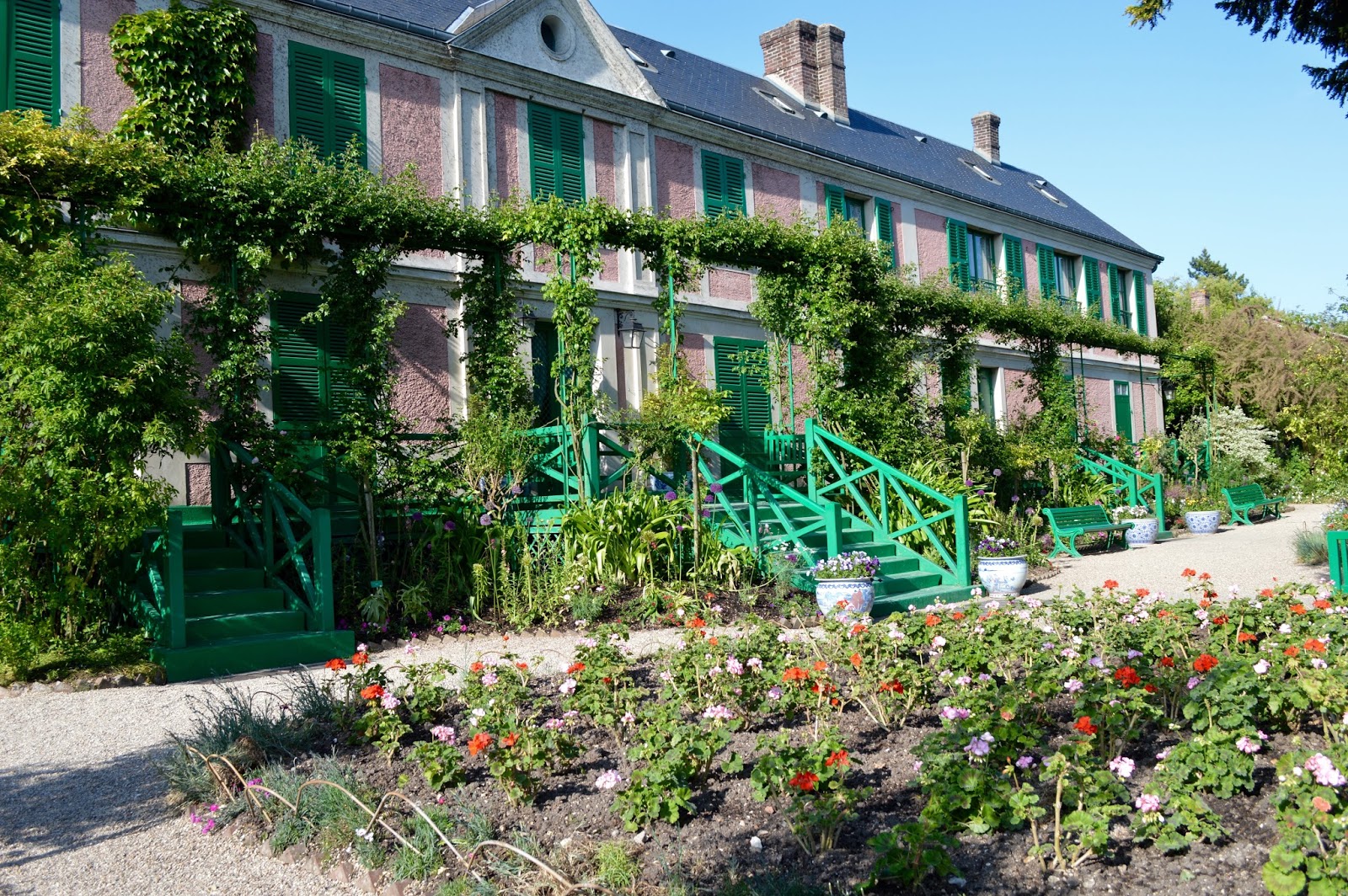
It may come as a shock, but Claude Monet didn’t live in his garden.  He lived in a very fine house overlooking the garden, which he rented for several years before he bought it.  For more than forty years, he would live in Giverny, expanding his art and expanding his country home into a warren of spacious rooms, splendid with bountiful color and art.  The interior runs from his studio on one end, to the fabulous kitchen on the other.  By the time of his death in 1926, he had built three studios, one the size of a high school gymnasium, used to produce his gargantuan water lily studies.

Claude Monet not only lived to paint, but also lived to sculpt a way of life that we would call stylish and avant-garde.  He was a modern man, an art collector, and ruler of his domain. Where did he get the money?  Weren’t all Impressionists dirt poor from start to finish?  Not hardly mon ami.  Monet was apparently a master businessman and his paintings sold well.  More and more, art dealers came to him. Unlike Van Gogh, who sold only a couple of painting in his lifetime and died a pauper, Monet’s fame spread throughout the world.  Other famous artists, as well as the art dealers, visited often.  Monet entertained them in style, and his home reflected his rustically lavish life.

The dining room  today

Design and color 
Dining Room


It had not always been so.  Before he was able to buy Giverny, he struggled and lived on the edge of bankruptcy for years.  By the time he purchased the house and grounds, those days had been lost in the shadows of yesterday.

Monet was a man of color and design, reflected in the length and breadth of his estate.  This was his world, a wonderful place that even to this day sparkles with fresh delights, and blossoms with magical hues, from corner to corner.  Outside, the vast garden still spreads in an amazing burst of rainbow colors.  Monet also kept a two and a half acre kitchen garden and much of his family’s food came from there and the surrounding fields where he and his family and friends, shot rabbits, and gathered mushrooms, or fished in his famous ponds . The house fit right into his expressive dream of creating a self-contained center of tranquility. This extended into his house, with the kitchen an amalgam of rich blue tiles and spotless copper pots, and the dining room an array of sun-swept yellows. 
Monet's wife's bedroom, Monet's also has a single bed, but the room is more sparsely decorated.
Other rooms held patterns of blue and white.  He fancied none of the dull and mundane colors popular at the time.  Even the startlingly green shutters were chosen by Monet, bold and bright, unlike the usual muted shades on houses of the day.


Every room but the kitchen held masterpiece canvases he'd purchased.  Cézanne.  Degas.  Japanese wood block prints and Japanese ceramics of every variety.  Today, what you see on the walls are copies, with few exceptions.

Japanese ceramics


About the kitchen.  First things you notice are the blue tiles from Rouen, the array of original, shiny copper pots, and an enameled iron stove only a bit smaller than a Sherman tank.  The stove is a wood-burning Briffault, sadly no longer made.  Oh, you can get something similar in gas or electric, but you may have to take out a second mortgage.  Prices I saw ranged from over $8000 for 1/3 size version, to La Cornue Gran Palais Cooking Stove for $47,300.  Just the thing for boiling water for Ramin noodles.


A wood-burning stove of this style has no temperature controls, other than the heat of the wood.  When the fire is going, each oven holds a different temperature, and the same with each of the iron stovetop plates.

The kitchen was a center of activity, as most kitchens are, and I suspect Claude Monet viewed a dining table as just another canvas, with the kitchen his palette.

Monet was serious about food, looking into the details of every recipe he’d gathered, personally selecting fresh ingredients, and dictating the bountiful courses served to family and guests.  If you would like to read more about the routines of life at Giverny, I refer you to a wonderful book by Claire Joyes, Monet’s Cookery Notebooks. 


At only one cent for a hardback copy, you really should be ashamed.


In a home, ambiance is everything, and when you walk through Monet’s home, you feel as comfortable as if the house were built last year.  He was the kind of modernist man who could seamlessly connect art to canvas, garden, and home design.  


The rooms are open and effortlessly joined, with large windows that give the feel of indoor spaces spilling out into the garden.  Makes you understand that Claude Monet was not only a man of his time, but a man whose art, design, and sense of color transcend time.

The first studio as it is today.


Claude Monet in his studio

Tuesday, June 2, 2015

Monet's Garden: A Masterpiece of Color and Design


The famous arch in the Upper Garden


Usually I write a pithy commentary, but not today.   I’ll write very little and allow the photos to tell the real story.  After all, Monet’s Garden is not about writing, but about color and light and capturing ever-changing images.  You just think you’ve seen a garden.  The grounds of Monet’s hideaway in Giverny will overpower you with the form and sheer immensity of color.

Upper garden to the left, lower garden to the right.


The Garden is actually two gardens, the upper garden (The Clos Normand), closer to the house, with overflowing rows and mounds of blossoming color.  Across the road (via underpass walkway) is the lower garden (The Water Garden), a woody and bamboo paradise of green, placid ponds strewn with lily pads, bridged with emerald arches evocative of Japanese styles, and in the afternoons the wondrous croaking of hundreds of frogs.  It was here that Monet painted the famous (and numerous) water lily studies.


Why so many?  It takes a little fuzzy explaining, rather like explaining why you swooned over a brassy red head yesterday, but today your heart belongs to a timid brunette.

That’s not as far fetched a metaphor as you’d imagine.  Lighting was the thing in Monet’s (and the impressionists’) mind.  Study a tree, for example.  Green, right?  Well, yes, as well as some black and brown, even among the foliage.  As the sun passes, you glance back and suddenly see whites and yellows and four shades of green.  But, it’s a just green freaking tree!  Different times, different lighting, different viewpoints.


Intuitively we recognize this.  Hollywood developed an industry around employing light and perspective to turn ordinary people into glamorous stars of the galaxy.

As has been said many times, Impressionism’s lifeblood is capturing an impression, a glimpse, a mood.  Light and gray shadows decorate a white house, yet even those grays and their shapes change in the rising and fading light of day.

As a matter of fact, Monet’s observations led him to assert that colors change every seven minutes.  With his water lilies, he tried to capture the changes, the impressions of the light as the sun swept across the sky, and the clouds danced between heaven and earth.  A mammoth task and one that led him to construct a huge ‘water lily’ studio and produce a prodigious array of massive canvases.


Want to know more about the basics, including opening hours (and months) for the garden, as well as how to get to this fabulous spot that should be in every art lover’s bucket of paint?

What is not said is that if you’re an artist (starving and talent optional), tickets are available that let you have the garden to yourself after 6:00 p.m., when the curators drive the riff-raff out and leave the immense gardens to budding Monets until the witching hour of 8 p.m..   We had a group of eight and other than another group of similar size, we painted alone, often not within sight of one another.

Is that the end of my story?  Heavens no!  There are tempting French meals to discover, Monet’s house to explore!  All within a short walk down the main street of the tiny village of Giverny.  Come back when I tell the rest of the story of my visit.

A quiet respite in the upper garden, The Clos Normand