Showing posts with label cooking. Show all posts

Wednesday, April 26, 2017

Lunch With Daniella: Cinque Terre, Part II

Our perfect hostess, Daniella


It’s mid morning. We lounge idly in canvas backed lawn chairs, on the sun-blessed terrace of Daniella’s eclectic home and wait for her to return with a chilled bottle of Prosecco.  Below us, in the near distance sits the placidly picturesque blue Mediterranean and old town Monterosso, with its colorful buildings clustered on the hillside below us.  It’s our fourth day in the World Heritage Site of Cinque Terre (Chink-co-terra).

We’ve wandered the cobblestones, admired the work of artisans, stared up at laundry hanging on the balconies of ancient buildings, slain the fatted calf a dozen times over, and soaked in the culture of the small fishing villages turned tourist Meccas.   This morning we wandered the local market, admiring fresh vegetables and fresh catch, while throngs of locals bartered and filled their shopping bags. Have we had enough?  Seen it all?  Not hardly, no way.

We’ve already met so many people.  Franco the short, graying taxi driver who lost his cab, Elania, the beautiful girl who works an outdoor café on the waterfront, another taxi driver named Franco, several watercolor artists, and Swiss, German, and yes---Italian--- tourists.

We’re wonderfully accommodated in one of Daniella’s hillside villas and now we’ve walked up a hundred stone steps to get to her home for an afternoon’s Italian cooking lesson.  Let’s be more specific and call it a Ligurian cooking lesson, for this is the Italian Riviera, spread along a rugged coastline, with its own tastes and styles of cooking.  Much of it features local olives, lemons, and seafood straight off any of the many small fishing vessels that line the harbor and rest on the sand.  Daniella even has a lemon tree on the terrace.


The promised Prosecco arrives and we are ever grateful.  We sip gently and pop fat green olives in our mouths, between bites of deliciously crunchy bread.  


Wonderful, giant capers!

Yes, I already feel as if I could live here, so long as the money holds out and my liver doesn’t desert me.  If wine is as good for you as they say it is, my arterial plaque is in for the fight of its life.  No, Prosecco is not from around here, but Prosecco has a vast variety of local cousins that have already helped us down quantities of fresh seafood. Now I’m wondering what new wonders of the Ligurian kitchen Daniella can show us?


First off is the kitchen itself.  It’s built into a corner of her terrace and is so quaintly lovely it should have come out of a romantic movie, starring Audrey Hepburn and Cary Grant.  In addition to an array of cooking implements hanging serenely above the tiles on the wall, there’s a four-burner gas stove, and a stone sink I plan to steal.  Except for three things:  it’s too heavy, more wine may slow me down, and Daniella’s husband may be too ferocious.  I don’t know for sure, but I can’t take the chance.


The expansive terrace is itself an architectural dream, with tiled floor, green plants, colorful flowers, that fruit bearing lemon tree, and glorious views in every direction.  Daniella turns out not only to be an exceptional cook, but a talented decorator.

The basil must be thoroughly dry.  Daniella shows us how.

See, I meant to simply tell you about a cooking lesson, but got carried away.  Cinque Terre is like that.  A bombardment of sun, style, friendly people, and an entirely different way of life.


So, back to cooking.  But, first I must mention the second wine Daniella served, a local white, and it is delightfully fruity and dry.  But, it’s not the best, says Daniella modestly.  Wait until you taste our best local wine.  If the wine we’re sipping is not the best, my knees may weaken and I may try out my Italian tenor’s voice.


So, as I said, back to cooking.  We’re going to make pesto, casserole chicken, lasagna, and baked fresh fish.  Those are the common American names.  I’ll give you the more charming and descriptive Italian names later.  You can be sure, all the dishes will include fresh – from the garden and the sea – ingredients.


First we hand make the basil pesto in an old stone mortar.  And with the first stone-on-stone scraping of the pestle against the mortar, Daniella begins to delight us with tales of food and family, heritage, and the wonders of an Italian-American wife living with a locally born Italian husband, in the most Italian place in the world.  Along the way, this requires her listeners to acquire a taste for several more bottles of local wine.  Her fascinating story, enthralls us with all the elements of history, romance, and family struggles that make up a great novel.
Ingredients for Lasagna 

The creamiest, more delicious Parmesan!  An essential in all the dishes we prepared.


But, once again I digress.  With the pesto, the remainder of which is made in a food processor, we have the first ingredient in what will become the most delicious lasagna I’ve ever tasted.  The other ingredients include flat pasta, of course, plus a silky béchamel sauce, and a generous handful of pine nuts. 

Lunch is a hands-on culinary experience!

Making the béchamel

The oven is inside and in it goes, while we start work on a wonderful chicken casserole, called Pollo Piero.

Other ingredients for Pollo Piero

The main ingredient for Pollo Piero is skinless, bone-in, chicken thighs, followed by a deluge of bell peppers, onions, tomatoes, and seasonings.  


Note:  Italian cooks do not normally use onions and garlic in the same dish, although for the accompanying asparagus dish a full head of unpeeled garlic will have the bottom sliced off and accompany the vegetable platter as it’s slipped in the oven.


Sea bass, right off the boat, is baked Liturigan style, meaning rosemary, salt and lemon in the fish cavity, with more of the same and olive oil over the top.  Yes, it’s a whole fish, with the sides slashed to permit the oil and lemon to penetrate the flesh.

For dessert, we have freshly made lemon cake, with cream and berries, along with short glasses of Daniella’s homemade Limonchello.  To make Limonchello, there are only four ingredients: lemons, vodka, water, and sugar.  Lots of recipes online.


Daniella’s lunch only lasts about 4-5 hours.  I stop counting after the second bottle of wine.  Delicious doesn’t really explain it.  A lunch on her terrace is an all-encompassing experience of incomparable tastes, scintillating conversations, carefree humorous banter, all delivered under blue skies, and in the glow of scenery that will forever live in memory.  A complete adventure in Italian living. Now if I can only figure out how to separate Daniella from her stone sink…

Perfection!

Saturday, June 6, 2015

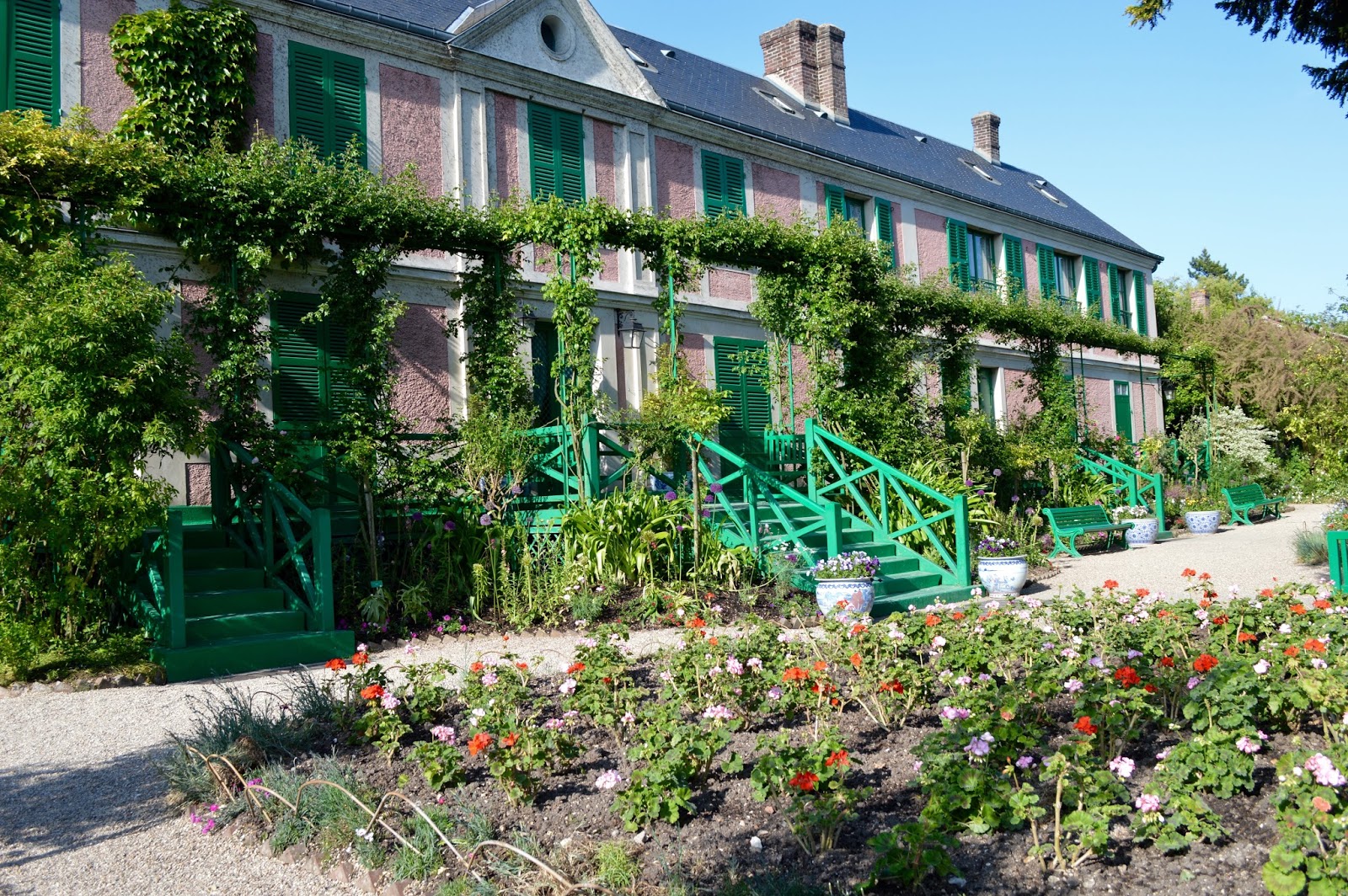
Claude Monet's House at Giverny


It may come as a shock, but Claude Monet didn’t live in his garden.  He lived in a very fine house overlooking the garden, which he rented for several years before he bought it.  For more than forty years, he would live in Giverny, expanding his art and expanding his country home into a warren of spacious rooms, splendid with bountiful color and art.  The interior runs from his studio on one end, to the fabulous kitchen on the other.  By the time of his death in 1926, he had built three studios, one the size of a high school gymnasium, used to produce his gargantuan water lily studies.

Claude Monet not only lived to paint, but also lived to sculpt a way of life that we would call stylish and avant-garde.  He was a modern man, an art collector, and ruler of his domain. Where did he get the money?  Weren’t all Impressionists dirt poor from start to finish?  Not hardly mon ami.  Monet was apparently a master businessman and his paintings sold well.  More and more, art dealers came to him. Unlike Van Gogh, who sold only a couple of painting in his lifetime and died a pauper, Monet’s fame spread throughout the world.  Other famous artists, as well as the art dealers, visited often.  Monet entertained them in style, and his home reflected his rustically lavish life.

The dining room  today

Design and color 
Dining Room


It had not always been so.  Before he was able to buy Giverny, he struggled and lived on the edge of bankruptcy for years.  By the time he purchased the house and grounds, those days had been lost in the shadows of yesterday.

Monet was a man of color and design, reflected in the length and breadth of his estate.  This was his world, a wonderful place that even to this day sparkles with fresh delights, and blossoms with magical hues, from corner to corner.  Outside, the vast garden still spreads in an amazing burst of rainbow colors.  Monet also kept a two and a half acre kitchen garden and much of his family’s food came from there and the surrounding fields where he and his family and friends, shot rabbits, and gathered mushrooms, or fished in his famous ponds . The house fit right into his expressive dream of creating a self-contained center of tranquility. This extended into his house, with the kitchen an amalgam of rich blue tiles and spotless copper pots, and the dining room an array of sun-swept yellows. 
Monet's wife's bedroom, Monet's also has a single bed, but the room is more sparsely decorated.
Other rooms held patterns of blue and white.  He fancied none of the dull and mundane colors popular at the time.  Even the startlingly green shutters were chosen by Monet, bold and bright, unlike the usual muted shades on houses of the day.


Every room but the kitchen held masterpiece canvases he'd purchased.  Cézanne.  Degas.  Japanese wood block prints and Japanese ceramics of every variety.  Today, what you see on the walls are copies, with few exceptions.

Japanese ceramics


About the kitchen.  First things you notice are the blue tiles from Rouen, the array of original, shiny copper pots, and an enameled iron stove only a bit smaller than a Sherman tank.  The stove is a wood-burning Briffault, sadly no longer made.  Oh, you can get something similar in gas or electric, but you may have to take out a second mortgage.  Prices I saw ranged from over $8000 for 1/3 size version, to La Cornue Gran Palais Cooking Stove for $47,300.  Just the thing for boiling water for Ramin noodles.


A wood-burning stove of this style has no temperature controls, other than the heat of the wood.  When the fire is going, each oven holds a different temperature, and the same with each of the iron stovetop plates.

The kitchen was a center of activity, as most kitchens are, and I suspect Claude Monet viewed a dining table as just another canvas, with the kitchen his palette.

Monet was serious about food, looking into the details of every recipe he’d gathered, personally selecting fresh ingredients, and dictating the bountiful courses served to family and guests.  If you would like to read more about the routines of life at Giverny, I refer you to a wonderful book by Claire Joyes, Monet’s Cookery Notebooks. 


At only one cent for a hardback copy, you really should be ashamed.


In a home, ambiance is everything, and when you walk through Monet’s home, you feel as comfortable as if the house were built last year.  He was the kind of modernist man who could seamlessly connect art to canvas, garden, and home design.  


The rooms are open and effortlessly joined, with large windows that give the feel of indoor spaces spilling out into the garden.  Makes you understand that Claude Monet was not only a man of his time, but a man whose art, design, and sense of color transcend time.

The first studio as it is today.


Claude Monet in his studio

Friday, May 8, 2015

Make Your Own Vanilla Extract and Yogurt

Photo compliments of Dorner Stroud


You can’t do everything yourself.  Appendectomies and winning a horse race come to mind.

But, in my humble opinion, when it comes to food, too many consumers think ‘ya gotta buy it.’   Fortunately, more and more, “We few, we happy few..” (Shakespeare, Henry V)  explore how to grow our own herbs, make our own salad dressings, and even brew beer.

Lately, I’ve run across a couple of more things to add to my ever-expanding repertoire.  Both of them are very simple, for my simple mind.  Yogurt.  Vanilla Extract.

Ever price vanilla extract?  $4 to $8 per small bottle!  You might as well be buying shots of whiskey at an upscale bar.  Well, you sorta are.  Vanilla extract has only two ingredients, vanilla beans and alcohol, eliminating the need to take off shoes and socks to finish counting.

After 30 Days, Vodka with Beans added.

For the alcohol, I purchased a very cheap vodka (less than $10 a liter), and ordered a package of 30 assorted vanilla beans from Amazon ($12.95).

Here’s the process:  Pour out a little bit of the vodka (I suggest a vodka tonic.), but only enough to make room for the beans. Cut the vanilla beans into half inch pieces (no need to split and seed the beans), and put them in the vodka bottle.  Shake the bottle once a day for 30 days.  Presto!  Enough vanilla extract to last a lifetime of baking.  Or, you can do what I did;  buy some cute little bottles and make gifts for your half-baked friends. (See photo at the top of the page)


On to yogurt, which is so simple even a knave or a fool can make it.  Buy a quart of milk, pour it in a saucepan and bring it to a boil.  Let it cool.  Stir in a couple of heaping spoonfuls of yogurt that has active culture.  Put the mixture in a bowl, cover it and let it sit on a kitchen counter for a day, or about 12-15 hours.  


When it’s thickened, strain the new yogurt through a clean dishtowel, just to separate out some moisture and make it even thicker. Cover the bowl and store it in the refrig for the creamiest and most flavorful yogurt you’ll ever taste.


See, it’s just not that hard to be Mr. Culinary Cool.  And now, at the next Super Bowl party, you can brag to your brawny pals who related how they pressed over 300 pounds.  “That’s nothing!  I made my own yogurt!”