Saturday, February 14, 2015

Gordon's: Oldest Wine Bar In London


Gordon’s Wine Bar is considered the oldest wine bar in London.  Really?  Gordon’s only started uncorking bottles in 1890 and London’s been selling wine since Roman times!  (Londinium) True, but Gordon’s was the first wine BAR.  And, they don’t sell other adult beverages.  No beer.  No spirits.
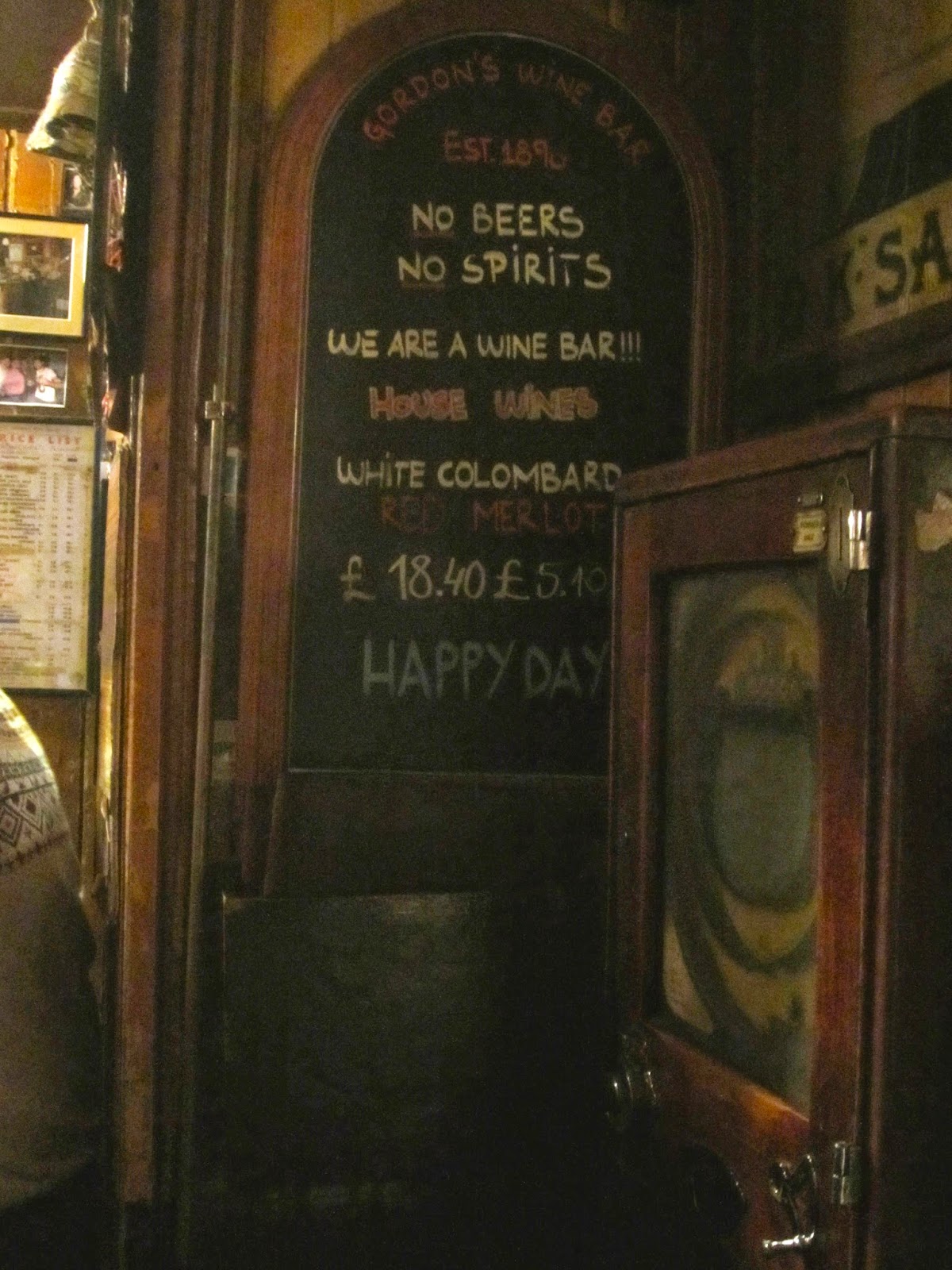


Except for a little wear and tear, it looks about the same as it would have looked in the Victorian era, and in the same historic building.

Getting to Gordon’s is an adventure.

You work your ass off finding 47 Villiers Street London WC2N 6NE.
Embankment is the closest tube stop.  Then you wonder if you’ve really found it.  A small alley offers plein air seating, but doesn’t seem attached to anything.  A closer look reveals a few rickety stairs leading into a cellar.  The entry appears a little grungy, but what the hell, you’ve come this far and siphoned off enough beer along the way to have several barkeeps say “Holy shit!”  A little grunge?  Bring it on!


The entry and bar area is small and elbow-to-elbow with thirsty Brits.  Gotta be something special about this hole-in-the-wall.  Atmosphere. The ancient walls are plastered with old newspaper clippings and posters and photos.  The bar is small, rustic and swarming. An enthusiastic crowd is either sipping or waiting, or chewing on olives and cheese.  Big wooden barrels promise glasses of sherry from the tap.  Open bottles of wine stand in regimental order.  


Salads, cheeses, and tubs of olives beckon. Away from the bar, bricked caves offer hewn wooden tables and wellworn chairs.  So dark in the caves you could meet your girlfriend with your wife sitting right beside you…I mean in theory you could.


This place is a melting pot, a social leveler.  Tattooed men and women in t-shirts share gossip with men in suits and fashionable women.  Backpacks rest on the floor next to briefcases.

Is this London or a hidden bodega in backstreet Madrid?  The redolence of wine and olives is like nothing I’ve experienced outside of Spain.  Hemingwayesque.  Yes, you can swill wine (which we did), munch olives (which we also did) and write a novel, which we didn’t do because at this point several curvy women started asking us for our phone numbers….well, they didn’t actually ask, but we insisted.


Speaking of novels, the building has a long, luxurious literary history.  Samuel Pepys lived here in 1688.  Francis Bacon was born here in 1579.  In 1890, Ruyard Kipling wrote “The Light that Failed” in the parlor above the bar.  Chesterton also used the parlor to good advantage.


But, to really get in the historic mood, let’s trot back a few centuries.  The building was first mentioned in 1237 and was then owned by the Bishops of Norwich.  Gallop forward to 1364 and the rein of Edward III.  Seems vintners loaned the king large sums, which he was unable to repay. So, he more or less told them “Boys, here’s what I’ll do for ye…Ye can sell wine anywhere and ye won’t even have to buy a license!”  What a pal.  Those so graced were titled “Free Vintners.”

I won’t bore you with every century’s change of ownership (not to mention changes in the street and building  and even the River Thames).  But you should know the original building burned in 1684 and was rebuilt four years later.  A little item called the Great Fire of London (1666) probably prevented an earlier rebuild.

In 1890, Angus Stafford Gordon opened the bar.  Angus was one of the last of the “Free Vintners.”

Where there’s a bar there are women.  All sorts of women.  In 1923, one Alfred Frederick Joyce stood convicted and fined for running a brothel in the building.
See how ruthless governments can be!  Sorta cuts down on anybody ordering a bottle of horizontal wine, wink, wink.  Governments are also shortsighted. The place is still packed with women, only now they don’t charge.  Way to kill off taxable income, boys.

In 1972, something strange happened. Luis Gordon noticed the bar with his name on it and bought the place.  After he died, his son, the current owner, Simon Gordon, took over.  And so, one of the most hidden and interesting places to sip some grape continues to attract crowds.  It’s like walking into your favorite backstreet bar that you’ve never been to before.

By the way, I can’t remember the name of the first, or second, or third glass of wine I sipped, but I’m pretty sure all three tasted really good.


Tuesday, February 10, 2015

Governo Toscano Rosso: A Wine to Remember


I want to talk about wine, and specifically an Italian beauty I picked up while enjoying lunch at a little German wine bar. 2012 Governo Toscano Rosso.

While the waiter asked me what I’d like to drink and I sputtered this and that, mispronouncing everything but hoof and mouth, he kindly inquired if I’d like his recommendation.  Oh, hell yes!  Dribble it on me, slap it to me, slosh it for me.

“Perhaps you would like a sample?”  A simple yes would have done the trick, but I insisted on punishing several more verbs and shredding the grammar like a bulldog with a yen for raw flesh.

The small, stemmed glass nestled gently in my paw, I took a sip and was overwhelmed with bursts of plum, undertones of cherry, and a depth of palatory pleasure I’ve seldom experienced since the first time I…but that’s another story.

I finished a delicious lunch and bought two bottles to go, just in case.  Cost of this luxurious red wine was 12.50 Euros or about $14.50 per bottle.

I opened one of the bottles this evening and grudgingly shared it with my family.  After all, one bottle of wine only goes so far and a man must have his secrets, so I hid the second bottle.

The waiter at the casa vino told me the wine would stand up to a good steak.  I decided to test the theory, but with something even stouter than steak, corned beef.


Reubens seemed to do the trick.  I know you know how to make Reuben sandwiches, so I won’t go into details about:  defrosting the corned beef, putting it in a baking dish, along with the juices and a cup of water, then slathering yellow mustard over the upturned fatty side, along with healthy doses of black pepper and chili powder.  No need to mention that I rubbed this paste all-over the top, then covered the meat with foil and cooked it in a pre-heated 325ºF (165ºC) oven for 4 hours.

Next I pulled it out, poured off the juices, recovered the dish and put the corned beef back in the oven for a couple of hours, until it was fork tender.  Pretty standard stuff and I know you’re bored.

You surely don’t want to hear about making your own delicious Russian dressing.


1 Cup mayo, 3 T Colman’s Horseradish Sauce, 1 T Worcestershire Sauce, 2T capers, ¼ Cup catsup, 3 T minced onion, plus 2 T chopped green onions.


Then there’s the sauerkraut that must be well drained and pressed to take out all the moisture, then heated.  First choice is fresh sauerkraut, second is glassed, and third, if you must, is canned.

Finally, there are thick slices of sturdy peasant bread to be buttered and slices of Swiss cheese.


You know, of course, to grill the Reubens as you would a grilled cheese sandwiches.


But, I told you I want to talk about the wine!  And, what exactly does it mean “stand up to a steak?”  Quite simply it means your mind is in a quandary as to whether to sip or chew.  The flavors balance and enhance each other.  You’d think:  Reuben sandwich, with it’s fierce spectrum of piquancy would overpower everything short of crude oil.  Not so, mon ami.  This wine added an exquisite aroma that lingered on the tongue and brought out the best of the corned beef.


What a colorful finish.  Bold, but without the heavy tannins.  Governo Toscano Rosso is not a wine you’ll have to struggle to remember.  Already finished your Reuben?  Sit back.  Have another glass of this very special vintage.  Picture yourself in Tuscany, by the pool, overlooking  miles of softly rolling, green leafy vineyards.  Maria Rosa is sunning herself languidly, stretching her tanned legs, straining her bikini. Wait!  She’s taking off her top!  Mama Mia!  But first, just another few sips of this delicious wine…


Friday, February 6, 2015

Stewed Champagne Pork With Root Vegetables


Winter is stew time, chili time, roast vegetable time, built a fire and sip some champagne time.  Outside it’s frosty, snowing.  Winds rip through you like an icy knife.  

Know a great…not just good…stew recipe?  Oh, hell yeah!

Bursting with melded vegetable favors, herbs, apple juice, champagne, and of course…..Pork!, this redolent  stew will make nostrils flare like beach umbrellas and your taste buds forget about whiskey and women.  Ok, maybe that’s an exaggeration.  Who can forget about whiskey?  But, it’ll come damn close.

Listen carefully, cause I’m only going to say this twice:  The Key is Good Pork.

I used a well-marbled, pork shoulder, but the cut is not as important as the meat itself.  We’ve come to assume: “Pork, the other white meat!”

Here’s a secret.  Swine enhanced by growth hormones, anti-biotic flim-flam, and unnatural feeds produce white meat.  Pork raised correctly is not white.  Feed ‘em well, let ‘em wander the barnyard, and you’ve got happy pigs.  But, how can you tell?  Let your eyes do the work:  Pork should be as red as beef.  If you see pale pink or nearly white pork, treat it like you would gray beef.

Now that you’ve mastered today’s lesson, here’s a fabulous recipe that will make your guests swoon and your true love promise to love you forever…or at least through the weekend.


Stewed Champagne Pork with Root Vegetables
Feeds 4

1 ½ pounds well-marbled, pork shoulder! (cut into one inch cubes)

Coarse salt and freshly ground pepper

3 Tablespoons vegetable oil (I use Safflower Oil)

1 Large leek (white and light green parts only) thinly sliced into rounds

3 Cloves garlic, peeled and thinly sliced

3 Sprigs of fresh thyme (I toss in the whole sprigs, stems and all)

2 Tablespoons all-purpose flour

¾ Cup natural apple juice (the cloudy kind, not clear)

¾ Cup dry Champagne or sparkling wine

2 ½ Cups low-sodium chicken broth (if you’re using packets, use 3 for 2 ½ Cups water)

1 Large parsnip, peeled and chunked

2-3 Stalks celery, rinsed and cut crosswise into bits

2 medium carrots, peeled and chunked


Season the pork with salt and pepper.  Put part of the oil in a deep pan (or Dutch oven) and heat to medium high.  Cook the pork in batches, for 5-7 minutes or until mildly browned.  As the pork is cooked, transfer it to a plate.

Add the rest of the oil and the leeks, garlic, and thyme.  Cook a few minutes until the leek is wilted.  Stir in the flour for a minute or so.

Add the apple juice and champagne and bring to a quick boil.  Use a long spoon, or spatula to scrape up any browned bits on the bottom of the pan. Add the broth and toss in the pork.  Add the vegetables.  Bring to a boil, then reduce to a bare simmer.  Cover the pot and cook for an hour. (Careful not to boil away all the liquid!)

Season with salt and pepper.

I served this with English peas and mashed potatoes.

Drink the rest of the Champagne and use those last few crusty bits of baguette to good advantage!

Watch the women go wild and the husbands get nervous.


Tuesday, February 3, 2015

Going Down The Tubes, Part Tube


If you’ve visited my favorite city, or read my flowing prose in the first part of “Down the Tubes,” (Of course you have!), you’ll know the Metro System is a great part of any London adventure. 


In Part II, I’ll enlighten you about another side of the tube system you may not have (in your inebriated state) considered.  The Tube as art.  I’m talking about line and shadow, and flashes of color.


The London Tube is not just for transportation; it’s also a haven of design, and beauty.  Not that I have come close to capturing even a portion of it.  With (by my count) 381 stations and a scattering of platforms at each station, it’s impossible to capture more than just a glance of the designing whims in the London Underground.  “Banks” alone has ten platforms.


Maybe I find the London Underground forever fascinating because I’ve spent so much time, wading through the crowds, cramming myself into packed carriages, and standing on platforms, idly waiting for the next train. 


It’s not just working hours that bring the crowds.  Londoners like to play and they use the tube to get everywhere.  Prime dinnertime, and cocktail hour, and ‘round midnight, after the theaters let out, you can find yourself mobbed.  Covent Garden.  Leicester Square. Piccadilly Circus.  A quiet riot of people.

In the morning peak, Waterloo is the busiest with about 50,000 people in a three-hour window and overall it’s the busiest with 89.4 million passengers each year.

Over 2.7 million people ride the tubes every day.  When I’m in London, I’m one of ‘em.  Sure, I do a lot of walking and I’ve tried the bus a few times.  Oyster Cards work on buses and subways.  You get to see a lot on a bus, a lot more than down in the tubes.  Problem is, buses plod along in heavy traffic, and you better know your bus routes, or be joyful about serendipity.

(stats from London For Transport:  https://www.tfl.gov.uk/corporate/about-tfl/what-we-do/london-underground/facts-and-figures)


One evening on the Piccadilly Line, my son and I were crammed so tight we had to take turns breathing.  He found himself pressed against three lovely young women, their faces only inches apart.  “Well,” he said, “As long as we’re stuck here, we might as well introduce ourselves.”  They thought it a good idea as well.  Londoners are like that, polite, even in the face of brash young American males.

But, the London Underground (which is 55% above ground) is not always so crowded.  The vast majority of the time, meandering tourists have no trouble finding a seat and enjoying the ride.


While you’re standing in the station, any station, gaze at the walls.  Yes, there are posters galore, but also fabulous runs of tiles, and in the larger stations, beautiful arrays of lights and shadows.  Even the rush of the train can be abstract amalgams of speed and color.


No wonder the Underground has set the mood in so many movies. The most common locations are Aldwych, a no longer used tube stop on the Piccadilly line, and the unused portion of the Jubilee Line in Charing Cross.

Aldwych was also used as the model for the London Underground in the video game Tomb Raider 3.

In no particular order, I offer some photos taken at various times, in various tube stations.

Look around you and you can find beauty damn near everywhere.  The London Underground is an always exciting art exhibit.