Friday, May 1, 2015

Recycle Those Olives

Olives supreme! 
You’ve got people coming over to lounge in your backyard, enjoy the spring sunshine and share a bottle of wine.  The closest grocery store doesn’t stock anything exotic, or impressive…and goodness knows we all want to impress.  Yeah, you could bust out packaged this or that.

Nope.  You want to serve something impressive.  You got an hour or more before they show up?  I’ve got just the thing.

First, you trot down to the corner grocery and buy a jar of ordinary olives and a can of smoky almonds.  When you get home, you don’t do anything with the almonds but put them in a dish.  If you’re a real show-off, finely chop some parsley and sprinkle it lightly over the almonds.

Ah, but the olives are going for glory.  Here’s how:

Drain the whole jar of olives.  Pat them dry and put them in a bowl.  Very finely dice approximately a teaspoon or more of lemon, lime, or orange rind. I prefer lemon. The finer the dice, the better.  Into the bowl they go.  Next, finely dice a couple of garlic cloves.  They also go in the bowl of olives.  If you have capers, add a heaping spoonful.  If not, don’t worry.  Grate some pepper over the olive mélange, then drizzle with olive oil and toss until you’re satisfied everything is well distributed.  Don’t be modest with the olive oil.

Leave them for an hour or more.  I like to leave mine overnight.

The first comments from your guests are likely to be, “I love your olives!” followed shortly by, “Where did you get them?”

That’s the perfect lead-in for a story about your trip to Sicily, the flat tire on a back road, and how an aging olive farmer led you through the grove of gnarled and ancient trees, back to his stone farmhouse for wine and cheese, and how his equally aged wife ushered you into her kitchen and showed you the secret to curing good olives.


You’re not lying, you’re just embellishing slightly.  A good story always enhances the taste of the wine, and after all, a good host always entertains his guests, even if it leaves his wife a little confused, wondering who the hell you took to Sicily!  Just pass her the bowl of smoked almonds and tell the story about…


Wednesday, April 29, 2015

Looking For Sekt In All the Right Places


An eclectic group of Germans and Americans gathering for Sekt!
Everyone knows if you want to call a sparkling wine Champagne, it better be grown in the Champagne region of France.  Other places call it other things. Even in France, if it’s not from Champagne, it’s usually called Crémont.   In Germany, it’s called Sekt, and comes in the usual array of dry, extra dry,etc.  But, even within those general descriptions, there’s a lot of variety.  Different grape varieties, different soils, different amounts of rain and sun, and most of all, different vintners.


Last Saturday, I wandered vineyards on the hillsides overlooking the widest part of the Rhine River (the famous Rheingau region) and tasted a river of delicious Sekt.  Barth Wein und Sektgut is a family run affair, covering 30 hectares. How big is a hectare ?  Funny you should ask.  I had the same question.  1 hectare = about 2.5 acres  Yeah, fine, but I wasn’t born next door to a barn.  How big is an acre?  43,460 Sq Ft, or 4,047 meters, both of which are about the size of a football, or soccer field, but not quite as long.


As both of my faithful readers know, 30 hectares on German vineyards are spread out all over the place, a patchwork result of literally centuries of wine growing.  Vineyards are bought and sold, children split up their inheritances, and so forth.  Barth’s vineyards are no exception.  Not sure exactly how far apart their hectares wander, but the tour took four hours, including a short stop for lunch.   If you’re using a pedometer, that’s 7000 paces, more or less.  Tours are only twice a year, spring and fall.  And, with the first two hours entirely on gentle to steep hills, make sure you’re reasonably ambulatory.

In our wandering, we paused six times, both to hear about a particular area, check out the soil type, and sample Sekt from grapes grown right where we were standing. There were Riesling Sekts, both Brut and Extra Brut, Pinots: Ultra, normal, and Rose.  In short, Barth offers an excellent Sekt to suit any palate, all from grapes grown on 100% organic vines.

What about the taste?  Dry is probably the most popular, even among those whose lips have never touched sparkling wine.  News travels.  Barth’s Sekt Ultra, made from pinot noir grapes, is quite dry, full bodied, and with a fruity nose.  The Riesling Brut, on the other hand, is lightly touched with sweetness, equally full bodied, and with a creamy finish.  Which is best?  Well, you’ll have to answer a few questions and then draw your own tasting conclusions.  Are you drinking the Sekt with a meal, or just lounging on the beach enjoying the bikinis?  If it’s the latter, the choice really doesn’t matter, does it?


This Wein und Sektgut family is particular!  Many of the vines are over fifty years old, but there are also new plantings.  Soil management is of equal concern.  Some years vineyards lay fallow.  Quality is always at a premium.  If a crop doesn’t meet Barth’s high standards, grapes from that hectare will not be used for wine or Sekt.

Interesting facts about Barth Sekt:

-       50% of Barth’s product is sold through direct retail, the rest is sold to secondary sellers, such as restaurants, and also exported around the world.  That means you can probably find Barth wines where you live.

-       It’s not unusual to see wild boars harvesting grapes, depending on how much food they can find in the nearby woods.

-       Not all finished bottles are labeled right away.  Some remain unlabeled until they are shipped abroad and then labeled to meet the laws of the importing country.

-       The Rhine flows generally south to north, but where the Barth vineyards are located, the river flows east to west.

-       Having plots of land in different areas means Barth’s separate hectares have different soil compositions and therefore produce different flavors, even when growing the same variety of grape.

-       Riesling has always been the most popular variety, but now that tastes have changed, Rieslings are grown not only for sweeter wines, but for dry and extra dry Sekt as well.

-       Each year, grape vines are lightly trimmed and the vines trained on wires to grow flat instead of straight up.  This allows more sun, and also allows the wind to dry the grapes and prevent fungus.

-       Using the traditional methods of production, Sekt is allowed to ferment in the bottle for as long as 24 months (two fermentations) and turned (riddled) a quarter turn by hand for a month before the yeast is removed (disgorged).


-       During bottled fermentation, the bottles are capped rather than corked.

-       For the normal bottles, disgorging is done with a mechanical device, but with the larger bottles, it must be done by very quick hands.
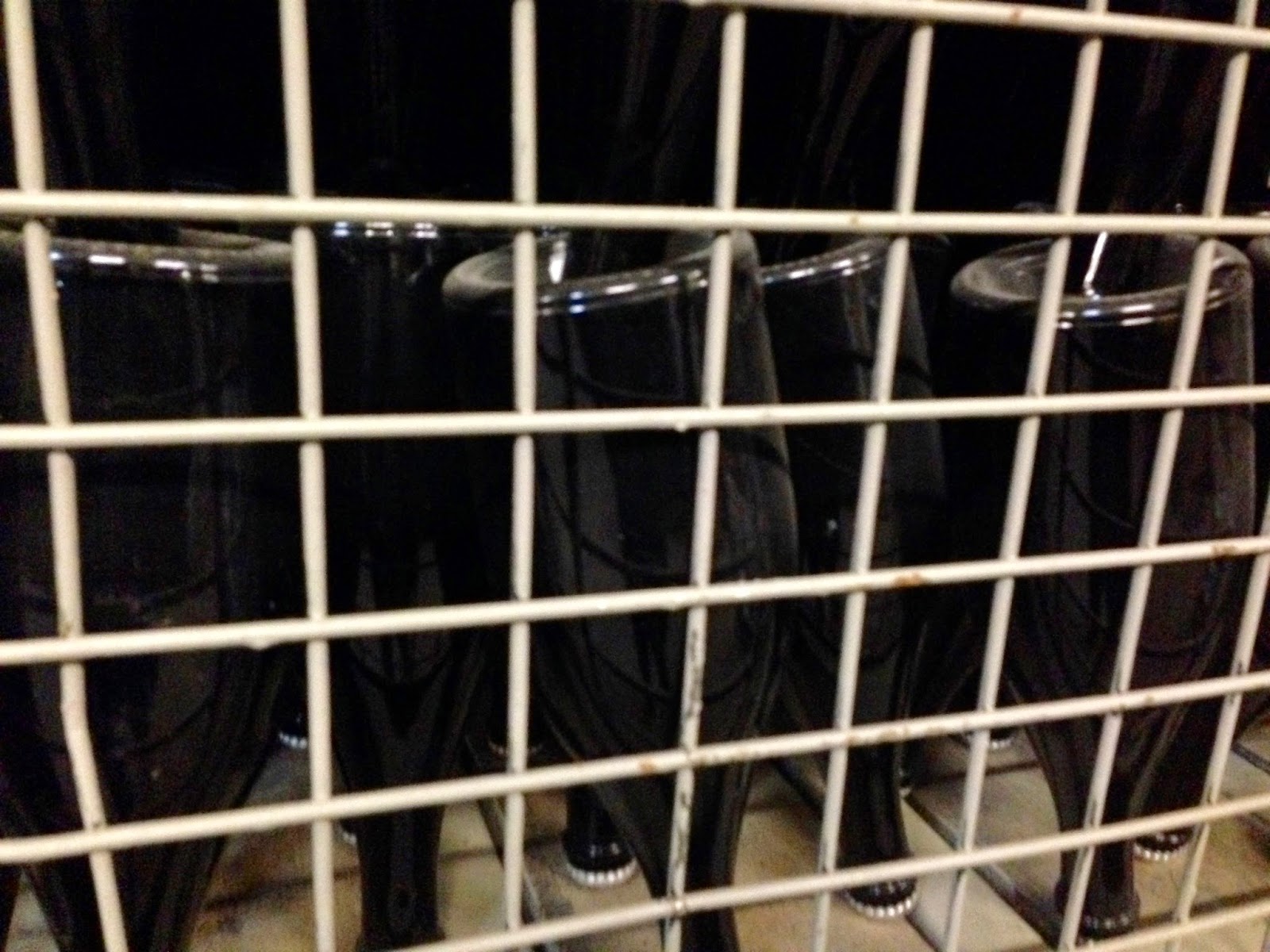
Sekt ready to be disgorged.

-       Easy to tell which bottles are being readied for disgorging.  They’re standing on their heads, allowing the yeast to collect near the cap.

No better way to spend the day, wandering vineyards overlooking the majestic Rhine River and sampling Sekt from one of the region’s great Sekt producers.

As Barth notes on their brochure, “Wine is our discipline, sparkling wine our masterpiece.”  That’s not an exaggeration.  Just ask anyone who’s tasted their Sekt.

Want to read more and explore upcoming events at Barth Weingut?  http://www.weingut-barth.de


Initial fermentation:  looking for 6 psi.

The final result of thousands of hours of work:  Sunshine in a glass!


Thursday, April 23, 2015


I’m telling you, I used to love Tex-Mex enchiladas.  Matter of fact, they were my go-to quick check on how good the whole menu was likely to be.  Somewhere along the line, the test no longer indicated much, except that the sauce came from a can and the ground beef sold for a dollar a pound.  Also, the red sauce version got a little bit old.  I traded red for green, but soon that came out of a can also.

Want some Mexican food worthy of the wonderful cuisine of Mexico?  Use fresh ingredients and make it in your own kitchen.  There are some exceptions.  I went into a Mexican restaurant in Manhattan (NY not Kansas!) and saw a sign over the kitchen door:  Our kitchen has never seen a can!  Now, that’s the kind of Mexican cuisine that ranks alongside the best in the world.

Ok, there are some limitations at home.  I confess I do not make my own tortillas, either flour or corn.  But, I have experimented and found the best packaged brands that suit my own taste buds.

Secondly, I do use jars of pickled jalapeños, although I also use fresh jalapeños in the summer, right out of my own garden.

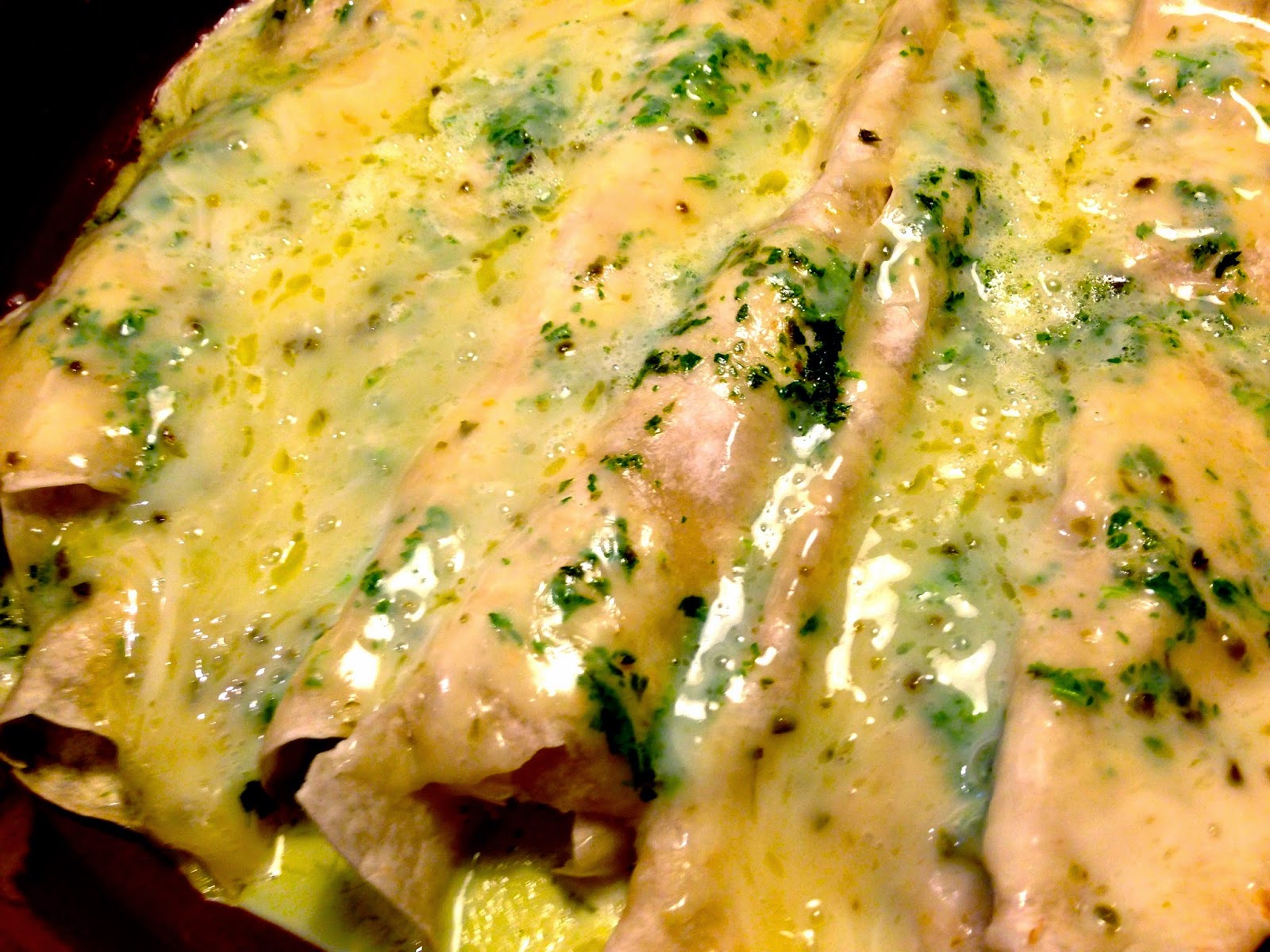
So, with true confessions nakedly displayed, let’s get on with making some terrific Grilled Pork Tenderloin Enchiladas that will please your loved ones and your family.

The Ingredients:

1-2 Tablespoons Oil (I use safflower oil)

1 Medium onion diced

3 mild green jalapeños, seeded and diced (if you must, use a small can of chopped, mild green chilies, drained)

1 Heaping Tablespoon chili powder (for the meat)

1 Pork tenderloin (about 1 pound or a bit more)

1 Package cream cheese

1 Heaping cup peppered Monterey Jack cheese, shredded

6-8 Flour tortillas (depending on size)

3 Tablespoons chopped fresh cilantro

2/3 Cup half and half cream

Salt and pepper

Preheat the oven to 350ºF (180ºC)

Prepare the Pork Tenderloin:

Sprinkle salt, freshly ground pepper, and chili powder generously on the pork.  Grill the meat, or cut it in half, add a little oil and brown it on all sides in a pan.  Note: The meat will not be cooked through, but not to worry, you’ll fully cook it later.  Cut the meat into fairly thin slices and either chop it, or put it in a food processor and give it a few spins.  The result should look like a course grind, not finely ground like hamburger.  Set the meat aside.

Prepare the Sauce:

Put the chopped cilantro and the half and half in a bowl (or food processor) and blend well.  Put the cream sauce aside.

In the same pan you used for the meat, add the diced onion and a bit more oil.  Sauté over medium heat until caramelized.  Add the diced jalapeños, or the canned chilies, and cook until soft. 

Combo:  Add the meat to the onion/diced chili mixture and stir to cook the meat.  As soon as the pork loses its pinkness, it’s done.  There’s not much fat on a pork tenderloin, so if you overcook it, the meat will be dry.  Now add the cream cheese to the meat/onion/diced chili mixture and mix until fully blended.  Your enchilada filling is ready!

Put it all together:

Put a couple of heaping tablespoons of filling on a tortilla, wrap it and put the enchilada seam-side down in a baking dish.  Make the remaining enchiladas in the same manner and add them to the baking dish.

Pour the cream/cilantro sauce evenly over the enchiladas.

Sprinkle the shredded Monterey Jack cheese over the enchiladas and cover the baking pan with aluminum foil.

Bake for 35 minutes in the 350ºF (180ºC) pre-heated oven.


I served mine with refried beans.  The story has a happy ending.  My wife extended our marriage contract for another year, my son smiled at me between bites, and the next day he offered some to his friends.  High praise that warms an aging father’s heart.


Saturday, April 18, 2015

Before I Go to Sleep, a mystery by S.J. Watson


Before I Go to Sleep is Steve Watson’s first novel, published in 2011.  Ingeniously plotted, it’s the story of a woman who’s lost her memory.  I don’t mean memory loss as in can’t remember the latest dance step, or the words to the ‘Hokey-Pokey.  This is serious shit.  It’s more on the order of “What the F is my name and who is that bastard who just boinked me?”

A nightmare?  Not quite.  She knows from her body and how she dwells on trivial things that she’s a woman, but after that?  She can’t remember last night, or yesterday, or anything past today.  The next morning is more of the same.  “What’s my name again?  You say you’re my husband?”

Of course, when you’re being boinked, being with a stranger has some erotic benefits.

But, plain panic turns to panic-and-angst, twin riders on a motorcycle of confusion, going god only knows where.  I don’t mean a real motorcycle, idiot, that’s a metaphor.

Just when you think things can’t get any worse, doubt jumps onto the page like an unsolvable calculus problem you never understood in the first place.  I’m talking ‘confusion’ with a capital T.  In a world with no absolutes and no yesterdays, whom can you trust.  Lots of people tell you things, but where do truth and trust unite?  You learn.  You forget. Suspicions creep into your life.  You embrace them, then doubt them. 

Every morning gives not a hint of who you are, or where you are, and “Why does that stranger refer to himself as my husband?”  I suspect a lot of women would like that question answered.

Before I Go to Sleep rides on a fiendish plot that sucks you in and glues you to the sharply drawn characters.  This well and smoothly written novel will keep you flipping pages faster than a preacher who’s dropped his Bible in the middle of a sermon.  Once you pick up this extraordinary mystery, don’t plan on getting much sleep.


Before I Go to Sleep is also a motion picture, which I do not plan to see, not wanting Hollywood to tell me what the characters look like and how they act.  I already know.   Nobody gets to mess with my memory.