Wednesday, March 2, 2022

Biscuits à l'Orange (orange cookies)


Biscuits à l’Orange:  Orange cookies by the Careless Cook


I like cookies.  Perhaps it’s a throwback to childhood when I followed my mother around the kitchen.  Ah the aromas! And the excitement for a child!  Often she let me stir, or when things were too difficult for my childish fingers, she would explain and show me what she was doing and why she was doing it, this way and that.  And, of course, with pies and cakes and especially cookies, she let me lick the bowl.  Magic words when she handed me the dough covered spoon or the beaters, or the spatula. I’ve written earlier about my mother’s recipe for sugar cookies.  Never saw that?  Never made her sugar cookies?  Ah, I pity you for your loss.


Mom's Sugar Cookies


Today I have another cookie recipe, but this one didn’t come from my mother’s kitchen.  Matter of fact, it didn’t come from anyone’s kitchen but mine.  Bold statement, not having been in everyone’s kitchen. But, hyperbole is my stock in trade.


These cookies require little time to make, have few ingredients, cook fast, and the icing on top is so simple even an idiot can make it. I proved that.


 As Mark Twin famously said, “Reader, suppose you were an idiot.  And suppose you were a member of Congress.  But, then I repeat myself.


Biscuits à l’Orange (Orange cookies)

Heat oven to 325ºF or 160º


Ingredients


2 cups all purpose flour

2 sticks butter (a cup)

1 cup fine sugar (I put regular sugar in my electric coffee grinder)

2 tablespoons of grated orange rind

1 teaspoon vanilla extract

1 tablespoon of milk


The icing

2 cups powdered sugar

½ cup of milk, or maybe a little more. Be careful; you’re not making soup!

candied orange rinds for decoration (Make these while the cookies bake:  See below.)


Make the Cookies


Use a hand-mixer or food processor to cream the butter and sugar.  Add the flour and orange rind, mix well, then add the milk.


Roll out the dough to about a quarter inch thickness and cut into rounds.  I used a well-washed tomato paste can, with both ends removed, which gave me 28 cookies.  Put the cookie rounds on a baking sheet and slap ‘em in the pre-heated oven.  Bake for 15 minutes or until the edges are just barely starting to brown.  Note:  check the cookies once or twice on the way to 15 minutes! Every oven heats differently.


Candy the orange rinds


Cut a few tablespoons of orange rinds into very small pieces (see cookie photo)

Put them in a small pan or skillet.  Add a half water, half sugar solution and cook on low heat for about ten minutes.  Discard the sugar solution and put the candied rinds on a plate to dry and cool.


When the cookies are ready, move them to a room temperature surface or a cooling rack.


When the cookies are cool, dip or paint on the icing and immediately add some cooled candied orange rind on top of the soft icing for decoration.


If you didn’t make enough cookies, now you have a problem because your unruly guests will eat these by the handfuls and then want to take a bunch home.



Want more recipes, travel articles, short stories, poems, and photos?  Of course!  Don't forget to subscribe!


Thursday, February 24, 2022

Beef and Barley Soup from the Careless Cook


Beef and Barley Soup from the Careless Cook


As my three faithful readers know, I do not make difficult recipes.  It’s a confession that while I like to cook, I’m an impatient eater.  So, if a recipe is difficult, I make it simple.  If I don’t have the exact ingredients, I unapologetically grab something similar.  That’s especially true of herbs.  Hey, I have a small, polite herb garden … ok, it’s not a REAL half acre garden, just a few pots of the standard perennials. But, moving past herbs, I may also grab whatever my careless eyes spy in the refrig or the pantry. Example: Going to make black bean soup, but don’t have black beans?  No prob!  Pinto beans work and I have two cans.  Call me a rule breaker, or just a Careless Cook! 


And with measurements I frequently use the T-LAR method, That Looks About Right.


I look at a recipe as a good place to start.  Where it ends is up to you.  Hey, you’re the chef!  Make it like you want it! If the diners don’t like it, meal’s over!


In the case of my barley soup, I added sausage to the mix because it seemed like a good idea, and besides a half-pound was left over from a previous recipe.  


Enough blather. Time to don that apron, pour yourself a proper goblet of a nice, polite red wine and let’s get cooking your very own delicious Beef and Barley Soup!


Beef and Barley Soup 


Ingredients (you’ll need both a skillet and a large cooking pot)


1 pound lean ground beef (90 to 93% lean)

½ pound Jimmy Dean Sausage (Hot, or Natural, or Original)

3-4 peeled and chopped carrots

1 large sweet onion, large dice

3 large ribs of celery, chopped

3 tablespoons tomato paste (It’s why I buy tomato paste in a tube.  Seldom does a recipe call for a whole can.)

4 cloves of garlic, peeled and chopped

2 (24 oz) cartons of beef broth

3 tablespoons soy sauce 

3 tablespoons Worcestershire sauce

3 generous sprigs of fresh rosemary, or a heaping tablespoon of dried

3-4 generous sprigs of fresh thyme, or a heaping tablespoon of dried

1-2 cups of pearl barley (use one cup for soupy, or two for very thick)

salt and pepper to taste


Note: I don’t strip the leaves off herbs when I use them in soup or stew.  I wash them and toss them in, stems and all.  The leaves cook off and I can pluck out the stems easily before serving.


Puttin’ It Together


Fry the sausage in a skillet, breaking up the meat as you cook, then drain and reserve.  Do the same with the lean ground beef, but add a little olive oil, and when it’s finished cooking, don’t drain it.


In the large pot, add a splash of olive oil and toss in all the chopped vegetables.  Cook and stir for about 3 minutes.


Add the tomato paste, stir and cook a minute or two.


Add beef broth and everything but the barley, to the pot and bring to a simmer.  When it simmers, stir in the barley. (you can always add more barley later)


Cover the pot and reduce heat to low.  Cook about 45 minutes or until the barley is tender.  Consider barley a tough version of rice, so it needs to cook longer.


I served my thick soup in bowls, accompanied with chunks of warmed baguettes and refills of that polite red wine.   Salut!  Prost! Cheers!


Your guests may not talk much, but you’ll know they love it by the rude slurping and sipping. Several of my guests required bibs, but I did get these heathens to use spoons; apparently a novelty for some.  Guess I should have passed out straws for the wine.


Friday, February 18, 2022

Beckham's Bookshop New Orleans


Decatur Street in New Orleans is one of the few thoroughfares in the French Quarter that isn’t pockmarked and doesn’t share the squalid conditions found on the back streets.


Matter of fact, this broad street has quite a few wonderful spots worth a visit, some of which I wrote of earlier:  Café du Monde, Jackson Square and the Red Slipper breakfast spot. There’s also the old Jackson Brewery, now a high-end conglomeration of shops.


On my last trip to New Orleans, I found a gem on Decatur Street, and what for me is a very special place, Beckham’s Bookshop.  I confess I’m addicted to bookshops, especially those dusty places that have a cluttered, backroom ambiance, with a fabulous array of used books, stacked carefully on worn and a seemingly endless array of book cases and also stacks of books on the floor by wooden chairs that creak when you sit down.  With all this and more, Beckham’s has found a proper spot near the top of my list.


Two older men, seated in their own creaky chairs looked me over when I walked in, or at least one of them did.  The other one was involved with a magazine and in a battle to overcome poor eyesight. The one who wasn’t involved was bald, wore glasses and had on a dress shirt and jacket.  He smiled.  I smiled.  End of conversation.


I looked around. At once I knew I was in a place to linger, to marvel.  Paperbacks, leather bound classics, best sellers of yesteryear.  It’s the kind of place where, no matter your level of education, you are overwhelmed with how much you don’t know and how much you want to know.  I asked myself how long has it been since I’ve read the authors of the twenties.  Too long. Then I found a biography of this and that well-known classicist, whose names I recalled.


You have to understand me to understand my passions.  I’m stuck in the 20s, 30s, and 40s.  Books and music. Wit as well as somber novels.  Raymond Chandler, Hemingway, Fitzgerald, to name a few. Writers and artists from their most productive years in Paris and London and New York.  I spotted a book: a bio of Dorothy Parker.  Remember her and the Algonquin Roundtable, meeting at the eponymous hotel in Manhattan?  Care to read a few lines from her pithy mind ?


“This wasn’t just plain terrible, this was fancy terrible.  This was terrible with raisins in it.”


“Don’t look at me in that tone of voice.”


“Tell him I was too fucking busy -- or vice versa.”


And one of my favorite bits of Parker verse:


By the time you swear you’re his,

Shivering and sighing.

And he vows his passion is,

Infinite, undying.

Lady make note of this—

One of you is lying.


I asked the clerk, Do you have any books in French?  Yes?  Plenty.  Upstairs in the back, left corner.  Ah, yes.  Books that stretch my memories of high school when I swore I would learn French, while my grades offered different options.


A bookstore, especially an old one, like Beckham’s, on a passible street in an old and crumbling city, is like a diamond of a thousand facets, sparkling in every direction.  A place of dreams, wrapped in clouds of self-promises.  Or maybe it’s an older woman, face streaked with ancient wrinkles, and yet whose beauty shines through the years and the pages.


Yes, I bought some books, a couple of them in French.  Hope undying. Vive l’espoir! Long live hope!


Wednesday, February 9, 2022

New Orleans French Quarter


When I speak of New Orleans, I speak of the French Quarter, the land of dreams, the rhythmic notes of jazz, a gracious lady and tangled upstart of languages and conquests that treads the dusty path of history. But, let’s not mince words.  New Orleans today is a decrepit, scrappy, moth-eaten town, the kind of place that makes you want to scrape the bottoms of your shoes and replace the axles on your car.


Robed in a colorful history and still offering the flavors of France and Spain, spiced by the making of America, it now lies desecrated by cracked third-world streets and sidewalks, adorned with drugs and filth. 


Night sneaks into the city like a creeping, feral cat. Back streets in the French Quarter, le Vieux Carré, all except restaurants and bars, are closed with chains and iron grills, and the quarter is home to rabble in filthy, garish clothes, stumbling and yelling, their unshaven faces reddened by drink and plenty of it.  Small groups of beggars clog the street corners, singing off-key songs with high pitched voices, and tin can and tambourine for drums, plastic buckets on the edges of the broken streets, waiting for the gullible to drop coins and bills.  Of course, you can get out of the old quarter, but then in my mind you are out of New Orleans and into the scabs of modernity, with casinos and shopping malls and buildings that reach to the clouds.


Remarkably, some small parts of the old city retain their history and beauty, gently whispering to sit, relax, ponder and read. 


A black wrought iron fence surrounds Jackson Square, one of the few places of solitude. A heroic statue of the 7th President and ‘Hero of New Orleans’ astride his horse marks the center.  The square languishes just in front of the St. Louis Cathedral on a corner side, opposite the famous Café du Monde, home to rich chicory coffee and beignets, French-style fried donuts, dusted with white powdered sugar.  Coffee called and so did beignets. 


While I sat and sipped and tasted my feather-light treats, a small combo played wonderful notes of When the Saints Go Marching In, the happy sounds so far removed from the screech on the corners of the night. When they tired, a smooth as glass saxophone artist took over, calming, soothing and leaving promises that the soul of this city lived on.


Coffee sipped to the last bean, I followed the call of the book I’m reading, Mrs. Dalloway, by Virginia Woolf.   Across the street in Jackson Square, I settled into a seat on one of the wrought iron benches that form a semicircle close to the Jackson statue.  I guess I should have been reading some Faulkner.  After all, for six months he lived in Pirate Alley (1925-26, called Orleans Alley until the 1960s), between the Cathedral and the Cabildo, the old Spanish governor’s mansion.   Faulkner wrote his first novel there, Soldier’s Pay. Samuel Clemens, better known as Mark Twain also spent a lot of time here and  famously said, “New Orleans food is as delicious as the less criminal forms of sin.”


You may wonder if I ever made it to some of the fine restaurants.  Yes.  On one of the back alleys, I watched my step and dined on seafood pasta and some flame-charred oysters at a crowed, rundown eatery, that was close to my hotel.  Delicious, but more was to come.


The next morning I wove my way through a light, foggy drizzle to meet friends at the Red Slipper, a breakfast joint I’ve written of previously.


That night, we took an Uber to Dragos at the Hilton Riverside, all agleam in tile and stainless steel.  We sat at the bar, and once again dined on chargrilled oysters.  Delicious!  It was a remarkably quick addiction. 


But, all in all, it will be a while……never say never…..before I return to this city, the Queen of the Mississippi.  And when I do, I’ll stay at a hotel away from the French Quarter, enchantingly romantic as it may seem. I remember New Orleans as one would remember a charming lady, well dressed and well spoken.  That lady has aged in heartless ways, lost a few teeth, still wearing the same dress that now has rips and stains.  With whiskey breath she slurs her words and offers a crooked smile.  


Oh, my darling, whatever has become of you?


Tuesday, January 25, 2022

The World At Night (Paris 1940) by Alan Furst


The World At Night (Paris 1940) by Alan Furst


I’ve written reviews of Alan Furst’s novels, all of which take place in the dark and somber days leading up to and during the Nazi era.  I get a hunger for them.  When you pick up The World At Night, as with his other novels, you don’t really read them, you live them, your overcoat clutched tightly to your chest, as you wander darkened street, embraced by the heavy fog of war, passing friends and enemies, without full knowledge of who is who.  


Furst’s fully packed novels, of which The World At Night is a prime example, blanket the scope of the filthy whirlwind that swept Europe, tearing it apart from 1939 to 1945, capturing the period year by year, from the Balkans to France and England, and Spain, always with a cast of indelible characters that follow crooked roads to survive or perish. 


Characters are innocent men and women smeared with the horror of war, as they plot their way from day to day.  And as they do, things always happen to push them into positions they don’t want to be in.  They’re not spies, but circumstances make them spies, still wedged between friend and foe.  They’re not resistance fighters, but many times they must fight. And meanwhile life goes on.  They fall in love, bargain with those they hate, meet in both elegant and seedy cafés, always treading on the razor’s edge.


Jean Claude Casson is not Parisian, but he lives in Paris and does his best to mind his own business.  He’s connected with the film world, which even in the midst of conflict carries on the business of making movies, writing scripts, collecting actors, scraping for financing, and finally getting stories on the silver screen.  He knows people.  A lot of people. Some want to use him, in fact most do, for both political and personal reasons.


The war in Europe was not just fought on the battlefields, by hordes of well-armed armies and ships and airplanes, but by the common people, the store clerks and farmers, restaurateurs, journalists, writers, and yes, the movie crowd.  Nor was it seldom fought by just one country and within one country.  I mentioned whirlwind and that’s the way it was.


Paris, Lisbon, Warsaw, even Berlin and London were a dark and active collection of those who lived underground in every sense of the word.  Trust?  Trust no one.  The need was a tangle of money, weapons, organizations of all sorts, and friendships made and broken for every reason under the sun, moon, and stars. 


To use an old cliché (I haven’t heard of any new ones), Furst has a way with words, and his heavy knowledge mined from libraries, letters, and persons who were there, weaves the words into a world of truth, torment, and terror, love and circumstance.


I must give you an example of the use of his remarkable prose!


He shaved, smelled the lotion he used to wear, then put the cap back on the bottle. Went for a walk. Rue de Vignes. Rue Raffet. Paris as it always was – smelly in the heat, deserted in August.  He came to the Seine and rested his elbows on the stone wall and stared down into the river --Parisians cured themselves of all sorts of maladies this way.  The water was low, the leaves on the poplars parched and pale.  Here came a German officer.  A plain, stiff man in his mid-thirties, his Wehrmacht belt buckle said Gott Mit Uns, God is with us.  Strange god if he is, Casson thought.


One of the wonderful things about Furst is how he sets the stage so elegantly, and when the twists and turns and action come, you know the setting, the smell of fresh bread, the taste of the wine, the burn of brandy when you come in from the cold, the deep and unselfish reasons you turn away from a friend, the complications of who you know, and who’s involved and what the stakes are; a perfect tableau for what is to come and why it startles and keeps you reading and makes me wish I could go back to Paris, now that it is Paris once again, and I thank god I wasn’t there when it wasn’t.


My other book reviews on Alan Furst:


The Foreign Correspondent


Mission To Paris


Under Occupation


The Spies of Warsaw


Wednesday, January 5, 2022

Japan's Most Famous Artist You've Never Heard of: Katsushika Hokusai


The Great Artist Himself

Fairly recently, I saw some great art at the British Museum in London.  Most of you have heard of the place, home to the Elgin Marble (which the Greeks are still trying to get back), the Rosetta Stone and other antiquities without number.  Always a delightful surprise to tap into their ever-changing displays. Nice pub across the street too.  Of course it’s called The Museum Pub.  Originality runs rampant! 


Recently, the museum’s featured exhibit was a renowned Japanese woodblock artist. Ever heard of The Great Wave off Kanagawa? The name has so many variations:  The Great Wave of Kanagawa, The Great Wave, and simply The Wave.  Truly one of the most well known works of art, and especially Japanese art.  See the photo above.  Recognize it? What’d I tell you? But do you know where Kanagawa is?  Oh, what gaps in your knowledge.  AND the answer is:  The open water in front of Yokohama and melds into Tokyo bay.


Back to the famous art known around the world. Oh, yeah, now you recognize the crashing wave!  But do you know the artist and his unusual story?


At this point, most bios flood you with a deluge of where the artist was born, what he did as a child, who his parents were, etc., all part of a gusher that makes you shut down your mind and turn the book into a Frisbee.  I shan’t do that.  Nay, nay!  Let’s stick with cocktail chat.


Katsushika Hokusai was an artist’s artist and so oddly amazing I have to reign myself in.  But, never fear, I’ll give you enough of a taste to make you beg for just one more sip.  


I ask my three faithful readers, all of whom usually start in at breakfast, to hold off on that second and third martini for just a little while.


To begin with, nobody knows exactly when and where Hokusai was born, but 1790 is a good guess.  And by the way, the Japanese language doesn’t put emphasis on any one syllable, so his name is pronounced HOK-SIGH, in one breath.


Even though the dates are not exact, he was born and he painted during the Edo era, also called the Tokugawa Period, 1603-1867.  But, why the hell is that important??? At the time, Japan was run as a dictatorship, that for the most part sealed the nation off from the rest of the world.  And here comes the art part:  It was a period of emphasis of home grown art, a time when Kabuki theater, Haiku poetry, and woodblock printing (Ukiyo-e) flourished, and much of Hokusai’s art was done in woodblock.  In fact, The Great Wave was printed over 8000 times.  The Woodblock method grew into printed books.  Hokusai’s woodblock art on view at the British Museum was taken from a book that was never published.  Let's look at a few examples also from that unpublished book.


The Japanese are artists and poets to their very soul. Ukiyo-e (OO-KEY-YO-E) means pictures of the floating world, or sorrowful world, or life that has an ending.  In Hokusai’s day, Ukiyo-e encompassed everything from flowers to steamy erotica. A word about Japanese erotica.  Unlike the porn of today, it has style and grace and although the body parts are there, so is the passion, a story that makes you notice the looks on the faces, the circumstances and the astounding pleasure.


I’ve set the stage.  Now let’s look more closely into the life of this fascinating artist, with a blast of information.


As a young man, he worked under a handful of mentors and some chased him away because of his originality that conflicted with the accustomed patterns of the day.


It’s said he did over 30,000 pieces (not all woodblock) in his life.


He changed his name every time he embraced a new style. Hokusai means North Studio.


He was married twice and outlived both his wives.  Lots of kids and grandkids.


Hokusai didn’t like to clean his studio, so instead, when his workplace became too cluttered and dusty, he moved.  Over the years, he moved 93 times!


Talk about dedication to his art, Hokusai worked from dawn to dusk, everyday. And although he created 30,000 pieces of art, a fire destroyed much of his work.


A most peculiar superstition:  He began each morning by drawing a Chinese dragon on a piece of paper and then tossing it out the window to ward off evil spirits.


His most famous work, The Big Wave, was part of a larger work called 36 Views of Mount Fuji (1830-1832).  Here's another Mount Fuji from the same work, this one almost as famous as the wave.


Always striving for perfection, Hokusai had a very long term plan to get there.  He described exactly how far he would come at 70, 80, 90, and 100 years old.  Sadly, he only made it to 90 (we guess) at his death in 1849.


The inscription on his tombstone translates to, Old Man Mad About Painting.  But, the story doesn’t end there.


With the end of the Edo period, Japan began to open its doors and Japanese art almost immediately exerted a strong influence on European art, and in particular the Impressionist painters, as well as other painters of the time.  Look at Van Gogh’s cherry blossom branch for one, and  the walls in Monet’s home in Giverny  that are covered with Japanese woodblock art.  It didn’t stop there, but raced into the 20th and 21st centuries. 


Vincent Van Gogh

 
Woman Bathing, by Mary Cassatt

The Japanese Style Bridge at Giverny, by Claude Monet


I’d write more, but my three faithful readers….well, you can guess they are itching to look more closely at some Japanese erotica. Just for the sake of art. 


Saturday, December 11, 2021

Bar Américain, Among the Swankiest of Swanky London Bars


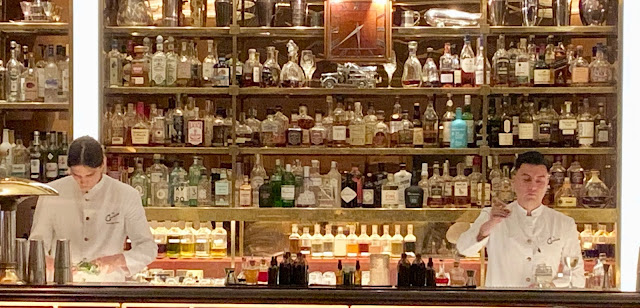
Bar Américain

Bar Américain, Among the Swankiest of Swanky London Bars


In London, I do most of my drinking in pubs, the pride of England’s social life.  Pubs are a social leveler where you see tattooed, scraggly construction workers idly chatting with coat and tie business men and clusters of women old and young passing the time of day over pints of brew and glasses of wine, and cider.


But, there is another side to London’s drinking habits, a classier side with women in elegant dresses, men in coats and ties and  delightful cocktails that cost nearly as much as…well, you get the picture.


On my last trip to the capital of English money and the scene of English fashion, I dropped a few £ at a very classy watering hole, Bar Américain, deep inside and downstairs in the Brasserie Zédel, which is not to be confused with the world famous American Bar in the landmark Savoy Hotel.  The American bar is world famously historical for a reason and I’d easily slip in for a sip or six, but right now let’s concentrate on Bar Américain.


What makes a good bar?
  In my opinion you only need one word: gentility.  But since my three faithful readers no doubt need a wider explanation, I have one right here and ready.   A gentile bar requires comfortable seating, music at a level fit for the low tones of polite conversation, subdued lighting that speaks of luscious romance, with a wait staff that is not there to be your friend, but to serve you with care and consideration.  The staff wear classically smart uniforms of a quality meant to serve the queen.  Should you choose to sit at the bar, which I normally do at 45 Jermyn Street, the bar staff must be incredibly knowledgeable and ready to provide a depth of information about each and every bottle behind the bar. No doubt they have tasted each and at times wept over the wonderful flavors. Only mention tune of your taste buds, and they will offer samples of those drinks for which you are not familiar. And while you sip at the table or the bar, you will munch on an assortment that begs you to ask:  Where did you find these wonderful tidbits?


Need a list of such prominent places to sip and enjoy the evening?  Of course you do.  Although I’ve provided photos of Bar Américain, Here’s a list, but certainly not an all inclusive list, of other of London’s gentile places to sip and ponder and gaze into those beautiful eyes that….well, we shan’t go too far… and besides, I could barely afford the drinks let alone some frolicsome gazing.


American Bar at the Savoy Hotel


45 Jermyn Street (click on the link)

45 Jermyn Street

Duke’s Bar at the Dukes Hotel (click on the link)

Dukes Bar

Any of the bars at the Dorchester Hotel, but especially the Promenade Bar


Don’t you just love the way the English use past participles that we colonials has let drift away:  I shan’t do that, the flowers smelt nice, I hope you have learnt from your mistake.  (But if used as an adjective you still must used learned)  It was a lesson well learned.


Even the use of shall has faded into the past of American English.


Ah, well, on we go, back to the gentile Bar Américain.


The layout is vast and yet the placement of the tables, and the way the room is broken up and flushed with soft light, gives the feeling of intimacy.  The wait staff, dressed in livery, is both professional and polite.  In seconds you know they are well trained and their job is done with pride.  “What may I offer you, gentlemen?”


What about the drinks?  I sipped a Perfect Manhattan.  And what is a Perfect Manhattan?  Your favorite bourbon, with a dash of bitters, and a splash of both sweet and dry vermouth, with a sweet cheery.  Because I know you’re sitting on the edge of your seat to find out….I prefer Four Roses, but oddly enough the original, instead of the single barrel and others from the talented minds of merchandizers. My companion had the same, for a great reason.  Not only is our favorite cocktail, it was also our father’s favorite.


A Manhattan is best when served in a stemmed, chilled glass, bringing back the days of Humphrey Bogart and Lauren Bacall, Audrey Hepburn and Gregory Peck.  Ah, yes, the days when Hollywood stars weren’t just beautiful, they were glamorous, as is the Bar Américain!


So, the next time you’re in London…Well, here’s looking at you, kid!