Showing posts with label French cuisine. Show all posts

Tuesday, April 12, 2022

Cassoulet My Way by The Careless Cook


Cassoulet My Way by The Careless Cook


Cassoulet is a traditional French dish that started in southeastern France, on the border with Spain and Andora, and like all good things…especially food…it spread across the country and into every French household. You may see a recipe for “Classic” cassoulet, but rest assured that every mother in France has her own recipe. Finding the original recipe is as difficult as finding the Garden of Eden and resisting a bite of the apple, offered by a lovely lady wearing fig leaves and smiling suggestively.


By the way, who taught the serpent to talk before language was invented?  I’d guess sign language, but serpents don’t have hands and can’t blink their eyes to signal “One if by mouth, Two if you’ll settle for a fig.”


Originally, like all good dishes that outlast their origin, cassoulet was a peasant dish, whose main ingredients were meat and white beans. After you lock onto those two, do what you will and nobody’s going to call you a liar, at least not to your face.  Hence the expression, Watch your back! Itself a gymnastic event.  Only Marie Antoinette was able to accomplish that, but she lost her head over it on her first try.


So, with the spread of cassoulet, it’s no wonder, as I sipped brandy and pondered what was in my pantry, that I called my dish Cassoulet My Way.


After all, a recipe is just the start of the process…..no, wait a minute….curiosity is the start, next comes a recipe, and then the high point is “Well, watta ya know, I don’t got no duck fat.  Gonna have to wing it.”


Some things I left out:  duck fat, chicken with bones and skin, and soaking dried cannellini beans overnight.   But, let’s not fight about it, especially since I’m the one pouring the brandy and feeding the suffering masses by simplifying your work in the kitchen, allowing you to create a dish that will delight your family, and/or loved ones.


But enough listening to the pitter-patter of little tongues.  Let’s get cookin!


FIRST, A VERY IMPORTANT THING TO REMEMBER.  THIS DISH WILL COOK FOR SIX HOURS IN A 300ºF OVEN.   CONSIDER MAKING IT THE NIGHT BEFORE OR PREPARING IT AT NOON AND SERVING IT FOR SUPPER.


Ingredients:


2 cans of cannelloni beans drained and rinsed

1 32 oz carton of chicken broth

3 packets of unflavored gelatin

4 strips of thick bacon, diced

6 boneless, skinless chicken thighs

2 to 4 links of garlic sausage (I used 2 links of mild Italian)

2 shallots, or one half of a sweet onion, peeled and chopped

1 cup baby carrots

1 cup celery, sliced

whole head of garlic, peeled, but not chopped

salt and pepper to taste


Puttin’ It Together – use a big pot or Dutch oven


Add the bacon to the pot on low heat and cook until the fat is rendered and the bacon only partly crisp. Set the bacon aside, dust the chicken thighs with salt and pepper, place in the rendered fat and cook until lightly browned on both sides.


Meanwhile, put half the chicken stock in a separate pot and when heated, sprinkle in the gelatin and stir well.  Set aside.


Remove the chicken thighs and add the sausages, shallots, and garlic to the pot. Cook until the sausage, the shallots, and the garlic cloves are lightly browned.


Remove the sausages and slice medium thick.  (see photo)


Note:  Neither the chicken thighs nor the sausage will be cooked through, but don’t worry; they will cook in the stew a long time.


Finishing up: Add the carrots, celery, bacon, sausage, and beans to the pot.  Stir well.  Add all 32 oz of chicken broth, then place the chicken thighs on top, pushing them into the broth. Bring to a low boil.


Put the uncovered pot in the 300ºF oven and cook for two hours.


A crust will form.  Break the crust and cook another 4 hours, breaking the crust from time to time.  In the last hour, a good portion of the liquid will have evaporated.


Remove the pot from the oven, and serve in bowls with toast points.  Add chopped parsley if you choose.   


Time to crack open that bottle of dry white wine!


Salut! Now sing La Marseillaise without spilling your wine!


Monday, June 22, 2020

Quiche Lorraine a Long Way From Lorraine


Quiche Lorraine a Long Way From Lorraine

Best quiche I’ve ever eaten was at a small outdoor café on the Place St Jacques in Metz, France. Haven’t been back in over a year and the light and exquisite quiche still calls to my taste buds, tenderly and sweetly.  Taste buds don’t forget.

The real thing, in Lorraine


Want the history of Quiche Lorraine?  Didn’t think so and frankly it’s a little hard to track down the origin among the plethora of dishes made with eggs and cream.  The name may have come from the German word for cake, Kuchen, but even that’s as uncertain as a blind man walking the plank.  

But, history or no history, I decided to make quiche.  You may be surprised I didn’t just fly to France and sit at the outdoor café, or sign up for Le Cordon Bleu in Paris. My wife was surprised, too.  But, in these times of stress, one does not venture far from home.  One may not be able to venture back.

Before I give you the recipe, you have to understand that for every sexy woman in Lorraine, there are at least two versions of quiche.  Most share the common ingredients:  eggs, crème fraiche, lardons, and Gruyère cheese.   But, if you stray from the standards, the culinary sky is the limit. Salmon.  Vegetables as far apart as onions and broccoli and asparagus.  Various flavorings.

Sadly, after my death defying bike ride a mile or two to the local grocer, I discovered crème fraiche and lardons are not part of the American diet, and the cost of Gruyère requires a down payment and credit check.

For the crème fraiche I had several options:  Use heavy cream alone, or add one tablespoon of buttermilk to a cup of heavy cream and wait 12 hours at room temperature for it to turn into crème fraiche.   Or, I could shoot from the hip and use half heavy cream and half sour cream. I drew fast and shot from the hip.  Fortunately, I’m a good shot.

Rather than forfeit my meager allowance on a bit of Gruyère, I grabbed a package of Baby Swiss. Flavors are nearly the same.

Lardons morphed into four slices of thick bacon, some fat removed, cut in small bits, fried and drained on a paper towel.

Of course, my friends in the U.K. or on the continent, will not have these problems.

Now that you know the secrets of my almost Quiche Lorraine, here’s the recipe.

Quiche Lorraine a Long Way From Lorraine

Heat the oven to 400ºF (200ºC)

Pastry crust (see note below the recipe for instructions)
1/2  pound of thick cut bacon, cut into bits, fried and drained
1 1/2 cup chopped baby Swiss cheese (usually comes sliced)
6 large eggs
3/4  cup of heavy cream
3/4  cup sour cream

Vegetarians never fear!  Just leave out the bacon/lardons and you will still have an amazingly tasty dish!

Smacking it together

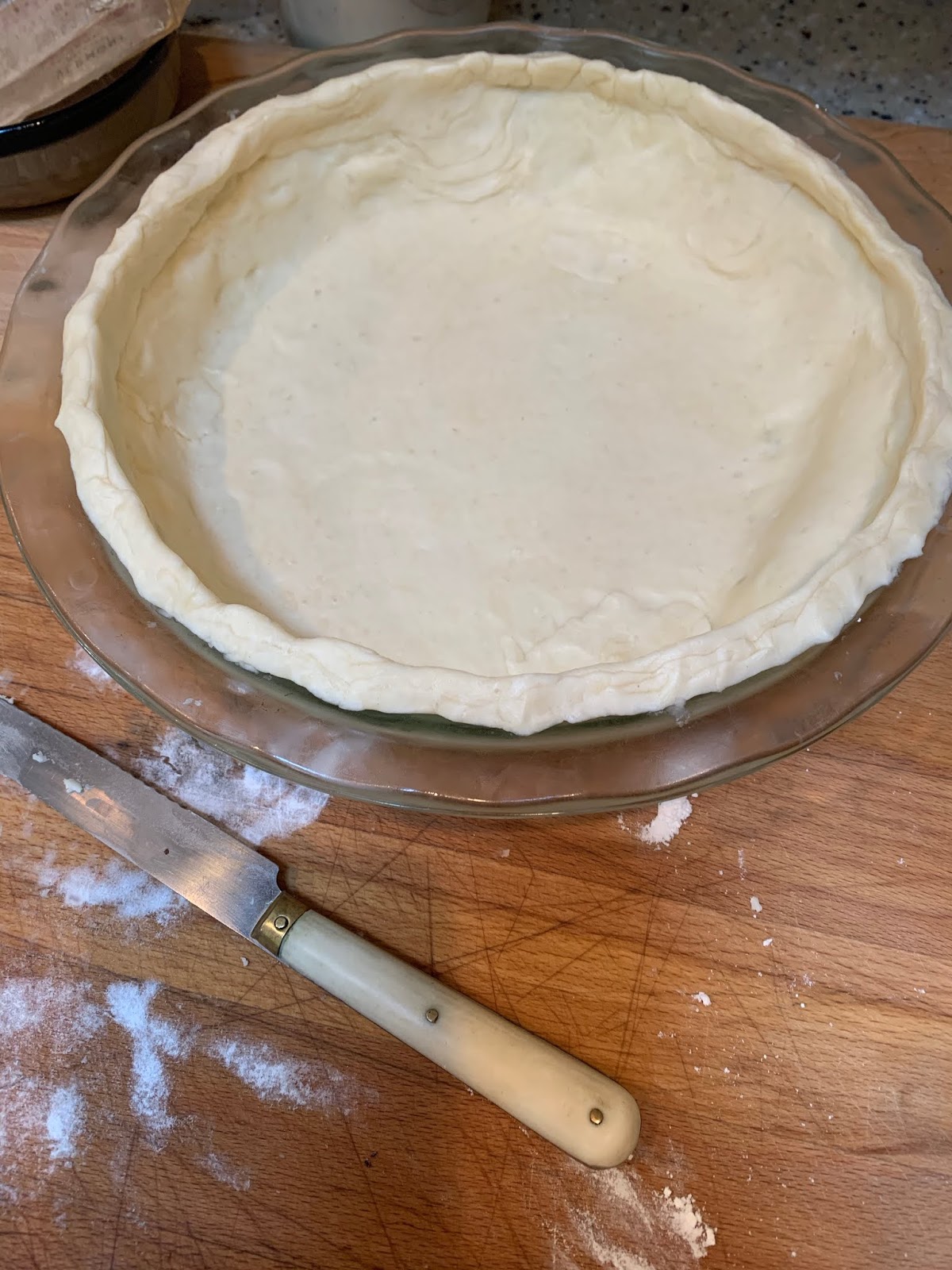
Roll out the pastry crust, fit it in your pie plate, prick the bottom and sides with a fork, and put it in a 400ºF oven for 7 minutes.


When the piecrust comes out of the oven, turn the oven down to 350ºF, and set the pie crust aside.

Meanwhile, beat the eggs in a bowl, add the cream/sour cream and beat until blended or your significant other complains about the noise. Add the cheese and continue beating, complaints or not, until all is blended. 


Scatter the bacon chips on the bottom of the crust, then pour in the egg mixture. You may need a spatula to scrape all the bits of cheese out of the bowl.


Bake for 40 minutes.  All ovens are different, so check after 30 minutes.
After baking, put it under the broiler for 2 minutes, but watch it carefully.

I served this with a nice Alsatian rosé.


So how did it compare with the Alsatian version, the thing of dreams? Very, very close.  But, when I get the chance, I’m still going back to Place St Jacques.  You know how it is about the memory of old loves.


And yes, I am a guy who likes to quiche and tell.

No dinner is complete without an espresso and a glass of a charming Armagnac!


Pastry Crust:
1 ½ cups all-purpose flour
large pinch of sea salt
8 tablespoons of butter, cut into bits
6 tablespoons cold water

Put all the ingredients, except the water, in a food processor and pulse until all is blended. Should look like coarse meal.

Put the water in by spoon-full to spread it around.  Pulse again until the dough clumps together.  Roll it out thinly on a surface dusted with flour. 

So simple!  You will find yourself using this flaky crust over and over.

The only way I can introduce my blog to new readers is on Pinterest and by my loyal subscribers and casual visitors spreading the word to friends and reposting on social media.  Thanks so much for your help!

Monday, February 4, 2019

La Bastille, Saarbrücken


La Bastille, Saarbrücken

Yesterday, my companion and I traveled to the city of Saarbrücken, of which I have written a time or two.  For those who don’t know, this glorious city is near the French border (or what used to be the border).  Drive twenty minutes further west and suddenly people say Bonjour, instead of Guten Tag.

It was shopping that took us to Saarbrücken’s long, wide pedestrian street, from the immense Karstadt department store (located in so many large German cities) to long clusters of smaller shops selling everything imaginable, from the inexpensive and mundane to premier fashions that cause you to pause and reflect on whether to buy a suit and shoes or a new car. 

Wonderful shopping is what we found, but also a gem of a French restaurant, La Bastille.  But before we get to the glory of French cuisine, allow me to give you a thumbnail sketch of Saarbrücken’s heritage.   

This city dates back to Roman times and has seen any number of wars and conquerors.  It’s a list too lengthy to go into here.  But, even in modern times, this city lived through a bouncing ball of hand offs from German to French to German, changing hands more often than a nervous square dancer, most recently in 1920 -1925 as the capital of the Saar Basin (Treaty of Versailles, giving control to France) and 1947-1956 as the Saar Protectorate (French Zone of Occupation, only nominally independent of France).  In 1957, it once again became German.

But, enough about Saarbrücken….the word meaning bridges over the River Saar.  Suffice to say, there are a lot of nice restaurants in this vibrant city and on our trip, we found one to remember.

Down a side street of the main shopping square, sits La Bastille, a French restaurant that lives up to the French fame for wonderful, glorious, fantastical food.  We’ll come to that, but first, your education is important to me, so let’s get a thumbnail of the name, La Bastille.  I’m sure you remember from your Modern European History in high school, there was an unpleasantness in France, better known as The French Revolution, a decade long struggle from May 5, 1789 to November 9, 1799, which dethroned and decapitated a king, while revolutionaries ran wild with a guillotine, known as ‘the people’s avenger.’  You may not know it was France’s official method of execution until capital punishment was abolished in 1981, and was last used to decapitate a murderer in 1977.


La Bastille was a castle, used as a prison in downtown Paris.   It became the symbol of all that was wrong with France’s royal, autocratic government.  The revolutionists attacked it on 14 July 1789 (now a national holiday) releasing seven prisoners, four forgers, two lunatics, and one sexual deviate.  But hey, it’s the thought that counts.  Later torn down, the site is now a traffic circle known as La Place de la Bastille.  In fact, since La Bastille was expensive to run, the government had already decided to tear it down, but if they had, the French would be lacking a holiday.

Place de la Bastille today

But, back (at last) to La Bastille, the restaurant, which on the other hand, was never a prison and I didn’t see any forgers, lunatics, or close friends of mine. It also was not a focus of revolutionaries, and by the way, it serves exceptional food, with exceptional service.  It’s not roomy, but small size cleverly gives it the air of an authentic French bistro.


We opt for an aperitif of Crémont, with a peach flavor and crowned with a speared Mirabella plum. Soon mixed olives and thick slices of baguette arrived.  You know Crémont, right?  I’ve written about this sparkling wine of Alsace, too.  Mirabella plums?  Yellow, sweet, and only the size of large grapes.


the spots are reflections from the polished metal bowl. 
I ordered spaghetti with shrimp, knowing the French would put their own spell on this Italian staple, and my companion ordered potato pancakes with applesauce.  

My dish came with a splendid salad, enhanced with light vinaigrette. The spaghetti had the creamy taste of the French cooks preference for butter.  Delicious!  The shrimp were politely cooked and wonderfully juicy.

As for the potato pancakes and homemade apple sauce….sublime.  They’re not what we Americans think of as pancakes.  More like hash-browns, festooned with fragrant bits of vegetables. 

Halfway through the meal we exchanged plates briefly, a good way to get to know your neighbor.  The woman across from me, whom I had never met……only kidding. And, I’m only a bit ashamed to say my companion and I traded a few more bites after the ceremony of the exchanging of plates.


The meal ended with double espressos and the young woman waiting the table came by with an offer of delicious chocolates.  A perfect accompaniment to the delightfully bitter coffee.

And now, I offer a few photos to give you the mood, the décor, and to let you know exactly why I will soon return to try more of the menu in this exceptional and historically named restaurant in the heart of Saarbrücken’s shopping district.