Showing posts with label Henri Cartier-Bresson. Show all posts

Tuesday, June 16, 2020

Just Takin’ the Shot: More Black and White Photos, Part I

Girl on a bike in Metz, France.


Just Takin’ the Shot:  More Black and White Photos, Part I

Today, I’m presenting more of my black and white photos.  It’s an evil plot to carry you into the mystery and intrigue of places and people you may never have seen, spring on you possible questions unanswered and mysteries unknown.  

The photos come from the U.S. and also from across Europe.

As always, and with the concurrence of Henri Cartier-Bresson, I take the shot and later decide if it’s good or not. A very freeing experience and one I suggest. 

I separate the use of a camera into two realms, photography and snapshots. There’s a place for both.  Often, all the snapshot photographer tries to capture are the smiling faces of loved ones, or a certain place or well-known area. Easily done with a snapshot.  I don’t denigrate snapshots at all.  Sometimes it’s humorous.  I’ve seen people nearly frozen in time, gathering the courage, or waiting for all the smiles to be just right before pushing the camera’s button, and then being startled by the click.

I take snapshots myself and you might be tempted to put portraits in the same category.   The major difference I find is that with a portrait there’s more concern with lighting and mood, with the photographer attempting to capture the personality of the subject.  You might say that portraits are a point where the artist with the brush and canvas meets the artist with the camera.  There are many other areas where the two meet and sometimes there is a confluence, with paint being applied to photos, or photos used in other artistic compositions. And of course there is Photoshop, with it’s electronically enhanced colors.

Artistic photography has much more latitude than snapshots in lighting and composition.  With snapshots, blur or motion can be devastating, calling for an immediate retake.  But, even with snapshots I readily accept the unplanned, for example, the two people in a group who are talking and not looking at the camera, or the dog who decides it’s time to run through the picture, or the baby who lets everyone know he can scream.  I value the unexpected, which to me makes the shot more memorable in the years to come.

So here are some more examples of this amateur breaking all the common rules of photography and just taking the shot! 


I love foggy mornings.  They carry the promise of mystery and romance.


Always have your camera at the ready.


When I took this shot, I could feel the wind in the tunnel.


Any delicious cocktail is worth a delicious shot.


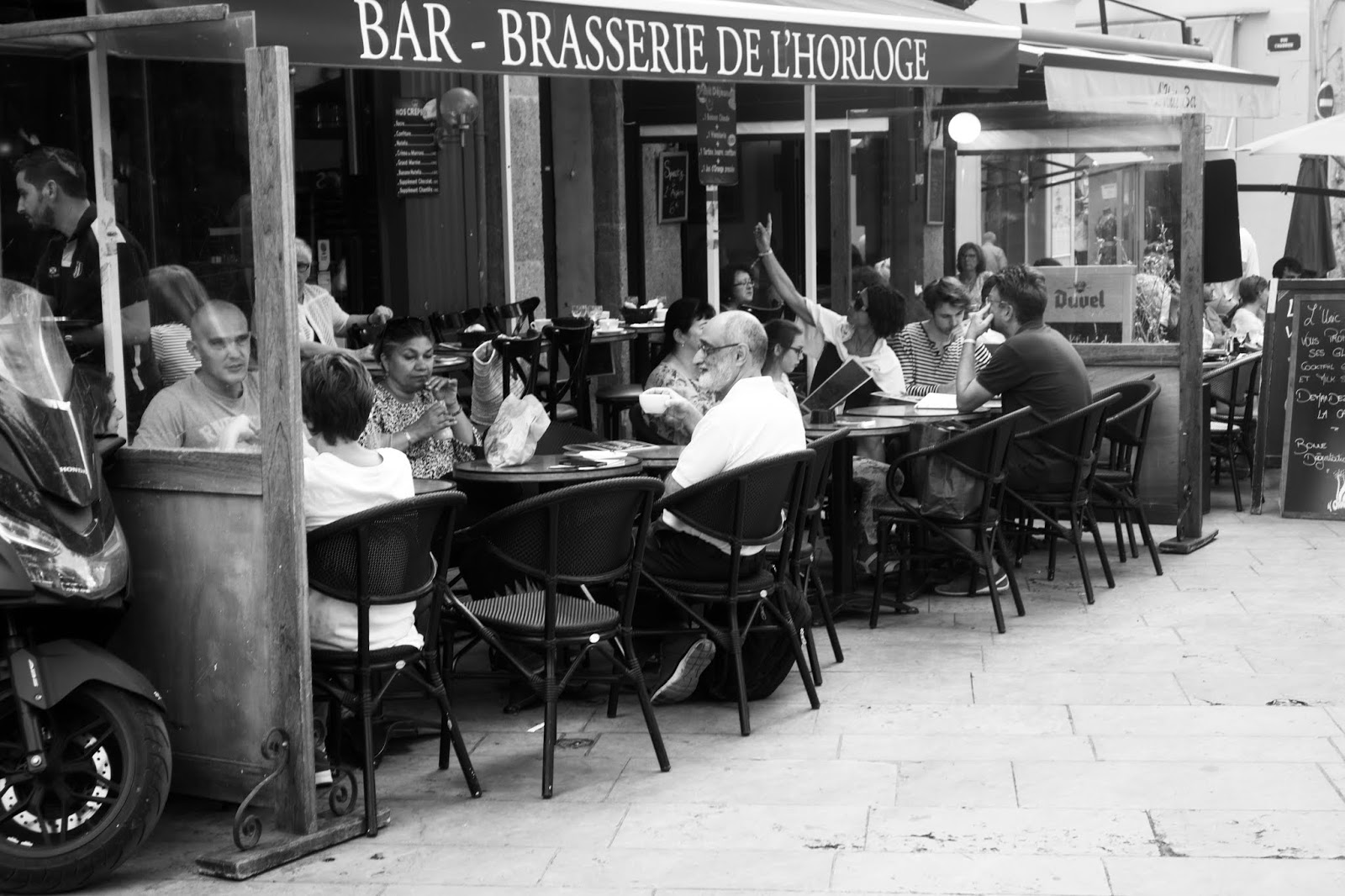
People provide the most interesting subjects and women the most of all. It's not a question of beauty, but of style and nonchalance and how they look when they don't know they're being observed.


Such a simple shot, but I love the design.


The tomatoes were bright red, but look how a black and white shot brings out the succulence shadows.


A quick stop for wine and another quick photograph.


Daunt Books, London


Cruises give you the freedom of the world.


Thursday, April 23, 2020

The Wonder of Black & White Photography


A photo I took in Provence.

The Wonder of Black & White Photography

Don’t worry; I’m not going to bore you with photographic jargon and detailed explanations of shutter speeds, aperture, and ISO.  For that you can find any number of experts with far more experience and knowledge in the technical aspects of camera settings.

What I will attempt to do is introduce you to one of the finest black and white photographers, Henri Cartier-Bresson (1908-2004), show you some examples of his work, give you his philosophy of photography in his own words, then show you some of my work, not for reasons of arrogance, and certainly not to compare my work to a genius in the field of black and white photography, but to let you see that with little instruction, some courage, and without more than a sparse knowledge of the finer aspects of clicking a button on your camera, you can come up with some rather amazing photographs.  Hey, if I can, you can!

Bresson, didn’t drape himself with photographic paraphernalia.  He used a small camera, with one fixed lens.  But, the equipment photographers need is very much dependent on what they’re going to photograph. Sports photographers, for example are loaded down with tripods and a variety of lenses that cost as much as a family sedan. 

But, Bresson photographed life; simple life, mostly composed of people and situations, dependent only on geometry, composition, persistence and without hesitation.

In this short blog I’m not going to talk extensively about composition, but you can read about “the golden ratio” here:  https://photographyhero.com/golden-ratio-photography/

Now, on to Henri Cartier-Bresson!


The creative act lasts but a brief moment, a lightening instant of give-and-take, just long enough for you to level the camera and to trap the fleeting prey in your little box.  ---Henri Cartier-Bresson

To me that is one of the greatest instructions in all of photography, summed up by:  Take the shot or lose it forever!

A couple of examples of his magnificent work.


And from my own experience:  A close friend of mine, and much better photographer than I, were strolling the streets together on the left bank of the Seine River, in Paris.  At the same instant we spied a bread man making a delivery, looking so Parisian, floppy blue work jacket, two-day beard, dark hair carelessly combed, walking with a large bundle of fresh baguettes under his arm.  She and I grabbed our cameras at the same time, but both of us were a second too late!  He walked past within two feet of us and we missed the shot!  Neither she nor I will ever forget.  Take the damn shot!

It is life that interests me and therefore always the next photo.
--- Henri Cartier-Bresson 

Have you noticed that the most interesting photos are invariably candid?  Even when I’m shooting group gatherings, I find a rare moment or two when I can use candid shots to capture more of the personalities.  And black and white photos highlight life’s drama and intensity, discarding distracting arrays of colors to keenly focus directly on the subject.  When the subject is a group of people, candid black and white presents a tableaux of faces, emotions, frozen in the exact moment when individuals are no longer a group, but once again individuals, clear and distinct.  Black and white exhibits the solemn power of concentration.  In a color photo of a field of wildflowers, one sees the field and brilliant colors, but with black and white, one’s eyes are drawn to a particular flower.

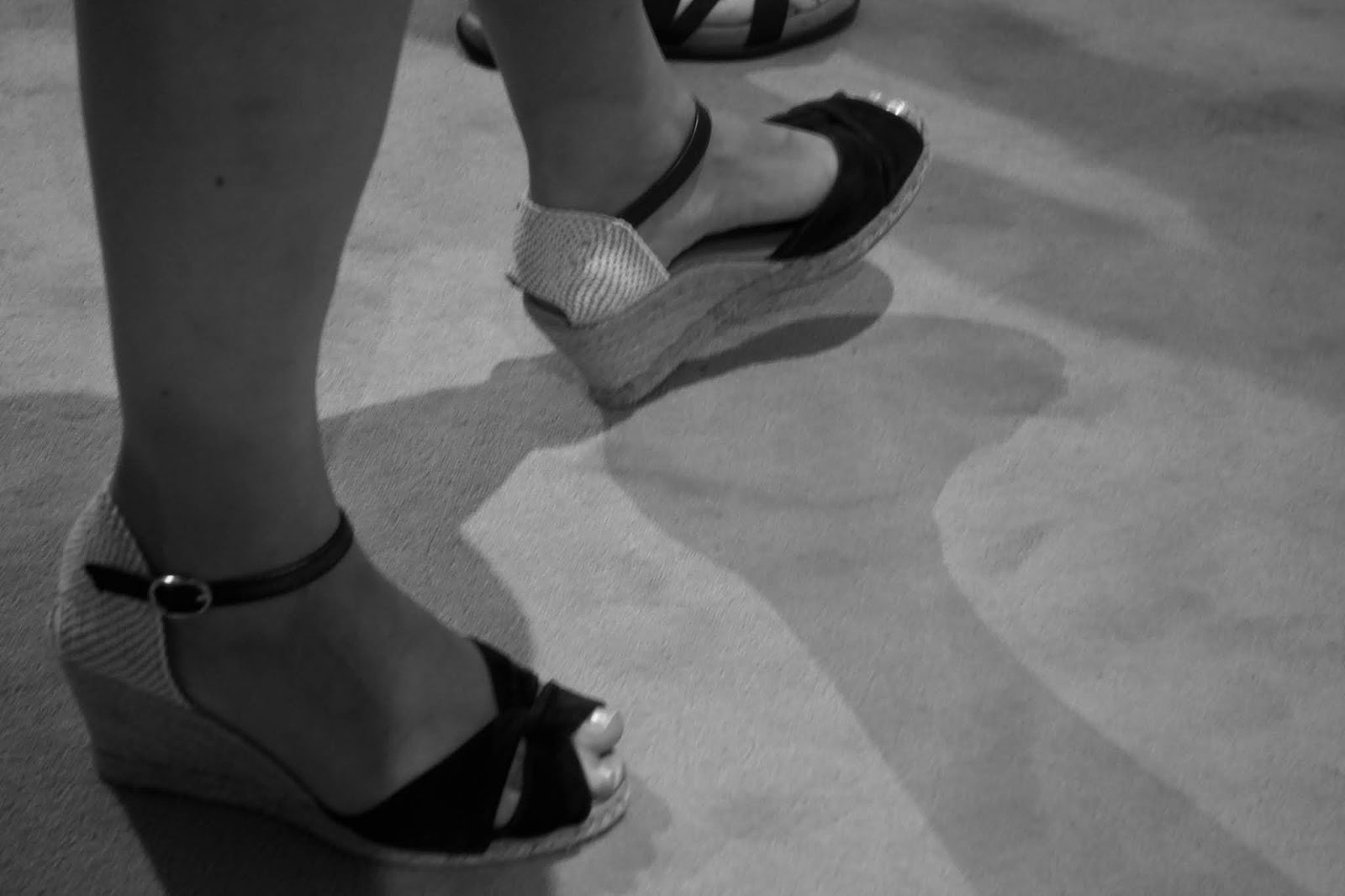
Photographs in B &W also pick up the details of everyday life, things you would never have noticed suddenly take on a thought provoking importance.  A pair of shoes.  The intricate gnarl of a ravaged tree, the careless beauty of a flower, and so much more.  Far from taking away from the form and action, black and white photography accelerates comprehension with a single, intensified glance.

Try it and see if you see what I see.  In Bresson’s case, nearly all of his best photos are candid and he was particularly taken with humans in motion and from unusual angles, with the human as part of the design.

Man.  Man and his life, so short, so frail, so vulnerable.  For my part…I am almost exclusively concerned with man.  I cut straight to the chase. Eternity is for landscapes.  ---Henri Cartier-Bresson

Some more quotes from Henri Cartier-Bresson.

I am a visual man.  I watch, watch, watch.   I understand things through my eyes.

Photography is not a job to me, it’s just a fierce enjoyment; you have no expectations, you wait for the surprise…

To me, film has nothing to do with photography.  Photography is a visual thing that can be seen in a plane, like a drawing, a lithograph, or a painting.  Film is a discourse.

And now a random few of my own B & W photos, that no doubt fall far short, but they give me hope! Like Henri, I tend to concentrate on people, but for me it's people in conversation. Here then are some of the times when I took the shot!


Tomorrow, I will show more selections of my efforts in B &W.

Thursday, December 13, 2018

Trees and Dreams in the Fog, PART I


Trees and Dreams in the Fog, PART I

What makes a good photograph? Aside from a few hints about perspective, don’t know and don’t give a damn.  Just as with any form of art, I can only tell you what I like and what I don’t. More careful descriptions serve only to buttress my opinions in a plea for agreement, or a manner of taking off my hat and bowing to the artist.

An art critic’s opinion is only as good as a TV football commentator’s, who with great solemnity tells you which team will win the big game and why and how.  Doesn’t affect the outcome of the game one whit.

But, I can tell you this, with some assurity, a good painter will splash color on canvas with complete indifference to what anybody thinks, just as a good quarterback will run his offence and expect to win, no matter whom the experts picked.

A good artist lives on a diet of self-satisfaction, and often dines alone.

A good writer or photographer or ceramicist is the same.  Popularity and art are two separate entities and seldom are they friends.

I once overheard a woman ask an artist, whose work I admired, “I like this painting, but could you do it over, with more orange to match my couch?” Only the threat of arrest and imprisonment allowed me to silently walk away.

Art doesn’t have to be complicated.  Some of the paintings on my walls are literally child’s play, from my sons’ elementary days.  Emotion can make any art beautiful, just as love can make any woman beautiful or any man handsome.

Another example of simplicity: The French photographer, Henri Cartier-Bresson, only used a Leica camera with a fixed 50 mm lens.  He shot in B&W and created photographs that to my eye plumb the depths of emotion. His specialty was the candid photo. As he famously said, “Take the shot or lose it forever.”

One of Bresson's most famous photos

Fog and trees and riders in the fog and braces of foliage along the highway intrigue and fascinate me. Today I offer a few examples of when ‘I took the shot.’

Are they art? Don’t know. Don’t care.  I do care that I took the shot.


 Tomorrow, PART II