Saturday, June 13, 2020

Stroud's Rule breaking Gumbo


Stroud’s Rule Breaking Gumbo

Right off, I’ll tell you the closer you live to Louisiana, the less you’re going to like my gumbo.  Yes, it is absolutely delicious, but gumbo eaters from Louisiana, Mississippi, and even East Texas have unbreakable rules.  Rule number 1:  You begin by making a roux.  A roux is at least a cup of flour and the same amount of oil/butter, cooked until the mixture is the color of an old penny.  I forget the other rules…oh yeah, you have to use green bell pepper and sassafras bark.   In a bow to tradition, I did use a little bit of sassafras bark, but that’s not really necessary.

You want to put some bark in your bite, you’re going to have to go to a health food store.  And by the way, one of the traditional ingredients of gumbo, sassafras leaves, is now on the FDA’s carcinogen list.  But, I used dried sassafras bark. 

Not knocking it, but making roux with a cup of oil/ butter, and a cup of flour will overload my delicate figure, put me in the Clydesdale division and make my talking scale scream “One at a time, please!”

Fortunately, for me and my group of three faithful readers, I’ve found an option so flavorful you’ll be shouting, “Screw the roux!” And even those folks from New Orleans will be congratulating you and buying the drinks.


Stroud’s Rule Breaking Gumbo

1 Sweet onion, diced
1 Bell pepper, diced (I use a yellow bell pepper)
2 Stalks celery, diced
1 Potato, diced
2 Green onions, chopped
4 Cloves garlic, peeled and thinly sliced
10 oz Smoked sausage, cut in thin rounds. I found a local source for smoked sausage, but you can use Andouille or Kielbasa or any other sausage with a smoky flavor.
1 lb Shrimp, peeled, tail off, chopped in two or three pieces depending on the size of the shrimp
1 Can fired roasted diced tomatoes, undrained
4  Cups chicken broth, plus 1 cube
2 Heaping tablespoons Creole mixture
Note:  Some Creole mixtures are quite salty.  Taste before you add more salt.
1 Teaspoon sassafras bark (optional) Got mine at a health food store.
Black pepper to taste
2-3 Shakes red pepper flakes
3 Tablespoons rice flour, diluted with enough water to make a paste.
3 Tablespoons olive oil
2 Chicken thighs, cooked, then skin discarded and meat picked off the bone

1.    Slosh the olive oil in a large pot with a lid. When the oil is hot, add the vegetables, except for the diced potato.
2.    When the onions are translucent (about 5 minutes), add the sausage, the chicken bits, and garlic.  Stir well.
3.    Add the Creole seasoning and other seasonings and stir, then add the tomatoes, chicken broth, potatoes, and half the chopped green onions.
4.    Bring to a boil, reduce heat, cover and cook until the potatoes are tender.  Stir in the rice flour and water mixture to thicken things up a bit. Now add the shrimp.  When the shrimp are pink, they’re done and so is the gumbo.
5.    Serve over rice or plain, with the remainder of the green onions sprinkled on top.

I served mine plain, which makes me a conscientious objector to rules in general, recipes in particular and gumbo specifically.  But, rather than saying “Rules are made to be broken,” I prefer just to ignore them.  

Sometimes the results are delicious!


Now, I’m going to pop the cap on another Abita Beer, brewed in Covington, Louisiana.  Not ALL rules are made to be broken.


Wednesday, June 10, 2020

World War I, 1914 -1918, and the Death of Joyce Kilmer


World War I, 1914 -1918 and the Death of Joyce Kilmer

I’m confident my three faithful readers know that thousands of books have been written about the First World War, which had been called The War to End all Wars and the years after was referred to as The Great War.  

Before you think I shall attempt to drag you through the deep mud of history, I assure you I will not.  My purpose is to give you a few pertinent facts that may be useful for cocktail conversation and then to plunge you into the death of the poet, Joyce Kilmer at the Second Battle of the Marne.

“Why bother?” you may well ask.  A bit over a hundred years ago!  No longer relevant. Right?

First of all, the First World War led to the Second World War.  Secondly, the war introduced an array of technology that led to killing on a scale never before seen.  Thirdly, it was the first time the United States became deeply involved in a European war. Fourthly, the First World War saw more U.S. casualties 320,518) than any war except for World War II (1,076, 245) and The Civil War (1,031,881). 

And let’s not forget the war caused the breakup of the Austro-Hungarian Empire, the breakup of the Ottoman Empire, and the rise of Soviet Russia.


Ok.  Good facts.  But, important now?  Read on.

Another salient point is, although it is called a World War, for the most part, World War I was a European War, although the big powers’ colonies supplied some troops to the war effort and opposing colonies also fought on a smaller scale.

Lasting effect of World War i:

The Sykes-Picot agreement, between Britain and France, first begun in 1916, was directly responsible for the current hodgepodge of boundaries in today’s Middle East and the resultant troubles.

Let’s look at the belligerent in World War I:

Entente Powers: Britain, France, Russia, and later the U.S., and their allies

VS

The Central Powers: Germany, The Austro-Hungarian Empire, Turkey (Ottoman Empire), Bulgaria, and later Italy

Both sides had various smaller allies and colonies.


Note: The Austro-Hungarian Empire and Austria-Hungary were the same country and often referred to by either name.

A very simplified version of salient points:

1914: Archduke Ferdinand of Austria-Hungary and his wife were assassinated by two nationalist Serbs.  The traditional tale says the assassination started the war.  In my opinion a simplistic version, at best.  The Balkans had been a powder keg for years, with Austro-Hungary in the middle of the disruptions and previous assassinations left and right.  The turmoil prior to the war is fascinating and may I recommend Why 1914?: The Causes of the Great War, by Derek Robinson (see note at the bottom to find out where to get a copy.)

1914: Germany attacked France, pretty much as they would do in the Second World War (1939-1945), only this time the French stopped them at the First Battle of the Marne.

That’s the thumbnail, but what’s fascinating is how quickly the dominoes fell! It’s as if everyone was already prepped for war and eagerly awaited the crack of the starter’s pistol!

28 June 1914 - Assassination of the duke
28 July – Austro-Hungary declares war on Serbia
1 Aug – Germany declares war on Russia
1 Aug – Germany and the Ottoman Empire (modern day Turkey) sign a secret alliance treaty
2 Aug – Germany invades neutral Luxembourg
3 Aug – Germany declares war on France and Belgium denies permission for Germany to cross its border
4 Aug – Germany invades neutral Belgium

These countries had declared their neutrality:  The Netherlands, Italy, Sweden, Denmark, Norway, Switzerland, Belgium, Luxembourg.

4 Aug – United States declares its neutrality
5 Aug – Montenegro declares war on Austria-Hungary

I could go on and on, but you can see the tangled spaghetti of alliances from the very beginning of World War I.

In very simple terms, when the French and British forces stopped the German advance, the war became a stalemate and quagmire into which millions of men were used as cannon fodder. 

The United States declared war on Germany and the first American troops landed on 26 June, 1917.  In total, America would send two million soldiers, of whom over 53,000 were killed in combat and another 60+ thousands died from other related causes.

The United Kingdom and France and Germany and Austria-Hungary lost even more. To give you an idea of the scope of hostilities, at the Battle of the Somme, some three million men took part, with over one million casualties. But numbers are just numbers and don’t tell the story of misery and death for four bleak years, of men’s bodies torn apart and being gassed and coughing up blood and unable to breathe.  In the trenches they died of disease and lack of medical care and something called trench fever.


On the Russian front, 4 June to 20 Sep 1916, the count of dead and wounded rose to 2,317,800

In the final offensive, 8 Aug to 11 Nov 1918, the slaughter claimed 1,855, 369 casualties. 


The slaughter went on until 11 November  1918.  The Peace Treaty of Versailles was signed on 28 June 1919, after the victors worked out the details at a lengthy Paris Peace Conference.

Now let’s move to the Second Battle of the Marne and Joyce Kilmer’s death.


The Second Battle of the Marne, like the first battle of the same name that started the war, was a German offensive.  It proved to be the last major German offensive and was a decisive victory for the French, English and American forces.  It was also the battle where Joyce Kilmer was killed. The war ended about 100 days later.


Joyce Kilmer’s Death:

Kilmer enlisted in the New York National Guard and was assigned to the 69th Infantry Regiment, better known as the “Fighting 69th”, which later became the 165th Infantry Regiment.  Kilmer rapidly rose to the rank of Sergeant and at first was a statistician, but wanted to be part of the action.  On 7 March 1918, 22 men of the 165th were in a dugout when the German bombardment began and the dugout collapsed.  19 of the men never made it out alive, in spite of a determined rescue effort.  In their memory, Joyce Kilmer wrote a poem, which began:

In a wood they call the Rouge Bouquet
There is a new made grave today.
Built by never a spade nor pick,
Yet covered with earth ten metres thick.
There lie many fighting men, 
Dead in their youthful prime,
Never to laugh nor love again
Nor taste the summertime.
For death came flying through the air
And stopped his flight at the dugout stair
Touched his prey and left them there.

Kilmer’s desire for more action was realized when he was transferred to the military intelligence branch of the regiment in April 1918.  Today military intelligence is mostly a desk job, far from the front.  Not so in World War I.  Intelligence staff was often farther forward than the main body of troops, crawling forward through the mud to search out and report back about enemy troop movements. Today  we would call them forward observers. 

He wrote to his wife that his new job “promised a double dose of glory and thrills.”  On 30 July 1918, Kilmer volunteered to go with Major “Wild Bill” Donovan’s battalion, which was sent forward to lead the attack.  Sergeant Kilmer led a scouting party to find the position of of a German machine gun.  When his comrades found him later in the day, at first they thought he was asleep or just staring over the top of a small hill, where he had possibly crawled for a better view.  But, when they called to him and he didn’t answer, they went closer and found him dead of a sniper bullet to the head.  He was 31 years old.

The French government awarded him the Croix de Guerre.   He is buried at the Oise-Aisne American Cemetery and Memorial in France, just across the road and stream where he was killed.

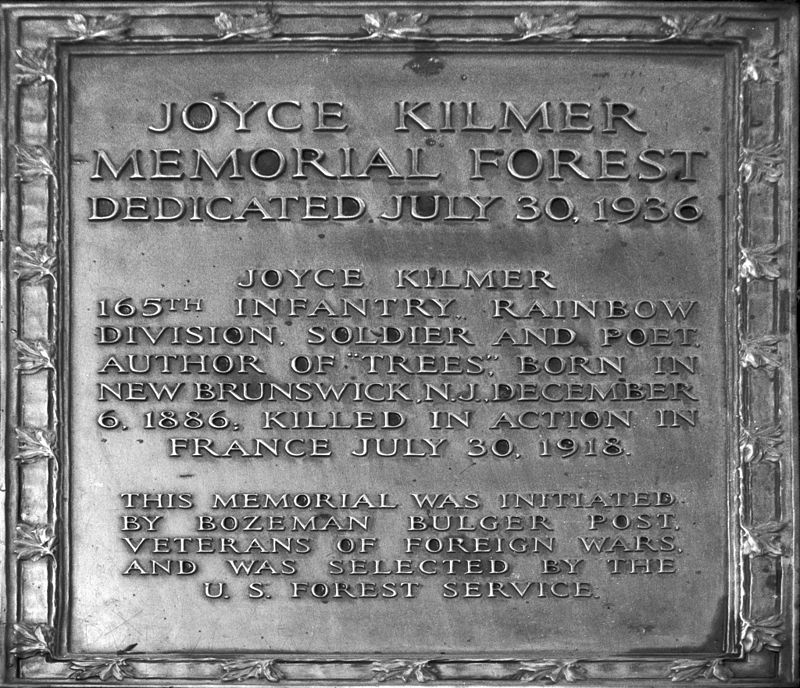
A forest in North Carolina dedicated to Joyce Kilmer
The Oise-Aisne American Cemetery in northern France
In a final note on the importance of World War I to our modern culture, the war, with its extravagance of carnage and the horror of the trenches, where so many lived in the slop of mud and died from disease and bullets and the explosions of often days of cannon fire raining death from on high, western literature was changed forever. Besides Kilmer, any number of renowned writers and poets from every nation served their time in the trenches, watching men die amid the slaughter. No longer would the literature of warfare be charged with heroic tales, spirited by nationalism.  A comment attributed by Union General William Tecumseh Sherman in the American Civil War, “War is hell,” had become even more real.  Both victors and vanquished had killed each other on an unrelenting scale of millions. No longer did writers and poets write from a distance.  They had been there. They knew.

Unfortunately, this proved to be only a taste of the fires of hell that was yet to come.

Note:  Where to buy a fabulous read about World War I.  Why 1914 ?, by Derek Robinson, one of my favorite authors, whose flying novels of World War I I have written about previously.  www.derekrobinson.info, or write him at delrobster@gmail.com.  He is also on FaceBook.


Monday, June 8, 2020

Trees, And a Poem in Tribute to Joyce Kilmer


Trees (1913)

I think that I shall never see
A poem lovely as a tree;

A tree whose hungry mouth is pressed
Against the earth’s sweet flowing breast;

A tree who looks at God all day,
And lifts her leafy arms to pray;

A tree who may in summer wear
A nest of robins in her hair;

Upon whose bosom snow has lain;
Who intimately lives with rain.

Poems are made by fools like me,
But only God can make a tree.

                        ---Joyce Kilmer (1886 – 1918)
                                    Killed on 30 July 1918
                                    The Second Battle of the Marne
                                    World War I


A Poet of My Heart

I thought of you today Joyce Kilmer,
The long dead poet of New Jersey,
The poet of Trees, the marker
Of nature’s grand design
In rhymes as simple as the sniper’s bullet
That felled you in the mud of war
And left you bleeding
Lying still in death, embraced  
By mother earth’s sweet bosom,
At the crest of a small hill in France.

I saw a tree today, as dead as you,
It’s arms stretched heavenly,
As if to reach your lifeless, muddy
Fingers in a pleading moment
Of fearful supplication,
It’s gray and brittle limbs 
Tortured by time and
Free at last to die
Among the rising life of 
Opulent greenery, the 
Carefree joy of sunshine,
The blissful cooling rain.
The lonely arms outstretched
Caught my eye and trapped
My attention. It was then, 
I thought of you.
            
                        --- William Stroud


Later, I shall write about World War I and the Second Battle of the Marne.

Should you wish to know more about Joyce Kilmer, this is a good place to start:  


Friday, June 5, 2020

Challah - A quick way to dress up your meal!


I’m sure you’ve heard of Challah (Cha-la), the traditional Jewish bread served on the Sabbath and holidays.  Braided bread.  Lots of those around in different countries and cultures.  This one is easy to make and goes great with stews and other cold weather meals.

Aside from simplicity, why would you want to make Challah?  Lots of choices.  You’re going to the synagogue’s Wednesday night potluck.  You thought Monica Lewinski was really, really  cute.  Braids bring up fond memories of your fifth grade girlfriend.  Or, Challah has the tender sweetness of your ninth grade girlfriend, who was also easy to make.

Thanks, Bob, but I think I’ll go with number five:  Challah’s such a crowd pleaser, the women will want to kiss the cook. I say, let ‘em!

One thing different about Challah from most braided breads, is that it’s parve.  Rabbis may call me on this, but to me, Kosher is divided into three areas:  meat, dairy, and neither. For now let’s keep it simple.  Parve is the ‘neither.’  So in the case of Challah, the bread is made without butter, milk, or any meat products.  How about eggs???  Also parve.

Another thing, Challah is a European Jewish tradition.  Middle Eastern and Spanish-background Jews use unleavened bread on the Sabbath, something more like pita. 

Lots of variations.  12 braids, 6 braids, 3 braids.  Sometimes raisins or nuts, sometimes whole wheat flour.

Enough chitchat.  I go simple.  No raisins or nuts.  3 braids.  My recipe, stolen unabashedly and without shame from a former associate, is also very simple.  Throw the ingredients in a food processor.  Put the dough in a greased plastic bag and let it rise.

Wait a sec.  You probably want to know the ingredients.  Ever helpful am I!

3 1/2 Cups flour (I use organic, unbleached.)
1 package yeast (If you can get fresh yeast, it’s even better.  Use half a cube)
1 egg
1/4 cup vegetable oil (I use sunflower oil)
1 1/2 teaspoon salt
1/4 Cup sugar
1 Cup warm water (95ºF or 35ºC)
Turmeric, as desired to make the bread yellow (Not too much! Turmeric is bitter!)

Dissolve the yeast in warm water (in the food processor).  Add sugar, salt, and two cups of flour. Mix well, using the dough blade.  Add egg and oil and mix again. If you want the bread to have a yellow glow, add a few pinches of Turmeric at this point.  Add the remaining flour and knead for ten minutes.  The dough pulls away from the sides of the food processing bowl, and has an elastic feel.

Place the dough in a greased plastic bag and allow it to rise.  In cooler weather, I put the bag in my oven and leave the oven light on.

When the dough is doubled, about an hour or two, take it out of the bag and form three balls.  Pull and roll each ball into a long strand (about 15-18 inches long). 


Pinch the strands together at one end, braid them and then pinch the final end. 


Put the loaf in a long bread pan and let it rise again.  If you want the bread to have a shiny look, brush the braided loaf thinly with a beaten egg.  Sprinkle on sesame seeds for an extra touch.


Same loaf after the second rising.  Note the difference in size from the photo above.


Bake at 375ºF or 190ºC for 25 minutes, or until the top is a medium golden brown.


Talk about delicious cultural diversity!  Mazel Tov!


Wednesday, June 3, 2020

Whatever Happened to Little Red Riding Hood?


Whatever Happened to Little Red Riding Hood?

We all know the story of Little Red Riding Hood and how she walked through the woods to her grandma’s house, and slew the wolf.  Which got me wondering, how did Red Riding Hood turn out when she grew up, and was it true that a young girl had killed a wolf?

I did a lot of research.  Here’s the fractured story, as best I have been able to find out.

L.R.R.’s Teenage Years

After she moved through elementary and middle schools as a very good student, her life took a different direction in high school.  Her grades dropped.  She gave up on the riding hood shtick, tried to fit in, and started hanging out with a bad crowd, smoking dope in the backseat and learning to use the word LIKE at least twice in every sentence.  

Her psychologist suggests that was about the time her father, long absent from the original story, took up competitive drinking, and lost his job as a woodchopper, being crowded out by the advent of laws regarding timber harvesting, and the onset of machines that could chop wood faster than he could finish a pint of whiskey.  He picked up the name Pecker Head and wrote a book about how he’d taught his daughter to kill wolves and plow a field using only her teeth.

Her mother divorced her husband of twenty years, lost sixty pounds, became a holistic yoga instructor, and married a man who called himself Rocky Starlight, twenty years her junior and a drummer in the up and coming band, Straight to Hell. The band later changed its name to My Shit Don’t Stink. The lead singer, Chunky Droppings, left the band to go solo and Rocky Starlight found himself out of work.  L.R.R.’s mother divorced him shortly after, and took up with the female minister of The Church of Sweet Jesus! Christ Almighty! 

L.R.R. dropped out of high school at the age of sixteen, and by lying about her age, became a stripper in a large, nearby city, under the stage name, Belinda Buxom.  Soon the media caught wind of it and Teddy Tender, the club’s owner, was sued for employing under aged girls, and lost his club to lawyers’ fees. L.R.R. lived on the street for a while.

LR.R. in Her Twenties

After the media storm, and living rough, the former Little Red Riding Hood, moved to another town and became a waitress. But, soon the media found her again and this time a group calling itself Wolves of the Forest, or WOOF, began to picket the restaurant, claiming that Little Red Riding Hood had dispatched the wolf in a careless and cruel manner.  “Wolves are our friends,” declared Patty Wagon, the leader of the group.  She told a reporter, “Wolves are our friends and kill the hateful and crop eating deer!”  She later was forced to modify that remark, saying she only meant the really, really hateful deer, not all of them.

L.R.R. gained a lot of weight, joined a motorcycle gang and was called by some, Morbidly Obese Riding Hood. The members of the Very Moody Pudsuckers motorcycle club just called her Pork Rider.  By this time, most of the club members knew why. 

She’d dyed her hair orange, trying to rid herself of the Little Red Riding Hood story altogether.

In time, she dropped out of the gang, lost all the weight she’d gained, married a banker, and embraced her newly rediscovered fame as the little girl who’d saved her grandmother.  Her husband often liked her to dress up in the Red Riding Hood outfit after dinner and play tame the wolf with a cat-o-nine tails.  She never shared that with the ladies in her bridge club.

No one ever found out that the wolf was actually a transvestite named Will Done-it, whom Little Red Riding Hood caught molesting her grandmother, and plunged a pitchfork into his particulars, severing the carotid artery.  He bled to death and she and grandma ate cookies while they dismembered the body and burned the parts in the oven.

“Say it was a wolf,” her grandmother told her, “so I don’t have to go to court and relive these awful moments.”  

Grandmother never admitted she’d invited him to the cottage and had wine in the frig.