Wednesday, February 19, 2014

Quiche That'll Make You Want to Quiche and Tell!


Quiche is timeless and adaptable to breakfast, lunch, or the middle of a Super Bowl when you’re out of breath from watching freakishly large millionaires run up and down a grassy field with an oblong, leather package.

And there’s nothing sissified about quiche, at least not when I make it with onions, bacon, cheese, milk, and eggs, and some chopped artichoke hearts, then bake it in a flaky, mouth-watering crust.  Goes well with just about any unsweetened beverage you can name.

What are some common complaints? Too eggy.  Too difficult.  Too Frenchy. Too Bridge-Party-With-the-Girls.  What? You don’t eat eggs, bacon, or onions?  And, my quiche is NOT eggy.

Quiche originally comes from the Lorraine region of France, so yes, it is Frenchy.  Wear a beret and speak with an accent like zis and zat, if it makes you feel better.

Ok, so you’re all, like, “I don’t like even eat, you know, the flesh of like living beings.”

Leave out the freaking bacon!

“But, I’m like you know a vegan-tarian.”  Fine. Want salt and pepper with your onions and chopped artichoke?

Just got back from Brussels.  My wife dined on quiche for breakfast.  It was delicious, but I figured I could do better than a restaurant’s baked-yesterday approach.  So can you.  And, it’s not tough to do.  And you will get cheers, a bouquet of kisses, and an offer of all earthly delights.

“Quiche me quick!”  Your wish, darlin’ is my ultimate pleasure. 

This recipe will feed six polite adults, or two teens. I used a 12 inch, deep dish pan.

First the pie dough, because it needs to sit in the refrig, for an hour.

2 ½ Cups all-purpose flour
½ Tablespoon Salt
½ Cup (1 Stick) of chilled butter
½ Cup shortening
4 Tablespoons ice water

Mix the flour and salt.  Using forks or a pastry cutter, cut the shortening and butter into the flour.  Sprinkle on the ice water.  (I normally do a bit of this and that, but the ice water should be measured, or the dough will be too soggy.)

Cutting in the butter and shortening

After adding the ice water.

Note:  Do not use a food processor to make pie dough.  The butter and shortening will be cut in too finely and the crust will not be as flaky.

Press the dough out into a rough circle, cover it front and back with plastic wrap and put it in the refrigerator for at least an hour.

Getting the dough ready for the frig. 

 After at least an hour, and before you start on the filling, roll the dough out in a circle and put it in the dish.  Pierce the bottom and sides with a fork.  Don’t be shy. If you don’t do this, the crust will bubble.

Paint the dough lightly with the white of one egg and bake it in a pre-heated oven at 375ºF for 15 minutes, or until it is a very light, golden tan.  Note: you will have egg white left over.  Note:  The crust will recede when it is baked.

Now for the filling

¼ pound of bacon, fried crisp, then chopped to half the size of your little fingernail.
6 Eggs, plus the extra egg yolk, and leftover egg white you used to paint the crust
1/3 Cup artichoke hearts, chopped.  Marinated hearts are ok, but use a paper towel to sop up the excess oil.
1 medium onion, peeled, halved and sliced thinly
2 ½ Cups grated Gruyere, or a similar cheese
2 Cups milk
¼ teaspoon nutmeg

Beat the eggs, nutmeg and milk in a large bowl.  Add everything else and mix well. Pour it into your pie plate, making sure the cheese gets spread evenly.  Slip the pie in the preheated oven and bake for 45 minutes, or until the top has brown spots and when you shake the dish, the center of the quiche doesn’t wiggle.

Ready to go in the oven. This is a 12 inch, deep dish pan.

 Out of the oven it comes!  Cheers erupt!  Champagne corks pop!  Women push and shove to get closer, except for the lank haired, skinny girl in the corner, but it doesn’t matter.  She’s got onion breath.


Tuesday, February 18, 2014

Brussels' Beer Cafés - Part II


Brussels is strewn with signs in two languages.  Good reason. There’s the French speaking south and the Dutch (Flemish) speaking north, plus Brussels, which is bilingual.


Brussels is also the capital of the European Union, so just name a language and it’s spoken here.  English, German?  No problem.  Japanese?  Maybe.  I see lots of tour groups. I also see signs claiming Brussels is the capital of Europe.

We walk the streets.  Difficult to tell which melodious syllables will float past.  Italian.  Spanish.  Those are just the ones I identify.  In a Europe without borders, much like water seeking its own level, the masses flow to fill the jobs.  Europeans from the east flood the west.  Poles.  Rumanians.  Bulgarians.

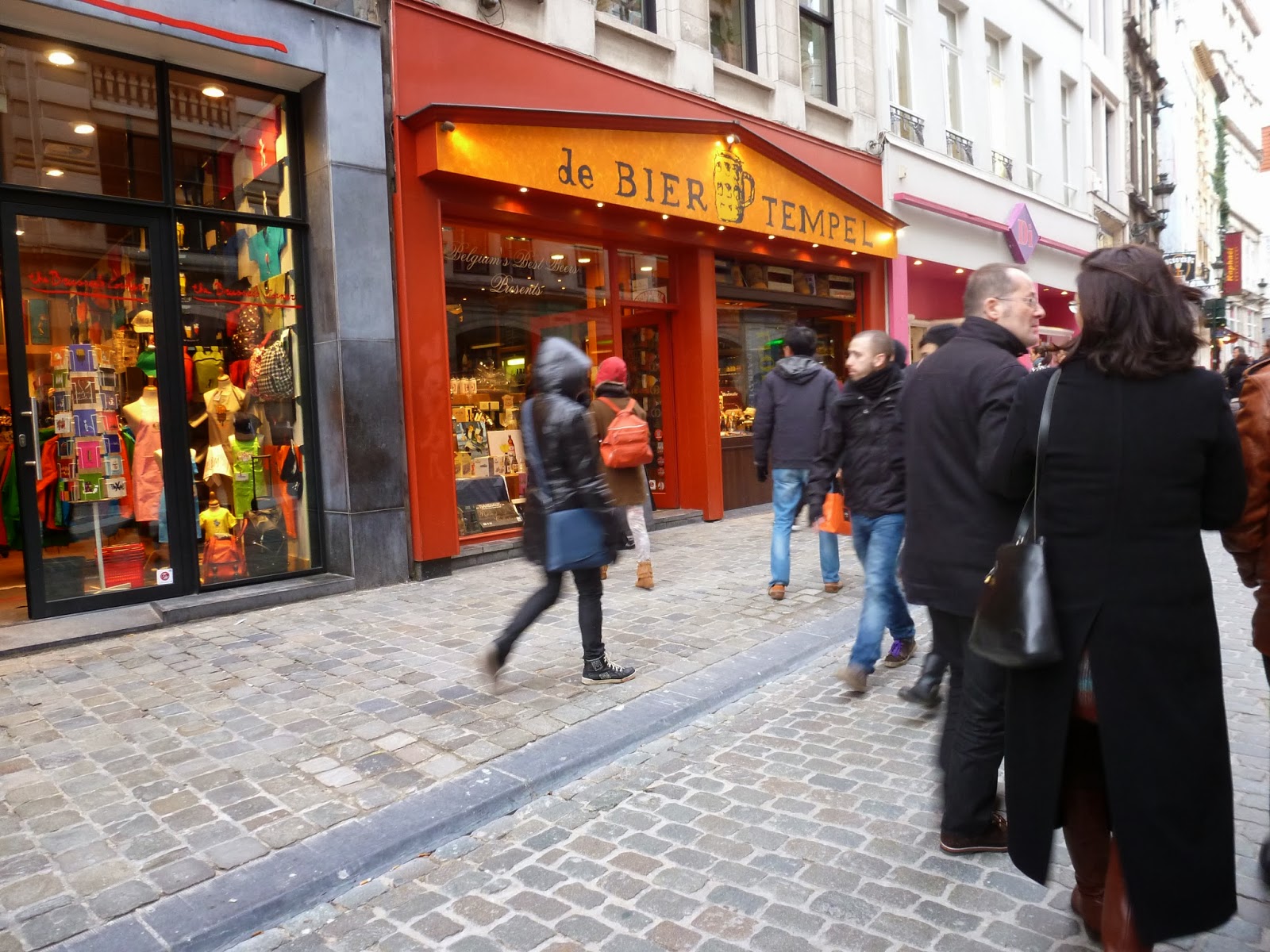
I’m content to amble the streets, window-shopping, traipsing into shops that specialize in beer.  Beer Planet. De Beer Tempel.  Racks of bottled beer for sale.  Shelf after shelf of beer glasses. 


Enormous Selection


The Belgians are sticklers for serving beer properly.  Unlike in other lands, in Brussels beers come in glasses uniquely shaped and sized.

My wife tires of the quiet trundle through the light, but incessant rain.  We pass Delirium Village, which serves over 2700 different beers, 27 of them on tap.  Her tears confirm it’s closed. Only another beer will end her agony.   I am nothing if not anxious to please.

From her now wrinkled map, she places a well-manicured, red fingernail on the exact spot.  La Chaloupe d’Or. Right on the Grand Place, less than a hundred yards away.

The Grand Place is itself a vast wonder of cobbled space, and towering stone buildings, most dating to the 17th Century.  There’s the Brewers’ House, the last functioning guild in Europe, the Hôtel de Ville (town hall) and many more.  All of them grand.  No wonder this is a World Heritage Site.  The first mention of a market in this area goes back to the 1st Century.  Streets leading into it pay homage to the market it once was.  Poulet (chicken) Herbes (herbs) Fromage (cheese). By the 12th Century, the swamps and marshes disappeared, and along the way, so did the market.  Through the centuries, the buildings were toppled by cannon or design, but always rebuilt.


In the basement of The Brewer’s House is a brewing museum.  Sadly, it is also closed.  Wait a sec….closed?  Means we will have to come back!

On to La Chaloupe d’Or (The Golden Rowboat).  Another historic beer Café. Before that it was a tailors association.  History prances before us in layer after layer.


We seat ourselves at a small, back table, on the mezzanine overlooking the main bar area.  My wife makes a choice. Trappistes Rochefort 8.  There’s also a 6 and a 10.  We have no idea, until she downs the bottle and breaks into song, that the number approximates the alcohol content.  The number understates the reality.  9.2 %. 


Note the dark amber hue.


On the nose, it’s sweet ginger, but the first sip says chocolate.  The finish is bitter, but pleasing.

I op for an Affligem double dark.  Sweet vanilla nose.  Light whiskey flavor.  Easy finish.

Make no mistake. Both of these are full bodied.  Rich.  Deep in flavor.

We linger, watching the waiters (and one waitress) race from bar to table to upstairs tables.  A lady on our right protests loudly that she has not been served.  French language, but the message goes on and her voice goes up.  The waiter apologizes, but there is no need.  There are six or seven of them and a couple of hundred of us.  Ah, but thirst has no patience.  This is a lively crowd.  Food comes out on large trays, held aloft, otherwise food would be divided randomly.

My wife considers it.  Cheese and bread?  A few slices of this or that?  Her humble servant awaits the decision.  The next table over is laden with bits of cheese and small slices of bread.  We stare, much like crows watching road kill while waiting for the cars to pass.

Perhaps another beer? I suggest.  Out comes the trusty map.  Another red nailed decision.  We march through the throngs and onto the rain slick Grand Place.


This time the pick is Falstaff, a gorgeous art nouveau café (1886), designed by a student of the famous Brussels’ architect, Victor Horta.  Originally a weinstube, it is now an excellent stop on the beer trail.

Down a side street.  From the entryway to the rear, Falstaff is a feast for the eyes.  At the very back, stained glass images of Shakespeare’s famous comic cover an entire wall.


The place is crowded, but not packed.  My wife orders a pils.  I order a Gordon Scotch Ale.  We sip. Glasses are quickly exchanged. She ends up with the Scotch ale, which is something over 8% alcohol.


It sports a fresh grass nose, full rich flavor and goes down smoothly…and fast.

Hunger rears it’s needy head.  She orders half a chicken, with fries and salad.  I order mussels (moules) au gratin.  I love mussels.  These are ok.  Her chicken has a funny flavor, as though shuttled over from the chickens’ retirement home.  My wife loves chicken, but not this particular bird.

I note that the wife downed two ass-kicking, high-octane brews in less than half an hour.  We started this gig at 4:30 p.m.  The hands now hover closer to 8:30 p.m.  We have walked several miles.  Plus, we drove almost four hours to get here.  There are consequences.

By comparison to us, her chicken was a youngster.  We stroll the streets a bit more.  Hunger rages.  We stop and grab a cellophane bag of large, chocolate-coated waffles. 

My wife, normally a late nighter and delicate eater, races through the chocolate waffles like a woman possessed.  I salvage two or three for myself.

More beer? I ask her.  She gives a one-word answer:  Bed.  I keep a tissue in my hand just in case.  We make it back, both of us exhausted.  Apparently, those happy years of drinking all-night and dancing until four in the morning are behind us.  Or maybe we just need to do this more often, go into beer training.

Brussels is the place to do it.  Traditional and historic Beer cafés galore.  And, the Belgian beer lives up to its distinctive reputation.  In general, it’s stronger and more flavorful than any other I’ve tasted.  Complex flavors. Even the Scotch ales we tried have more rich, full flavor here than any beer I downed in the U.K.  Other characteristics:  amber to dark colors, except for the pils.  Almost no head, for the traditional Belgian beer is top fermented, unlike its German and American cousins. 

I place Belgian brew somewhere in the gab between wine and beer.  And where better to sample it than in Brussels, one of the finest cities in Europe!


Should you go, stop in any info station or hotel and grab a beer map, “Brussels on Draught.”  Or visit:  http://visitbrussels.be/bitc/BE_en/do-see/to-do/attractions-and-leisure.do?gclid=CMGE-L_O1bwCFSTMtAodqQMAkw.  Click on top spot marked Eat & Drink.

Monday, February 17, 2014

Brussels' Beer Cafés - Part I


The only Brewers' Guild left in Europe


My wife says to me, “I want to go to Brussels for the weekend and drink a lot of beer.”  I deserve no special sympathy.  I know the same thing has happened to you.

“You probably want a first class hotel, too,” I say.

She simply nods, knowing that at this point I have the reasoning power of a trapped mouse. The suitcase sits on the bed, open and empty, a gaping mousetrap.

We pile our meager belongings in the trunk of her convertible and head down the autobahn, across the rolling hills of Germany, green valleys of Luxembourg, and a small slice of France, to reach Brussels, a fine old city of ancient open markets, cobblestone streets, and a host of restaurants and beer palaces.  Towering building line the squares, dating from the time when architecture meant solid, hewn stone, instead of slender threads of steel and sheets of glass.  Too many words for you?  Want me to shorten it?  Ok.  Brussels is old.

We pull into the hotel parking lot and I find that parking will cost 35 Euros, or about forty-eight bucks a night.  Cheap Tickets is mute on this point.  There is also a nightly ‘city tax’ of nine bucks a night.

But, the hotel, Radisson blu, is right astride the old city, perfect for walking to everything you want to see, do, eat, and drink.

Our first stop is A La Mort Subite, a café I wrote of earlier.  (http://stroudallover.blogspot.de/2013/01/la-mort-subite-maybe-best-beer-bistro.html)  Hasn’t aged a day since 1900.  We step through the narrow, etched glass door and into a time machine. The place is crammed.  The waiter, in black trousers, a white shirt and black vest, with a white, waist apron, brings me a Faro and my wife a Kriek.  For the uninitiated, these are both types of Belgian beer, of which there are some 400 varieties.  In this case, both are on tap and both carry the La Mort Subite name.  Both are also of the traditional Lambic variety, meaning top fermented and therefore not fizzy.  Smooth.  Tasty.


Kriek carries a definite cherry nose and cherry flavor, although there is little to no sweetness.  Sour cherries are added in the barrel on the second fermentation.  Round finish.  My wife wastes no time downing it.

My Faro has a tinge of sweetness, with soft caramel and bright citrus notes.  Sour finish, but somehow more satisfying for it.

A Brussels beer parlor is all drama.  In an hour you’d have material for a short story, in an evening, a novel.


We linger, watching the panorama unfold in the high ceiling, softly muted room.  A couple struggle with their baby.  Whoops, the other couple with them also has a child.  A table down, an elderly woman lightly butters her bread, then adds a slather of soft cheese.  She bites into this as delicately as a hungry croc crushing the bones of an antelope. Along with the bread, she tooths a bit of radish and a nibble of raw, green onion.  In moments, a season’s worth of radishes and green onions disappear, along with two heavy slices of bread, a cup of butter, and a solid belt of cheese.  All washed down with a half pint of light colored beer.  This old girl is not shy about what she wants.  Wonder what she was like in her healthy, hormonal 20s?

Across the way, a man tries to move two chairs to an already heavily crowded table.  The waiter objects.  The man stands his ground, ignoring all, but his companions at the crowded table.  Clearly he is blocking the narrow opening past the table into the kitchen.  The waiter shrugs, his hands at shoulder level, palms up.  Finally the man wedges the chairs into suitable positions.  Crisis averted.

We pay our bill and struggle to find a path down the lenghty aisle to the door.  Outside, the cool air is a welcome relief.

My wife pulls out a map, dotted with famous beer joints, none of which is newer than the early 20th Century. The map is a great relief, as I have no freaking clue.  Plus, my wife has a sense of direction that could have led Columbus straight to India.


Next in line is Le Cirio, originally an Italian deli.  Francesco Cirio’s photo is still on the wall.  We order more beer.  Surprised?  For me it’s a Watney’s Scotch Ale.  When I see English beer on the menu, I gotta giv’er a go.  Luscious whiskey-vanilla nose.  First sip is just a tad sweet, as if a willing wench kissed the rim of the glass.  I don’t tell my wife this.  “Not bad,” I say, licking the rim.  Full bodied brew.  Easy finish.


My spouse orders a Maes pils.  I generally don’t have a thirst for pils.  This one is no exception. Bland nose.  Bare wheat taste.  Rough finish.  Her nose turns up, but just barely.  Ladies do not complain, because they always get what they want anyway.  This time is no exception.  She reaches for my beaker of Watney’s.  I try to look pleased.  Same smile you’d give if a weightlifter crawled under the table and gave me the old squeeze-ho.  I do not get my Watney’s back.

If anyone sees me grimace, they don’t show it.  The couple crammed into the dinner plate sized table beside ours must be married.   They’re not saying much.  She could be pretty.  He could be an accountant who’s worked at the same job in the same office for thirty years.  He would be happier at home, with a glass of warm milk.  Not her.  I feel someone looking at me.   I turn just a quarter turn. She smiles shyly.

On the other side of us is a table for four.  Two ancient, unhappy men and two comparable women trying not to be.  I speak little French, but one man is saying how much better this place used to be.  Sure, like he can remember anything earlier than breakfast.

Just as in many Brussels restaurants, in Le Cirio all the waiters are men. They all wear the same black and white ensembles I mentioned.

Le Cirio does not hold the crowd that populated A La Mort Subite, but it’s still far from empty.


Once again, we fight our way to the rain swept streets, but hover near the door and my wife pulls out her map.  I feel sure the best is yet to come.


End of Part I, but do not fear.  More Brussels beer adventures in Part II.


Thursday, February 13, 2014

Le Vin de Merde - Holy Shit, Pierre!


A Red and A Rosé


No I’m not making up the name, although over the years I may have associated that moniker with a wine or two.  Several years ago I poured an entire bottle of Hungarian wine down the sink.  Had a happy ending.  It cleared the drain.

Le Vin de Merde?  Was the vintner dazed from a hard day at the vats? The wine is from Southeast France, bordering the Mediterranean.  The Languedoc-Roussillon Region. Besides wine, other things that put this treasure spot on the map are caves, beautiful ancient villages, camping, and the Pyrenees.  Makes you want to drag the vintage Jag out of the garage and go for a spin through granite hewn tunnels and twisting turns of a mountain road.  Or, maybe you prefer to just sip a wine.


With a name like Le Vin de Merde, you’d expect a snappy slogan and you’ll not be disappointed:  Le pire cache le meilleur = the worst hides the best.  (For English speakers, Lu peer cash lu may-you’re).  You’ll note from the photos there’s a fly on the label.  Appropriate.  Below the label you’ll find Le Vin des Philosophes, the wine of Philosophers.   Ah, you’re thinking, must be good shit!

Jean-Marc Speziale, the genius restaurant owner and marketer behind the brand, got a friend and qualified oenologue to blend wines from the region, because, as he put it,  “I know many winemakers. I understand their daily problems, and to hear that people continue to class the wines of our region as ghastly plonk or, worse still, Algerian drain-cleaner, makes my blood boil. Winemakers around here bend over backwards to get the very best from their vines.”

Let it be noted they bend over backwards.

You could go on and on with the witticisms.  This wine is only served in Le Maison de Ptomaine.  They also serve Bière de Pissoir.   Don’t grab your Guide Michelin, I’m joking.

Monsieur Speziale has the last laugh.  His first 5000 bottles in 2008 sold out faster than you could say No Shit! and they have continued to top the regional charts.  So, how did your fortunate chronicler happen to find a bottle or two, and what did it cost?

Down the street from me, well to be honest, down the super-fantastic-German-Autobahn, is the quaint country of France.  Shortly after you flash across the border, you’ll find a Super Walmart….hahaha…only kidding.  Cora, which could easily be translated as Super Walmart, except that Cora has a food and wine selection that’s like having your own private food merchant deliver fresh daily.  Cheese varieties by the hundreds.  A fish market bigger than many grocery stores.  Yards of fresh bread from an on-site bakery.  Wines by the thousands.  It was there that the name caught my eye.  Opinions of wines vary greatly, but I’d never seen them expressed so clearly on a label.  Six and one half Euros, or a little less than nine bucks a bottle.  I made sure no one was looking down his Gallic nose at me and grabbed two bottles, a red and a rosé.

The wife came home, tossed off her coat and scarf, and collapsed on the couch.  I greeted her joyfully.  “Honey, I’ve got some shit wine for you!”

Enough of the blather. How ‘bout the wine???  Ok, first the red:


Fruity nose.  On the first sip, hints of citrus, and leather.  Smooth finish.  This  is not a sophisticated wine, meaning no strong flavors and no heavy tannin.  Vin ordinaire.  Didn’t taste what all the fuss is about.  I wouldn’t turn down another bottle, but I’m not storing a case or two in my cellar.

Now the rosé:

Great with a soft blue cheese and a fresh baguette


Pleasantly strong floral nose.  Did I smell roses?  Makes you want to take another whiff.  On the first sip, sour cherries and an oak finish.  This is a wine that could stand up to roast beef, or be a pleasant sip on the back porch, while you watch your 25 year old neighbor stretch out for some nude sunbathing.  Still, it’s not a wine I would stock.

Why would I not especially want more of either of these wines?  Bad stuff?  Not at all, but not distinctive either.  Creates no cravings, unlike the neighbor. Sipped with a common comment of “not bad” and then quickly forgotten.

Once again, a master marketer has hit a home run, but for me, I don’t really care about the final score.