Showing posts with label D-Day. Show all posts

Monday, June 6, 2022

D-Day 6 June 1945


D-Day


On this date, June 6, 1944, beginning with bombing shortly after midnight, and then at one thirty in the morning, about 160,000 American, United Kingdom, and Canadian troops hit the beaches at Normandy, composed of  five American Divisions, five UK divisions, and one Canadian division, plus various other support troops. And it wasn’t just men, but tanks and trucks and so much more.  A huge operation?  No, it was gigantic, the result of long term planning that began a year earlier in 1943, and postposed several times by weather.


The Germans knew the allied forces were coming.  They just didn’t know when or where.  The allies had gone to extreme measures to keep the enemy guessing in the dark.


In southern England, General George Patton created a false army, complete with mock aircraft and tanks and flurries of faux messages meant to be intercepted.  You may also have heard of corpses being dressed in allied uniforms, provided with false orders and ‘secret’ documents, then allowed to wash up on beaches where the Germans would find them.  The subterfuge worked its magic, but the Germans were not just sitting and waiting. Guessing, yes, but preparing.


They thought the invasion would come at Calais, France only twenty-seven miles from the English port of Dover.   But, still, they provided significant forces and preparations all along the coast, including Normandy.   And if the Germans were fooled about the where, they were not so foolish as to think there were not other possibilities besides Calais. They spent months preparing over 2400 miles of defenses. To give you a comparison, our border with Mexico is 1,933 miles.


During the D-Day landings, the allies suffered at least 10,000 casualties, with over 4,000 dead. Our dead lay scattered on the beaches.  And the Germans also paid a steep price, with casualty estimates ranging from 4,000 to 9,000.


Nor was victory on the beaches a certainty.  Over 6,900 vessels delivered and protected allied troops in the landing, with over 4,000 being landing ships and landing craft. Even so, the landing stood a good chance of being turned back, defeated. After all, the Normandy area was notorious for vicious, unpredictable tides and weather.  And the weather did its worst, causing troops to land far from planned locations.  Of 29 amphibious tanks, only two made it to shore.


But to my mind, statistics are only numbers on paper, disregarding the real terror and frightfulness of war.


Here are some quotes from those on the beach.


“They’re murdering us here. Lets get inland and get murdered.

--- Colonel Charles D. Canham, 116th Infantry Regiment Commander on Omaha beach


“You get your ass on the beach.  I’ll be there waiting for you and I’ll tell you what to do. There ain’t anything in this plan that is going to go right.”

---Colonel Paul R. Goode, in a pre-attack briefing to the 175th Infantry Regiment, 29th Infantry Division. 


“I took chances on D-Day that I would never have taken later in the war.”

---First Sergeant C. Carwood Lipton, 506th Parachute Regiment, 101st Airborne Division.


And from one of our United Kingdom brothers in arms: David Teacher, 71 Royal Air Force Beach Unit.


“Jerry (Germans) started to shell the beach at about 9am.  Suddenly, all hell broke loose.


The beach was under fire from shells, mortars, and machine guns; we dived for cover.


The sea was covered with blood and vomit and flies began to arrive by the thousands, which created another nightmare.


We continued all night and into the following day without a break.  Slowly, slowly we overcame all the nightmares…there was no lack of humor.


A soldier coming ashore asked, “Is this a private beach? I was promised a private beach. If not, I’m not staying.”  And we heard, “My mother told me not to travel by air. She thought it was much safer by sea.”


An Army officer coming ashore and instead of getting his men off the beach quickly, he stopped to consult his map.


“Sir, you’ve got to get off the beach now!”


“And WHO are you?” he asked.


“Sorry, no time for introductions!”


Perhaps you don’t realize that less than 4% of World War II veterans are still alive. The history of our wars and the sacrifices suffered by our men and women, on the battlefield and at home is slowly drifting into the dusty past and soon will be only slightly remembered by the younger generation and coming generations.


It is so important to keep history alive, not as a series of facts to be learned in school, but to remember the importance of days and nights and sacrifices, not just on D-Day, but on other days and other wars.


Tuesday, April 15, 2014

Dartmouth...Again!


I wrote of Dartmouth, England once before (http://stroudallover.blogspot.de/2013/09/dartmouth-pilgrims-castles-and-war.html), but there’s far more to say…and being loquacious, which, of course means dashingly handsome and charmingly conversant…I’m going to thrill you even more with things to do and places to see.

Dartmouth rests on the south coast of England and will forever be literally and historically connected to the adventures and perils of the sea.  Allow me to do some first class name dropping:  Second and Third Crusades. Henry Hudson. Drake.  Raleigh. The Pilgrim Fathers. Pirates. Privateers. Britannia Royal Naval College. D-Day.

I'll whet your appetite with a few more:

In 1853, Britannia Royal Naval College became the first formal schooling for Midshipmen. 

Looking down on the Castle, the church of St Petrox, and the River Dart


A castle guards the entrance to the Dart River and has since the 14th Century, although the Normans may have built fortifications after they won the Battle of Hastings in 1066. 

And, if you think Dartmouth’s history ends there, you’re wrong.  The American Army took over the Britannia Royal Naval College and did much of the planning for the D-Day Invasion there.  At one time nearly 500 American ships and landing craft sat anchored in Dartmouth Harbor.

Agatha Christie's home and flowing garden, Greenway, is nearby.  Take a ferry across the bay and a steam train to get there.

History permeates the air, but always the traveler’s eyes are almost hypnotically drawn to the magnificent bay, dotted with boats, ships, and ferries.  Dartmouth is still a working fishing village. The fish are fresh, and plentiful.  Youngsters kneel along the stone embankment, dropping their lines and laughingly pull out crab after crab.


The natives are friendly.  We stopped and asked some kids to see their catch.  Got an earful. Asked questions of neighboring tables in the restaurants and pubs.  Found out even more.

Speaking of restaurants, feel like fish and chips?  One of the best in all of England is Rockfish, only a short stroll to the riverfront.   Need a beer or six?  Historic pubs abound, the earliest dating from 1380.  Check The Cherub.


Then, there’s the Dartmouth Museum, where the town entertained Charles II in 1671, in what is now known as the King’s Room.


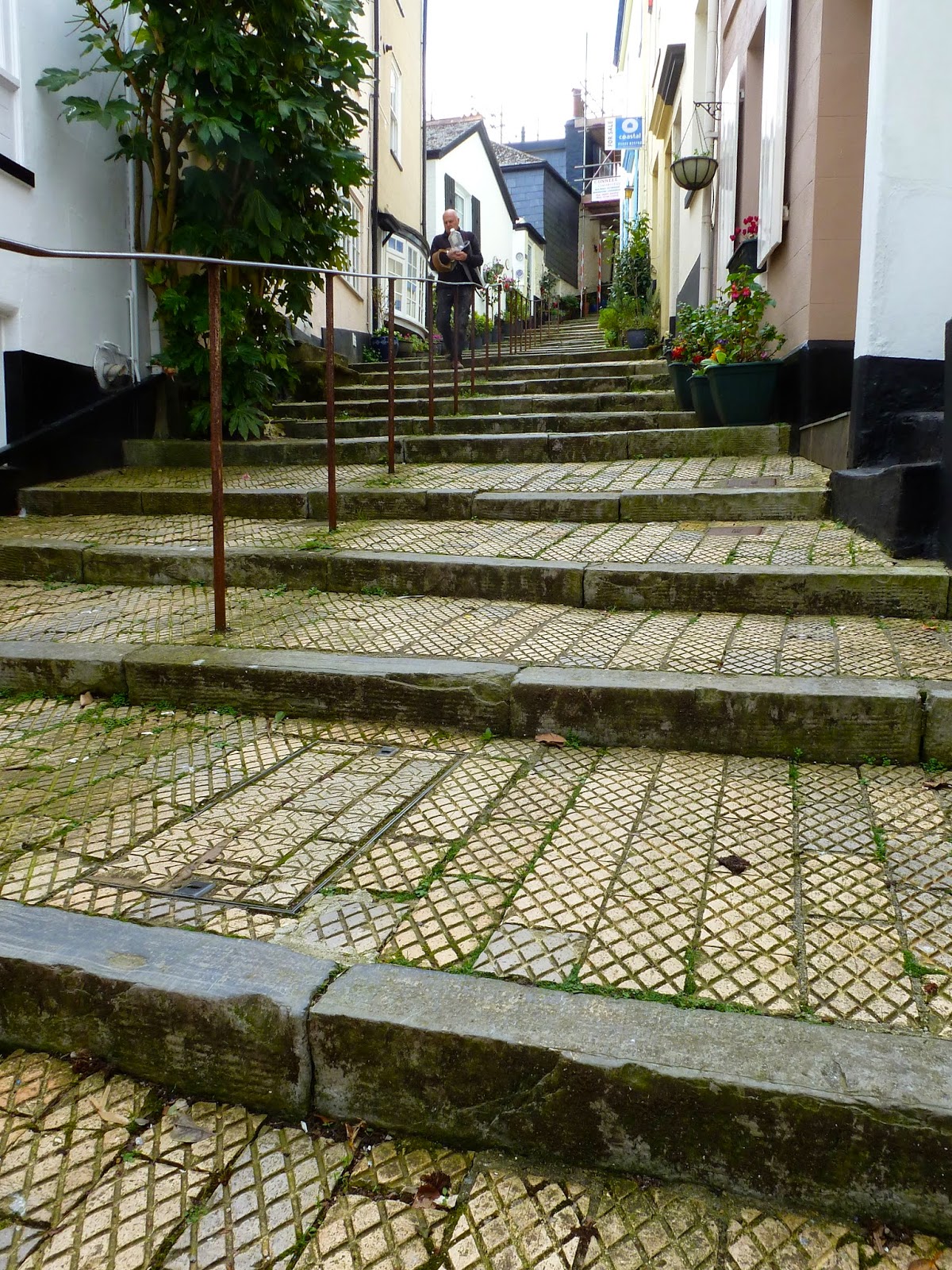
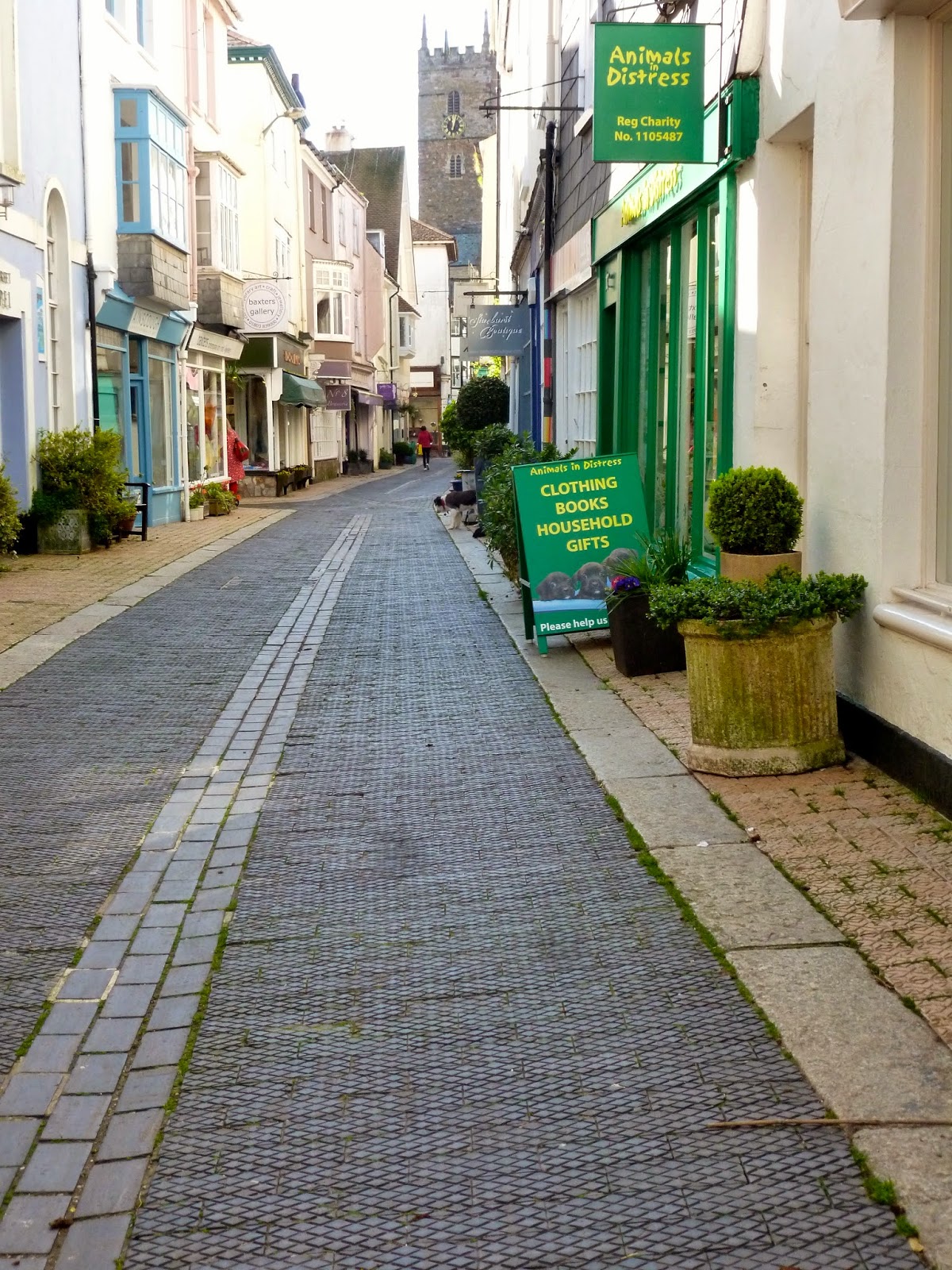
What about the town itself, the ins and outs, the streets and backways?  Cobblestone lanes, and narrow alleys, most dating from Elizabethan and even medieval times, tangle though this picturesque ville.


One of the many shopping streets...early morning.

Another cheery pub!


The Royal Castle Hotel dates from 1639 and where it sits marked the water’s edge prior to the 19th Century land reclamation.  Grab a pint in The Galleon Bar. 

On the Waterfront!


The waterfront now makes for a splendid walk that leads you down to Bayard’s Cove, the only cove at the time and the spot where the Speedwell and Mayflower anchored for repairs.  In short, Dartmouth stepped right out of your dreams about what England should look like.

Bayard's Cove


Rather than give away all of Dartmouth’s secrets in one gulp, in the weeks to come, I’ll blog more about a whole host of reasons why this very special (and semi-isolated) part of England should be a star on your trip-list.

How in the world do you get there?  I can tell you how we did it.  Airplane.  Underground. Train. Bus.  Sounds more difficult than it is.  First stop is a London airport.  Ours was Heathrow.  Next a short ride on the London tube to Paddington station.  Next a 3 ½ hour British Rail ride to Totnes, followed by a 45 minute bus trip to Dartmouth.

You have to hand it to the British.  Transportation connections are wonderful and very comfortable.  After all, Dartmouth is a tourist destination.  The first time we came was on a cruise ship.  It was summer and the streets bulged with visitors from the far corners. April was much more gentle.  Never did we suffer through long lines or the inconvenience of packed restaurants, and the weather was cool, but sunny.


In fact, our four days overflowed with dreamy strolls, interesting visits, chats with locals, and deep breaths of sea air.  Well, of course, there was also the occasional pub…but then what is England without a pub or two and what better place to down a pint than Dartmouth?


Before you go, visit the Dartmouth Information Center site.  Many of the tours are only one or two days a week.  These folks are extremely helpful with scheduling visits and tours.  http://www.discoverdartmouth.com.  For a real treat, have them set you up for a walking tour, hosted by John Putt, known by the locals as Putty.  It takes about an hour and a half and you won't want to miss a second!

Coming up:  I'll show you the best places to eat and drink and stay and visit in Dartmouth!!!


Dartmouth by night


Sunday, September 8, 2013

Dartmouth: Pilgrims, Castles, and War

Dartmouth, right on the dot!

A wonderful, sleepy harbor.


Let’s take a trip to Dartmouth.  I don’t mean the Ivy League, Dartmouth College in Hanover, New Hampshire.  I mean the city:  Dartmouth, England.  But, there’s a connection.  The 2nd Earl of Dartmouth gave the college its name.

You can get tangled in connections between the United States and England. American school kids are like only, like, mostly, like familiar with, like, you know, three:  Pilgrims, Colonies, Revolutionary War.  A diet of thin gruel and pond water, with a hefty shot of 220 Volts for wrong answers might buck those little heathens up.

But, back to the peaceful city in southern England:  Dartmouth.  Strange name.   Dart is the name of the river flowing through the town.  Why dart?  Oh, you clever beast, trying to catch me.  Dart is an old Celtic word meaning river lined with oak trees.  One small word can’t cover all that?  Try sauté, meaning ‘lightly fry in a pan with a little bit of butter.’  By the way, the banks of the Dart are still lined with native oak.  Since the town was built at the mouth of the River Dart…Voilá!  Dartmouth.

There’s even a direct connection to the Pilgrims, who put into Dartmouth for repairs to the Speedwell, the sister ship to the Mayflower.

See, compared to your beer swilling buddies, you’re now on a par with Nobel Prize winners.  But, wait, there’s more.


The Royal Castle Hotel sits in the midst of the port, a regal building, with a regal history.  Opened in 1639, Sir Francis Drake, Queen Victoria, and a host of other dignitaries have had stays, among them Cary Grant, and Dame Agatha Christe, who used the setting in a couple of her mysteries.

 A ghost carriage regularly pulls up in front of the hotel, to the clatter of horses’ hooves.  The heavy wooden beams inside came from ships in the Spanish Armada.  Have a drink in the Galleon Bar, also made from the wreck of a Spanish Man-o-War. 


Inside the Royal

The Galleon Bar

Across the street is the Dartmouth Museum, a nautical treasure trove that encourages you to open drawers and piddle with things. King Charles II was entertained here in a room still known as The King’s Room.  The entry stairs twist around a ship’s mast.

Outside the Dartmouth Museum

At the mouth of the harbor, Dartmouth Castle has guarded the port since the late 14th Century.  Took part in the English Revolution and served as a fortification in both World Wars. 

But, there’s far more to Dartmouth than a few architectural relics, although after several pints of fine English ale, I found them absolutely fascinating, right up until I was asked to leave.


Dartmouth Castle


More recent history also stalks Dartmouth.  Devon was the center of preparations for D-Day.  Ever hear of Slapton Sands, Exercise Tiger and the full-scale D-Day rehearsal?  May 1944.  As Exercise Tiger was in full swing, landing craft were spotted by German E-boats, fast, wooden hulled attack boats.  946 American troops lost their lives.  Because of the secrecy surrounding D-Day, little was reported.

A German E-Boat


Enough painful memories.  In Dartmouth, what can you do for fun?  Take a ride down the Dart on a 1920’s steam driven paddleboat.  See the oaks along the banks, watch oystermen ply their ancient trade.  Catch a glimpse of the Britannia Royal Naval College.  The college is the last and only Naval College left in England, as sadly the British Navy, protector of the realm for a thousand years, has been allowed to wither.  The college is active and only open to visitors on certain days.

Nearby is Greenway, the holiday home of Agatha Christie, owned by the National Trust and open to tourists.

Now to the real business of a day, food and drink.  Plenty of pubs.  Head back to The Royal Castle Hotel’s Galleon Bar, or tread the dainty cobblestone streets for shopping and sipping.  Plenty of seafood, including some of the most fabulous fish and chips in all of England.

Ah, the beer!  But, I’ve written so extensively about the glories of hand-pulled pints that you may believe all I think about is beer.  Not so.  But, my wife won’t let me write about English women.

A local brew in the Galleon Bar
And anyway, this is about Dartmouth.  Spend a day or a week, or come for the summer and finish that novel.  The real glory of Dartmouth is what I would label a fascinating tranquility.  And now that you know what the hell Dart means, you’re practically a native.


Oystermen check their beds


Scones with Jam and Devon clotted cream