Showing posts with label dining. Show all posts

Friday, March 28, 2014

Just Another Little Two Hour Lunch In the Alsace


I’m writing about Le Biblenhof , not because it’s special, which it is, but because it gives some idea of the perfection one can expect in the area of France known as The Alsace.  Wines galore, of course, but also dining at it’s best.  This special spot is located just 20 minutes east of Strasbourg, on Route des Vins d'Alsace, the Alsatian Wine Road.


But there's no real need to pick out a special, renowned restaurant, one that’s mentioned in all the guides, and spoken of in New York Times restaurant reviews.  In the Alsace, you can throw a dart at a map and hit a superb place for lunch or an evening of exuberant succulence.

Just to prove my point, about a year ago, a group of us darted here and there, looking at castles, sampling wine, and exploring.  Suddenly, a hunger came out of nowhere.  Only problem was, we hadn’t watched the clock and many French restaurants close for lunch around 2 p.m. and don’t open again until close to 6 p.m.

We drove through town after town.  Out of raw hunger and growing despair, we finally stopped at an unlikely spot in a small village.  From the outside, the place had all the allure of a Denny’s attached to a truck stop.  Inside, we were shocked to find semi-rowdy groups claiming most of the tables, sipping wine and downing some spectacular looking food.

As I often say, the French can teach anyone how to eat!  As a great friend of mine once said, when told by a physician “You need to change the way you eat.”

His reply, “We don’t eat, we dine!”  He could have been talking about the whole French nation.

I thought the Japanese were fanatics on freshness.  But, Nippon has nothing on France.  These folks don’t buy vegetables that aren’t stained with fresh dirt.  Cheeses don’t just vary by name and location, but also by use and age and an indelible sense of pairing.  And wine?  Every French person I’ve met can talk about a wine’s nuances with the very best oenologist.  They don’t eat, they dine!

Once again we found ourselves hungry in the Alsace.  Once again we picked a restaurant at random, but his one had the charm of a historic chateau.  Old stone walls lent a regal presence.  We would have gone inside anyway, just to satisfy our curiosity. But when we pulled into the parking lot at the restaurant and hotel Le Biblenhof, we fully expected a fine lunch.  We weren’t disappointed.


An Array of Tiny Breads

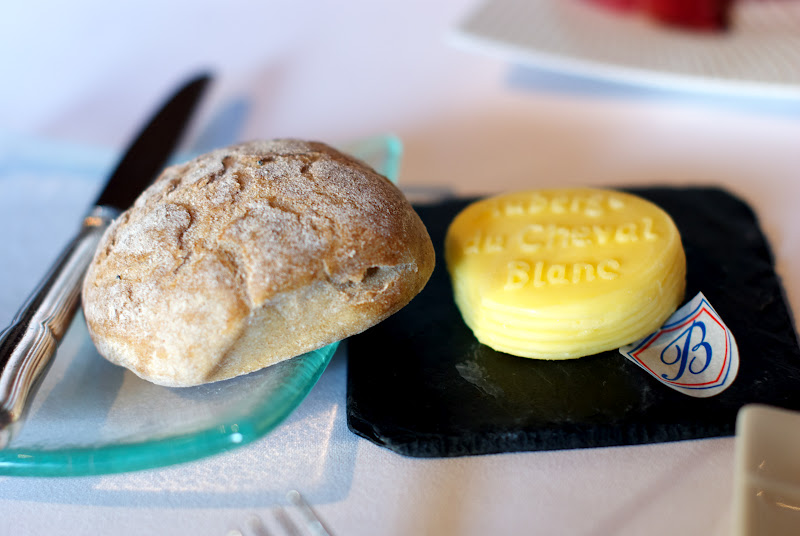
Even the sweet butter was special!

...as fragrant and elegant as a warm ceviche.
Roasted Sea Bass on a bed of diced root vegetables.

Veal-stuffed Cannelloni over stewed wild mushrooms.


To finish, coffee and a bit of sweets.


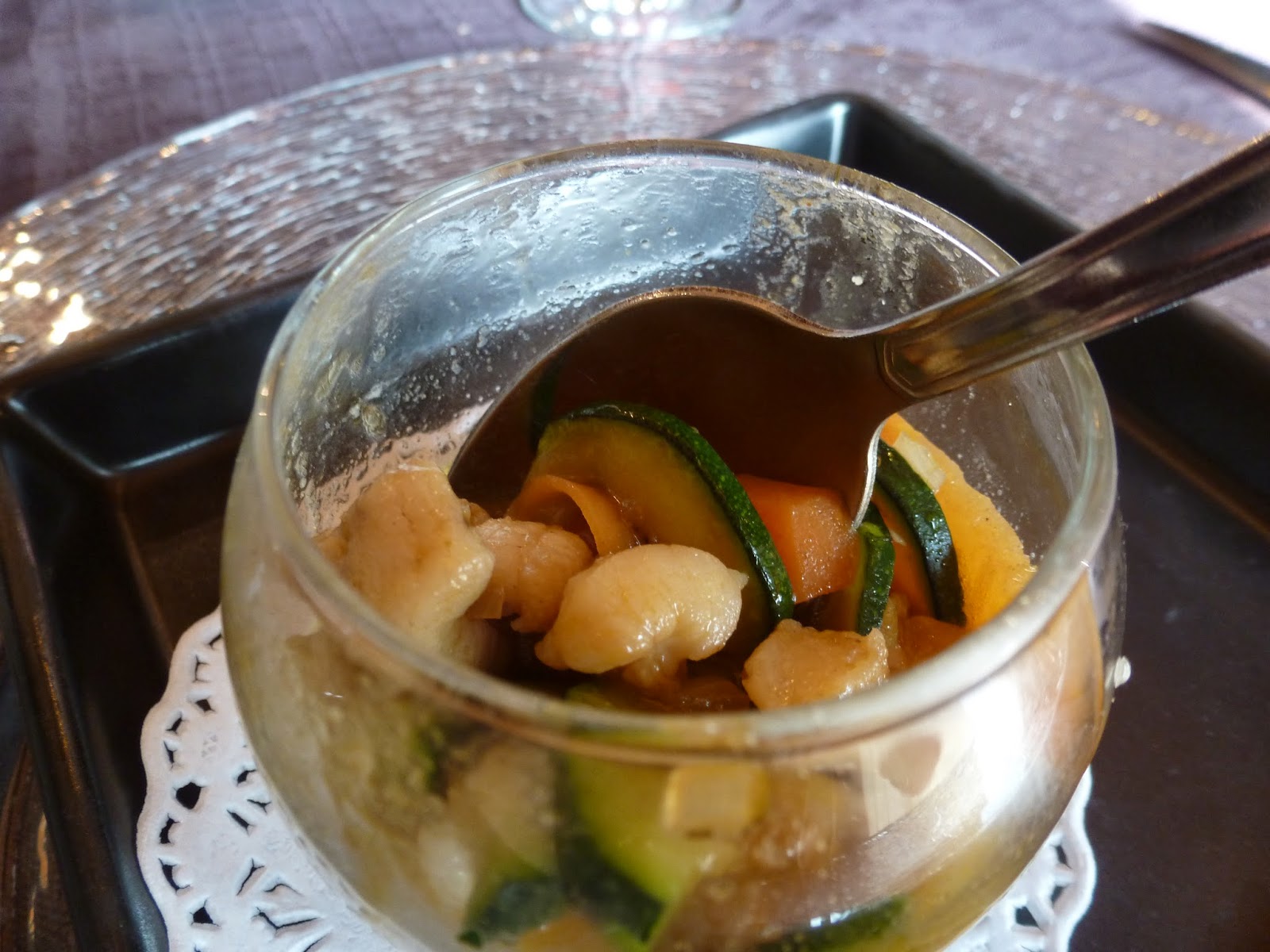
I love it when the wait staff is properly trained, holding their dignity and even a little Gallic charm as they offer suggestions and take your order.  I tried out my aging French, while the waiter, in black trousers and white, starched shirt, took our order and tried out his brand new Anglais.   We began with glasses of Crémont, the Alsatian version of Champagne.  Along with that came a picture perfect array of tiny breads, with sweet butter.  Next, compliments of the chef, a small goblet of fish and vegetables, in a spectacular fish broth.  This was truly worth a stop and I’m certain it will be again.  Vive la France!


I could write on and on, but the photos tell the whole story.  Bottom line: Just pick a restaurant.  You won’t be disappointed either.

http://www.lebiblenhof.fr/fr/


Monday, June 25, 2012

Le Cheval Blanc – Worth Every Penny


A corner of the main dining room

Crémont - the justly famous Alsace bubbly


Well, perhaps not every penny.  You must put aside a bit here and there, for rent, gas, and keeping the odd cobweb out of your wine cellar.  Nevertheless….

We threw money to the wind and had dinner at Le Cheval Blanc (The White Horse) in the half-timbered Alsatian village of Lembach.  (scroll all the way down for full address and tel)  From the moment we were greeted by the receptionist, shown to our table and offered wine, until we left some three hours later, we were never disappointed for even a fraction of a second.

What do you look for when you go out to eat?  I’m talking about you personally.  Ambiance?  A quick bite?  A dining experience?  If I’m spending more than pennies, I want it all and I want it better than anything I could cook at home.  As a friend of mine put it:  If you have an expensive meal and walk away thinking you could have done that yourself, you’ve wasted your money.  I may add, you’d also like to walk back in with a shotgun and suggest the Chef-in-Thief return your silver shekels, or lose what’s left of what he so proudly calls his brain.   But, of course civilized people don’t do that. We know when we’ve been robbed fair and square.   We tell all our friends to make reservations under different names and cancel at the last minute.

No worries at Le Cheval Blanc.  I guarantee that unless you are a master chef, with your own Michelin starred restaurant, there’s no way you can match this cuisine.


Delicate, little finger sized vegetable creams 


Which brings us to the whole question of La Guide Michelin and the meaning of their stars.  Without putting too fine a point on it (pun intended), one star means “a very good restaurant in its category.”  Two stars means the restaurant offers “exceptional cuisine and worth a detour.”  The coveted three star ranking means you should bow down and thank your lucky three stars that you could get a reservation this century and that you could afford it.  As of late 2009, there were 26 Michelin three star restaurants in France and 81 in the world.  Some have carried the distinction for years and others have just arrived and the kitchen staff is still drunk and celebrating.

Proudly carrying one Michelin star, Le Cheval Blanc offered one of the most superb meals I have ever had, for décor, service, and unbelievable deliciousness.  I walked away after happily parting with my money, armed with a broad smile that stretched across my face and down to my belly

Le Cheval Blanc offers an a la carte menu and also several compete menus. We decided on The Gourmand menu, which had so many courses I ran out of fingers, but you can count them yourself on their web site: http://www.idealgourmet.fr/930-restaurant-ideal-gourmet-presentation_mr-gb.html.  No meal in France begins without wine.  We selected a Crémont, the Alsace version of Champagne and were not disappointed, with it’s crisp, yet soothing taste.


Shaved slices of smoke cured beef

Beer bread and local farmhouse butter


Foie Gras - silky smooth and melts on your tongue

Cannelloni as you've never had it.  A glass of local, light Pinot on the side.

Rather than test the limits of language and endurance, I will exhibit great restraint and restrict myself to impressions of the cannelloni.   Why pick pasta?  Common point of departure. Everyone knows pasta and we all have our favorites.  None are in the same category as Le Cheval Blanc’s version of this Italian staple.

The pasta we’ve all eaten is doughy, heavy, with a mostly predictable topping of cream or tomato and beaucoup cheese.  Le Cheval Blanc’s cannelloni was as light as a crêpe.  The filling of duck foie gras and slivered, wild mushrooms rested in a reduction of black truffle emulsion, frothy and heavenly.  Each ingredient was individual, with nothing overpowering the effect of the whole.  Flavors soared!  I have never tasted such a divine blending of tastes and perhaps (depending on my investments and whether or not I choose to ever drive a car) never will again.  And yet, the cannelloni was only one of a parade of delicious surprises, many photos of which I had to exclude for reasons of space.

Each course and the many palate cleansing intermediate courses arrived like works of incredibly wonderful, stupendously interesting, tongue slapping works of art.  In truth, I had to restrain myself to capture the moment on film before reaching for my fork.

This was not a good restaurant, or even a great one.  It was far more.  Le Cheval Blanc was a dining experience that will live on my palate and in my dreams for decades to come.  If there are better restaurants, neither my taste buds, nor my wallet are prepared for the challenge.


Stuffed zucchini flower, with crawfish in a light, herbed cream.

Roasted lamb chop with purée of carrots.

Roasted duck breast

A spectacular cheese tray with some twenty selections.

Dessert:  Peach four ways, roasted, sorbet, mousse, and in egg custard

Le Cheval Blanc
4 rue de Wissembourg
67510 Lembach - France
Tel : 00 33 (0)1 45 72 07 14
House made, hand dipped chocolates, cookies, and gelées

Thursday, April 19, 2012

Spargelzeit - Asparagus At It's Best!

Find a nice restaurant... 
...near a vineyard

...with a certain casual elegance...

...order a dry white, or whatever the chef suggests

...a crisp salad...


Spargel with pan roasted potatoes and Weiner schnitzel


The same, but with turkey steak


In Germany, April brings Spargelzeit (Asparagus season).  You don’t have to mark your calendar.  Restaurant chalkboards everywhere brag “fresh asparagus.”

I view Spargelzeit not only in culinary terms, but also as a harbinger of spring.  Time to drop the top on the cabrio, change to cotton scarves, have a meal al fresco, find another table inside because the sun went behind a cloud and your wife spears you with an icy stare.  When you ask her what’s wrong and she answers “NOTHING!” You’re in trouble.  In this case ‘nothing’ may be translated as “Read my mind, you unfeeling bastard.”  The brave man would sit it out, the coward caves.  She liked it much better inside.

I confess to loving the changing seasons, something I missed where the weather was constantly warm.  Germany has a bunch of seasons to like.  Not just spring, summer, winter, and fall.  There’s asparagus season (April –June), pumpkin season (Sept-Nov), beer season (Ever heard of Oktoberfest?), new wine season (Sept-Oct), strawberry season (June), and kick hell outta the French season (no longer celebrated) to name a few.

In the United States, and I suspect elsewhere, vegetable and fruit seasons are a dying phenomenon.  Supermarket chains scour the globe to being you everything you want, all the time.  Pumpkins in the spring?  Grapes in January?  No problem. But, we lose something in the process of having everything.  What if you celebrated your birthday, or Christmas everyday?  I know what you’re thinking.  Damn, I don’t want to get that old, that fast!

Asparagus (Spargel) served in Germany is almost exclusively the white variety.  Thick, succulent, even a little sweet, the woody stalk must be peeled before it’s cooked, but it’s worth the effort. No wonder the Germans rightly refer to asparagus as edible ivory, or the king of vegetables.  Spargel season is something to celebrate.

Say, isn’t white asparagus the same as green asparagus?  Kinda. There’s no biological difference between white and green asparagus.  The big difference is in the way they’re grown.  In short, white asparagus isn’t allowed to see the sun.  Lots of ways to do that.  Pile dirt on it (called hilling).  Cover it with a black tarp.  Without sunshine, no photosynthesis takes place, hence the paleness.  The result is a much milder and sweeter stalk.  Because it grows longer (green asparagus must be picked young), white asparagus is larger.  Here’s the bottom line for me:  serve white asparagus with a light hollandaise sauce and suddenly everything else on your plate is a side dish.

Traditionally, asparagus is bundled and cooked standing up in salted, boiling water.  If you find it in a market, buy it now.  The season traditionally ends on 24 June, with the feast of St John the Baptist.

Want expert help in cooking and serving?  Put the top down, drive to a sensational restaurant near a vineyard and pick a table inside, with an outside view.  Just sayin’….

Gutshof Bauer's Stuben
Altdorfer Straße 3
67482 Venningen
Tele:  06323-27-34