Showing posts with label shrimp. Show all posts

Thursday, July 16, 2020

Fish Stew


In my younger years, my impoverished family, which included sixteen siblings and me, often dined on my mother’s famous earthworm and dandelion sashimi.  Then the family moved to Everglade Acres, a new swamp development, and my father taught the older boys how to fish, using us younger boys as very quick and unwilling bait.

I developed a real taste for fish in the muddy, bite or be bitten world we fished in.  I also remembered wetting my pants each time I heard the words, “Wanna go fishin’?”  

Shortly afterwards, my seven year old cousin, Gorina, and I hatched a plan to get married and move closer to the coast.  The Everglades mayor, who was also the chief of police, justice of the peace, taxidermist, and mortician, married us in a very private ceremony, under cover of darkness, which consisted of few words:  Do you?  Yep. Well ok then. And free taxidermy for the first one who dies.

Living on the coast of Costa Rica, after fleeing from my father’s angry pack of bloodhounds, Gorina learned to make a delicious Fish Stew, which is the recipe I offer you today.


Fish Stew:  nothing fishy about it

Extra Virgin Olive Oil  (that label always puzzles me for obvious reasons.)
1 large, sweet onion, diced
2 large celery stalks, split and sliced cross grain
salt and pepper
5 large cloves of garlic, peeled and chopped
1-2 tablespoons herbes de Provence, or herbs of your choice
pinch of red pepper flakes
2 tablespoons capers
1 cup dry white wine (I used Goya brand)
3 large, ripe tomatoes, chopped
1 tablespoon tomato paste (intensifies the tomato flavor)
2 eight-ounce bottles of clam juice (check the label for pure clam juice)
3 cups vegetable broth
1 cup crab meat
¾  pound wild caught salmon
½ pound (or more) any solid fleshed white fish
½ pound shrimp, peeled
¼ cup raisins (optional for me, or mandatory for certain people)
2 packed cups chopped cilantro (I use both leaves and stems)

Puttin’ It Together


Slosh some olive oil in a 5 quart Dutch oven and turn the heat to medium.  Add the celery, onions, garlic, a dash of salt and pepper and cook, stirring regularly until the onion is wilted.  Add herbes de Provence, red pepper flakes and cook until the wonderful fragrance tickles your nostrils and weakens your resolve to save the rest of the bottle of wine for dinner.


Add the white wine and stir, then add the clam juice, vegetable broth, and capers. Plus raisins, if you must.

Cook for 15-20 minutes to allow flavors to blend and passion to build.  

Good time to pour that third glass of wine.

Add the fish, crab meat, and shrimp.  Bring to a simmer and cook for 5 minutes.  Remove the pot from the heat, cover and let it stand another 5-10 minutes so the fish will finish cooking.

Stir in the chopped cilantro and crack open that second bottle of wine.


Serve with crusty bread.


Pretend you just came in from the swamp and are really hungry….on second thought, you won’t have to pretend about the hunger part.


Saturday, September 13, 2014

Fleet Landing in Charleston, SC Has It All


Charleston, South Carolina.  Old World atmosphere. Cobblestone streets.  Architecture back to the 1700’s. Friendly folks.

Ok, fine.  You get the portrait of this charming older lady by the sea.  What’s another word that comes to mind?  Seafood.

Yep, you can find it in seafood shops and seafood restaurants and even at the Saturday Farmer’s Market, where a local vendor calls out in the low country patois, “Aw shrimp was swimmin’ yes-ta-dei.”


Shrimp and oysters.  I raise the flag and salute both of those mainstays.  But, that’s not to leave out hand caught crabs and bounteous fish and seasonal soft shell crabs.

I’ve long since forgotten how many times I’ve visited The Holy City, or how many restaurants have come and gone.  And not all that have disappeared were second rate.  Families gave up the pressured life of serving the public.  Leases lapsed.  Tastes changed.

One thing for sure.  In Charleston, restaurant longevity rests on two things:  atmosphere and food.  Believe me, to survive you better be real heavy on the second.  Atmosphere will get people in the door, but only the high quality, deliciousness of what’s on the plate will bring them again and again, and make them tell their friends, family, and folks they’ve met at the bar to “Get your ass over there and go early, ‘cause there’s gonna be a line.”

What’s the first place I think of when I want seafood?  Fleet Landing.  Sure, there have been other pretty faces in my misspent youth, but Fleet Landing remains.  You can well ask, “If you can get seafood all over Charleston, why play a favorite?”


Ok.  You’ve probably never been there, so I’m going to forgive you for asking.  The answer in simple English is:  Lots of Stuff!  As you might guess, FRESH is the key word.  But, that’s not all.  The menu covers the gamut from the usual (and especially delicious) fried fare, to fantastic salads, gumbo, and crispy flounder with apricot glaze.  Don’t give me that look, you unbelievers!  Check out the menu.   http://www.fleetlanding.net


Don't miss the gumbo!


Thanks to Chef Drew Hedlund, this seafood haven has caught the eye of not only Charlestonians, but national foodie magazines.

Fleet Landing sits right near the old vegetable market, on the water’s edge, in the marsh, with a panoramic view of the harbor.  Built by the U.S. Navy in 1942, Tradd Newton turned it into a first class restaurant in 1988. Almost thirty years later, it’s still packed at rush hour.

Walk through the market, past the Old Custom’s House, and continue toward the water.  Look to the right.  There it is.

The City Market, not to be confused with the Saturday Farmer's Market on Marion Square
Of course, there’s a nautical theme throughout the interior, but tastefully done.  A long, inviting bar slides gracefully along one side of the dining room. Large, revealing windows make you feel like you’re on a dock, ready to put to sea.  Matter of fact, if you really want the feeling of being on a dock, sit outside on the wrap-around porch.


On one visit, the air conditioning was out.  This was summer in Charleston and normally, a restaurant without air conditioning would be an abandoned building.  With the staff prying open windows that hadn’t been opened in years, the interior welcomed the cooling comfort of a sea breeze.  A hint of salty air captured the aroma of frying shrimp, creole flavors, and delicate greens.  It was beyond comfortable.  I ordered another Martini.  This was Charleston as it should be, a historic seaport, redolent with the sea.

Outside was a tranquil harbor that had once been the site of wars and home to pirates.  Fleet Landing hadn’t been there for all of that, but now it is definitely a part of the glamor and the history.

Over the entry, frozen in cement are the words:  U.S.  Navy.  Inside is the spaciousness of an open restaurant, bordered by a sweeping porch, serving the best of Charleston seafood. 

History.  Atmosphere.  Spectacular food.  Fleet Landing has it all.  No wonder it’s my first choice, every time.


Wednesday, August 20, 2014

Sommertime South Part II


In Summertime South Part I, I spoke of the joys of sitting by a lazy lake, plinking at cans with a pellet gun, blasting the neighborhood with fireworks, walking on the dock, and scattering tidbits for the wildlife that suddenly weren’t so wild when they sensed food.  Ducks. Swans. Fish. Turtles.

But, what if you don’t live on a lake, or have a new friend who lives on a lake, or can’t find a new friend because the last time you mentioned a new friend the conversation lapsed into a heartless discussion of division of property and alimony.

Never fear…well, almost never.  In the Deep South, everybody knows somebody with a backyard swimming pool and a way to boil water.

Step One:  Drift out by the pool, with a bottle/glass/pitcher of something cold to offset the sunshine and renew your perspective on life.

This is the SOUTH.  Almost forgot to mention you need a dog.
Step Two:  Boil enough water to cover a mess of potatoes, corn, sausage, shrimp, and crab legs.  Add seasoning to the water, along with a sliced lemon or two.

You understand what’s happening here, right?  You’re well on your way to a savory, Low Country Boil.  It has other names.  Frogmore Stew.  Shrimp Boil.  Have to wonder where the name Frogmore Stew came from.  Wonder no longer.  Richard Gay, owner of the Gay Fish Company called his dish Frogmore after a small community on St Helena Island, near Beaufort, South Carolina.  That was circa 1948.

The good news is, there ain’t a lot of rules for Low Country Boil.  Add crawfish if you want, or whole blue crabs, or stone crab claws, or oysters.

But, I am partial to Alaskan King Crab legs.

Only one mistake you can make:  Adding the seafood too soon.  Crab and shrimp and crawfish only need moments in rapidly boiling water.  Overcook them and they get tough.  Overcook them even more and you lose your pool privileges and somebody else gets to drink your beer.

So here we go on a journey to good eatin’, straight from the coastline of the Deep South:

Smart to use a pot with a lift-out insert.  Helps to pull the goodies out.  But, if not, no worries.  Use a scoop.

The Process

Boil the water, with lemons and herbs (perhaps Old Bay Seasoning and a couple of packets of Shrimp and Crab Boil).  How much?  Suit your taste buds.


Drop in small or chunked potatoes and cook for 20 minutes or so, then add chunks of quartered onions, smoked sausage and ears of corn.  How much?  How many you cookin’ for?


When the corn is tender (about ten minutes more), add the shrimp and crab legs.  Cook for only three to five minutes.  When the shrimp turns pink, it’s cooked.


Scoop out the goodies from the broth and spread them on a big platter, or on newspaper.  Dig in.  Utensils?  You kiddin’ me?   Pass the paper towels…


Friday, January 10, 2014

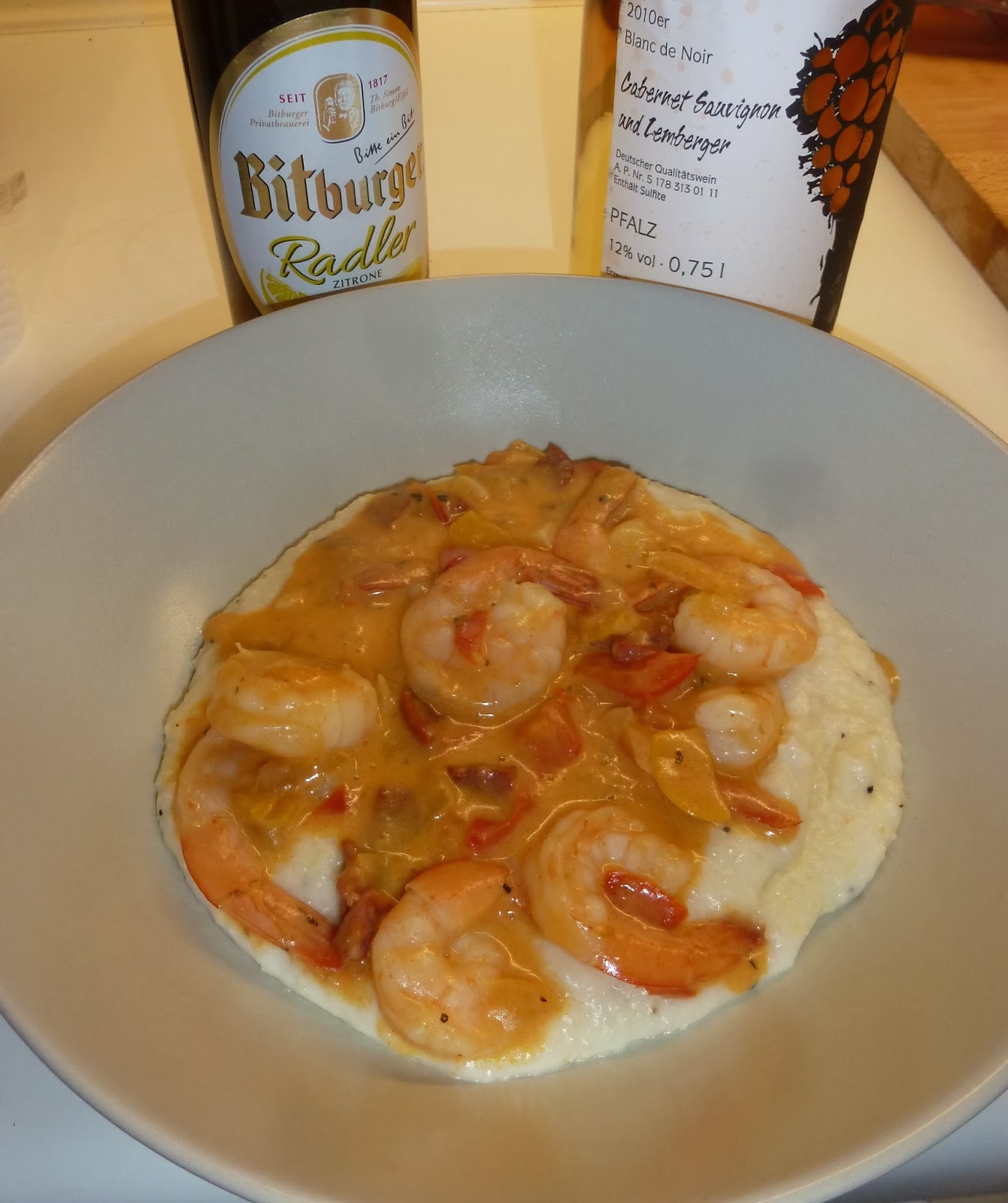
Shrimp and Grits - My Way!


Shrimp and grits, my way.  Talk about a Southern low-country culinary tradition!  But, let me explain a few things to un-boggle your so-called mind.  Lots of people who have shivered through snow clogged winters, lived through dust storms on the great plains, and think their football teams can keep up with the teams from the southeast, have no idea what grits are.

First, some basic American history and meaningless trivia.  Native American tribes gifted the early English settlers with corn, or at least that’s how the story goes.

Stick with me….the word grits comes from the old English word, grytt, meaning coarse meal.

Now we get to the difference between cornmeal and grits, and you can stick polenta in there as well.  Grits are corn kernels that have had the husk and germ removed, usually using lye or another alkaline agent, which turns the kernels into hominy.  Looks like a nude kernel of corn that has never seen the sun.  As a matter of fact, grits are sometimes called hominy-grits. 

Now grind the hominy kernels.  In the old days, they used a stone mill for the grinding and you can still find ‘stone ground grits’ today.  Voilá!  You got yerself some grits.  Started out as mostly a breakfast food and I still love ‘em with eggs and sausage.

Flash forward to around 1985 when a New Yawk Times food writer, Craig Claiborne proclaimed the marvel of the sensational shrimp and grits he found at a North Carolina restaurant.  He wrote an article, and being from the Mississippi Delta himself, Mr. Claiborne knew what he was talking about.

A note about Craig Claiborne, who passed away in 2000.  If you want to know about the basics of cooking, don’t go to Julia Child. Pick up any one of Mr. Claiborne’s books. 

http://topics.nytimes.com/top/reference/timestopics/people/c/craig_claiborne/index.html

Claiborne’s article turned into a twelve cylinder, culinary engine that powered grits from the backwoods into the spotlight.  Today, you’ll find shrimp and grits everywhere  from north to south and east to west, from hole-in-the-wall eateries, to the big name restaurants.  Along the way, every major chef in the country has added his two grits worth to the basic recipe.  Barbecue.  Red pepper.  Garlic.  Cheese.  Haven’t seen escargot and grits, but I know it’s coming.

Now, I’m not a purist, but I do like my shrimp and grits to taste like shrimp and grits.  If I wanted to taste barbecue, I’d go to Texas.

So let’s quit messin’ around and git to it!  My recipe is in two parts, as you might guess.  First the grits, then the shrimp.

First the Grits


1 Cup of grits (use the 5 minute variety if that’s all you can scrape up)
2 Cups of milk
2 Cups of water
salt to taste
coarse ground black pepper to taste
1 Stick of butter (using a half stick at a time)

  Note:  Your amounts may vary, depending on the grits you use, but in any case, stick with half water and half milk.

Put the first four ingredients and a half stick of butter in a sauce pan and bring to a boil.  Stir well. The recipe on your box of grits is going to ignore any mention of milk and is going to tell you to bring the water to a boil first, then add the grits.  BUT, I like my grits creamy, especially if I’m going to layer them with shrimp.  The secret to creamy grits is to bring everything to a boil at the same time.  Then, cover and lower the heat to a simmer.  Stir once in awhile until the grits are done.  Your box of grits will give you a pretty good guess at how long that will take.  If the grits become too thick, add a bit more water or milk and when they’re done, stir in the other half stick of butter.

Now the Shrimp


1 lb of large shrimp  (41 to 50 count per pound)
1 ½ Cups of chopped onions (medium chop on all the vegetables)
1 Cup chopped celery
½ Cup chopped bacon
½ Chopped red bell pepper
2 Tablespoons butter for cooking the vegetables
1 to 1 ½ Cups chicken broth
Splash of Worcestershire Sauce
Two pinches red pepper flakes (too much will overpower the flavor of the shrimp)
Salt to taste

¼ Cup butter + ¼ Cup flour, mixed into a paste

Low-medium heat.  Put the vegetables, the bacon, and 2 Tablespoons of butter in a sauté pan.  Cook until the vegetables are soft, but not brown.  Add the spices and shrimp. Stir.  As the shrimp turn pink, add a cup of the broth.  Stir in the flour-butter mixture and allow the mixture to thicken.  Continue to cook on a low temperature for another three minutes.  Add the remainder of the broth as needed to keep the sauce from getting too thick.  You’re looking for a creamy consistency.

Put a helping of grits in individual shallow bowls and ladle the sauced shrimp on top.  Super for breakfast, lunch, or dinner. 


Enjoy it with your breakfast coffee and juice, or with a light, white wine.