Monday, September 2, 2013

Wine Festivals, Big and Small

A Sweet Mosel While

The Mosel itself is worth the trip
Ah, yes, the source of the juice


Don't neglect the German reds!


Many more photos follow my written drivel.


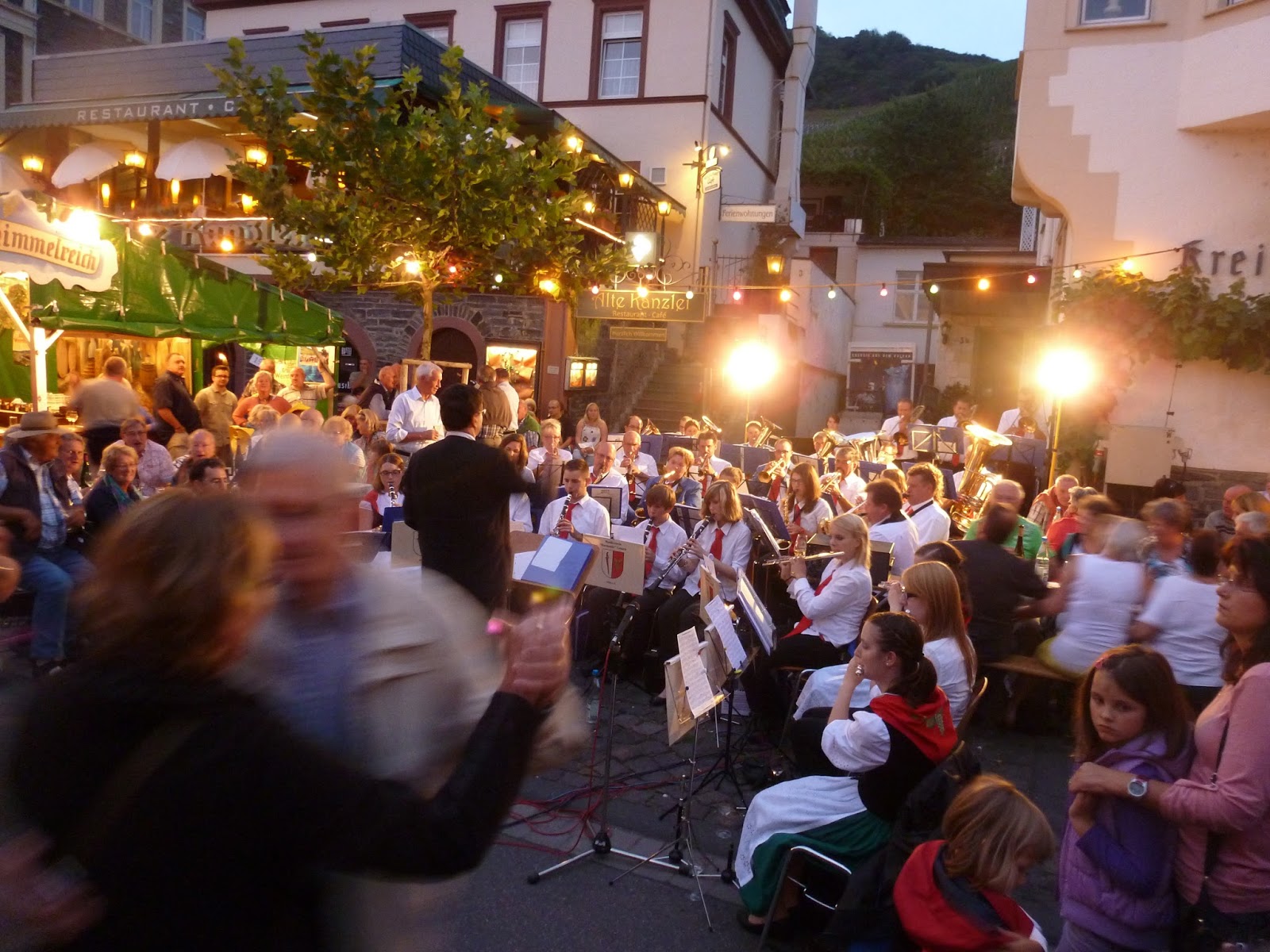
Went to a couple of Weinfests on the Mosel River last weekend.  Friendly crowds, wines galore, and wood fired, grilled meats that will make you swear off vegetables.  

Bernkastel-Kues is one of the largest and most famous, while the Reil wine fest is almost unknown except among aficionados.   I could write volumes about each, but I’m sure you’ll agree photos do a much better job of capturing the celebratory spirit.  Short version:  The big fests have more of everything, including elbow-to-elbow throngs, multiple bands, and food booths that would fill several American malls. The small fests are less of a party atmosphere and while the food can still be exceptional, the focus is on wine and individual vintners.  I relish the big and the small, because most of all, I like German wine.  At fests you can buy wine by the glass or the bottle.  Another note, don’t just stick to the white wines.  German reds have come a long way!

Wine fests are spread across Europe, not just in Germany and not just on the Mosel River. From now through October, you can sip to your heart’s content, eat grilled meats, potato pancakes, and fries, dance with the natives, listen to band music, and get in the Bacchus spirit. Most wine booths will give you a significant price cut if you’re buying the bottles to go.

Two wine fests did not quench my thirst for juice of the grape.  I may have to go back.  If you’d care to join the fun, here’s a list of fests, both past and those to come:


The Mosel River, Moselle in French, starts in the Vosges Mountains in France before flowing for 339 miles through Germany and into Luxembourg.   Funny, I always think of the Mosel as German, probably because it’s one of Germany’s thirteen wine regions.  Some call it a tributary of the Rhine because the two rivers meet in Koblenz.  I say, “Phooey!” but then I say that about a lot of things.  The Mosel Valley is filled with sporting activities.  Hang gliders loft through the air, while boats, canoes, and kayaks try to avoid the huge barges carrying coal and steel.  There are wonderful bike trails and camping sites along either bank, with picturesque villages and historic castles seemingly every mile.  So even if no wine fests are on the agenda, the Mosel is a still worldwide tourist favorite.  As with most tourist destinations, there is a season.  Don’t come in the winter!  Shops and restaurants are buttoned up.

The Big Fest:  Bernkastel-Kues

Spiesbraten and Würst!

Nothing shy about these folks!

Big, but friendly crowds

Bernkastel is a splendid old town.

Ah, a slave to fashion!


Must have been half a dozen major bands.

Frying those delicious potato pancakes

Served with fresh apple sauce, they're delicious!


The small fest at Reil

Small does not mean plain.  Beauty around every corner.


Grapes grow everywhere.  The sign advertises smoked trout.

Less crowded, but still fun.


Local color.

What every wine fest is all about!

If you think it looks good, oh, you should have had a taste!
                                                             

Thursday, August 29, 2013

Verbal Perversions


Some words and expressions should be hung, drawn, and quartered.  If you're one of those who don't support capital punishment for verbal perversions, stop reading right now, you ignorant bastard. 

I won't mention political and pc euphemisms.  Verbal overcoats, pillowcases, and baby blankets tossed over verbal wharf rats.  Stick with me and try to keep breakfast down while we slide our naked hands into a garbage pail of putrid words and expressions.

Words that involve bodily functions.  What you do with your body should forever remain a secret between you and the hamster.  I make exceptions for inoffensive words such as sneeze, hiccup, cough, as well as descriptions of female body parts, and legal sexual encounters.

Other machinations that switch the button in my brain from ‘friendly’ to ‘you must be a moron:’

Misuse of personal pronouns.  Let’s take, “He gave it to her and I.”  Her and I?  Wad that one up and fling it like a stick yearning for dog slobber.  “I” is a subject, but we don’t have to get all teary eyed and grammatical.  Just break it down.  “He gave it to her,” and “He gave it to I?”  Me is not a four letter word.

Like.  Enough said.

Right?  You expect me to confirm “I was walking down the street, right?”  Fuck if I know.  I’ll take your word for it.

Multitasking.  I get it.  You’re capable of not fully concentrating on several things at once.  “Simple tasks, such as tapping my foot, while licking a stamp, are exceptions.”  Really?  How many times did you tap your foot?  And why did you lick a self-sticker?

Quality time.  “Rip off those clothes, baby and stand by for some quality time before I race to your sister’s.”

Try.  "I’ll try to get to it tomorrow."  Fine, you can surprise the both of us.

A known fact.  Thank god you’re not throwing the unknowns at me, which we abbreviate as:  bullshit.  But then, you wouldn’t know that.

Actually.  “Actually, I’m going to China.”  Actually, I hope you won’t be teaching English.

Officially.  “I’m officially dating again.”  I’ll take it from here and warn the other officials, small dogs, and men with elephant guns.

You know.  I do?  I didn't know that.

OK.  "I've got too much to do today, ok?"  Fine with me.  Now beat it and take your ESL book with you.

 The fact that.  Amputate that phrase and chuck it in the dumpster!  Replace it with a simple word out of Mr. English's happy hat.  'Because' will usually do.

Now that we have all that officially straight, you know, we can like actually move on to known facts, right?  Ok?  Absolutely!


Wednesday, August 28, 2013

Off the Beaten Path: The Bailiwick of Guernsey

35 miles from France, 70 from England


Relaxing by the shore


Ah, a trip to the islands.  I'm referring of course to the Channel Islands, and more specifically to Guernsey, the biggest of the group.  Guernsey, sitting in the watery crossroads between England and the continent, has seen more than its share of swashbucklers, Vikings, Normans, French, English, and Germans.  The name is derived from several languages, including the Old Norse word 'ey' meaning island.  The rough translatiion of Guernsey is 'Corner Island."

Closer to France than England (35 versus 70 miles), Guernsey’s a part of the British Isles. However, the relationship takes a bit of explaining.  Guernsey is officially The Bailiwick of Guernsey, a Dependency of the Crown, making it not a part of the United Kingdom, but a possession of the Crown.  Along with Guernsey, there are two more possessions of the Crown, The Bailiwick of Jersey (also a channel isle), and The Isle of Man, located in the Irish Sea.  Confused? I won’t bore you with legalities and political niceties.  Instead, ponder these idiosyncrasies: 

-       Guernsey prints its own money and stamps
-       Has its own parliament
-       Comes under the U.K. for its defense (little good it did in World War II)
-       Is not a member of the European Union, but is allowed free trade with EU members
-       Has its own language, a kind of Frankish Creole, spoken by only 2% of the population, but understood by 14%.  That’s pretty much like Latin and Roman Catholics, n’est pas?
-       The official language is English


A bit of modern history.  The Channel Islands are the only parts of the British Isles to be invaded and occupied during The Second World War. The Germans built substantial fortifications, most of which are still in place. Bunkers and other fortifications polka dot the seascape.  One wonders why.  After all, the Brits had already left the place to its fate.

In any case, the occupation was neither benign, nor innocuous.  People were arrested.  Citizens were shipped off to resettlement camps where they died. Executions were not rare.  The so-called ‘Jewish Question’ resounded.

A tour of the German headquarters, a cave really, shows a plethora of memorabilia, many of which are “Shoot on sight,” and “To be executed” orders signed by the German commander. 

Fortunately, most of the children and many adult islanders had been evacuated to England prior to the German occupation.  Unfortunately, some of the children were never to be reunited with their parents. 

The people of Guernsey still celebrate their liberation each May 9th, and one of the popular beers is aptly named Liberation Ale.

For a synopsis of the occupation, I suggest: http://en.wikipedia.org/wiki/Occupation_of_the_Channel_Islands


Ever heard of Guernsey cattle?  The milk is golden, from the high concentration of beta-carotene.  Unfortunately, with advent of commercialization in the U.S., pure Guernsey milk is tough to find.

The good, the gooder, and the best of Guernsey Island, in no particular order.  People on Guernsey are friendly.  Tourism depends on that, but even for a tourist town, Saint Peter’s Port (the Capitol.  Pop.18, 000) is clean, welcoming, and not a bad place to holiday.  Many seaside cottages are holiday rentals.


But, the main business of Guernsey is business, as in banking.  You might call it a smaller Switzerland.

You don’t need a tour guide to get around St Peter’s Port.  The castle and German headquarters, as well as the shopping areas, are an easy walk.  To venture beyond the city, an inexpensive bus ride, from the middle of downtown, roams the island.


Castle Cornet dominates the town and there are five museums within its walls, including the Guernsey Light Infantry (WW I) and RAF museums.  The castle has stood guard over the harbor for eight centuries.


The real pleasures are wandering St Peter’s Port lazy streets, sniffing the sea air, enjoying the scenic wonders of rocky coast, marinas filled with boats, and buildings festooned with flowers.  Don’t neglect to dodge into a pub to quaff Liberation Ale, and enjoy some fresh fish and crab. Hey, you’re on holiday!


Pubs are a pleasure


The justly famous Liberation Ale

Fresh Crab Sandwich

Saturday, August 24, 2013

Tasting the Scotch in Scotland

On The Royal Mile

The magnificent Edinburgh Castle
Churches galore


Blowing the pipes.

Edinburgh, a fine old medieval town. Whining bagpipes, kilts, clans and Scotch whiskey.

Want to play the bagpipe?  Race around in a wool skirt?  Claim ancestry back to the Celts?  Mac this, Mc that?  I don’t want anyone checking my ancestry, or my credit rating.

On the other hand:  Want some smooth sipping aged malt whiskey?  Even the Judge is nodding. The defense rests.


Found just the place to sip some Scotch and learn trivia that’ll win you a bar bet or two. The Scotch Experience, a discrete four story building in downtown Edinburgh, in the middle of The Royal Mile.

“Honey, you go on ahead.  I’m just going to stop in here for a second.  Looks like a real educational opportunity.” 

That’s not a lie.  The Scotch Experience will fill you with more information than you can possibly digest before compete inebriation.

Step through the door, a lovely maiden sells you a ticket, and plops you in a rotating barrel. Just sit back and grab an insight into the three steps of making whiskey.

The Tasting selections, from smoky to sweet


Fermentation.  Ingredients are almost the same as beer.  Malt, water, yeast.  What is malt again?  Barley drenched in water, allowed to sprout, then dried and ground. Mixed with water and yeast, fermentation takes place.  To get a smoky flavor, they dry the barley with a peat fire.

Distillation. Separates the water from the fragrant alcohol, raising the alcohol content to about 70%.  See, if you hadn’t slept through Chem class…

Maturation.  Scotch Whiskey must be made in Scotland, using only barley, water, and yeast, and it must be matured no less than three years.  Most single malts are aged much longer.  The longer it matures, the less Scotch you have.  Evaporation takes about 2% a year.

Barrels of oak, first used for Bourbon or Sherry...then Scotch

How about ‘blended whiskies?’  Good question.  To create a blended whiskey, a master blender combines several Scotches, along with some so-called grain whiskey.  Grain whiskey comes from wheat, or other grains other than barley. 

Here’s a tip:  A blended whiskey carries the age of the youngest scotch used in the blend.


The age of the Scotch (time in the barrel) determines the flavor.  But aging is not linear.  I tasted The Dalmore 12 and 15 year old Scotches, then bought the 12 year old, finding it smoother and tastier.  Taste is individual, like the ideal temperature of bath water, or the size of the perfect breast.  With breasts, of course, opportunity trumps everything but getting caught.

Another tip:  Once a Scotch is bottled, the maturation process stops.  Cold.  A 10 year old bottle of Scotch forever remains a 10 year old bottle of Scotch, until it finally becomes an empty bottle of Scotch.

Geography.  There are five Scotch producing areas in Scotland:  Highlands, Lowlands, Islay (pronounced Eye-la), Speyside, and Campbeltown.

Tip:  Every minute, 2340 Bottles of Scotch are sold worldwide.  That’s about 20 bottles per second.


Here’s a quick tour of the four major areas, by flavor.

Lowlands:  Citrus, to an almost bread flavor.

Highlands:  Sweet, nutty florals.

Speyside:  Light to dark fruit, like Christmas

Islay:  smoky, sweet, possibly a light iodine finish

These are only hints. Expect dramatic variations and surprises.  In any case, the best place to begin your quest in the heart of Edinburgh, on The Royal Mile, at The Scotch Experience. 

The perfect glass for tasting.  Glencairn. Designed in 2006 and winner of The Queen's Award 

One wall of the 3400 bottle Scotch collectiion

Another wall of the collection

World's largest bottle of Scotch...five feet tall

But, there's more to Scotland than Scotch


“Honey, I’m fine.  Just a few more minutes.  Go ahead and finish the castle tour… visit the gift shop, go to the spa, get a massage, have your nails done.”


Tuesday, August 20, 2013

On Board Her Majesty's Yacht Britannia


On the bridge

note the enclosed railings to protect the royal skirt from breezes


Want to spend a couple of hours stepping back into times and styles of the middle to late twentieth century?  Have a fascination with royalty and things British?

Ever dream of having tea with “Her Majesty Elizabeth the Second, by the Grace of God, of the United Kingdom of Great Britain and Northern Ireland, and of Her other Realms and Territories, Queen, Head of the Commonwealth, Defender of the Faith?”

You can, you know.  Yes, you can …almost…

Tour Her Majesty’s Yacht Britannia, relax with visions of Princess Di and her kids;  have a pot of tea and fluffy, oven fresh scones.  Magical.  Childhood dreams. Visions of grandeur.  HMY Britannia. 

Sadly the Queen no longer has the privilege of gracing her decks, yet her presence is still here.  There’s a fragrantly pleasing air about the expansive teak decks, the spotless railings, the armchairs that beg for a sunny book.

Now moored in the Port of Leith, Edinburgh, Scotland, the price and chore of Britannia’s upkeep falls to a Scottish charity.  They do a splendid job.  Getting to the port is only a matter of stepping on a bus in downtown Edinburgh.

Let’s begin Britannia’s lengthy tale with the story of the ship itself. Commissioned by Queen Elizabeth in1954, and after 43 years of faithful service, the Labor government had the vessel decommissioned in1997 as a cost saving measure.  The government also declined to build a replacement.  To make matters even darker, Britannia’s last overseas voyage was to bring the last British Governor of Hong Kong, Chris Patten, and Prince Phillip back to the U.K., after the return of the former British colony to the People’s Republic of China.

Now, before you settle down to tea and a quick, but elegant bite, tour the ship and accustom yourself to ease and sea breeze.

In the 43 years of her service, the Britannia sailed over a million miles and served as the Queen’s family home, including several royal honeymoons, as well as a distinguished visitor center for such luminaries as Nelson Mandela, Bill and Hillary, Gerald Ford, and Ronald Reagan.  If the place looks more homey and less formal than one would expect, it’s because the Queen supervised every phase of the interior design, wanting to keep it a ‘country cottage’ décor.

Although voyagers were restricted to Royalty and Royal guests, the Britannia was a proud Royal Navy ship, complete with a crew of some 330 sailors and marines, including a Royal Marine Band and a compliment of Royal Marine guards. The Marines were only on board when the Royal Family was.

Other oddities:  The yacht was designed to be converted to a hospital ship, should the need arise.  During the cold war, it was also to be the Queen’s safe haven, flitting from craggy loch to loch in Northern Scotland, as protection from nuclear calamity.

Ready for a tea break?  Just a couple of more items:  The Queen and Prince Phillip had separate, adjoining bedrooms.  Easy to tell one from the other.  One was frilly and flowery, and the other stark, as befitting a Naval officer’s cabin.

When Prince Charles and Diana honeymooned onboard, he had a double bed installed in a guest room.  Very bright of him, although I’m sure it was a complication for Camilla.

Tea need not be boring
On to tea.  The café on the Royal Deck was certainly not a café in the Royal days, but now it’s a bright and sunny spot on the upper deck.  Waitresses in black and white take orders from the small, but elegant menu, and of course the drink selection is all you would expect, both hot, cold, alcoholic and non. Starched table cloths.  Flowers.  Sparkling china, glassware, silverware.

Being old school, meaning married, old, and a complete slave to tired traditions, we succumbed to tea and scones, complete with fresh strawberry jam and clotted cream.

Tea is never just tea
Culinary tidbits:  clotted cream is heavy cream (not ultra-pasteurized) heated several hours in a very low temperature oven, until clots rise to the top.  Here’s another:  the Brits called golden raisins sultanas. Our scones had both raisins and sultanas.

It’s hard not to linger.  Difficult not to order a second pot of tea, while luxuriating on a ship fit for a queen.  Ah, but times whisks away.

Another quick stroll around and it was time to be piped to shore, leaving behind a wonderful ship, which will unfortunately no longer proudly sail the seas.  Wish the government would’ve found another way to shave off a few pounds of fat. Want to see her back afloat?  Me too.  Meanwhile, you can walk the teak decks, stare at the Queen’s Rolls Royce Phantom and enjoy at least a brief brush with royalty.


The State Dining Room

Sunday, August 18, 2013

Live by Night by Dennis Lehane


“Some years later, on a tugboat in the Gulf of Mexico, Joe Coughlin’s feet were placed in a tub of cement.  Twelve gunmen stood waiting until they got far enough out to sea to throw him overboard…And it occurred to him that almost everything of note that had happened in his life – good or bad – had been set in motion the morning he first crossed paths with Emma Gould.”  So begins Live by Night, by Dennis Lehane.  You may have heard of him, or read Shutter Island, or seen the movie.  Dark.  Deep and dark, yet his characters grab you with their stretched equations of right and wrong.  With their flickering, daring lives.  

One thing that annoys me is when a book breaks its promises.  Sometimes it’s just poor writing.  Sometimes it gallops until the horse dies and the author just keeps flogging.  With Lehane, there’s no chance of either.  His prose races clean and crisp, his characters are razor sharp.  And the plot sizzles like a lit fuse.

The setting is Boston, in the middle of the Roaring Twenties.  Always wondered about that name.  Was it the 3-4 and 4-4 time jazz that rambled from speakeasies and leaked out onto the streets?  Or the shuffle of flappers bouncing along, doing the Charleston?  Maybe it was the illegal flow of the devil’s potions that nobody, not even the Congress, or the strong arm of the law, could dam up.  I think it was the roar of gunfire that swept the streets of every major city, including Boston.

Joe Coughlin was in the middle of it.  And when you live outside the law, there’s no coming back.  The police want to kill you.  Your partners want to kill you, but most of all your competition wants you cold and dead.

Lehane is right on target with Live by Night.  This book shoves you into the epicenter of danger and corruption, love and betrayal, good, evil, and everything in between.

If you liked Puzo’s The Godfather, you’ll sink your teeth into Live by Night.  Take a trip back to Boston in the 1920s.  Taste the rotgut booze, ogle the easy women, smell the cordite. Run for your life!