Thursday, December 17, 2020

The Cedar Oak Café and The Olde Towne Gallery


 The Cedar Oak Café and The Olde Towne Gallery.


On a Wednesday morning, I woke up thinking of heading up the road to a rustic bit of Americana, The Cedar Oak Café in St Marys, Georgia. For those familiar with the military, you may recognize the name, St Marys being the home of Kings Bay Submarine Base.


As one wag said, Kings Bay has more satellites overhead than anywhere on earth, so don’t forget to smile and wave when you drive into town.


St Marys is an historic town that belonged to Spanish Florida until 1763, when it became part of Georgia.  So between history and submarine, there’s much to do here.  Museums, festivals, and don’t miss the huge and beautiful homes in the historic district.  


There are also excursions to the equally famous Cumberland Island.  Here’s a link: https://www.exploregeorgia.org/city/st-marys


But, the Cedar Oak Café was my center of attention.  Breakfast is my favorite meal and to do it properly, ya gotta git away from them boring Hut this and House that!  I like rustic and off the beaten track, BUT, the food has to be interesting and well prepared.  Not saying the typical breakfast is not good, but if you’re going to drive a few miles, there should be a delight at the end of the journey.


I found all the delight I could handle at the Cedar Oak Café in St Marys.  The café shares a building with an artists’ co-op, the Olde Towne Gallery and I’m glad they do.  This gallery shows off local talent that centers on the beauty of the surrounding area.  So, crafts and stuff?  Oh, so much more than that.  This co-op has art and crafts and many of the paintings and sculpture and jewelry would enhance many museums, as well as your home and mine.  Creativity flows down a lengthy hallway and into separate artists’ ateliers.  A combination of a feast for the eyes and a salve for the budget. So reasonably priced, the tags will make you blink.


This setup of quaint café and gallery is marketing genius!   And, no they’re not combined in the same room, but you have to go a few paces down the gallery hallway to enter the café.


And in the café, you’ll find an old time décor, with a breakfast and lunch menu with variety, culinary quality, and wonderful service.  This is not just a bacon, eggs, toast and coffee establishment, although you can surely order those.  I opt for the Breakfast Special, of country fried steak, grits, eggs over easy, whole wheat toast and coffee.


You have to realize that country fried steak is one of the ten commandments for any southern restaurant.  An addendum says, “Thou shall serve it with delicious sausage gravy!”


Now, I make some pretty good country fried steak at home, and my gravy isn’t bad either, but now I am shamefaced.  My attempts are woefully inadequate when compared to the fare at the Cedar Oak Café!  The breading on the steak was delightfully crunchy and the gravy was very close to heaven from a pan.  The rest of my breakfast was equally excellent!


My traveling partner ordered an omelet, stuffed with bacon and feta cheese.  I admit, I had my doubts because I am not one who ever gets a craving for feta cheese.  But, I figured, what the heck, I’m getting my country fried steak, so why should I give a hoot?


And then my partner offered me a taste.   My mind flipped a switch and my lips formed the words, “Gimme some more!”  The huge amount of crumbled bacon was crispy, and a touch of feta complimented perfectly the salt crunch of the bacon and the soft flavor of the eggs.  I never would have dreamed of putting these three flavors together and yet, they were perfect!  This talented chef knew what she was doing! 


I walk away happy when I know the meal is so good that I couldn’t compete.  This breakfast was so good I won’t even try!


I not only have no complaints, but I awoke this morning thinking I  should make another trip to the Cedar Oak Café and I should do it pronto!

Sunday, December 13, 2020

Hungarian Goulash Sorta


Hungarian Goulash Sorta


It was a dark and rainy evening.  I was hungry.  What better time for a dish from Hungary for the hungry.  And even though it was evening, it suddenly dawned on me. Goulash!  But, this would be no flash in the pan.  It would take slicing and dicing a plenty, but nevertheless worth stewing over.


The recipe called for two lovely Hungarians from Budapest, Boglàrka and Zsófia, but unfortunately they were not in the cards, or the deck and my significant other insisted I try another recipe, or she would deck me. Hahaha, what a card.


By the way, did you realize Budapest was once two cities, Buda and Pest, or three for a while?   The cities fell under the Ottoman rule, until the re-conquest of Buda in 1686.  For quite some time the combined city was known as Pest-Buda, and in 1873, the cities of  Buda, Óbuda, and Pest combined to form Budapest, which became the co-capital of the Austro Hungarian Empire. Shall I keep my three faithful readers in suspense? No, but, I can take my time; they’re slow readers.  Of course the other co-capital was Vienna.


But, let’s get back to the really important stuff, cooking and eating.


Hungarian Goulash Sorta


Ingredients, or as the Gabor sisters, Eva and Zsa Zsa and Magda said to so many men:  Mi egymásnak lettünk teremtve!  We were meant to be together.


You need not worry.  Ingredients are simple and readily available.  No surprises like pickled eye of newt, or frog liver paté.


2 lbs beef stew meat

Olive Oil

2 sweet onions, diced

2 red onions, diced

5 cloves of garlic, sliced

3 mid sized red bell peppers, seeded and diced

1 can fire roasted, diced tomatoes, juice and all

4 heaping tablespoons sweet paprika

1 Tablespoon smoked paprika

2 cups beef broth (or more, depending on if you lean toward stew or soup)

Salt to taste

1 package of egg noodles, if it’s stew you want, you Hungary devil!


Puttin’ it together:  Táncoljunk!  Let’s dance!


Put ¼ cup oil in a stew sized pot over medium heat and when the oil is

hot, add the chunks of beef.  Stir to brown, then add all the vegetables, except for the diced tomatoes, and stir well.


Heat the oven to 350ºF or 180ºC


When the onions are translucent, add all the paprika and mix again.  Add the can of diced tomatoes and the beef broth.  For stew, if you need to add more broth as it cooks, do it gingerly.  I added another half to one cup.


Let the stew come to a boil, turn it to simmer and cook until the meat is barely tender.


Put a top on the pot and put it in the oven for two hours.


About ten minutes before the stew comes out of the oven, cook the egg noodles according to package directions, then stain.  Put a couple of splashes of oil and two tablespoons of butter in the noodle pan. Add the drained noodles and mix well.


I served the goulash over the noodles.  My professional taster deemed it edible, but just to be sure, I finished my snifter of brandy before checking to see if she were still breathing.  I tend to trust survivors.


Now, should I reveal the story of the time I met Zsa Zsa in Las Vegas?  Well, to tell the truth (as I seldom do), we had both been drinking and


Wednesday, December 9, 2020

Let’s Make Cuban Bread = Hagamos Pan Cubano


Let’s Make Cuban Bread = Hagamos Pan Cubano


Ok, my fellow bread makers, let’s mostly follow the recipe for baguettes, add a few changes and make some Cuban bread.  Why would we want to do that? you calmly ask, while sipping a Cuba Libre.


Cuba Libre? What’s in that concoction and why the funny name?  Came from Cuba, of course and means Free Cuba, a term adopted around 1900, when the Coca Cola company set up shop in Cuba after Cuba was freed from Spanish domination in the Spanish American War of 1898.  As you can guess, the war set U.S. vs Spain, the results of which also saw the Philippines ceded to the U.S. 


As a side note, you may get a surprise when you ask for a Cuba Libre in Spain. The Spaniards make them with either rum or gin. 


Three years after the war, 1901, Cuba became independent and the U.S. gained a naval base, Guantanamo, in perpetuity. 


Just in case you’re interested, the Philippines gained full independence on July 4, 1946.


Ever had a Cuban sandwich?  If the answer is no, I can understand your semi-reluctance.  But, if you have tasted that deliciously crunchy melding of cheese and pork and sauces, pressed into each bite, you’re ready to follow me to bread makers’ heaven, no questions asked.


Maybe you want to review how to make baguettes.  Happy to help you out:  https://stroudallover.blogspot.com/2020/11/oh-those-baguettes.html


Now that you’ve finished your review, take a peak at those additions that will turn baguettes into Pan Cubano!  Oil. Sugar. More yeast.


Lista de Ingedientes:


3 cups flour (bread flour or all purpose flour)

1 ½ teaspoons salt

½ package of yeast

¼ vegetable oil

¼ cup sugar

1 ½ cups very warm water

more oil for greasing the finished loaves.


Las Instrucciones:


Place all the dry ingredients in your food processor and blend for a moment or two.


Add the oil and hot water.  Blend until you have sticky dough.


Take the dough out of the processor and put it onto a scattering of flour.  Knead slightly and form into two cylindrical loaves.  Oil them well, cover with a tea towel, and place on a baking sheet.  Put the baking sheet in a cold oven, turn on the oven light and let the bread rise for a few hours.


Heat the oven to 450ºF.


The loaves may spread out a bit as they rise.  Put them back on a floured surface and reshape, if necessary, although I leave them a little flatter than baguettes.


While the oven heats, place the loaves back on the baking sheet,  give them another coating of oil, and let them rise uncovered a second time.


Put a pan of hot water on the bottom shelf of the oven. When the oven reaches 450º, slide the loaves onto the top shelf.


Bake for 15 minutes, or until the loaves are golden.


Cuban bread, sliced, buttered and toasted is a treat with your morning coffee, but if you want the full mouth-watering effect, make yourself a Cuban sandwich.


Ingredients for a Cuban sandwich:


Cut about four inches off a loaf of Cuban bread, then slice it horizontally.  Add sliced baby Swiss cheese, sliced ham or roast pork or both, sliced chicken or turkey, pickles and any sauce you favor.  I like to spread Mojo sauce on both slices of  the Cuban Bread. Mojo is available at many supermarkets, or on Amazon.


Spray some vegetable oil in a hot skillet, put the sandwich on the skillet and press hard.  When the bottom side is toasted, turn it over and press again.  The ham and such should be hot and the cheese melted.


Personally, I like to eat mine with a café con leche, which is more or less like a café au lait, half a double espresso and half scalded milk.


Saturday, November 28, 2020

Charleston's 39 Rue de Jean


I was excited to escape the daily routine and get back to Charleston, South Carolina, one of my favorite cities.  Charleston is filled to the brim with a fascinating history, from the founding of the United States to the present, along with fabulous architecture, seaside scenery, old markets, plantations, and mouthwatering restaurants. 


I’ve been going to this city for the best part of fifty years and eaten in both the upper crust, coat and tie establishments, and the smoke-filled-sawdust-on-the-floor barbecue joints.  And as my three faithful readers know, I’ve written about several of them in this blog.


Lately, when I visited the Holy City…wait a sec, holy city?  Oh, I know you’re begging for some details, and answering that question is a good start.


Charleston was established in 1680 (by Royal Charter of King Charles II) and moved to its present downtown location in 1783.  The old site is still well marked, and about a couple of miles north.


Since its founding, Charleston’s been known for its tolerance for all religions and boasts many historic churches to prove the point.  The most famous of which is The Huguenot Church, founded by French Protestants who fled France when Louis XIV revoked the Edit of Nantes and revived the persecutions of non-Catholics.  Matter of fact, it’s the only Huguenot church in the U.S. and still uses the French liturgy, but in English.


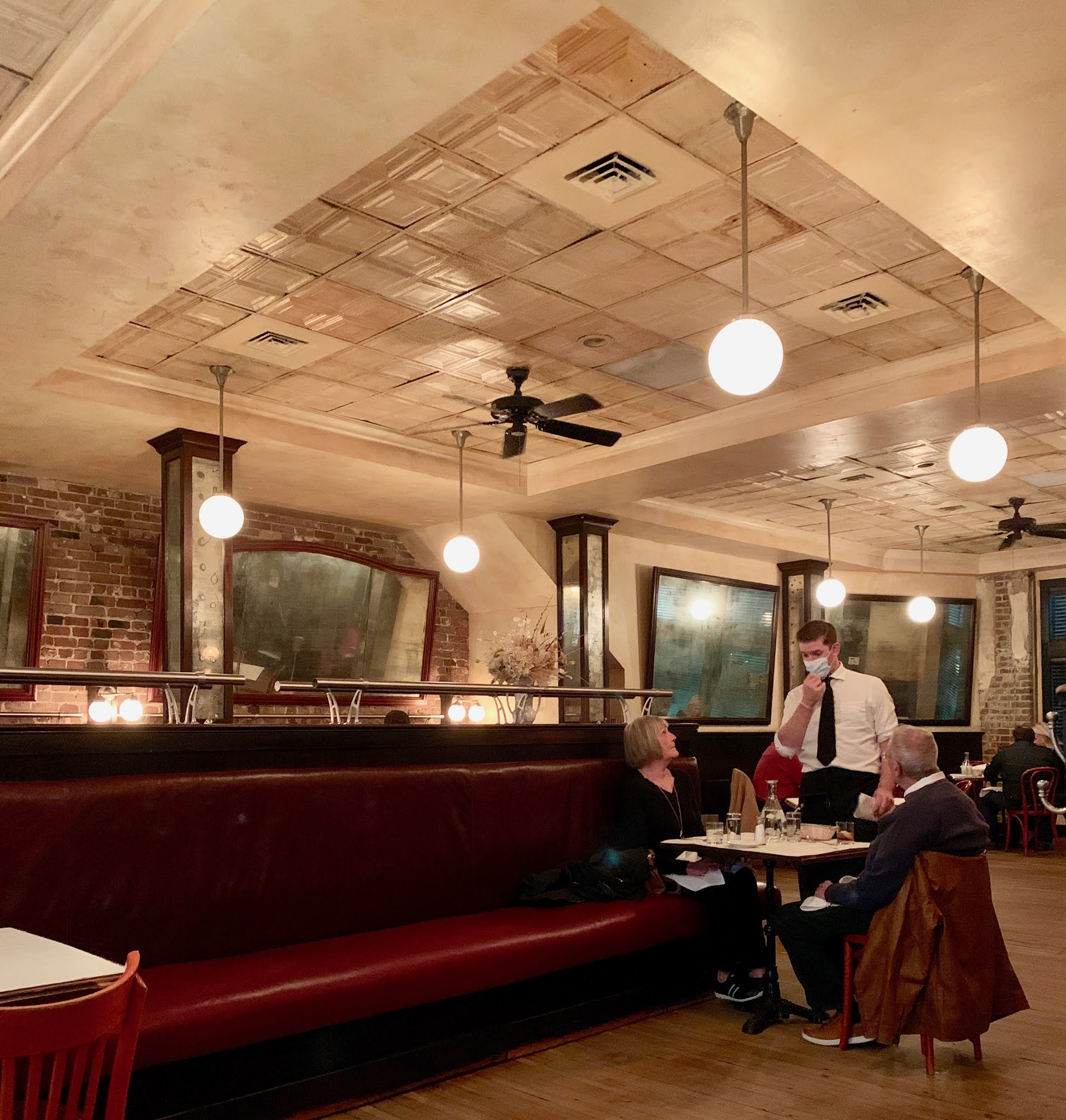
With a French religious flavor, it’s only natural that one of the best restaurants in this well-preserved old city has a French name, 39 Rue de Jean.  As you may guess, it is located at 39 John Street.   If you don’t feel like guessing, it’s still at 39 John Street.


But, more than a French name, 39 Rue de Jean has an atmosphere that rivals that of restaurants in another of America’s French influenced cities, New Orleans.


Large, 18th or 19th century mirrors line the walls, chairs at the tables have a French café flair, the bar is gloriously dark and long, and best of all, the menu is a compilation of delicious French fare.


I admit to being something of a secret snob.  My companion differs.  “Not so secret,” she says.


Well, ok, I admit it, if being a snob means appreciating a well-trained, polite wait staff, dressed in traditional black and white, and who know the details of everything on the menu.  And, perhaps I should mention bartenders who mix from scratch, know how flavors fit together, and in my case, know how to make an excellent Manhattan, served straight up in a delightfully chilled martini glass.


Ok, you’ve gotten the French ambiance of modulated voices, lowered lighting, antique, tinned ceilings, and a wonderful wait staff.  Now it is time to speak of the reason we came to this fine establishment: the menu.  Firstly, we shared a plate of Hunters Gnocchi, featuring house made duck fat gnocchi, rabbit sausage, wild mushrooms, goat cheese, and arugula, all afloat in a buttery wine sauce.  


For the main course, I opt …(yes op is present tense and opt is past tense, despite what the bad news bearers of horrid English proclaim)… for a nearly fork tender, Angus steak with a mound of herbed butter, and crisp frites on the side, along with a delightful glass of pinot noir.


My dinner companion and designated chauffeur ordered trout almandine in brown butter, covered with gently fried almonds, and served over a soft potato purée and crisply tender haricot verts (green beans) on the side.  And, of course, no French meal would be a meal without a fresh baguette, although in the American style, fresh butter was also offered.


Ok, buddy, you thinking, you’ve impressed us with your uncompromising command of French, tossing out words like rue and Jean, and them hardy cut beans.  But, how about the taste!


I judge the excellent meal thusly:  if I walk away saying to myself, mighty chef that you are, you couldn’t have done better at home, then it was an excellent meal.  This meal was excellent!  And added to that, the French ambiance, a worthy Manhattan, and superb waiter, Aaron, made this a special evening.  To top it off, we shared a Lemon Cream Torte with strawberry coulis.


And of course we finished with an espresso.


Bientôt encore j’espère! Or, in gooder English, Damn I wanna do this again!


Friday, November 20, 2020

Oh, Those Baguettes!


Oh, Those Baguettes!


France is known for wine and cheese, but when sipping your wine in a small street-side café and your attentive waiter silently places a small basket of freshly sliced baguette on your table, wine takes a momentary holiday.


Baguettes are the quintessential French bread. Yes, even more than the croissant. Baguettes are ubiquitous. Never changing.  And, oh how they bring back the memories, from many sparkling days in Provence to the side streets of Paris’ left bank to the fabulous covered market in Metz.


Each morning, in nearly every town, you’ll see small bread trucks, filled to the brim, with drivers in short brimmed caps and blue, workers smocks, unloading fresh armfuls at restaurants and cafés large and small, celebrated and humble.


But did you know in France there are several types of baguettes?  A larger, thicker baguette style loaf is called a flûte or flute, but it sounds more like flit when the French say it.  Then there’s a shorter, thicker one, called a bâtard or bastard.  And naturally there’s a skinny style called aficelle or string.


Where did the baguette originate?  No one seems to know, but lots of stories persist. Some say Napoleon insisted bakers invent a loaf that was more easily carried by soldiers.


As I suspect, even my drunk and unruly readers realize the baguette is not only prevalent in France and French speaking regions such as Belgium, and Switzerland, but around the world.  In Vietnam (once a French colony) they add rice flour. In the U.S. you can find multigrain and sourdough perversions!  “Mon ami, I spit upon this ignoble bowing before the world of fashion.”  


In today’s commercial world baguettes have become well known all over. You don’t have to be French or speak the language to enjoy them, or to make them. 


But, until now, to get the best baguettes you have always had to travel to France. No longer!  I will show you the true path that you can follow in your own kitchen, be it ever so humble.  Vive la baguette!


Faisons un Baguette ou Deux!

(Let’s Make a Baguette or Two!)


Few choose to believe, but I don’t make any recipes that are very difficult.  And this recipe is no exception to my code of simplicity.


Four Ingedients


3 cups unbleached all purpose flour, or use bread flour

1 teaspoon salt

¼ teaspoon yeast

1 ½ cups very warm water


I use my food processor.  Put in the flour, salt, and yeast.  Pulse to mix the dry ingredients.  Now add the very warm water.  Turn on the processor and mix until a dough forms.


Put the dough on a well floured surface and cut into two equal parts.  Form into two baguette shapes and then flatten them out.


Fold the two long halves into the middle and shape.  Spray a baking sheet with oil, add both baguettes, and cover with a dishtowel.  Allow to rise for a few hours.


Note:  I put the covered baguettes in my oven and turn on the oven light.


When the dough has risen, you may find that it has spread.  Just tuck in the sides to reform and put some slashes across the top.  Heat the oven to 450ºF or about 232ºC


When the oven is hot, put a pan of hot water on the bottom rack.  Put the baguettes on the top rack and check after 20 minutes, add more time if necessary.  


Note:  The water helps to crisp the crust.


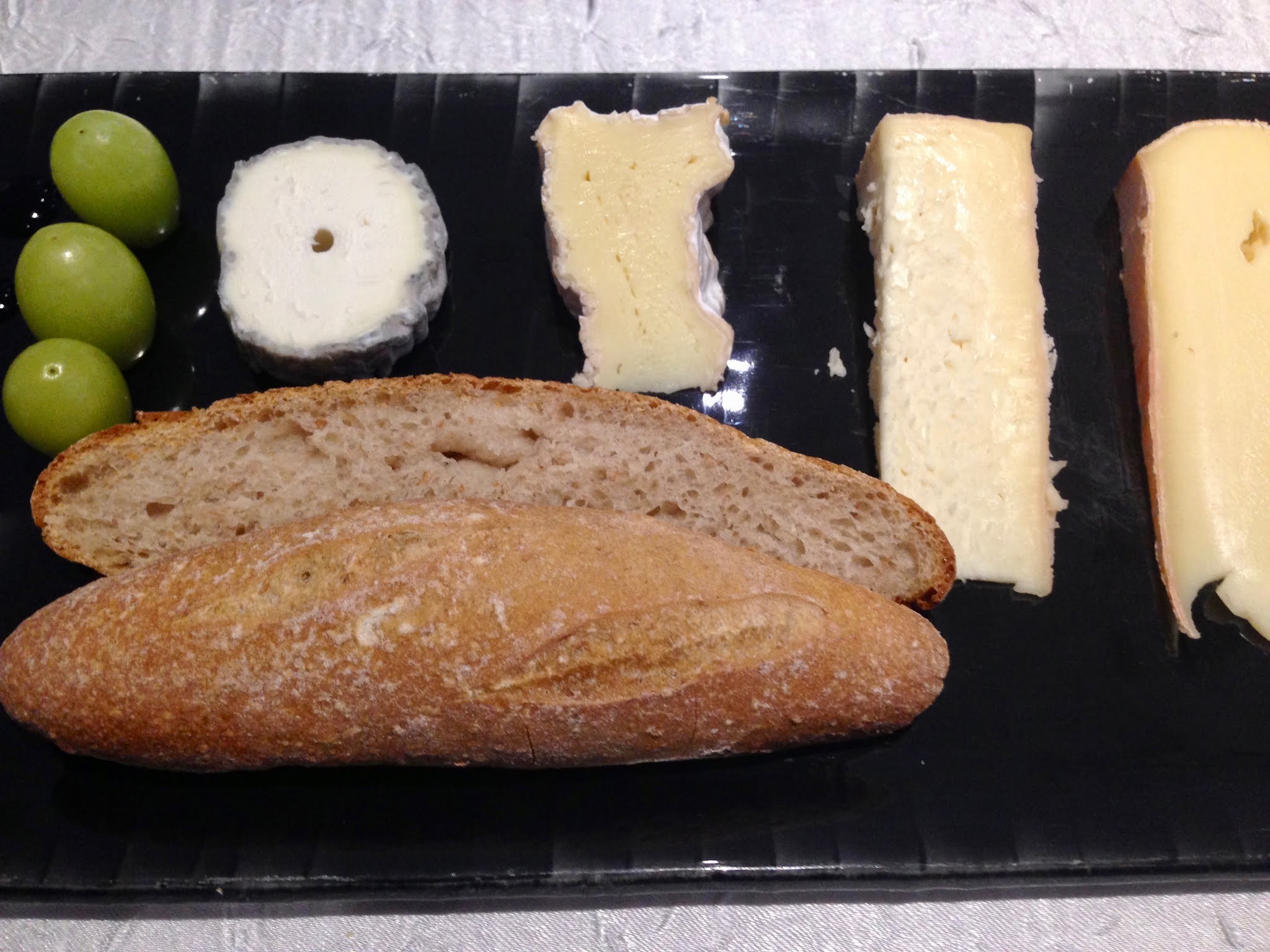
Now, assuming you have already opened the second bottle of wine, it’s time to bring out the cheese tray and few grapes.  But let the baguette loaves rest for 15 minutes before slicing.  The French don’t butter their slices, but I do!  Á votre Santé!  Cheers!


Saturday, November 14, 2020

Russell Thomas Highpoint a very short story


Russ, whose full name was Russell Thomas Highpoint was never called lazy, at least not to his face, and never by the men and women who worked for him.  Although his lack of attention, even to the personal, saw him still sipping a cold first cup of coffee late into the afternoon.  Had he been a dreamer, he could have spent the time toiling over how best to market his company’s next product, or something else to do with business.  But, Russ was not a dreamer, at least not in the conventional sense.  A better description of how he spent his time would be tarry.  He tarried enough to be the winning contestant in a Rip Van Winkle attention span contest.


Punctual and dedicated to routine, he definitely was, arriving at eight in the morning and leaving promptly at five in the afternoon.  Lunch was a tuna fish sandwich on toasted whole wheat. Daily.  It arrived on a bamboo tray with silver handles and corner pieces, brought into the office by his secretary, along with a bottle of Perrier, half of which had been poured by her into a clear, eight ounce glass. Normal Perrier, never contaminated with lemon or lime.


The secretary, ancient well beyond her years, matched him exactly. She was a worrier about things that were none of her business, such as people spending too much time on this and that she found to be an improper use of company time.  This she thought her duty to report to one and all. Her pet name by the employees was Fuck You Sally, most often abbreviated to FYS.


Once she had the audacity to post a note in the break room:  Coffee Time is Wasted Time. Someone had inked over it, FYS is wasted space.  Another had written:  Please refrain from relieving yourself in Sally’s desk drawer until after close of business.  An irate Sally removed the sign and seldom left her desk. 


Russ held business meetings that were as interesting as counting the individual hairs on a barbershop floor, and lasting longer than winter.  These occurred on Fridays at three o’clock until exactly five in the afternoon, a time when beer and the weekend dominated employees’ rambling thoughts.  Russ thought it brilliant of him to give people something to think about in their free time.  It would have been brilliant except the interminable meetings invariably offered a clean plate of nothing worth thinking about.  The placement of chairs so the janitorial service could best sweep the floors. The proper use of paper towels to avoid excessive cost, including a fifteen-minute demonstration by a supplier.  A discussion of various shades of beige for the repainting of the walls in the underground garage.  Whether or not it was really necessary to replace the break room’s coffee machine and a PowerPoint presentation of various alternatives, complete with graphs of price comparisons of possible replacements and more graphs of long term maintenance costs.


Several employees remained comatose long after these meetings were over, reviving barely in time to avoid a call for an EMT. In one such meeting, EMT was called to restart a heart that had simply grown tired of beating.


Russ, of course remained oblivious.  He was also oblivious when he walked through the parking garage and was hit and killed by a delivery truck.


It happened on a Friday, so celebrations didn’t begin until Monday.

Friday, November 13, 2020

Mission to Paris, by Alan Furst


Mission to Paris, by Alan Furst


Mission to Paris is one of those all too rare novels that strips away the characters’ coats of armor to revel real people, pushed and transformed in the awkwardness of real situations.  


I get so tired with the ho-hum triteness of perfection.  I think you know what I mean; characters always knowing the perfectly clever replies, making the right moves, with perfect timing, always choosing the best wine, staying in the best hotels, getting the girl, and forever being one step ahead of numerous adversaries. 


Frequently tucked into the clutter of plot, there’s also the triteness of heavy-handed romance.  Boy gets girl, loses girl, gets girl.  Even reminding yourself of the pattern makes you want to toss the book hard enough to dent the wall. 


Alan Furst, in all his novels, and definitely in Mission to Paris, avoids those careless blunders of perfection and the lack of them is the key to chiseled characters, dented and scratched by age and experience and inexperience, that glued me to each page.  This novel, that purports to be a spy novel, is more a study of humanity, supported by an intriguing and ever shifting and intensifying plot.


It is autumn of 1938 and the setting is Paris, a Paris straining under the threat of war.


To refresh your memory, in 1933 Hitler came to power in a Germany still seething over its treatment by the Allies at the end of World War I.  In many German political minds, France was the mastermind of this villainy.  While peace was now in hand, Germany burned with the need for white-hot revenge and the object of that revenge centered on France.


In 1938, the Germans were playing political poker, holding their cards tightly and making the world guess.  Would there be war?  Should France rearm?  Surely everyone wanted peace, n’est pas?


Despite this Parisian world of intrigue and uncertainty, Warner Brothers wants to film a movie, staring Fredric Stahl, Austrian by birth, but now a Hollywood heartthrob.  Stahl is mostly non-political and simply wants to make the movie and get back to America.  He speaks his native language, German of course, but also English and French.  He is also a star of some magnitude, making him the perfect chicken to be flavored, stewed, and served to an array of politicians and plotters of all the major players.


And while he innocently meets old friends and enjoys his favorite city, the pot begins to boil. Stahl is not immune.  He feels the heat building.  And suddenly the plot intensifies to heart stopping intensity.


The beauty of the writing and finely drawn characters alone carried its own joy, transporting me to that time and place.  Then the carefully crafted plot, carried me into the caldron of passionate intrigue and nail biting intensity.  This is a book that will haunt you and even make you doubt your own courage, as you’re engulfed in the rising flames of war.


Pick up a copy of Mission to Paris, by Alan Furst, and like all his other spy novels, you won’t want to put it down.