Friday, September 17, 2021

Cream Cheese and Blueberry Biscuits From The Careless Cook


Cream Cheese and Blueberry Biscuits From The Careless Cook


Why does The Careless Cook stick with making biscuits?  Well, he doesn’t!  There are plenty of recipes on www.stroudallover.blogspot.com.  If you’ve subscribed, you’d know that, but if you haven’t yet taken the plunge, dive in!  The water is fine and calm and has no political waves.  The blog is FREE!


But, after all that blather, I have to admit I am fond of biscuits.  Biscuit recipes are like a book of short stories. And recently, I’ve been tasked with supplying food to the multitudes, otherwise known as the famished multitudes.  Sure, I could stand still and become a monogamous cook, but then the complaints would rain down, as if they had to read the same story over and over.  I prefer to turn the pages.


Today’s recipe has something in common with many of The Careless Cook’s recipes.  It’s mostly done with a food processor.  Total time:  30 minutes to make, and 12 minutes to bake.


So, crank your oven up to 425ºF, put down that second Breakfast Bloody Mary and let’s get started.


Cream Cheese and Blueberry Biscuits from The Careless Cook

Also Vanilla Butter


Ingredients


3 cups flour (I used unbleached bread flour, but all purpose flour works just as well)

1 teaspoon baking soda

1 tablespoon baking powder

1/3 cup white sugar

½ teaspoon salt

1 ¼ cups buttermilk, or use regular milk, or oat milk, or coconut milk, or cream (I used buttermilk because I had some in the frig)

4 oz cold cream cheese

1 stick (1/2 cup) cold butter, chopped into small pieces

1 cup frozen blueberries (keep them frozen)


Puttin’ It Together


Put all the flour and other dry ingredients in the food processor and mix well.


Break the cream cheese into bits and add to the processor, along with the small bits of butter. Turn the processor back on and mix well.  The result should look a little crumbly.


Add the buttermilk and mix until a dough forms.  Too sticky?  Add flour  a little at a time.  You want the dough soft, not dry.


Flour your counter and turn the dough out.  Press or roll the dough until flat and about an inch thick.


Now it’s time to scatter the blueberries and press them into the dough. Fold the dough over on itself, again and again until the blueberries are well distributed.


Cut to your preference (I did rounds) and put the biscuits on an ungreased baking sheet.  When you bake, I suggest setting the timer for ten minutes for a quick check and add another two minutes if you need to.  You want the tops to be browned. Now, paint on the Vanilla Butter.  Voilà! 


Vanilla Butter

3 tablespoons of melted butter

splash of vanilla

1 or 2 teaspoons sugar


Now you can get back to that Bloody Mary and enjoy the smiles of the hungry, multitudinous masses who have already swarmed your kitchen. 


Wednesday, September 15, 2021

Caramel Scones from The Careless Cook


Caramel Scones from The Careless Cook


I was still on the edge of sleep at 0800, but someone had a meeting to attend and it suddenly became my job to furnish coffee compatible knick-knacks for twenty-five hopeful ladies.  Most mere mortals would balk, or lack the confidence of The Careless Cook.  But, The CC never backs or bakes away from a challenge. 


I’m certain you assume he had a splendid recipe at hand; something that would flutter the hearts of the hopeful.


Sadly, he did not.  And, a search of Chef Google’s recipes revealed a tangle of either special ingredients, or lengthy and boring procedures that might cause The Careless Cook to begin drinking early, or race to the local grocer for cellophane packaged pastries created in a chemistry lab.  Could he inflict such culinary insults on the helpless?  No, he could not.  By helpless, he meant ladies who had outlived two or more husbands and raised a flock of children mostly single-handedly.


But wait a minute, thought this King of the Kitchen, What if I know a shortcut through the woods to grandmother's gullet?   Perhaps he’s found a way to avoid grating the butter, and not letting the dough rest until Santa knocks on the door, and eliminating hand mixing until the fingers lose their purpose?  Of course he has! 


Lesson number one:  A food processor beats the tactile massaging of, well, whatever.   I may have to rethink that, but I know for sure it’s handier than kneading by hand.  Close call.


So sifting through Chef Google’s repertoire, here’s what I came up with.


Caramel Scones from The Careless Cook


Heat oven to 400ºF or 200ºC


2 cups all purpose or bread flour (more for dusting)

2 ½ tablespoons of baking powder

½ teaspoon salt

1 stick of butter, cut into small chunks

½ cup brown sugar

white sugar for dusting

1 ½ apples (about 1 ½ cups) peeled and diced

1 tablespoon vanilla extract

1 egg

½ cup buttermilk (or use regular milk or cream or coconut milk)


Make your own caramel sauce for drizzling, or use the commercial version.


Toss everything, except the white sugar and the diced apple, into the food processor.  Turn it on and leave it on until a dough is formed. If the dough is too sticky, add a bit more flour. 


Dust the counter with flour and roll out the dough to about half an inch thick.  Scatter the diced apple evenly over the dough.


Fold the dough onto itself until the apple bits are evenly distributed.


Roll the dough out again.


Cut to your own specifications. Wedge shape is the norm, but I cut the dough in small rounds, using what used to be a tomato-paste can. Matter of fact, all my round cutters used to be vegetable cans of one size or another.


Put the scones on a baking sheet, dust them with white sugar, and slide them in the pre-heated oven.


Bake for 12-15 minutes.  As I keep reminding everyone, all ovens are different.  In my case, it took the full 15 minutes.


When the scones come out, drizzle caramel sauce over each.


Hint:  If you use commercial caramel sauce, pour some in a bowl and use a spoon to drizzle.


I prepared enough scones for the feisty twenty-five.  No complaints and no scones came back!  Best of all, I was soon back in bed for an early nap, followed by a short trip to a delightful coffee shop.  Just for coffee, you understand.  The Careless Cook doesn’t consume their chemical concoctions. 


Sunday, September 12, 2021

Marginal Tower Football


Marginal Tower


Marginal Tower was a small town…make that a tiny town on the outskirts of nowhere.  Even so, it had a football team that hadn’t won a game in years.


No one remembers how Marginal Tower got its name.  


The same with the town’s school.  Some say it was a French schoolteacher who named it, but he wrote the name in French and a poor translation, combined with spelling errors came out:  School for Witless Flesh Eaters.  


Time moved on and the name of the school changed from here to there, like the roving arrow on a Weegie Board.  At present it was called Marginal Tower High School. 


The football team was first called The Warriors, but a one eighth member of a long forgotten Native American tribe was upset.  Fourteen law firms vied to be the savor of this vile transgression and the name was changed to The Fighting Cats, until PETA, People for the Ethical Treatment of Animals, went to court with the argument that when football teams lost, the phrase was: they had been beaten.  Fighting Cats who were beaten just didn’t fit well with the PETA advocates.  To no avail, the town sought support of another PETA group: People Eating Tasty Animals.  In the end, the county couldn’t afford a court battle.  The name was changed to the Rickshaws, which lasted until a young female Chinese student at Uptown Tech University, who was studying the ancient Egyptian use of chalk, with a minor in Egyptian worship of sand dollars, decided Rickshaws was a misappropriation of Chinese culture.


This time the county voted on a name change.  The biggest vote getter, Dead Fucking Rats, was overruled by the school board.  The second in line, Mouseketeers, was vetoed by the Disney Company.  TV stations balked at The Walking Dead, even if the football team fit the description.


But, America was changing.  The team now had a black quarterback and an Asian tight end.  Yes, even with squawks from the homosexual community, the team still used that description.  The center position was filled by a native American of the Arapahoe tribe.


The name changed to the Horse Loving Chopstick Tomahawks and in deference to others in the community, the school colors were changed to black and pink, with the school song sung with a lisp.


The football coach was dismissed for uttering, “Thank god they didn’t beat us by more!”  This was considered prayer on school property. 


The position was soon filled by a rather large woman, Matilda Blattsworthy, who had once played Parcheesi.  She lost her position after a domestic argument with her wife that led to an hour-long discharge of munitions, including flamethrowers and grenades and the governor calling out the National Guard.  Charges were soon dismissed when Matilda agree to attend anger management classes at the Army’s artillery range, and with the judge’s decree, “Let’s just let bygones be bygones.”


However complains from her neighbors led to anonymous threats of death by liposuction.  


Matilda sued the school board on grounds that all events happened off school property and after school hours.  She was awarded $250,000 and given the position of guidance counselor.  As a result of the cash award, the football team had no money for helmets, which meant they played much more carefully, but still lost.


The Marginals became the team’s unofficial name, which angered some psychologists, who preferred, Logicians Without Portfolio.

Saturday, September 11, 2021

Generational Progress And the Way of the World


Generational Progress


Sometimes I sit and wonder about how the world has changed, especially through the lives of the last few generations of my family, although this is in no way a history of my family, only quick glances at the world when my grandparents were born, my mother and father, and I were born.  Wondering is par for writers and idiots, but as Mark Twain said of idiots and politicians, I repeat myself.


My thoughts on the changing face of America begins with my maternal grandmother, born in 1882.  Let’s take a snapshot of her world.  No electric lights (Edison and Tesla were still fighting it out), no telephones, no radio, or TV, or airplanes.  Indoor plumbing for running water and indoor toilets were only for the rich.  Even in the city, cold water in homes and apartments was the norm, and central heat was only for the wealthy. 


Only the elite went to college and the vast majority were men.  There were few female doctors and lawyers.  The first female doctor in America was an English woman, Elizabeth Blackwell, who earned her medical degree in 1849 at Geneva Medical College (NY) Later it became a part of Syracuse University.


In my grandmother’s time, the south was totally segregated and not much better in the north. When we think of segregation, we immediately think of black Americans, but segregation was a lot broader than that and included a large variety of Caucasians, such as Italians, Jews, and Irish.  Race riots were all over the land, and one of the biggest was in New York City, as well as New Orleans, and more sprinkled across the south.  Prominent blacks, such as W. E. B. Du Bois, berated another prominent black, Booker T. Washington, in a way we could now refer to as “being too white.”  Help wanted signs frequently included “Irish Need Not Apply.” Jews were banned from joining many private clubs, and anti-Semitism was rampant.  One of the biggest anti-Semites was Henry Ford.


Chester A. Arthur was President, after the 1881 assassination of President Garfield, shot by a disappointed office seeker.


What did America’s map look like?  Montana, New Mexico, The Dakotas, Arizona, Wyoming, Washington, Alaska, Hawaii were all territories. The last two states, Alaska and Hawaii didn’t achieve statehood until 1959.  Hawaii was the last.


The Wild West was still wild. Sioux and Apache wars did not end until around 1890.  The Battle of Little Big Horn was fought in 1876.  The famous outlaw, Jesse James, was shot and killed on April 3, 1882.


About this time, one of my friend’s grandmothers was sitting on a fence at her home in north Georgia, when Indians rode up on horses and chatted with her.


Speaking of horses, during this time, New York City had a big public heath problem with the thousands of horses used for every mode of transportation.  The streets often clogged with horse manure.  Dead horses often lay for days where they fell, because it was easier to dismember them and haul them away after they were stiff.  Imagine the smell and the problem of keeping shoes and clothes clean!


Other personalities who shared my grandmother’s birth year:  Franklin D Roosevelt, Virginia Wolf (writer), Robert H. Goddard (Rocket Designer)


And if you think Covid was a sweeping, global terror, just glance at the Spanish Flu of 1917-1918, which swept the globe, causing 25 to 50 MILLION deaths.


It’s worth mentioning that World War I changed the face of the globe.  The Austrian-Hungarian Empire disappeared.  The Russian Empire collapsed and was replaced by the Soviet Union. Europe was rearranged with different boundaries, as was the Middle East and Africa.  The world still suffers from European politicians redrawing the world’s maps.


Speaking of the Spanish flu, yes, I get my flu shot every year, and have been vaccinated against Covid, and will gladly take any vaccination that prevents death and disease.  Maybe you don’t.  If not, I congratulation you for one who faces death head on!  Fight on, brave warrior!


My mother’s father was a doctor and died treating a huge number of flu patients.  She was not yet three years old when he passed away.   But, before you trace my mother’s steps, let’s look very briefly at my fraternal grandparents’ world.  They lived in various places, including Georgia and Florida, where my father was born in 1918.  His parents, my grandparents, rode a mule from Georgia to a small town in South Carolina, where my grandfather started a laundry business. A decade later the Great Depression fell out of the sky, sweeping up my mother’s and my father’s families in a starving, pinch penny world.


But the Great Depression was not all bad news.  It sometimes brought out the best in people.  A man walked into my grandfather’s laundry and asked if he would wash his shirt and dry clean his suit.  He said he was going for a job interview and would come back to pay the bill.  A few months later, the same man pulled up in a car, came in, thanked my grandfather and paid the bill.


My mother was born in 1916 and my father 16 months later.  The First World War had just concluded when a second disaster stuck, this one economic.  They grew up in the heart of the Great Depression.


Yes, the Great Depression was deep and wide and became the first of many life lessons for my parents’ generation. My folks were some of the lucky ones who always had food on the table. My paternal grandfather had a spacious backyard garden, which he plowed with a plow pulled by a mule.  My paternal grandmother, like many other wives of the period, seldom shopped for canned foods at a grocer’s, but instead she canned everything that came from my grandfather’s garden. As a child, I remember her pantry still stocked with row after row of glass jars of red tomatoes and green beans. 


Of course, from my parents’ time and into mine, glass jars of milk were delivered door to door, at first by horse drawn wagon, and in my time by a milk truck.


Known as Black Tuesday, the world’s stock markets crashed on October 29, 1929.  For those who think the stock market is only for the rich, know this:  with the stock market crash, international trade soon dropped by more than 50% and unemployment in the United States rose to 23%!  Just picture your neighborhood of a hundred homes, with 25 of them suddenly driven to poverty.  By 1933, the nadir of the worst economic dip in the history of the industrialized world, 25 million Americans were out of work and about half the country’s banks had failed.  Hard earned savings?  Gone and forever forgotten.  A good lesson here:  When industry fails, people starve.


Yet several companies were born and thrived in the same period.  Just to name an array:  Hewlett Packard, KFC, Publix, Disney.


In my parents’ years, they faced not only the Great Depression, but another World War, and this time it truly did span the globe.  World War I, the war to end all wars, was mostly fought in Europe, with some in the Middle East and African colonies.   In World War II, the Japanese controlled much of Asia and Germany controlled Europe.


So, what was the source of my parents’ generational success?  Home. Family. Love.  All of which taught responsibility and determination. In my opinion, if you take away those three, failure is almost assured.  There was one other factor:  faith.  I’m speaking of faith in the broad sense.  It could be founded in religion, but perhaps not; perhaps it was faith in each other, with parents teaching their children and children having faith that their parents would always be there.  And parents had faith their children would do the right thing and remain a vibrant part of the family.


In my mother’s case, although her father died before she knew anything of the wide world, she had older siblings and an extended family to lead her and nurture her.


But, let’s go back to the broad brush strokes.


There were plenty of tech advances, and many are those things my grandparents never would have even conceived of.  In 1903, the Wright Brothers would begin the trek from an Ohio bicycle shop, to the sands of Kitty Hawk, North Carolina, a first tentative step into the jet age. 


With the onset of the age of the automobile, there were few rules.  As a third grader, my father drove his father’s laundry truck, after my grandfather strapped blocks of wood on the clutch and brake and gas pedal so my Dad’s feet could reach them.


As a teenager, my father got his first airplane ride in a biplane, flown by a barnstormer, a former World War I pilot.  Later on, Dad, along with thousands of others, would fly heavy bombers and drops millions of bombs around the world against our World War II adversaries.  After the war, he would fly jets.


Air transportation blossomed and little by little took over for passenger travel.  Still, it was a familiar world.  As a youngster, my parents had no worries sending me alone by commercial air to visit a friend.


All of you are familiar with modern tech conveniences, so I won’t belabor those, but will add a few lines about other common items that crossed the line between my parents’ generation and mine.   For brevity, I’ll use a list, most of which involve transportation:


The rise and decline of long bus trips.


The rise of jets, especially for international travel and the rise of international travel itself.


The rise of general (private and corporate) aviation.


The near abandonment of lengthy train travel.


The decline of the family, with fewer and fewer solid marriages and more and more children being raised in single parent homes.


More and more large American cities with serious crime rates.


Rise of the anti-gun culture, not always without reason, I quickly add.  When I was a child, in rural areas, teenagers might walk to high school with a rifle, shoot a few rabbits on the way, and park it in the principal’s office until school was out.  No one can imagine it now.  Does that mean good people are suddenly bad, or are there more bad people on the streets in cities and towns?  I have no definitive answers, but I do have some theories I prefer to keep to myself.


Fewer and fewer meals are eaten at home.  That also means there are fewer and fewer discussions at the supper table.


The rise of the TV dinner and the resultant lack of familial conversation.


Obesity has risen to such astounding levels, that in America, it’s almost the norm.


More people seem to hate the rich, especially the people who want to be rich and with it, the rise of the consumer class to staggering levels.


But, let’s mention some good things:


A university education is available to almost everyone, including men and women of every race and creed.


Jobs are plentiful and opportunities are wide open.  Just look at the huge companies that have risen in the past 25 years. And in this age of Covid, check out the multitudinous Help Wanted signs.


Competition has allowed unknown companies to beat the big guys.  The Kresge Company morphed into KMart and was then eclipsed by Walmart and Target, which have been battered by Amazon.  The American automobile industry has been given a bloody nose by the Japanese and German and Korean car companies.


Polaroid and Eastman Kodak have fallen and in fact, the photographic film industry has nearly disappeared with the rise of the digital camera and its spring-off, the smartphone camera.


TV came on the scene….pardon the pun,  in the early 1950s.  Radio drama disappeared.  I still remember the Lone Ranger and the call of Hi Ho Silver!  Away!  And the question:  Who knows what evil lurks in the hearts of men?  THE SHADOW KNOWS!


For the most part, American middle class income has kept up with inflation.  Lower incomes have decreased slightly.  But, as I always say, income is not the main thing.  The main thing is how much you can buy with it.   With that in mind, our income has pretty much kept pace with the rise of food prices. Cost of cars also tracks well.


In my opinion, if we look to rugged lives my grandparents had, including the ever-present foils of nature, life has gotten less and less harsh over the last three generations. But, are our lives better?  My answer is:  Yes and No and the No part worries me.


Sunday, September 5, 2021

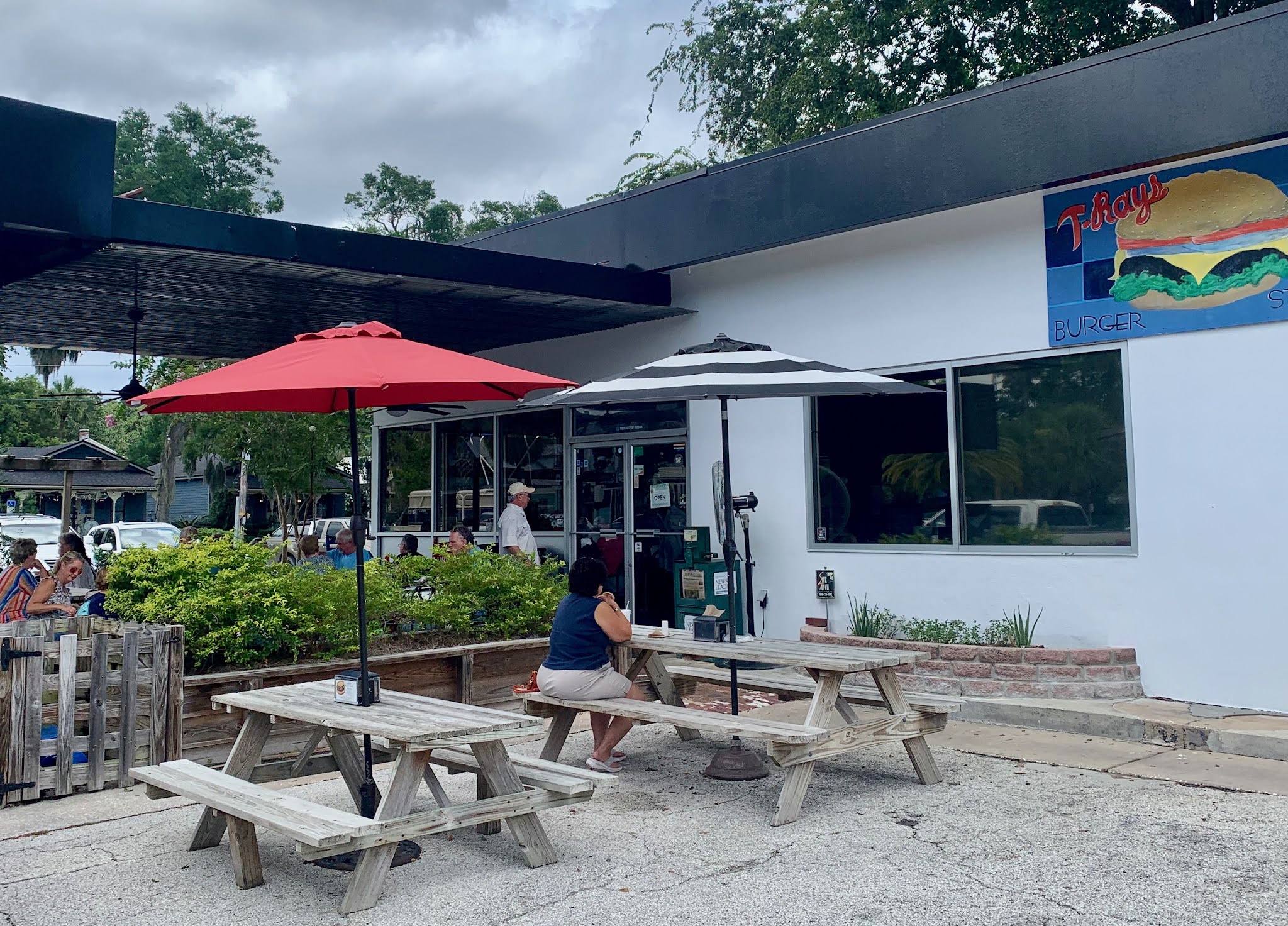
T-Rays Burger Station: a taste of Americana


T-Rays Burger Station


First the essentials, for my three faithful readers who have millisecond attention spans unless whiskey is being poured.


Open six days a week, 0700 to 1400.  For readers who are unfamiliar with the 24 hour clock, I’m giving you the benefit of the doubt about 0700, but for 1400, just start with 12 and show me two fingers.  By Jove you’ve done it!  See how I’ve improved your self-confidence instantly?  By next week, I’ll have you learning 3 o’clock by starting with 12 and holding up three fingers!  For the nimble of mind, education never stops!


When I say “By Jove” I hope I haven’t added to the confusion. You surely know who Jove is.  But, for those who consider learning of the Greek and Latin deities as sacrilege, I’ll explain it, but not make you say it.  Jove is the Greek version of the Roman god, Jupiter, king of the gods, owner of the skies.  I’m told that in a Greek court of law, they still swear by Jove to tell the truth.  I do not know this for sure and hopefully will not find out on a personal level.


Now, where was I…..hummmm…..Ok, let’s leap forward to the present and enjoy a bit of true Americana with a meal at T-Rays Burger Station.


The saga begins in 1972 with the opening of a Standard Oil gas station in Fernandina Beach, Florida.  Mr. Ray Mullis ran it.  Then his son got involved….this is the short version, I promise.  The son started selling sandwiches (First fashioned by a cook for the Earl of Sandwich…you remember him, right?).  Soon the sandwich/gas station was very popular and thrived with the slogan, Eat Here and Get Gas.  People began bringing in chairs and tables to sit while they ate.  Then the son talked his daddy into expanding the menu with family recipes.  There’s something magic about family recipes.  Nothing fancy, nothing phony and aromas that bring a sense of calmness and contentment.  With T-Rays, you may drive by once or twice without stopping.  You notice families and smiles and few tables empty. You’ll stop the third time and the aromas will magnetize your taste buds and the atmosphere will  put a smile on your face.  T-Rays is much more than a place to eat; it’s a step back into the America you grew up with.  Good times. Soothing. Satisfying. A sense of belonging.


Around 2003, the gas station became a full time restaurant, but kept the appearance of a gas station, as well as the odd collection of tables and chairs. People also dropped off football regalia, and various other pieces of Americana.  Yes, it’s one of those great places that you find in America and nowhere else!


What about the food?  Locals flock to T-Rays and it’s not just to look at Georgia and Florida football regalia. Besides the normal menu, T-Rays  has specials everyday except Saturday. And they close on Sunday. For me, Friday is the big attraction.  Local shrimp, very lightly battered, and fried to perfection. An alternative are crab cakes.  I haven’t tried those yet.


I know many of my readers, all three of them, are trying to work their way back into the size they were in high school and are foregoing fried foods.  For good reason; as the famous baseball pitcher, Satchel Paige said, “Fried foods anger the blood.”


Ok.  I get it, but lightly battered and fried shrimp have a special dispensation from Jove.  So, my advice is, eat the shrimp on the Friday Special and skip the overly delicious French fries.  That’s what I do.


On different days, other Specials include fried chicken, meatloaf, chicken and dumplings, and fried fish. Read more about the T-Rays story and check the full menu and daily specials here:  http://www.traysburgerstation.com


And, for goodness sakes, let's not forget the burgers!  Hey, it in the name, T-Rays Burger Station!


Yes, they serve beer, bro!  Order food at the window and they bring it to the rustic table of your choice.


This is the Deep South transplanted to Florida, and all the servers are women, so expect to hear plenty of darlin’ and honey and y’all.  For my northern friends, it’s call being graciously friendly.


Now, let’s review the bit about the 24 hour clock….for the evening hours, you may have to put down the whiskey or burger and use both hands, or get your significant other to help.


T-Rays Burger Station, a fabulous bit of tasty Americana!


Monday, August 30, 2021

Farmer Style Chicken Stew and Biscuits from The Careless Cook


Farmer Style Chicken Stew and Biscuits from The Careless Cook


As I have told my three faithful readers many times, I don’t make any difficult dishes.  Let me add a couple of addendums:  I don’t use any ingredients you haven’t heard of, AND if I can make it, you can make it.


Which is not to say I don’t sometimes blend unusual combinations.  Take biscuits, for example.  Hey, if you cook with me, you have to expect some twists and turns and blind alleys. 


Take my good friend, Daphne, who sometimes asks questions designed to flummox The Careless Cook.  “Does Chinese food come from Japan?”  Oh, Daphne, where to begin?  This is what The Careless Cook calls a blind alley. 


“Why doesn’t everyone just speak English? The French sound so stupid!”  Daphne, dear, let’s keep it simple, although I don’t think you can keep it any other way.  Care for another bottle of wine and a straw, while I explain? 


Farmer Style Chicken Stew


Why do I call it ‘Farmer Style’?  Because, As you will see, I used every vegetable I had in my kitchen.  At this point, the inebriants, who haphazardly follow my instructions, skipping many of the letters, are no doubt blubbering, “Hey Buckaroo, where is the damn recipe???”


On their behalf, let’s slosh along.


Suggested Ingredients for farmer style stew

(Biscuit recipe to follow)


6 skinless, boneless chicken thighs

1 red bell pepper, roasted, peeled, seeded, and roughly chopped

1 green bell pepper, roasted, peeled, seeded, and roughly chopped

1 sweet onion, peeled and roughly chopped

3 large stalks of celery, finely cut crossways

1 cup sundried tomatoes, chopped (I used those in oil – see photo)

1 large golden beet, peeled and cut in 1 in cubes (a substitute for potato.)

1 carton of chicken broth (32 oz) PLUS one cube of chicken broth (if you want a richer broth)

Olive Oil

Italian seasoning (see photo to see what I used)

Salt and pepper to taste


Heat the oven to 400ºF (200ºC) By the way, did you know that Fahrenheit and Centigrade are the same at -40 degrees?  I find that fascinating, although not as fascinating as …..sorry, I need to press on.


Coat the chicken thighs with olive oil and dust heavily with Italian seasoning.  Bake for about 20 minutes, but not long enough to dry them out.  Chop into bite sized pieces.


Slosh a little olive oil in a frying pan and toss in the chopped onions.   Cook on medium heat until they are translucent and slightly brown.


Pour the chicken broth into a large pot.   Add all the vegetables, plus the onions and chicken.  Cover and cook until the golden beets are cooked, but not falling apart.


Taste and add salt, pepper, and a cube of chicken broth. (I used one)  Also, add more Italian seasoning to taste)


Oat-milk Biscuits


Oven to 450ºF (230ºC)


2 cups flour

3 tablespoons baking powder

1 teaspoon salt

2-3 pinches black pepper

6 oz melted butter

1 cup oat milk (I like Oatly brand)


In a large mixing bowl, add the dry ingredients and mix well.  Pour in the melted butter (I used the bits of here and there butter I needed to finish with…half vegan butter and half regular butter).


Stir  in the oat milk and mix well.  I mixed first with a wooden spoon and after it came together, I used my hands.  To finish, dust a counter and knead the dough a bit.  Roll it out to about an inch thick and cut in rounds.  Place on a baking sheet and bake for 12 minutes.


Ok, Daphne, let me spare you some breath.  I used oat milk because I’d never tried it for biscuits.  Yes, it turned out deliciously.


Can you use other vegetables?  Yes, Daphne, use whatever the hell suits you.  What does chicken taste like?  It tastes like rattlesnake.


Now give me a chance to make a huge Manhattan before you ask again.